How to Buy Bitcoin as a Beginner: Complete Guide 2026
📋 En bref (TL;DR)
- Anyone can start : you can buy Bitcoin from as little as $10 on a regulated platform
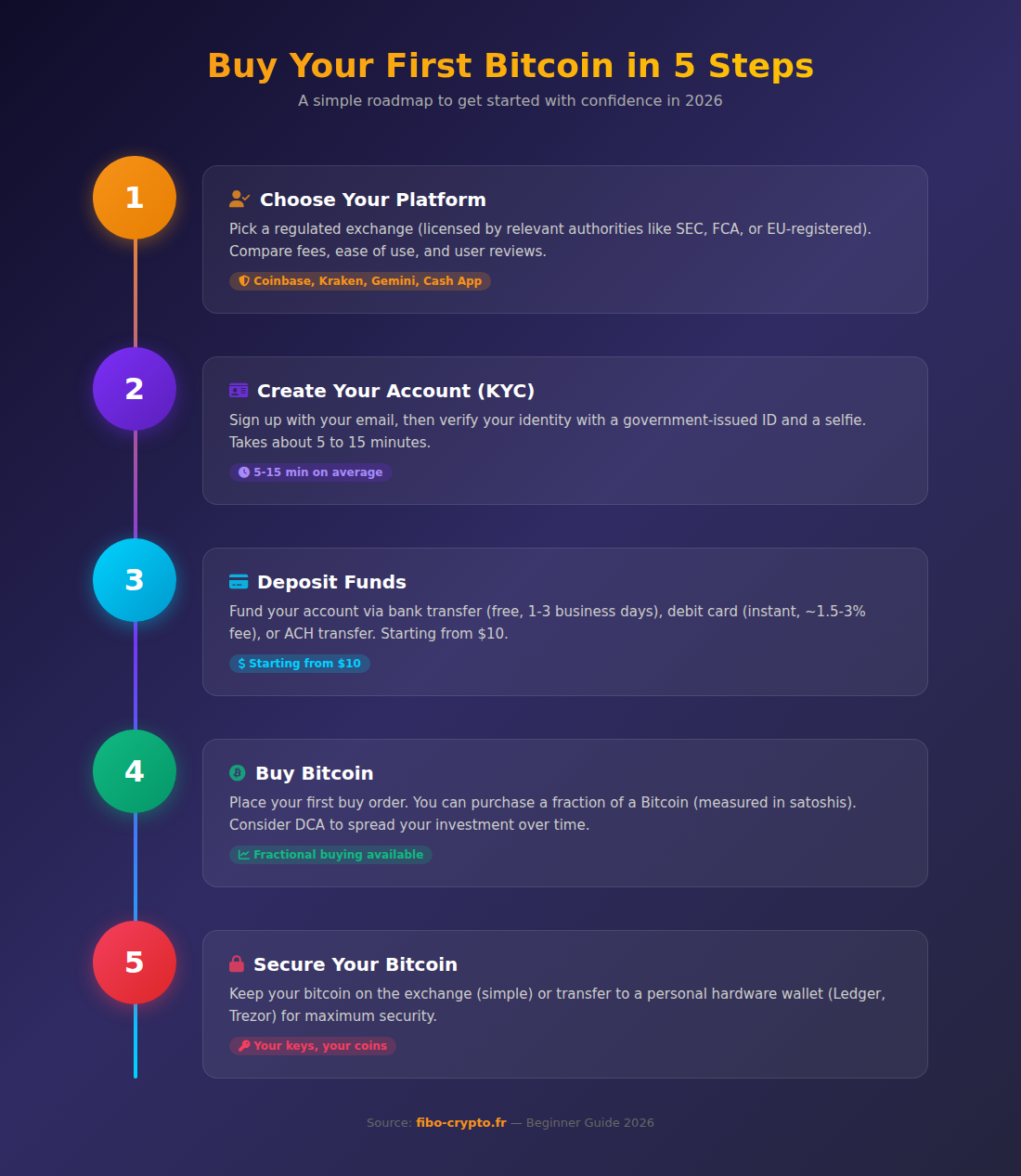
- 5 simple steps : choose a platform, create an account (KYC), deposit funds, buy BTC, secure your holdings
- 2026 context : Bitcoin above $100,000, spot ETFs approved, institutional adoption accelerating globally
- Regulation matters : always use a licensed exchange (SEC, FCA, MiCA-compliant in Europe)
- Tax rules : US capital gains tax applies (short-term vs long-term); UK has CGT with an annual allowance
- Security : for significant amounts, transfer your bitcoin to a hardware wallet (Ledger, Trezor)
Why buy Bitcoin in 2026
In 2026, Bitcoin has cemented its position as a mainstream financial asset, consistently trading above $100,000 and attracting both retail investors and major institutions worldwide. The approval of spot Bitcoin ETFs in the United States in January 2024 was a watershed moment: for the first time, industry giants like BlackRock and Fidelity offered direct BTC exposure through traditional financial products.
The April 2024 halving cut new Bitcoin issuance in half, reinforcing its programmed scarcity. Historically, each halving has been followed by a bullish phase within 12 to 18 months. Meanwhile, the European MiCA regulation provides a clear framework for investors, and jurisdictions worldwide are establishing clearer rules for crypto assets.
2x cheaper fees. Up to 6% yield. No seed phrase. Fibo, the wallet you've been waiting for.
Join the waitlist →Whether you want to invest $50 or $5,000, this guide walks you through every step of buying your first Bitcoin safely and confidently.
Prerequisites before buying
To buy Bitcoin, you need three things: a valid government-issued ID, a bank account (or debit card), and a very modest starting amount.
What you need
- Government ID : passport, driver’s license, or national ID card. Identity verification (KYC) is mandatory on all regulated platforms.
- Bank account or card : for bank transfers (ACH in the US, SEPA in Europe) or debit/credit card payments.
- Minimum amount : most platforms let you start from $1 to $10. You don’t need to buy a whole Bitcoin — you can buy fractions, measured in satoshis.
The right mindset
Never invest more than you can afford to lose. Bitcoin is a volatile asset: its price can fluctuate 10–20% within days. Start small, learn the ropes, then gradually increase your exposure if you feel comfortable.
Choosing the right platform
Choosing your platform is the most critical step: always prioritize a regulated exchange licensed by reputable authorities (SEC in the US, FCA in the UK, or MiCA-compliant in Europe).
Top platforms for beginners
Here’s an overview of the most beginner-friendly platforms:
Coinbase — US-based, publicly traded (NASDAQ: COIN). Extremely user-friendly interface, ideal for first-time buyers. Fees: ~1.49% per transaction on the simple interface, lower on Coinbase Advanced. Available in 100+ countries.
Kraken — Founded in 2011, one of the most trusted exchanges globally. Strong security track record. Fees: 0.16–0.26% on Kraken Pro. Offers both beginner and advanced interfaces.
Gemini — Founded by the Winklevoss twins, fully regulated in the US (NYDFS). Excellent security and insurance on deposits. Fees: ~1.49% on the basic interface. Great for security-conscious investors.
Cash App — Square’s popular payment app makes buying Bitcoin incredibly simple. Fees: ~2.2%. Best for casual investors who want a quick and easy experience. US-only.
Robinhood — Commission-free Bitcoin trading alongside stocks and ETFs. No withdrawal to external wallets (custody-only). Best for those already using Robinhood for stock trading. US-only.
🇪🇺 For European users
Fibo (recommended for Europe) — French investment platform designed specifically for beginners. Fibo stands out with its personalized educational support, clean interface, and guided investment journey. Registered as a PSAN with France’s AMF and MiCA-compliant. Transparent fees and responsive customer service in multiple languages. The ideal choice for European investors seeking a simple, secure, and regulated solution. → Discover Fibo
Bitpanda — Austrian platform, MiCA-compliant across Europe. Very intuitive interface. Fees: ~1.49% per transaction. Also offers stocks and precious metals.
Trade Republic — German broker regulated by BaFin. Buy Bitcoin and ETFs from the same app. Fees: €1 flat per order + spread. Perfect for combining crypto and stocks.
Key selection criteria
- Regulation : verify the platform’s license with the relevant financial authority
- Fees : compare trading fees, deposit fees, and withdrawal fees
- Ease of use : prioritize an intuitive interface if you’re a beginner
- Payment methods : bank transfer, debit card, Apple Pay, wire transfer
- Withdrawal options : can you transfer your Bitcoin to your own wallet?
Creating your account and completing KYC
Account creation takes 5 to 15 minutes and always includes mandatory identity verification (KYC), required by anti-money laundering regulations worldwide.
Step-by-step process
- Sign up : visit your chosen platform’s website or download the app. Enter your email address and create a strong password.
- Email verification : confirm your address by clicking the link sent to your inbox.
- Personal information : full name, date of birth, home address, Social Security Number (US) or equivalent.
- Identity verification (KYC) : take a photo of your government-issued ID (front and back), then complete a selfie or video verification.
- Approval : verification is often instant (a few minutes). In some cases, it may take 24 to 48 hours.
- Enable 2FA : activate two-factor authentication (Google Authenticator or SMS) to secure your account.
Making your first Bitcoin purchase
Once your account is verified, you can deposit funds and buy your first Bitcoin — or rather, your first satoshis — in just a few clicks.
Depositing funds
You have several options depending on your location:
- ACH transfer (US) : free on most platforms, takes 1–3 business days. The most cost-effective method.
- Wire transfer : faster but usually incurs a fee ($10–25). Best for larger amounts.
- Debit/credit card : instant purchase, but with extra fees (typically 1.5–3.5% depending on the platform).
- SEPA transfer (Europe) : free or very low-cost, takes 1–2 business days.
Placing your buy order
- Navigate to the « Buy » or « Trade » page
- Select « Bitcoin (BTC) »
- Enter the amount in your local currency (e.g., $50, $100, or $500)
- Review the summary (amount of BTC received, fees applied)
- Confirm the purchase
Real example : with Bitcoin at $100,000, a $100 purchase gives you 0.001 BTC, or 100,000 satoshis. That’s already a meaningful start!
Consider DCA (Dollar-Cost Averaging)
Rather than investing a large sum all at once, consider DCA: invest a fixed amount every week or month. This strategy smooths out your average purchase price and reduces the impact of volatility. Most platforms offer automatic recurring purchases.
Alternative: spot Bitcoin ETFs
If you prefer not to manage cryptocurrency directly, spot Bitcoin ETFs let you invest in Bitcoin through your regular brokerage account (Fidelity, Charles Schwab, Interactive Brokers).
Since January 2024, several spot Bitcoin ETFs are available in the US:
- iShares Bitcoin Trust (IBIT) by BlackRock — the most popular, managing tens of billions in assets
- Fidelity Wise Origin Bitcoin Fund (FBTC) — a trusted alternative with low fees
- ARK 21Shares Bitcoin ETF (ARKB) — backed by Cathie Wood’s ARK Invest and 21Shares
- Grayscale Bitcoin Trust (GBTC) — the original, now converted to a spot ETF
Advantages : no wallet management, no private keys to secure, simplified tax reporting, accessible through retirement accounts (IRA). Downside : you don’t actually own the Bitcoin, and annual management fees (~0.20–0.25%) apply.
Securing your Bitcoin
The security of your bitcoin depends on where you store it: on the exchange (custodial) or in your own wallet (non-custodial).
Option 1: leave it on the exchange
For small amounts (under $1,000), keeping your bitcoin on a regulated exchange is a reasonable option. Make sure to enable two-factor authentication (2FA) and use a unique, complex password.
Option 2: transfer to a hardware wallet
For larger amounts, a hardware wallet like the Ledger Nano or Trezor is strongly recommended. These devices store your private keys offline, making them virtually immune to hacking.
During setup, you’ll receive a seed phrase of 12 or 24 words. This is the master key to recover your funds: write it down on paper, never store it digitally, and keep it in a secure location (such as a safe deposit box).
The golden rule: « Not your keys, not your coins » — if you don’t hold your private keys, you don’t truly control your bitcoin.
Tax considerations
Tax obligations for Bitcoin vary by country. Here’s what you need to know in the major jurisdictions.
United States
The IRS treats Bitcoin as property. Capital gains tax applies when you sell, trade, or use Bitcoin to purchase goods:
- Short-term gains (held less than 1 year): taxed as ordinary income (10–37% depending on your tax bracket)
- Long-term gains (held more than 1 year): taxed at preferential rates (0%, 15%, or 20%)
- Buying Bitcoin is not a taxable event
- Crypto-to-crypto trades are taxable events in the US
United Kingdom
HMRC treats Bitcoin as a capital asset. Capital Gains Tax (CGT) applies when you dispose of Bitcoin:
- Annual CGT allowance: £3,000 (2024/25 tax year)
- Basic rate taxpayers: 10% on gains above the allowance
- Higher rate taxpayers: 20% on gains above the allowance
European Union
Tax rules vary by country. France applies a 30% flat tax on crypto gains. Germany exempts gains on crypto held for more than one year. Always consult a tax professional in your specific country.
Key tip : keep detailed records of all your transactions from day one. Most exchanges provide downloadable transaction histories and tax reports.
Common beginner mistakes to avoid
Here are the most common pitfalls new Bitcoin investors face — and how to steer clear of them.
- Buying on emotion (FOMO) : don’t rush in after a sharp price surge. Take your time to research and use DCA to smooth your entry.
- Investing your life savings : Bitcoin is volatile. Only invest a reasonable portion of your portfolio (5–15% maximum based on your risk tolerance).
- Neglecting security : weak password, no 2FA, seed phrase stored on your phone… These mistakes can be costly.
- Using unregulated platforms : always verify the platform’s regulatory status. With an unregulated exchange, you have no recourse if something goes wrong.
- Leveraged trading as a beginner : derivatives and leveraged products are extremely risky for newcomers. Stick to spot buying.
- Ignoring taxes : failing to report your sales can result in penalties and interest. Keep a record of your transactions from the start.
- Falling for guaranteed return promises : if someone promises you guaranteed profits, it’s a scam. Bitcoin offers no guaranteed returns.
📚 Glossaire
- Bitcoin : the first decentralized cryptocurrency, created in 2009 by Satoshi Nakamoto. Its supply is capped at 21 million coins.
- Satoshi : the smallest unit of Bitcoin. 1 BTC = 100,000,000 satoshis. This allows you to buy fractions of a Bitcoin.
- Blockchain : a decentralized digital ledger that records all transactions transparently and immutably.
- Wallet : a digital tool for storing, sending, and receiving cryptocurrencies. Can be software (app) or hardware (physical device).
- Exchange : a platform for buying, selling, and trading cryptocurrencies against fiat currencies or other crypto assets.
- KYC : Know Your Customer — mandatory identity verification procedure on regulated platforms to combat money laundering.
- ETF : Exchange-Traded Fund — a fund traded on stock exchanges that tracks the price of an asset. A spot Bitcoin ETF holds actual Bitcoin.
- Halving : a programmed event occurring every 210,000 blocks (~4 years) that cuts the mining reward in half, reducing new Bitcoin issuance.
- Seed phrase : a recovery phrase of 12 or 24 words generated when creating a wallet. It is the ultimate key to restoring access to your funds.
- DCA : Dollar-Cost Averaging — an investment strategy where you buy a fixed dollar amount of Bitcoin at regular intervals, regardless of price.
- HODL : a misspelling of « hold » that became crypto slang for holding your Bitcoin long-term through market ups and downs.
- Flat tax : a single-rate tax applied to capital gains. In France, crypto gains are taxed at a flat 30% rate.
Questions fréquentes
What is the minimum amount to buy Bitcoin?
Most platforms allow you to buy Bitcoin from as little as $1 to $10. You don’t need to purchase a whole Bitcoin — you can buy fractions measured in satoshis. For example, $10 would get you roughly 10,000 satoshis at current prices.
What is the best platform for beginners?
For US-based beginners, Coinbase offers the most intuitive experience. Kraken is excellent for those who want a balance of simplicity and lower fees. Cash App is perfect for casual buyers who want a quick setup. In Europe, Bitpanda and Trade Republic are popular regulated choices.
Is 2026 a good time to buy Bitcoin?
No one can predict Bitcoin’s price with certainty. However, the fundamentals are strong in 2026: institutional adoption through ETFs, post-halving supply reduction, and a maturing regulatory environment worldwide. Using DCA (investing a fixed amount regularly) lets you avoid timing the market altogether.
How should I store my Bitcoin safely?
For small amounts, keeping them on a regulated exchange with 2FA enabled is acceptable. For larger amounts, a hardware wallet (Ledger, Trezor) stores your private keys offline and gives you full control. The key is to back up your seed phrase on paper — never digitally.
Should I buy all at once or invest gradually?
Gradual investing through DCA is generally recommended for beginners. By purchasing a fixed dollar amount weekly or monthly, you smooth out market fluctuations and avoid the stress of trying to time the perfect entry point. Most platforms offer automatic recurring purchases.
Do I have to pay taxes when I buy Bitcoin?
Buying Bitcoin is generally not a taxable event. It’s the selling, trading, or spending of Bitcoin that triggers tax obligations. In the US, capital gains tax applies; in the UK, Capital Gains Tax applies. Always keep detailed transaction records and consult a tax professional in your jurisdiction.
What is the difference between buying Bitcoin directly and a Bitcoin ETF?
Buying Bitcoin directly gives you actual ownership: you can transfer it, use it, and store it yourself. A Bitcoin ETF gives you price exposure through a traditional financial product without ever owning Bitcoin. ETFs are simpler (no wallet needed) but come with annual management fees and dependence on the fund manager.
📰 Sources
Cet article s'appuie sur les sources suivantes :
- Bitcoin Whitepaper
- SEC — Spot Bitcoin ETF Approvals
- BlackRock iShares Bitcoin Trust
- IRS — Virtual Currency Guidance
- HMRC — Crypto Assets for Individuals
- EU MiCA Regulation
Comment citer cet article : Fibo Crypto. (2026). How to Buy Bitcoin as a Beginner: Complete Guide 2026. Consulté le 5 février 2026 sur https://fibo-crypto.fr/en/?p=21024
The simplest way to buy, swap and manage your crypto
Join the first users and get priority access. No seed phrase, fees 3.5x lower, built-in DeFi yield.
Join the waitlist →