How Does Bitcoin Work? Complete Guide
📋 En bref (TL;DR)
- Peer-to-peer: Bitcoin allows sending money directly between people, without going through a bank or any intermediary
- Blockchain: Every transaction is recorded in a public ledger, shared across thousands of computers, impossible to falsify
- Mining: Specialized computers validate transactions by solving complex calculations (proof-of-work) and receive BTC as reward
- Irreversibility: Once confirmed (~10 min), a transaction is permanently recorded and cannot be reversed
- Security: The combination of cryptography + decentralization + economic incentives makes the network virtually unhackable since 2009
- 21 million limit: The number of bitcoins is capped, with issuance slowing every 4 years (halving)
How Bitcoin Works: The Core Principle
Bitcoin is a peer-to-peer electronic payment system that allows sending money directly from one person to another, without going through a bank. This is the definition given by Satoshi Nakamoto, Bitcoin’s anonymous creator, in the white paper published in 2008.
Concretely, the Bitcoin network rests on three fundamental pillars:
2x cheaper fees. Up to 6% yield. No seed phrase. Fibo, the wallet you've been waiting for.
Join the waitlist →- The blockchain: a public ledger recording all transactions since 2009
- Cryptography: mathematical techniques securing every exchange
- The decentralized network: over 50,000 computers (nodes) verifying and validating transactions
This architecture allows Bitcoin to operate 24/7, without ever stopping — and without any entity being able to block or censor a transaction.
What Is the Bitcoin Blockchain?
The blockchain is Bitcoin’s technical heart. Imagine a giant digital accounting ledger, simultaneously shared among thousands of computers worldwide, that no one can falsify.
Each “block” in the blockchain contains:
- Approximately 2,000 to 3,000 transactions
- A precise timestamp (date and time)
- A cryptographic fingerprint (hash) of the previous block
- A random number called a “nonce“
This cryptographic linkage between blocks makes the blockchain virtually tamper-proof. Modifying a past transaction would require recalculating all subsequent blocks — an effort demanding more computing power than the entire network combined.
How Does a Bitcoin Transaction Work?
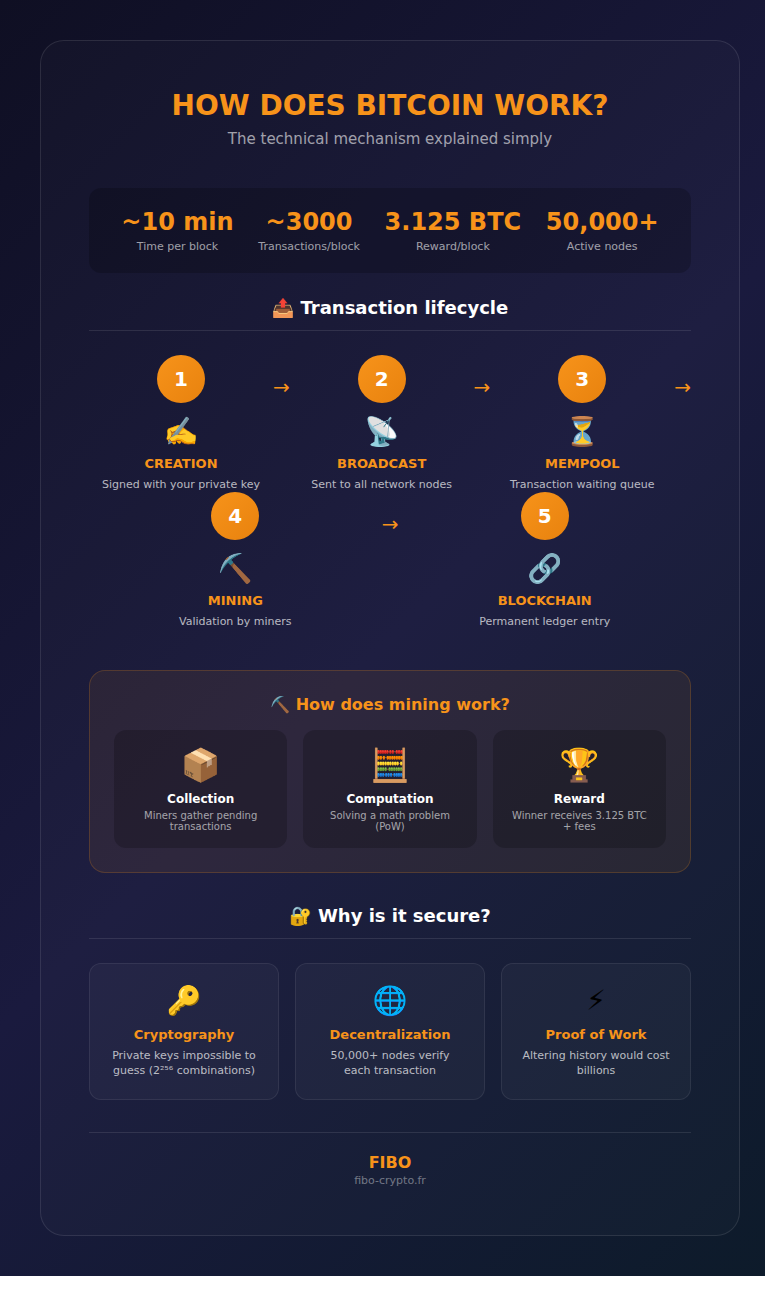
A Bitcoin transaction unfolds in five stages, from the sender’s wallet to its permanent inscription in the blockchain. The complete process typically takes between 10 minutes and 1 hour.
Step 1: Creation and Signing
When you send bitcoins, your wallet creates a message containing: the sender’s address, the recipient’s address, and the amount to send. This message is digitally signed with your private key — the cryptographic proof that you’re the rightful owner of the funds.
Step 2: Network Broadcast
Your transaction is sent to all nodes on the Bitcoin network. It enters the “mempool,” a waiting queue of transactions pending validation.
Step 3: Selection by Miners
Miners select transactions from the mempool (typically those with the highest fees) and group them into a candidate block.
Step 4: Validation (Mining)
Miners must solve a complex mathematical problem to validate the block. The first to find the solution “wins” the right to add their block to the blockchain.
Step 5: Final Confirmation
Once the block is added, your transaction is confirmed. As time passes (and more blocks are added), it becomes increasingly irreversible. For important transactions, waiting for 6 confirmations (~1 hour) is recommended.
How Does Bitcoin Mining Work?
Mining is the process that validates transactions and creates new bitcoins. It’s the system’s core mechanism ensuring network security and decentralization.
Miners use specialized computers (called ASICs) that attempt to solve a mathematical problem: finding a number (nonce) that, when combined with the block’s data, produces a hash starting with a certain number of zeros. It’s a guessing game at industrial scale — billions of attempts per second.
As reward for their work, the first miner to find the solution receives:
- The block reward: currently 3.125 BTC (after the April 2024 halving)
- Transaction fees: paid by users to prioritize their transactions
Proof of Work: The Key to Security
Proof of Work is the mechanism allowing the network to agree on the blockchain’s state without a central authority. It’s what makes Bitcoin resistant to censorship and attacks.
The principle is elegant: to add a block, a miner must prove they’ve expended energy (“work”) by solving a difficult computation. This proof is easy for all other network participants to verify.
Why this system works:
- Attack cost: falsifying the blockchain would cost billions of dollars in electricity and equipment
- Economic incentive: honest miners earn more by following the rules than by cheating
- Decentralization: anyone can become a miner and participate in consensus
Why Is Bitcoin Secure?
Bitcoin has never been “hacked” since its 2009 launch. Its security rests on three complementary protection layers:
- Cryptography: your private key is a unique digital signature, mathematically impossible to guess (2²⁵⁶ possible combinations)
- Distributed network: over 50,000 nodes independently verify each transaction
- Immutability: a confirmed transaction cannot be modified without redoing all the mining work that follows
The only theoretical way to “hack” Bitcoin would be controlling over 50% of global computing power (51% attack). In practice, this would cost several billion dollars per day — and attackers would be better off mining honestly.
The Limited Supply: Why Only 21 Million?
There will never be more than 21 million bitcoins. This limit is written into the source code and cannot be changed. It’s one of the fundamental elements making Bitcoin a scarce asset, often compared to digital gold.
In February 2026, approximately 19.8 million bitcoins are already in circulation. New BTC are created through mining, at a rate that halves every 4 years during the halving:
- 2009-2012: 50 BTC per block
- 2012-2016: 25 BTC per block
- 2016-2020: 12.5 BTC per block
- 2020-2024: 6.25 BTC per block
- 2024-2028: 3.125 BTC per block (current)
The last bitcoin will be mined around the year 2140. After that, miners will be compensated solely through transaction fees.
📚 Glossary
- Satoshi Nakamoto : Pseudonym of Bitcoin’s anonymous creator, who published the white paper in 2008 and launched the network in January 2009.
- Blockchain : Decentralized digital ledger that records all transactions chronologically and immutably. Each block is linked to the previous one through cryptography.
- Hash : Unique digital fingerprint generated by a cryptographic function. Any change in input data produces a completely different hash.
- Nonce : Random number tested by miners to solve the cryptographic problem and validate a block.
- Wallet : Digital wallet that stores your private keys and allows sending and receiving bitcoins.
- Mempool : Waiting queue of transactions pending miner validation. Transactions with higher fees are typically processed first.
- Miner : Network participant who validates transactions and secures the blockchain by solving complex calculations (proof-of-work).
- Mining : Process of validating transactions and creating new bitcoins through solving cryptographic problems.
- Halving : Halving of the mining reward every 210,000 blocks (~4 years), progressively reducing Bitcoin’s inflation.
- Proof of Work : Consensus mechanism requiring miners to prove they’ve expended energy to validate transactions.
- Private key : Secret code allowing you to sign transactions and prove bitcoin ownership. Must never be shared.
Frequently Asked Questions
How long does a Bitcoin transaction take?
A Bitcoin transaction receives its first confirmation on average after 10 minutes (one block time). For significant amounts, waiting for 6 confirmations (about 1 hour) is recommended for maximum security. Transactions with higher fees are typically processed faster.
Can you cancel a Bitcoin transaction?
No, a confirmed Bitcoin transaction is irreversible by design. This is a fundamental system feature. Before confirmation, it’s theoretically possible to attempt cancellation via Replace-By-Fee (RBF), but this requires technical knowledge and isn’t guaranteed.
Who controls Bitcoin?
No one and everyone. Bitcoin is open-source software maintained by volunteer developers. Major protocol changes require community consensus (miners, nodes, users). No entity — government, corporation, or individual — can unilaterally change the rules.
Does Bitcoin consume a lot of energy?
Yes, Bitcoin mining consumes approximately 150 TWh per year (comparable to some countries). However, over 50% of this energy now comes from renewable sources, and mining can utilize otherwise wasted surplus energy. The environmental impact debate remains nuanced.
What happens when all bitcoins are mined?
When all 21 million BTC are in circulation (around 2140), miners will no longer receive block rewards. They’ll be compensated solely through transaction fees paid by users, which should maintain network security.
📰 Sources
This article is based on the following sources:
- Bitcoin: A Peer-to-Peer Electronic Cash System
- Bitcoin Developer Documentation
- Mempool.space
- Cambridge Bitcoin Electricity Consumption Index
Comment citer cet article : Fibo Crypto. (2026). How Does Bitcoin Work? Complete Guide. Consulté le 20 July 2026 sur https://fibo-crypto.fr/en/blog/how-does-bitcoin-work-complete-guide/
The simplest way to buy, swap and manage your crypto
Join the first users and get priority access. No seed phrase, fees 3.5x lower, built-in DeFi yield.
Join the waitlist →