Who Owns the Most Bitcoin? Complete Guide to the Biggest BTC Holders in 2026
📋 En bref (TL;DR)
- Satoshi Nakamoto remains the largest individual Bitcoin holder with approximately 1.1 million BTC, unmoved since 2009-2010
- Strategy (formerly MicroStrategy) holds 713,502 BTC, making it the largest public company Bitcoin holder by a wide margin
- Bitcoin spot ETFs have absorbed over 1.2 million BTC since January 2024 — BlackRock’s IBIT alone holds 769,000 BTC
- Governments are significant holders: the United States owns ~198,000 BTC from seizures, while El Salvador actively accumulates (~7,500 BTC)
- Exchanges hold massive amounts in custody: Coinbase (~885,000 BTC) and Binance (~629,000 BTC) serve millions of users
- Extreme concentration persists: 0.03% of Bitcoin addresses control over 60% of the circulating supply
Why Bitcoin ownership distribution matters
With a hard cap of 21 million coins, understanding who holds the most Bitcoin provides critical insight into the network’s decentralization, market dynamics, and long-term trajectory. As of February 2026, approximately 19.8 million BTC have been mined, and their distribution among individuals, corporations, investment funds, and governments continues to shift dramatically.
The blockchain‘s transparency makes every transaction traceable, but a single address might represent anything from an individual investor to an exchange managing millions of accounts. Let’s examine the true heavyweights of Bitcoin ownership in 2026.
2x cheaper fees. Up to 6% yield. No seed phrase. Fibo, the wallet you've been waiting for.
Get early access →Satoshi Nakamoto: the largest Bitcoin holder
Bitcoin’s pseudonymous creator, Satoshi Nakamoto, remains the single largest individual holder with approximately 1.096 million BTC — 5.5% of the total supply. These coins were earned as mining rewards during the network’s first months, between January 2009 and early 2010.
Arkham Intelligence’s on-chain analysis identified these holdings through the “Patoshi Pattern,” a distinctive mining signature spread across roughly 22,000 addresses. At February 2026 prices (Bitcoin around $76,000), this reserve is worth approximately $83 billion.
The most remarkable fact: none of these bitcoins have ever been moved since they were mined. Satoshi disappeared from public life in 2011, and their identity remains one of the greatest mysteries of the digital age. If these private keys are lost, it represents the largest wealth destruction in history. If they still exist, their holder could trigger a market earthquake by moving even a fraction.

Public companies accumulating Bitcoin
Institutional adoption has fundamentally reshaped Bitcoin’s ownership landscape. Publicly traded companies now collectively hold over one million BTC, led by Strategy’s unprecedented corporate treasury bet.
Strategy (formerly MicroStrategy) — 713,502 BTC
Under co-founder Michael Saylor’s leadership, Strategy has become the poster child of corporate Bitcoin accumulation. The company began purchasing BTC in August 2020 and hasn’t stopped. As of February 2026, it holds 713,502 BTC — approximately 3.4% of Bitcoin’s total supply, valued at roughly $54 billion.
Strategy’s approach relies on issuing equity and convertible bonds to finance Bitcoin purchases. With an average acquisition cost of $76,052 per BTC, the company operates at a critical threshold — every Bitcoin price movement directly impacts its balance sheet. According to SEC filings, Strategy continues to purchase BTC regularly, adding 855 BTC in its most recent acquisition.
Other major corporate holders
Strategy’s playbook has inspired a growing wave of corporate adopters:
- Marathon Digital Holdings: 52,850 BTC — the largest public mining company, employing a “mine and hold” strategy
- Twenty One Capital: 37,230 BTC — a Bitcoin-focused investment vehicle
- Metaplanet: 35,102 BTC — dubbed “Japan’s MicroStrategy,” aggressively accumulating
- Bullish (NYSE: BLSH): 24,340 BTC — crypto exchange operator
- Riot Platforms: 18,005 BTC — major miner following the accumulation model
- Galaxy Digital: 17,102 BTC — crypto-focused financial services firm
- Coinbase (treasury): 14,458 BTC — separate from client custody holdings
- Hut 8: 13,696 BTC — Canadian mining company
- CleanSpark: 13,099 BTC — U.S.-based miner
- Tesla: ~11,509 BTC — after selling 75% of its initial position in 2022
- Block Inc. (formerly Square): ~8,500 BTC — Jack Dorsey’s payments company
Collectively, publicly traded companies hold over 950,000 BTC, a figure that continues to grow as Bitcoin becomes a mainstream corporate treasury asset.
Bitcoin spot ETFs: the new institutional giants
Since their SEC approval in January 2024, U.S. Bitcoin spot ETFs have become among the largest Bitcoin holders in the world, collectively managing over 1.2 million BTC. These funds provide traditional investors with Bitcoin exposure through conventional brokerage accounts, eliminating the need to manage wallets or private keys.
Here are the leading Bitcoin spot ETFs by BTC held (February 2026 data):
- iShares Bitcoin Trust (IBIT) — BlackRock: 769,180 BTC (~$58 billion) — the world’s largest Bitcoin ETF, with cumulative net inflows exceeding $62.8 billion
- Fidelity Wise Origin Bitcoin Fund (FBTC): 194,021 BTC (~$15 billion)
- Grayscale Bitcoin Trust (GBTC): 159,546 BTC (~$12 billion) — converted from a closed-end trust to a spot ETF in 2024
- Grayscale Bitcoin Mini Trust (BTC): 48,137 BTC (~$3.6 billion)
- Bitwise Bitcoin ETF (BITB): 38,878 BTC (~$3 billion)
- ARK 21Shares Bitcoin ETF (ARKB): ~38,000 BTC (~$2.9 billion)
BlackRock’s IBIT alone has shattered records, becoming one of the most successful ETF launches in financial history. The scale of institutional capital flowing into these funds has absorbed a significant portion of available market supply, fundamentally altering Bitcoin’s liquidity dynamics.
Government Bitcoin holdings
Several governments rank among Bitcoin’s largest holders, primarily through law enforcement seizures. However, a growing number of nations are actively exploring Bitcoin as a strategic reserve asset.
United States — the largest government holder
The U.S. government holds approximately 198,012 BTC ($15 billion), accumulated through major law enforcement operations:
- Silk Road seizure: tens of thousands of BTC confiscated after the darknet marketplace was shut down in 2013
- Bitfinex hack recovery: 94,000 BTC stolen in the 2016 hack, identified and recovered by the FBI. This single wallet remains the fifth-largest individual Bitcoin address on the blockchain
- Various criminal cases: money laundering, tax evasion, and other federal investigations
The Trump administration has proposed creating a Strategic Bitcoin Reserve, modeled after the nation’s gold reserves. The proposal would retain seized BTC rather than auctioning them off, and potentially authorize further acquisitions. If implemented, this could trigger a sovereign “arms race” for Bitcoin among major economies.
Other nations
- China: ~194,000 BTC seized from the PlusToken Ponzi scheme in 2019. Despite banning cryptocurrency trading and ownership, China reportedly retains these holdings
- United Kingdom: ~61,245 BTC from law enforcement seizures
- Ukraine: ~46,351 BTC — including crypto donations received since the conflict began in 2022
- Bhutan: ~11,268 BTC — uniquely accumulated through Bitcoin mining powered by the country’s hydroelectric energy, creating an environmentally sustainable model
- El Salvador: ~7,545 BTC — the first country to adopt Bitcoin as legal tender in 2021. President Bukele maintains a policy of purchasing at least 1 BTC daily
Exchanges and custody providers
Exchanges and institutional custodians are the largest “technical” Bitcoin holders, safeguarding funds for millions of users and ETF clients. It’s essential to understand that these BTC do not belong to the exchanges themselves — they are held in custody on behalf of third parties.
- Coinbase: ~885,000 BTC — including significant custody holdings for ETFs (BlackRock, Grayscale) and institutional investors. It is the world’s largest crypto custodian
- Binance: ~629,000 BTC — the world’s largest exchange by volume, with a primary cold wallet holding 249,000 BTC alone
- Upbit: ~175,000 BTC — South Korea’s largest exchange
- Robinhood: ~141,000 BTC — primarily held for the trading app’s retail users
- Bitfinex: ~130,000 BTC in cold storage
The concentration of BTC on a few major exchanges raises security and systemic risk concerns. The collapse of FTX in 2022 was a brutal reminder of the dangers of entrusting assets to centralized platforms — an event that accelerated the shift toward self-custody and the “not your keys, not your coins” philosophy.
Private companies and non-public entities
Beyond publicly traded corporations, several private entities hold substantial Bitcoin reserves that are harder to track.
- Tether: ~96,369 BTC — the issuer of the world’s largest stablecoin (USDT) holds a portion of its reserves in Bitcoin
- Block.one: ~140,000 BTC — the company behind the EOS project, one of the largest discreet holders
- Digital Currency Group (DCG): parent company of Grayscale, with significant exposure across the crypto ecosystem
- Sovereign wealth funds and family offices: a growing number of entities are quietly allocating 1-5% of their portfolios to Bitcoin
Individual whales
Beyond Satoshi Nakamoto, several identified individuals hold substantial Bitcoin positions, often acquired during the network’s early years when prices were in the single digits.
- Cameron and Tyler Winklevoss: ~70,000 BTC — the Winklevoss twins, co-founders of the Gemini exchange, reportedly acquired much of their Bitcoin in 2012 at around $10 per coin
- Tim Draper: ~29,656 BTC — the venture capitalist purchased most of his holdings at a U.S. Marshals auction of Silk Road-seized Bitcoin in 2014, paying approximately $632 per coin
- Michael Saylor: ~17,732 BTC personally — in addition to Strategy’s corporate holdings
Many anonymous whales also exist. On-chain analysis reveals dormant wallets holding thousands of BTC belonging to early adopters whose identities remain unknown. Some of these wallets haven’t seen any activity in over a decade.
How is Bitcoin distributed globally?
Bitcoin’s distribution among addresses reveals extreme concentration: 0.03% of all addresses hold more than 100 BTC and collectively control over 60% of the circulating supply. However, this statistic requires important context.
The reality behind the numbers
- Exchanges = millions of users: a single Binance address holding 249,000 BTC actually represents the assets of millions of individual users
- ETFs = indirect ownership: BlackRock IBIT’s 769,000 BTC belong to the fund’s shareholders, not to BlackRock itself
- Growing adoption: the number of addresses holding at least 0.01 BTC continues to increase, signaling gradual wealth distribution
Lost bitcoins
An estimated 3 to 4 million BTC are permanently lost, representing roughly 15-20% of the maximum supply. These losses stem from:
- Lost or forgotten private keys (discarded hard drives, forgotten passwords)
- Deceased owners who never passed on their keys
- Transactions sent to invalid addresses or “burn addresses”
- Satoshi Nakamoto’s coins, if the keys are indeed inaccessible
This effective scarcity makes every circulating bitcoin that much more valuable. The truly available supply is significantly lower than the 19.8 million BTC in existence.

2026 trends: accelerating institutionalization
2026 confirms a structural trend: Bitcoin is progressively moving from individual holders to institutions, investment funds, and governments. Several key dynamics are at play:
Institutional accumulation accelerates
Bitcoin spot ETFs continue absorbing supply at a rapid pace. BlackRock’s IBIT has surpassed $62.8 billion in cumulative net inflows, while new corporate entrants like Japan’s Metaplanet replicate Strategy’s model. The “corporate HODL” trend — public companies adopting Bitcoin as a treasury asset — is spreading globally beyond the United States.
Exchange reserves declining
The amount of BTC held on exchanges continues to decrease, indicating investors are moving their holdings to cold storage and self-custody solutions. This trend reduces immediately sellable supply and can create a “supply squeeze” during periods of high demand.
National reserve strategies
Following El Salvador and Bhutan, more nations are exploring Bitcoin as a strategic reserve asset. The U.S. Strategic Bitcoin Reserve proposal, if implemented, could trigger a sovereign accumulation race — a scenario some analysts describe as a “digital arms race” among nation-states.
The 2024 halving effect
The April 2024 halving reduced the mining reward to 3.125 BTC per block, drastically cutting new Bitcoin supply. Historically, halvings precede significant price appreciation, and the combined effect of reduced supply and growing institutional demand creates unique market conditions heading into 2026.

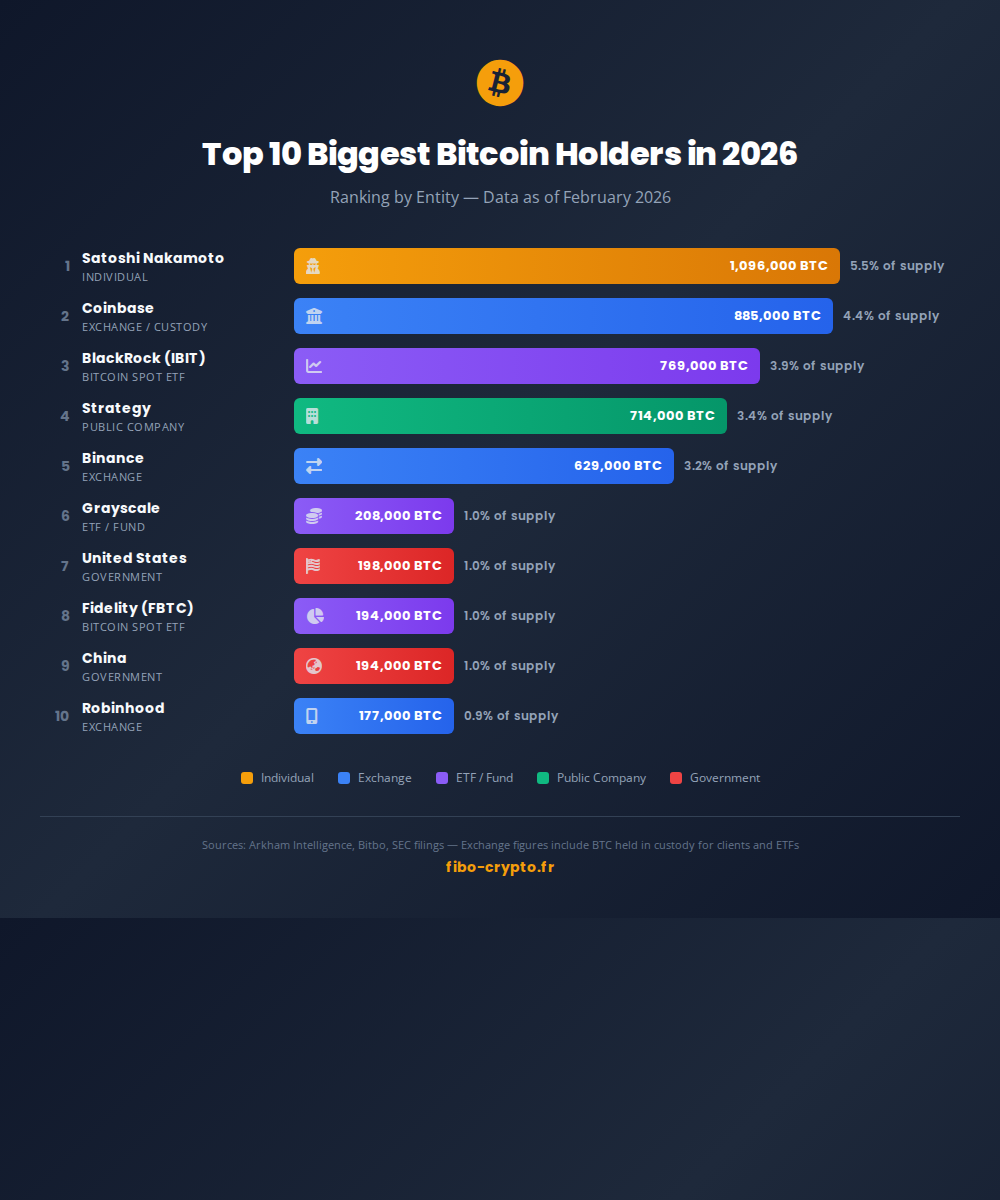
Summary ranking: biggest Bitcoin holders in 2026
Here is a summary of the major Bitcoin holders by category:
| Category | Entity | BTC Held | % of Supply |
|---|---|---|---|
| Individual | Satoshi Nakamoto | ~1,096,000 | 5.5% |
| Exchange | Coinbase (custody) | ~885,000 | 4.4% |
| ETF | BlackRock (IBIT) | ~769,000 | 3.9% |
| Company | Strategy | ~714,000 | 3.4% |
| Exchange | Binance | ~629,000 | 3.2% |
| Government | United States | ~198,000 | 1.0% |
| ETF | Fidelity (FBTC) | ~194,000 | 1.0% |
| Government | China | ~194,000 | 1.0% |
| ETF | Grayscale (GBTC + Mini) | ~208,000 | 1.0% |
| Individual | Winklevoss twins | ~70,000 | 0.35% |
Sources: Arkham Intelligence, Bitbo, SEC filings — February 2026 data. Exchange figures include BTC held in custody for clients and ETFs.

📚 Glossary
- Bitcoin : the first decentralized cryptocurrency, created in 2009 by Satoshi Nakamoto, operating on a blockchain with a maximum supply of 21 million units.
- BTC : the ticker symbol for Bitcoin, used on exchanges and in financial quotations.
- Blockchain : a distributed, immutable digital ledger that records all Bitcoin transactions chronologically and transparently.
- Whale : an investor or entity holding a very large amount of Bitcoin (typically over 1,000 BTC), capable of influencing market prices.
- Wallet : a digital tool for storing, sending, and receiving bitcoins. Can be software-based (hot wallet) or hardware-based (cold wallet).
- Address : a unique alphanumeric identifier on the Bitcoin blockchain, serving as a destination for receiving BTC.
- Cold storage : a method of storing cryptocurrency offline (on a device not connected to the Internet), providing maximum security against hacking.
- Custody : a service for holding and safeguarding digital assets on behalf of third parties, typically provided by regulated financial institutions.
- ETF : Exchange-Traded Fund, a fund listed on a stock exchange that tracks the performance of an underlying asset. Bitcoin spot ETFs hold actual BTC.
- Exchange : a trading platform for buying, selling, and trading cryptocurrencies (e.g., Binance, Coinbase, Kraken).
- HODL : a term originating from a misspelling of “hold,” which became a Bitcoin community mantra meaning to hold BTC for the long term without selling.
- Mining : the process of validating Bitcoin transactions by solving cryptographic puzzles, rewarded with newly created BTC.
- Halving : an event occurring approximately every four years that halves the Bitcoin mining reward, reducing the rate at which new BTC are created.
- Strategic reserve : a government policy of accumulating and holding Bitcoin as a national reserve asset, similar to gold reserves.
Frequently Asked Questions
Who owns the most Bitcoin in the world?
Satoshi Nakamoto, Bitcoin’s anonymous creator, is the largest individual holder with approximately 1.1 million BTC. Among entities, Coinbase technically holds more BTC (885,000), but in custody for clients and ETFs. Among companies, Strategy (formerly MicroStrategy) leads with 713,502 BTC.
How much Bitcoin does Satoshi Nakamoto own?
Satoshi Nakamoto holds approximately 1.096 million BTC, mined during Bitcoin’s first months in 2009-2010. These coins have never been moved since creation, fueling debate about whether the private keys are accessible and Satoshi’s true identity. At current prices, this represents roughly $83 billion.
Can you find out who owns Bitcoin?
Bitcoin’s blockchain is public and transparent — every transaction and address balance is visible. However, addresses aren’t directly linked to real identities. On-chain analytics firms like Arkham Intelligence and Chainalysis can identify wallet owners through clustering techniques and transaction tracing, though many holders remain anonymous.
Which governments hold Bitcoin?
Several governments hold significant Bitcoin: the United States (~198,000 BTC), China (~194,000 BTC), the United Kingdom (~61,000 BTC), Ukraine (~46,000 BTC), Bhutan (~11,000 BTC), and El Salvador (~7,500 BTC). Most holdings come from law enforcement seizures, except El Salvador and Bhutan which actively accumulate.
Is Bitcoin concentration dangerous?
The apparent concentration is partly misleading: the largest wallets often belong to exchanges or ETFs managing funds for millions of people. However, high concentration among a few entities creates risk of massive sell-offs impacting the market. The trend toward gradual distribution and self-custody is mitigating this risk over time.
How many Bitcoin are permanently lost?
An estimated 3 to 4 million BTC are irrecoverable — roughly 15-20% of the maximum 21 million supply. Losses come from misplaced private keys, discarded hard drives, or deceased owners who never passed on access. The most famous case is James Howells, who lost a hard drive containing 8,000 BTC in a Welsh landfill.
What is the U.S. Strategic Bitcoin Reserve?
The Strategic Bitcoin Reserve is a proposal under the Trump administration to make Bitcoin a U.S. Treasury reserve asset, similar to gold reserves. The plan would retain BTC from law enforcement seizures instead of auctioning them, and potentially authorize additional purchases. The proposal remains under political debate as of 2026.
How have Bitcoin ETFs changed BTC ownership?
Bitcoin spot ETFs have profoundly altered BTC’s ownership structure. Since January 2024, they’ve absorbed over 1.2 million BTC, effectively transferring ownership from individual holders to institutional funds. BlackRock’s IBIT alone holds 769,000 BTC. This institutionalization makes the market more mature but also more sensitive to traditional capital flows.
📰 Sources
This article is based on the following sources:
- Arkham Intelligence — Top Bitcoin Holders
- Bitbo — Bitcoin Treasuries
- The Motley Fool — Who Holds the Most Bitcoin?
- SEC EDGAR — Strategy 10-K Filings
- BitInfoCharts — Bitcoin Rich List
- Glassnode — Bitcoin Supply Distribution
Comment citer cet article : Fibo Crypto. (2026). Who Owns the Most Bitcoin? Complete Guide to the Biggest BTC Holders in 2026. Consulté le 21 March 2026 sur https://fibo-crypto.fr/en/blog/who-owns-most-bitcoin-biggest-holders
The simplest way to buy, swap and manage your crypto
Join the first users and get priority access. No seed phrase, fees 3.5x lower, built-in DeFi yield.
Get early access →