Crypto Investing: 10 Essential Tips for Success in 2026
📋 En bref (TL;DR)
- Rule #1: Never invest more than you can afford to lose entirely.
- Start strong: Prioritize Bitcoin and Ethereum before exploring altcoins.
- Systematic DCA: Dollar-cost averaging outperforms market timing in 92% of studied scenarios.
- Regulated platform: Choose a licensed, compliant exchange (MiCA-regulated in Europe, SEC/FinCEN registered in the US).
- Smart diversification: Spread across large caps, mid-caps, and stablecoins.
- Non-negotiable security: Enable 2FA, use a hardware wallet, and protect your seed phrase offline.
- Tax awareness: Every sale is a taxable event — track everything from your very first purchase.
Why do most crypto investors lose money?
Losses in crypto aren’t caused by the technology itself — they stem from recurring behavioral mistakes. Research points to four factors behind the majority of failures: FOMO (Fear Of Missing Out) drives investors to buy at the peak of a bullish trend, often after seeing spectacular gains on social media. In 2021, millions of investors bought Bitcoin above $60,000 before a correction exceeding 70%. Lack of research leads to investing in projects with no real fundamentals. Out of the 25,000+ listed tokens, fewer than 100 have a genuine use case and a credible team. Leverage amplifies losses as much as gains. Trading platform data shows that leveraged positions above 10x are liquidated in over 80% of cases during significant market moves. Market timing — attempting to predict highs and lows — fails consistently. Even professional traders can’t beat a regular investment strategy over the long term in the majority of comparative studies.10 tips for successful crypto investing
1. Never invest more than you can afford to lose
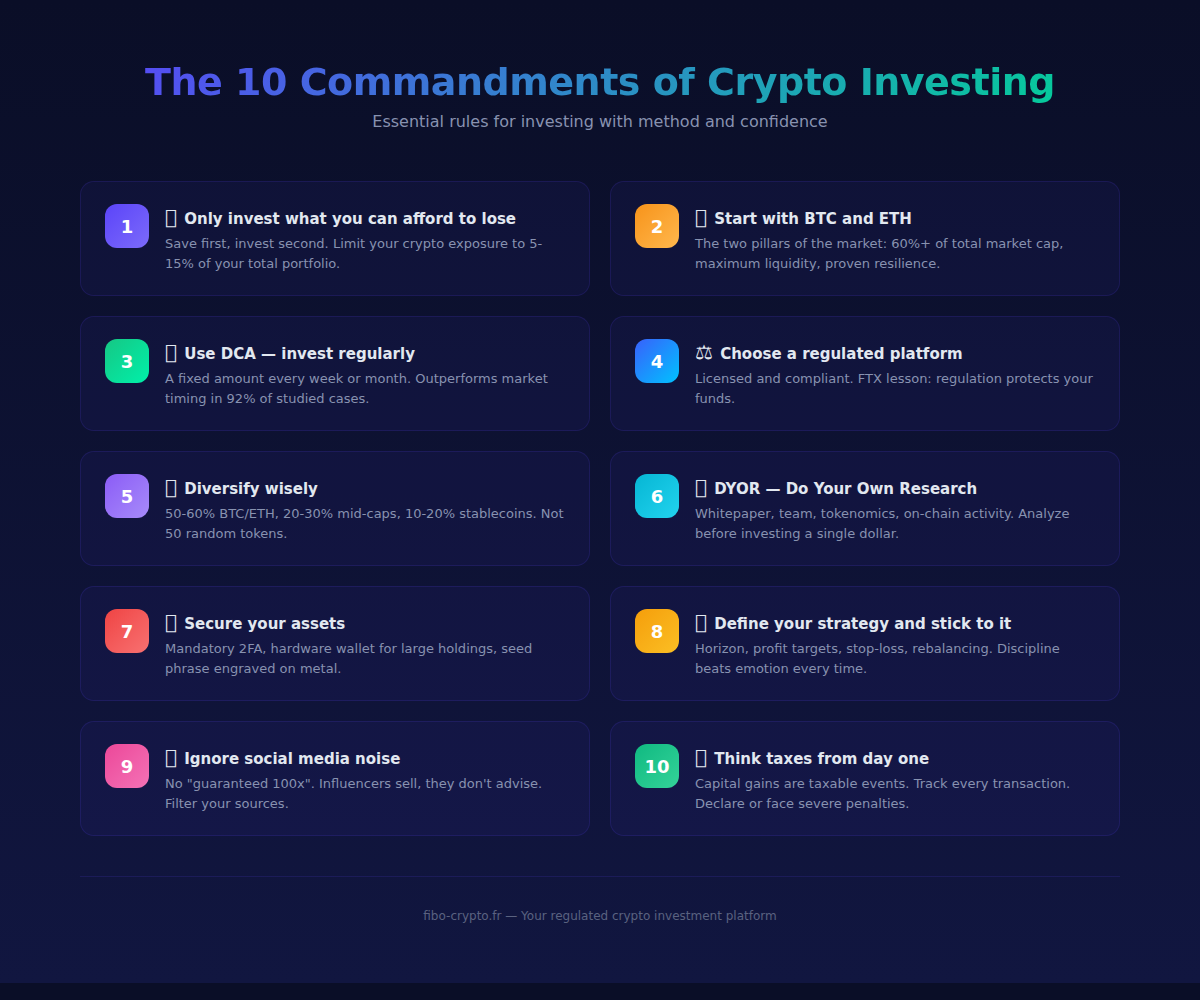
The first rule of crypto investing is to only commit money whose total loss would not change your standard of living. Cryptocurrencies remain a young and volatile asset class. Bitcoin has experienced -80% drawdowns multiple times throughout its history. In practice: first build an emergency fund (3 to 6 months of expenses), pay off high-interest debt, then allocate a limited percentage of your wealth to crypto — typically between 5% and 15% depending on your risk tolerance.2. Prioritize solid assets (BTC, ETH) to start
Bitcoin and Ethereum together account for over 60% of the total crypto market capitalization. These two assets benefit from the highest liquidity, the largest number of active developers, and the best historical resilience through bear markets. A beginner portfolio composed of 60% BTC and 40% ETH provides a solid foundation. Altcoins can be added progressively once you’ve mastered the market fundamentals.3. Use DCA instead of going all-in
DCA (Dollar Cost Averaging) means investing a fixed amount at regular intervals, regardless of price movements. This method smooths your entry price and eliminates the stress of market timing. Concrete example: an investor who put $100 per month into Bitcoin since January 2019 would have achieved an annualized return superior to most investors who tried to “time” the market. DCA is the most recommended strategy by financial advisors for long-term exposure to volatile assets.
4. Choose a regulated platform
In Europe, crypto service providers must be licensed under the MiCA regulation. In the US, platforms should be registered with FinCEN and comply with state regulations. These frameworks ensure minimum standards for anti-money laundering, fund security, and transparency. The collapse of FTX in November 2022 — which swallowed billions of dollars in client funds — perfectly illustrates the risks of using an unregulated platform. Always verify your platform’s regulatory status before depositing any funds.
Why investing in crypto through a PSAN registered with France’s AMF matters
FTX, Mt. Gox… Crypto scandals have cost investors billions. In France, the PSAN license guarantees a regulated framework: identity verification, fund segregation,…
2x cheaper fees. Up to 6% yield. No seed phrase. Fibo, the wallet you've been waiting for.
Get early access →5. Diversify your portfolio wisely
Diversification in crypto doesn’t mean buying 50 different tokens — it means spreading your exposure across complementary asset categories. A balanced portfolio might be structured as follows: – 50-60% in large caps (BTC, ETH) – 20-30% in sector mid-caps (DeFi, infrastructure, Layer 2) – 10-20% in stablecoins (to seize opportunities during corrections) – 0-10% in high-potential small caps (deep research required)6. Understand what you’re investing in (DYOR)
DYOR — Do Your Own Research — isn’t just a slogan: it’s the most important skill for any crypto investor. Before investing in a project, systematically analyze: – The whitepaper: Is the problem being solved real? Is the solution credible? – The team: Verifiable identities, track record, transparency – The tokenomics: Distribution, inflation, actual token utility – On-chain activity: Active users, transaction volume, TVL for DeFi – The community: Quality of discussions (GitHub, forums) vs. pure Twitter hype7. Secure your assets (wallet, 2FA, seed phrase)
Your cryptocurrency security depends entirely on you — there is no customer support to recover stolen or lost funds. Essential rules: – Enable two-factor authentication (2FA) on all platforms — use an app (Google Authenticator, Authy) rather than SMS – For significant amounts, transfer your assets to a hardware wallet (Ledger, Trezor) – Your seed phrase (12 or 24 words) should never be stored digitally — engrave it on metal and keep it in a secure location – Never click links received via message or email claiming to be from your platform8. Have a clear strategy and stick to it
A pre-defined investment plan is your best defense against emotional decision-making. Your strategy should specify: – Your investment horizon (short-term, medium-term, long-term) – Your profit-taking thresholds (e.g., sell 20% of the position after a 2x) – Your stop-loss rules (maximum acceptable loss level) – Your rebalancing frequency (quarterly, semi-annually) Discipline is what separates successful investors from those who panic at every 20% correction.9. Ignore social media noise
Social media is the number one source of poor investment decisions in crypto. “Influencers” promoting a token have often been paid to do so — or bought it before talking about it to sell at the top (pump and dump). Simple rule: if someone promises you guaranteed gains or a “sure 100x,” it’s either a scam or ignorance. Serious investors share analysis, not promises. Build your own analytical framework and limit your crypto content consumption to verified sources.10. Think about taxes from your first purchase
In most jurisdictions, selling cryptocurrency for fiat currency (or goods/services) is a taxable event. In the US, crypto is treated as property by the IRS — capital gains tax applies. In the EU, tax rules vary by country but are increasingly harmonized. From your first purchase, keep a precise record of every transaction: date, amount invested, acquisition price, sale price. Tools like CoinTracking, Koinly, or TaxBit automate this tracking. Failing to report crypto gains can result in significant penalties and back taxes.
How to build your crypto investment strategy
Your strategy should match your risk profile, time horizon, and financial goals. Here are three typical profiles: Conservative profile — 3-5 year horizon, low risk tolerance: – 70% BTC + 20% ETH + 10% yield-bearing stablecoins – Monthly DCA, annual rebalancing – Goal: capital preservation with moderate exposure to sector growth Balanced profile — 2-4 year horizon, medium risk tolerance: – 40% BTC + 25% ETH + 25% major altcoins (SOL, AVAX, LINK…) + 10% stablecoins – Bi-monthly DCA, semi-annual rebalancing, partial profit-taking during euphoric phases – Goal: capital growth with active risk management Aggressive profile — 1-3 year horizon, high risk tolerance: – 30% BTC + 20% ETH + 40% diversified altcoins + 10% opportunistic positions – Weekly DCA, active market monitoring, tactical allocation – Goal: maximum performance with acceptance of high volatility Whatever your profile, the key is consistency. Define your plan, automate your recurring purchases, and only modify your strategy in response to fundamental changes — not in reaction to a tweet or a news headline.Fatal mistakes to avoid at all costs
Some mistakes in crypto are unforgiving — they can lead to total loss of your capital. Blindly trusting a centralized platform. The collapse of FTX (2022), Mt. Gox (2014), and Celsius (2022) showed that even the largest platforms can vanish overnight. Rule: don’t keep more on an exchange than what you need for active trading. Using excessive leverage. Trading at 50x or 100x leverage turns a 1-2% correction into total liquidation. Derivatives platforms generate billions of dollars in liquidations every month — and that money comes from retail traders’ accounts. Investing in “shitcoins” based on hype. Memecoins and tokens without fundamentals lose an average of 95% of their value within 12 months of their peak. For every Dogecoin that survives, thousands of similar projects go to zero. Ignoring scam signals. Rug pulls, fake airdrops, and crypto Ponzi schemes account for billions of dollars in losses every year. Red flags: “guaranteed” returns above 20% annually, anonymous team, insufficient locked liquidity, unaudited smart contract.📚 Glossary
- Bitcoin : The first decentralized cryptocurrency, created in 2009 by Satoshi Nakamoto. Considered the store of value of the crypto market with a supply capped at 21 million units.
- Ethereum : A programmable blockchain enabling the execution of smart contracts and the deployment of decentralized applications (dApps). Its native cryptocurrency is Ether (ETH).
- DCA (Dollar Cost Averaging) : An investment strategy involving buying an asset at regular intervals for a fixed amount, regardless of price, to smooth out the average acquisition cost.
- Stablecoin : A cryptocurrency pegged to a stable asset, typically the US dollar (USDT, USDC, DAI). Used to lock in gains or as a liquidity reserve.
- Altcoin : Any cryptocurrency other than Bitcoin. The term encompasses thousands of projects with vastly different maturity levels and risk profiles.
- Wallet : A software or hardware tool for storing, sending, and receiving cryptocurrencies. A hardware wallet (physical device) offers the highest level of security.
- Seed phrase : A sequence of 12 or 24 words generated when creating a wallet, serving as the unique recovery key. Losing it means permanent loss of the associated funds.
- Rug pull : A scam in which the creators of a crypto project suddenly withdraw all liquidity after attracting investors, rendering the token worthless.
Frequently Asked Questions
What is the minimum amount to start investing in crypto?
There’s no legal minimum amount. Most platforms allow you to invest from as little as $10-50. What matters isn’t the initial amount but consistency: a $50 monthly DCA is more effective than a one-time $600 investment once a year.
Is it too late to invest in Bitcoin in 2025-2026?
Bitcoin is still a young asset with global adoption below 5% of the world’s population. Every cycle has seen investors believe it was “too late” — at $1,000, at $10,000, then at $50,000. DCA allows you to enter at any time without worrying about timing.
How are cryptocurrencies taxed?
Tax treatment varies by jurisdiction. In the US, crypto is taxed as property — short-term gains are taxed as income, long-term gains (held over 1 year) benefit from lower capital gains rates. In the EU, rules vary by country. Specialized software (Koinly, CoinTracking, TaxBit) can automatically generate tax reports from your transaction history.
Do I need a hardware wallet to secure my crypto?
For significant amounts (beyond a few hundred dollars), yes. A hardware wallet (Ledger, Trezor) stores your private keys offline, protecting them from hacking. For small amounts, your regulated platform’s wallet may suffice temporarily, but transferring to a personal wallet remains best practice.
Does DCA really work better than buying at the right time?
Historical studies show that DCA outperforms lump-sum investing in the majority of scenarios for volatile assets like Bitcoin. It doesn’t guarantee the best theoretical returns, but it eliminates the risk of bad timing and significantly reduces psychological stress.
What are the biggest red flags of a crypto scam?
Key warning signs include: promises of guaranteed returns (especially above 20% annually), anonymous or unverifiable team members, no smart contract audit, insufficient locked liquidity, pressure to invest quickly, and projects that focus more on marketing than technology. If it sounds too good to be true, it almost certainly is.
📰 Sources
This article is based on the following sources:
- Chainalysis — 2024 Crypto Crime Report
- CoinGecko — Annual Crypto Industry Report
- IRS — Virtual Currency Guidance
- European Securities and Markets Authority (ESMA) — MiCA
Comment citer cet article : Fibo Crypto. (2026). Crypto Investing: 10 Essential Tips for Success in 2026. Consulté le 21 March 2026 sur https://fibo-crypto.fr/en/blog/tips-successful-cryptocurrency-investment
The simplest way to buy, swap and manage your crypto
Join the first users and get priority access. No seed phrase, fees 3.5x lower, built-in DeFi yield.
Get early access →