Why Is the Crypto Market Crashing? The 6 Factors Behind February 2026’s Crash

📋 En bref (TL;DR)
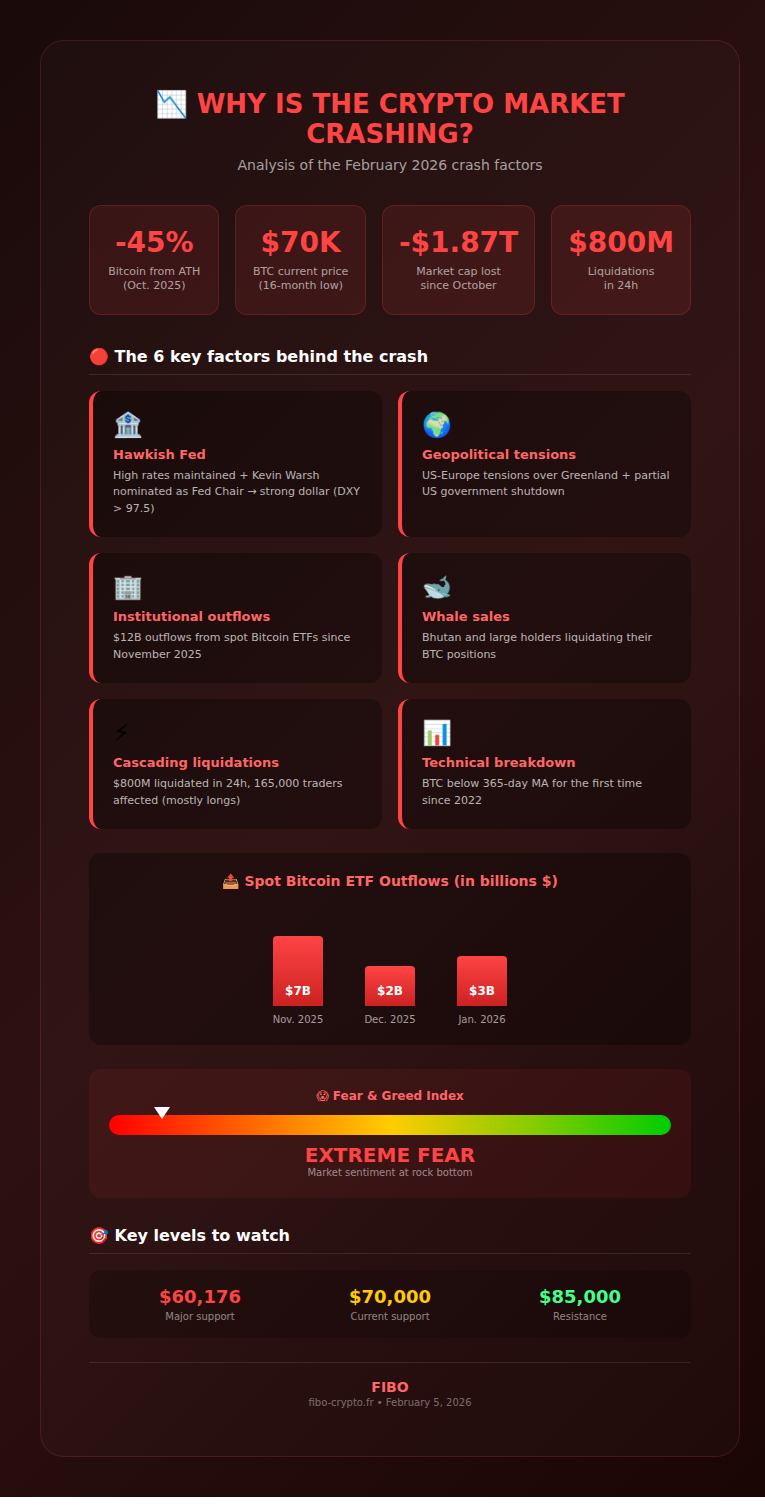
- Bitcoin at $70,000: BTC has dropped 45% from its October 2025 ATH (~$126,000), reaching its lowest level in 16 months
- Hawkish Fed: High interest rates and Kevin Warsh’s nomination as Fed Chair strengthen the dollar (DXY > 97.5)
- Geopolitical tensions: US-Europe crisis over Greenland and partial US government shutdown create uncertainty
- Massive ETF outflows: $12 billion withdrawn from spot Bitcoin ETFs since November 2025, including $3B in January alone
- Cascading liquidations: $800 million liquidated in 24 hours, affecting 165,000 traders (mostly long positions)
- “Extreme Fear” sentiment: Fear & Greed Index at rock bottom, signaling widespread market capitulation
The cryptocurrency market is experiencing a brutal correction. Bitcoin has lost 7% in 24 hours to touch $70,000, its lowest level since late 2024. The entire crypto market has shed $650 billion in a week and $1.87 trillion since October 2025.
What’s happening exactly? Let’s analyze the six key factors behind this crash and what it means for investors.
1. An Unyielding Federal Reserve
The primary culprit is US monetary policy. The Fed is maintaining high interest rates despite market hopes for easing. Kevin Warsh’s nomination as Fed Chair in late January reinforced expectations of strict monetary policy.
Result: the US dollar has strengthened, with the Dollar Index (DXY) exceeding 97.5. A strong dollar is traditionally unfavorable for risk assets like Bitcoin, as investors prefer the safety of cash.
2. Geopolitical Tensions Between the US and Europe
Transatlantic relations have soured over the Greenland question. The Trump administration’s territorial ambitions have triggered a diplomatic crisis with Europe, adding uncertainty to global markets.
Add to this a recently resolved partial US government shutdown that delayed the release of important economic data. This political instability is pushing investors toward more defensive positions.
3. Massive Institutional Investor Exodus
Spot Bitcoin ETFs, launched with such enthusiasm in 2024, are now experiencing massive outflows:
- November 2025: $7 billion in withdrawals
- December 2025: $2 billion in withdrawals
- January 2026: $3 billion in withdrawals
According to Deutsche Bank, these institutional outflows have drained market liquidity for Bitcoin, amplifying volatility. BlackRock notably withdrew $373.8 million from its positions recently.
4. Whales Are Selling: The Bhutan Case
A surprising factor: Bhutan is liquidating its Bitcoin reserves. The small Himalayan kingdom, which had accumulated BTC through its hydroelectric mining program, has begun selling its positions according to on-chain data from Arkham Intelligence.
This sale adds to those of other large holders (“whales”) reducing their exposure, creating additional selling pressure.
5. $800 Million in Cascading Liquidations
Excessive leverage has amplified the crash. According to Coinglass, over $800 million in positions were liquidated within 24 hours, affecting approximately 165,000 traders.
Liquidation details:
- Long positions: $650 million liquidated (traders betting on price increases)
- Short positions: $150 million liquidated
- Largest single liquidation: $11.36 million on a BTCUSDT position on Hyperliquid
These cascading liquidations create a snowball effect: each forced sale pushes the price down, triggering more liquidations.
6. Major Technical Breakdown
From a technical standpoint, Bitcoin has just broken below its 365-day moving average for the first time since 2022. This is an important bearish signal for technical analysts.
Other concerning indicators:
- BTC Bull Score: dropped from 80 in October to 0 today
- Net Realized P/L: -$317 million per day on average — investors are selling at a loss
- Fear & Greed Index: “Extreme Fear” — sentiment is at rock bottom
What Levels to Watch Now?
Analysts Peter Brandt and Citi teams point to the following key levels:
- $70,000: Current psychological support, being tested
- $60,176: Next major support if $70K breaks
- $47,824: Extreme support in case of prolonged capitulation
John Blank, Chief Strategist at Zacks Investment Research, estimates Bitcoin could even drop to $40,000 — 45% below current levels.
Gold and Silver Are Falling Too
Notably: even traditional safe-haven assets are affected. Gold has lost 2% and silver 13% this week. This indicates a generalized flight to cash (“flight to quality”), not just distrust of crypto.
Michael Burry, the investor famous for predicting the subprime crisis, notes that up to $1 billion in precious metals were liquidated in late January, correlated with the crypto crash.
What Should Investors Do?
Facing this correction, several strategies are available to investors:
- Keep a cool head: Corrections of 40-50% are part of Bitcoin’s history. BTC has already experienced 7 corrections of over 50% since 2010.
- Avoid leverage: Cascading liquidations show the dangers of leverage during volatile periods.
- DCA if you believe in the long term: “Extreme Fear” periods have historically been good times to accumulate.
- Watch key levels: $70K is crucial; a clean break would open the path to $60K.

Summary
This correction isn’t due to a single factor but to a convergence of pressures: restrictive monetary policy, geopolitical tensions, institutional outflows, whale sales, and excess leverage. The market is in “capitulation” mode, with sentiment at rock bottom.
For long-term investors, Bitcoin’s history shows that these periods of extreme fear often precede significant recoveries — but timing remains unpredictable. Caution is warranted.
Frequently Asked Questions
Why is Bitcoin crashing in February 2026?
The crash results from several combined factors: restrictive Fed monetary policy (high rates, strong dollar), geopolitical tensions (Greenland, US shutdown), massive Bitcoin ETF outflows ($12B since November), whale sales (including Bhutan), and cascading liquidations ($800M in 24h). Market sentiment has shifted to “Extreme Fear”.
How low can Bitcoin go?
Analysts are watching several levels: $70,000 (current support), $60,176 (next major support), and $47,824 (extreme support). Some strategists like John Blank from Zacks estimate BTC could reach $40,000 in the worst-case scenario — 45% below current levels.
Is now the time to buy Bitcoin?
The Fear & Greed Index is at “Extreme Fear,” historically a signal for long-term investor accumulation. However, timing the bottom is impossible to predict. If you believe in the long term, DCA (dollar-cost averaging) helps smooth out risk. Absolutely avoid leverage in this context.
Why are Bitcoin ETFs losing money?
Spot Bitcoin ETFs have recorded $12 billion in outflows since November 2025 as institutional investors reduce exposure to risk assets. The prospect of prolonged high interest rates makes bond yields more attractive compared to cryptos, which generate no income.
Gold and silver are falling too, why?
Contrary to expectations, even traditional safe-haven assets are declining. Gold has lost 2% and silver 13% this week. This indicates a generalized “flight to cash”: investors prefer cash (dollars) over any other asset in this uncertain environment. Dollar strength amplifies this movement.
📰 Sources
This article is based on the following sources:
- Bitcoin bleeds for second straight day – CNBC
- Crypto Market Crash: Why Is Bitcoin Dropping? – FX Leaders
- Why Is Crypto Down Today? – Yahoo Finance
- Coinglass Liquidations Data
- Arkham Intelligence
How to cite this article: Fibo Crypto. (2026). Why Is the Crypto Market Crashing? The 6 Factors Behind February 2026's Crash. Retrieved October 17, 2026 from https://fibo-crypto.fr/en/blog/why-crypto-market-crashing-february-2026/
The simplest way to buy, swap and manage your crypto
Available on iOS and Android. No seed phrase, fees shown upfront, built-in DeFi yield.