Crypto DCA: Complete Guide to Dollar-Cost Averaging in Cryptocurrencies

📋 En bref (TL;DR)
- Definition: DCA (Dollar-Cost Averaging) means investing a fixed amount at regular intervals, regardless of market conditions.
- Key benefit: DCA smooths out your average purchase price and eliminates the stress of trying to time the market.
- Simulation: $100/month in Bitcoin from January 2020 to December 2024 → approximately $17,900 from $6,000 invested (+198%).
- DCA vs Lump Sum: Lump sum statistically outperforms 60-70% of the time in traditional markets, but DCA is better suited to crypto’s extreme volatility.
- Best for: Investors who don’t have a large lump sum available and want to invest without worrying about market timing.
- Recommended duration: At least 2 to 3 years to effectively smooth out market cycles.
- Key limitation: DCA doesn’t protect against an asset losing all its value — choosing the right asset remains fundamental.
In January 2021, Bitcoin was trading at around $30,000. Three months later, it had surged to $63,000. By June, it had crashed back to $33,000. Who could have predicted these swings? Nobody. The cryptocurrency market is notorious for its extreme volatility, and trying to find the “right time” to buy is an exercise as frustrating as it is futile — even for seasoned professionals.
This is precisely the problem that DCA (Dollar-Cost Averaging) was designed to solve. This scheduled investing strategy, used for decades in traditional markets, has established itself as one of the most rational approaches to investing in crypto. Its principle is disarmingly simple: invest the same amount, at the same frequency, without overthinking it.
2x cheaper fees. Up to 6% yield. No seed phrase. Fibo, the wallet you've been waiting for.
Get early access →What is DCA?
Dollar-Cost Averaging is a strategy that involves investing a fixed amount into an asset at regular intervals, regardless of its price. Whether the market is up or down, you buy the same dollar amount every week, every two weeks, or every month.
To intuitively grasp the mechanism, imagine you go grocery shopping every week with a fixed budget of $10 for apples. When apples are expensive ($3/lb), you buy fewer. When they’re cheap ($1/lb), you bring home more. Over the year, your average cost per pound will naturally be lower than the simple average of listed prices — because you bought more when they were cheaper.
In crypto, it works exactly the same way. When Bitcoin drops to $20,000, your monthly $100 allows you to accumulate more fractions of BTC. When it climbs back to $60,000, you buy less. In the end, your average purchase price is mechanically smoothed out.

Real-world simulation: DCA vs Lump Sum on Bitcoin (2020-2024)
Numbers speak louder than theory. Let’s compare two investors who each deployed $6,000 in Bitcoin between January 2020 and December 2024:
Investor A — DCA: They invest $100 every month for 60 months. They buy Bitcoin at $7,200 in January 2020, at $57,000 in December 2021, at $17,000 in November 2022, then at $93,800 in December 2024. Their average purchase price settles around $31,500, and they accumulate approximately 0.191 BTC. On December 31, 2024, with Bitcoin at roughly $93,800, their portfolio is worth approximately $17,900, a +198% return.
Investor B — Lump Sum: They invest all $6,000 at once in January 2020, when Bitcoin was trading at around $7,200. They acquire approximately 0.833 BTC. On December 31, 2024, their portfolio is worth approximately $78,100, a +1,202% return.
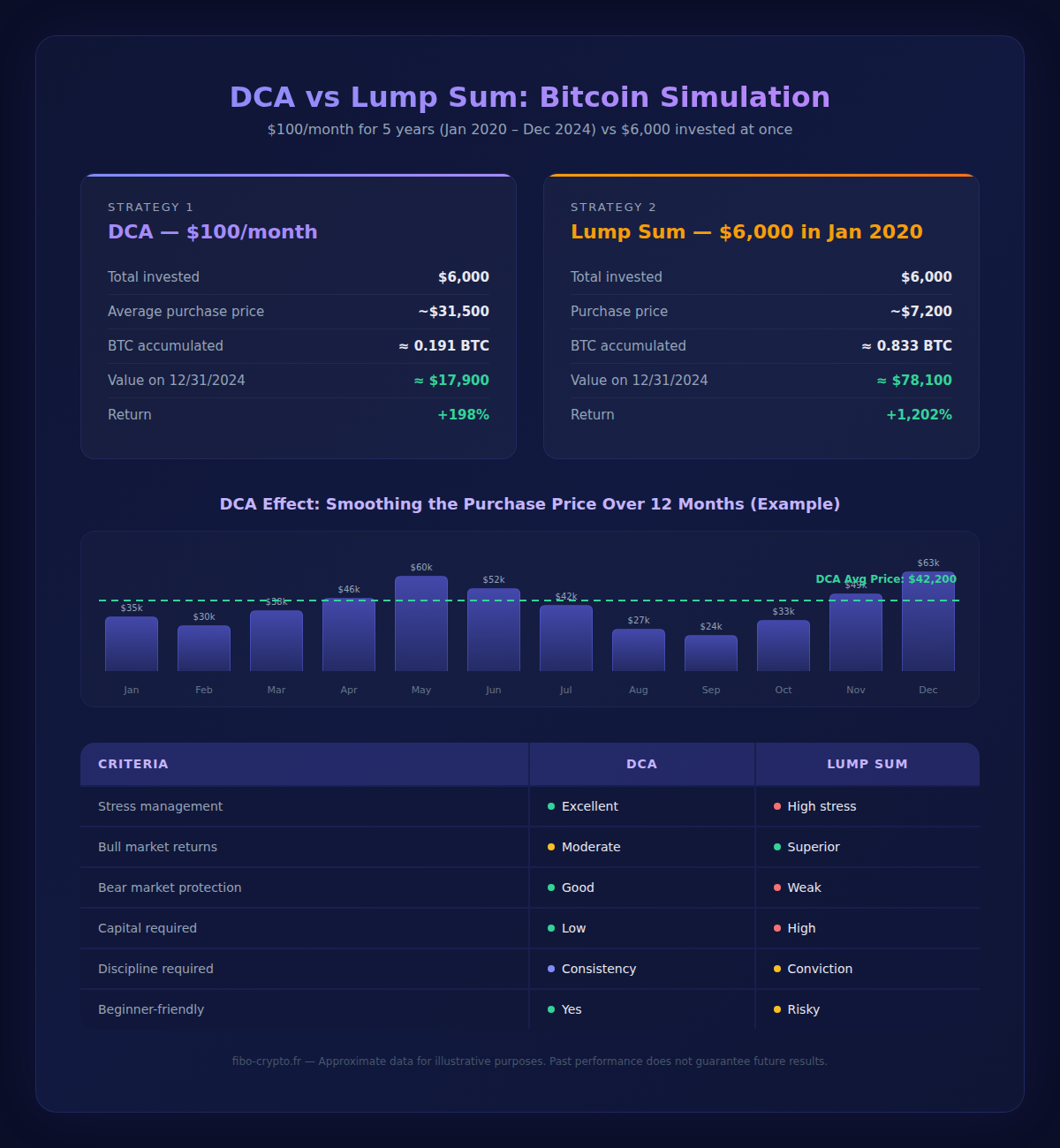
In this specific example, lump sum wins by a wide margin. But here’s the catch: Investor B had the luck (or courage) to invest $6,000 all at once in an asset that had just lost 50% of its value, right before a historic bull cycle. How many investors would have actually had the nerve to do that?
Moreover, consider the practical reality: most individual investors don’t have $6,000 available immediately. They save month after month. DCA simply matches the financial reality of most people.
DCA vs Lump Sum: what does the research say?
The benchmark study on this topic comes from Vanguard (2012), which analyzed stock markets across three countries over 10-year periods. The verdict: lump sum outperforms DCA roughly two-thirds of the time (66%). The reasoning is logical: financial markets tend to trend upward over the long term, and being invested sooner means capturing more of that upside.
However, this study covers traditional markets with typical annual volatility of 15-20%. Bitcoin exhibits 50-80% annual volatility. In such an environment, the risk of being on the “wrong side” of a lump sum investment is considerably amplified:
- An investor who put $6,000 lump sum in November 2021 (BTC at ~$65,000) would have seen their investment drop 75% within a year.
- The same amount deployed via DCA throughout 2022 would have achieved an average price around $28,000, providing a much better entry point.
DCA doesn’t guarantee better absolute returns. It guarantees better risk management and a significant reduction in regret — a psychological factor often underestimated in investment decisions.
The advantages of DCA in crypto
Volatility smoothing
By buying at regular intervals, you mechanically spread your entry price across an entire market cycle. You never buy everything at the top, nor everything at the bottom — but you capture a representative average.
Discipline and elimination of emotional bias
DCA transforms investing into an automatic process. No more need to monitor prices constantly, to give in to FOMO when the market pumps, or to panic when it dumps. This discipline is especially valuable in a market where emotions are the investor’s worst enemy.
Accessibility
You don’t need significant capital to get started. With $20, $50, or $100 per month, you can gradually build exposure to cryptocurrencies. Some platforms offer scheduled purchases starting from as little as $10.
Simplicity of implementation
Most exchanges today offer recurring purchase features. You set it up once, and the system handles the rest. Fibo, for example, offers integrated scheduled investing within its app, making the process straightforward.
The limitations of DCA: an honest assessment
Underperformance in continuous bull markets
If an asset goes up in a straight line (which is rare but possible over short periods), DCA means you keep buying at higher and higher prices. In this scenario, investing everything upfront would have been more profitable.
Cumulative fees
Each transaction incurs fees. Over 60 monthly purchases, these fees add up. It’s important to choose a platform with reasonable commissions (ideally under 1%) to avoid eroding your returns.
No protection against a failing asset
DCA smooths your purchase price, but it doesn’t protect you if the underlying asset loses all its value. DCA-ing into a project that collapses (as happened with numerous altcoins) simply means averaging down toward zero. The choice of asset remains the most important decision.
False sense of security
DCA reduces timing risk, not market risk. In a prolonged bear market, even disciplined DCA can show significant losses for months or even years.
How to set up your crypto DCA
1. Choose your asset(s)
For an effective long-term DCA, focus on the most established cryptocurrencies. Bitcoin remains the most rational choice for a core DCA: it’s the most liquid asset, the oldest, and the one that has historically best weathered market cycles. Ethereum is a solid second choice for diversification.
2. Set the frequency
Weekly or monthly? Studies show that over the long term, the performance difference between weekly and monthly DCA is marginal. Monthly is often more practical (aligned with income) and generates fewer fees. Weekly offers slightly finer smoothing during periods of high volatility.
3. Set a sustainable amount
The amount should be a sum you can invest without stress and without impacting your daily life. A DCA interrupted due to financial difficulties loses much of its purpose. Better to invest $30 per month for 5 years than $200 per month for 6 months.
4. Choose your platform
Look for a platform that offers automated recurring purchases with transparent and reasonable fees. Several options exist: Fibo (with integrated scheduled investing), Binance, Kraken, and Coinbase all offer this functionality.
Three practical DCA profiles
Conservative profile: $50/month
100% Bitcoin. This profile relies on BTC’s historical resilience and minimizes complexity. Ideal for beginners or those who want crypto exposure without spreading too thin. Over 3 years, this represents a total investment of $1,800.
Balanced profile: $100/month
70% Bitcoin ($70) + 30% Ethereum ($30). This profile captures the value of the two leading cryptocurrencies and diversifies risk between a store of value and a technological ecosystem. Over 3 years: $3,600 invested.
Dynamic profile: $200/month
50% Bitcoin ($100) + 30% Ethereum ($60) + 20% diversification ($40) spread across 2-3 other large-cap projects (Solana, Avalanche, etc.). This profile suits more experienced investors who understand the increased risks associated with altcoins. Over 3 years: $7,200 invested.
Practical tips for successful DCA
- Minimum duration: Aim for at least 2-3 years to ride through a complete market cycle. A few months of DCA barely smooths anything.
- Don’t check prices every day: DCA is meant to run on autopilot. Checking your portfolio once a month is enough.
- When to stop: When you’ve reached your target invested capital or your financial situation changes. Not when the market drops — that’s precisely when DCA does its best work.
- Annual rebalancing: Once a year, reassess your allocation and amounts. Your financial situation and the market evolve.
- Tax considerations: In most jurisdictions, regular crypto purchases aren’t taxable events — it’s the sale that triggers taxes. Keep a clean record of all your DCA purchases to accurately calculate your cost basis.
📚 Glossary
- DCA : Dollar-Cost Averaging, an investment strategy that involves buying an asset for a fixed amount at regular intervals, regardless of its price, in order to smooth out the average acquisition cost.
- Lump Sum : A one-time investment: the entire capital is deployed immediately into an asset, as opposed to DCA which spreads purchases over time.
- Volatility : A measure of how much an asset’s price fluctuates. The more volatile an asset, the more its prices swing over short periods. Bitcoin is known for its high volatility.
- FOMO : Fear Of Missing Out — the anxiety of missing an opportunity. In crypto, FOMO drives investors to impulsively buy when prices are rapidly rising.
- Portfolio : The collection of assets held by an investor. In crypto, a portfolio refers to the allocation across different cryptocurrencies (Bitcoin, Ethereum, altcoins, etc.).
- Bitcoin : The first cryptocurrency, created in 2009 by Satoshi Nakamoto. Bitcoin (BTC) is the most capitalized and widely used cryptocurrency as a store of value in the ecosystem.
- Bear Market : A prolonged market downturn characterized by widespread price declines often exceeding 50% in crypto. Bear markets typically last 12 to 18 months.
- Bull Market : A prolonged market uptrend characterized by a general rise in prices. In crypto, bull markets are often explosive with gains of several hundred percent.
Frequently Asked Questions
When is the best time to start DCA in crypto?
There is no ideal time — that’s precisely the point of DCA. The goal is to eliminate market timing. Statistically, the sooner you start, the more you benefit from the long-term upward trend of major cryptocurrencies. The best time is when you have a regular budget you can invest comfortably.
How much should I invest per month in DCA?
There is no universal minimum. The key is to choose an amount you can sustain over the long term without difficulty. Whether it’s $20, $50, or $500 per month, DCA works with any amount. Some platforms like Fibo offer scheduled investment plans starting from just a few tens of dollars.
Should I DCA weekly or monthly?
Over the long term (2+ years), the performance difference between weekly and monthly DCA is very small. Monthly DCA is generally more practical as it aligns with income schedules and generates fewer transaction fees. Weekly DCA offers slightly better smoothing during periods of high volatility.
Does DCA work for altcoins?
DCA is best suited for high-cap cryptocurrencies (Bitcoin, Ethereum) that have a long-term upward trend. For smaller-cap altcoins, DCA is riskier because these assets can lose all their value. If you want to diversify, limit the altcoin portion to 20-30% of your total DCA allocation.
Should I stop DCA when the market crashes?
No, quite the opposite. Market downturns are when DCA is most effective because you accumulate more assets at discounted prices. Stopping DCA during a bear market means abandoning the strategy at the exact moment it delivers the most value. If the invested amount is causing you stress, reduce it rather than stopping entirely.
Are DCA purchases taxable?
Regular crypto purchases are generally not taxable events in themselves. It’s the disposal (sale, exchange, or payment) that triggers taxation. Capital gains taxes vary by jurisdiction. It’s essential to keep an accurate record of all your DCA purchases to calculate your cost basis accurately.
📰 Sources
This article is based on the following sources:
- Vanguard – Dollar-Cost Averaging vs. Lump Sum Investing
- CoinGecko – Bitcoin Historical Data
- Of Dollars And Data – Dollar-Cost Averaging vs. Lump Sum
- Investopedia – Dollar-Cost Averaging (DCA)
Comment citer cet article : Fibo Crypto. (2026). Crypto DCA: Complete Guide to Dollar-Cost Averaging in Cryptocurrencies. Consulté le 21 March 2026 sur https://fibo-crypto.fr/en/blog/crypto-dca-complete-guide-scheduled-investing
The simplest way to buy, swap and manage your crypto
Join the first users and get priority access. No seed phrase, fees 3.5x lower, built-in DeFi yield.
Get early access →