Wealth and Savings: How to Integrate Cryptocurrencies into Your Financial Strategy in 2026

📋 En bref (TL;DR)
- Emerging asset class: Cryptocurrencies, led by Bitcoin above $100,000, are establishing themselves as a key diversification pillar in wealth management in 2026
- Measured allocation: Limit your crypto exposure to 5–10% of your overall portfolio, based on your risk profile and investment horizon
- DCA strategy: Dollar Cost Averaging remains the most effective approach for individual investors looking to smooth out volatility
- Regulatory clarity: The EU’s MiCA regulation is fully in force, while U.S. spot Bitcoin ETFs have attracted over $50 billion in assets
- Tax considerations: Crypto taxation varies by jurisdiction — capital gains tax in the U.S., flat tax in France, and evolving frameworks globally
- Institutional adoption: Bitcoin and Ethereum ETFs, approved in 2024, provide simplified institutional access to digital assets
Integrating cryptocurrencies into a wealth management strategy is no longer reserved for tech enthusiasts. In 2026, with Bitcoin holding above $100,000, spot ETFs approved by regulators on both sides of the Atlantic, and a structured regulatory framework through the EU’s MiCA regulation, crypto-assets have become a legitimate asset class within the world of wealth management.
Whether you’re a cautious saver looking to diversify your investments, or a seasoned investor seeking to optimize your allocation, this guide provides the keys to navigate the cryptocurrency era with method and discernment. We cover how these assets work, strategies for portfolio integration, tax considerations, and best practices for securing your investments.
2x cheaper fees. Up to 6% yield. No seed phrase. Fibo, the wallet you've been waiting for.
Get early access →Why cryptocurrencies are reshaping wealth management
A maturing market
The crypto-asset market crossed a decisive threshold between 2024 and 2026, evolving from a speculative niche to a structured investment universe. Total crypto market capitalization now exceeds $3.5 trillion, driven by massive institutional adoption and regulatory clarity.
Among the landmark events: the SEC’s approval of spot Bitcoin ETFs in January 2024 (BlackRock’s iShares, Fidelity, Invesco), followed by spot Ethereum ETFs in mid-2024. These financial products allow investors to gain Bitcoin and Ethereum exposure through traditional brokerage accounts, without managing digital wallets directly. Within months, Bitcoin ETFs accumulated over $50 billion in assets under management.
Major institutional players — BlackRock, Fidelity, Goldman Sachs, JPMorgan — now offer crypto investment products to their clients, signaling an irreversible paradigm shift in the financial industry.
Bitcoin: the benchmark asset
Bitcoin remains the reference asset of the crypto market, representing approximately 55% of total market capitalization. Its programmatic scarcity — limited to 21 million units with a halving that reduces the creation of new bitcoins every four years — makes it an asset frequently compared to digital gold.
Following the fourth halving in April 2024, Bitcoin surpassed the symbolic $100,000 mark in December 2024, confirming the historic bull cycle associated with this event. For wealth-focused investors, this scarcity dynamic provides a compelling diversification argument against inflation and expansionary monetary policies from central banks.

How to integrate cryptocurrencies into your portfolio
Defining your investor profile
Before making any crypto allocation, you must assess your risk tolerance, investment horizon, and financial goals. The volatility of cryptocurrencies remains significantly higher than that of equity markets: corrections of 20–30% within weeks are common, even in bullish trends.
Three typical profiles emerge:
- Conservative saver (long-term horizon, low risk tolerance): 2–5% allocation in Bitcoin only, via a spot ETF or automated investment plan
- Balanced investor (medium-to-long-term horizon, moderate tolerance): 5–10% allocation split between Bitcoin (60–70%), Ethereum (20–30%), and potentially select blue-chip altcoins
- Dynamic investor (flexible horizon, high risk tolerance): up to 15% allocation including Bitcoin, Ethereum, DeFi protocols, and staking positions
Portfolio allocation: where do crypto-assets fit?
The golden rule remains: never invest in cryptocurrencies more than you can afford to lose entirely. Within a traditional portfolio allocation (real estate, bonds, equities), crypto-assets occupy the “alternative assets” or “diversification” pocket.
Bitcoin’s historically low correlation with traditional equity markets makes it a relevant diversification tool. However, this correlation can increase during systemic crises, as observed during geopolitical tensions. Integrate cryptocurrencies as a complement, never as the core of your wealth strategy.
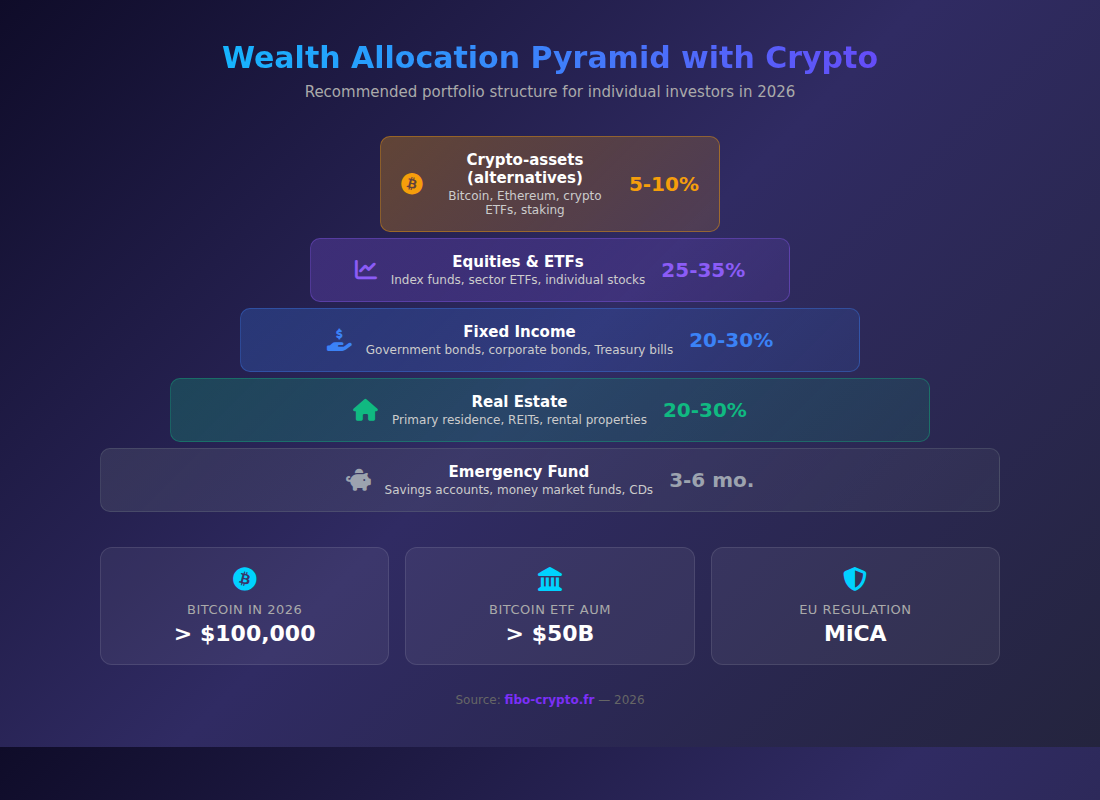
A balanced wealth portfolio might be structured as follows: 25–35% equities (index funds, sector ETFs), 20–30% fixed income (bonds, Treasury securities), 20–30% real estate (primary residence, REITs), 5–10% cash and savings, and 5–10% alternative assets including cryptocurrencies.

DCA: the go-to strategy for individual investors
DCA (Dollar Cost Averaging) means investing a fixed amount at regular intervals, regardless of the current price. This method smooths your average purchase price and eliminates the stress of market timing.
In practice, investing $100 to $500 per month in Bitcoin through an automated investment plan allows you to gradually build exposure without making emotional decisions. Over a 3-to-5-year horizon, this approach has historically outperformed market timing attempts, even for experienced investors.
Most regulated platforms now offer built-in DCA features: Coinbase, Kraken, Fidelity, and various neo-brokers allow you to set up recurring purchases in just a few clicks.
Choosing the right tools and securing your investments
Regulated investment platforms
In 2026, always prioritize platforms that hold proper regulatory licenses in your jurisdiction. In the U.S., this means SEC-registered broker-dealers and state-licensed money transmitters. In Europe, look for platforms with MiCA-compliant authorization (CASP — Crypto-Asset Service Provider).
Leading platforms for crypto investors include:
- Coinbase: U.S.-based, publicly traded, SEC-regulated. Wide range of crypto-assets, user-friendly interface, institutional-grade custody.
- Kraken: Established U.S. exchange with strong security track record, competitive fees, and advanced trading features.
- Fidelity Crypto: Traditional brokerage offering Bitcoin and Ethereum trading integrated with existing investment accounts.
- Bitpanda: European platform (MiCA-compliant) offering crypto, stocks, and precious metals with automated savings plans.
Securing your crypto-assets
The security of your crypto-assets depends on your custody model: platform-based (custodial) or personal wallet (non-custodial).
For significant amounts (above a few thousand dollars), a hardware wallet like Ledger or Trezor offers the highest level of security. Your private keys remain offline, protected from hacking. Store your recovery phrase (seed phrase) in a secure physical location — never digitally.
For modest amounts or DCA-based investments, regulated platforms provide an acceptable security level with the advantage of simplicity. Always enable two-factor authentication (2FA) and use a unique, strong password.
Tracking and tax reporting tools
To manage your crypto allocation within your broader portfolio, use aggregators like CoinGecko or CoinMarketCap for price tracking, and portfolio tools like CoinTracker, Koinly, or TaxBit for tax reporting. These tools automatically calculate your capital gains and generate the forms needed for your tax returns.

Tax considerations for crypto investors
United States
In the U.S., the IRS treats cryptocurrencies as property, meaning capital gains tax applies to all dispositions. Short-term gains (assets held less than one year) are taxed at ordinary income rates (10–37%), while long-term gains benefit from preferential rates (0%, 15%, or 20% depending on income).
Key points:
- Taxable events: selling crypto for fiat, paying with crypto, swapping one crypto for another — all trigger capital gains tax
- Cost basis tracking: maintain detailed records of every purchase, sale, and exchange. Use FIFO, LIFO, or specific identification methods
- Reporting: report crypto gains on Form 8949 and Schedule D. Exchanges are increasingly issuing 1099 forms
- FASB standards: since 2024, new fair value accounting rules (ASU 2023-08) allow companies to report crypto at market value, boosting institutional adoption
European Union: the MiCA framework
The MiCA (Markets in Crypto-Assets) regulation became fully effective on December 30, 2024, establishing a harmonized regulatory framework across the EU.
For investors, MiCA provides concrete protections: mandatory white papers from token issuers, minimum capital requirements for service providers, client fund segregation, and dispute resolution mechanisms. Stablecoins are subject to specific reserve requirements.
Tax treatment varies by EU member state: France applies a 30% flat tax on crypto gains, Germany exempts gains after a one-year holding period, and Portugal taxes at 28% (with evolving rules). Always consult a tax professional in your jurisdiction.
Global regulatory trends
Worldwide, regulatory frameworks are converging toward greater oversight and investor protection. The UK’s FCA has finalized its crypto regulatory framework, Singapore’s MAS enforces strict licensing requirements, and Japan maintains one of the most mature regulatory regimes. This global trend toward regulation, far from stifling the market, provides the legal certainty needed for long-term institutional adoption.

Outlook and recommendations for your wealth strategy
Structural trends shaping 2026 and beyond
Several fundamental trends are reinforcing the legitimacy of crypto-assets within a diversified wealth allocation.
Institutional adoption continues to accelerate: pension funds, family offices, and private banks are progressively integrating Bitcoin into their model portfolios. The tokenization of real-world assets (real estate, bonds, commodities) on the blockchain is opening new investment opportunities with enhanced liquidity and lower minimum thresholds.
Central Bank Digital Currencies (CBDCs), including the digital euro under development by the ECB and various pilot programs in Asia, will complement the ecosystem without replacing decentralized cryptocurrencies. They reflect institutional recognition of blockchain technology’s relevance.
Practical recommendations
To effectively integrate cryptocurrencies into your wealth strategy, follow these fundamental principles:
- Educate yourself continuously: the sector evolves rapidly. Follow regulatory developments, understand the fundamentals of projects you invest in.
- Start small: a DCA of $100–500 per month in Bitcoin is an excellent starting point.
- Diversify wisely: don’t concentrate everything on a single crypto-asset. Bitcoin and Ethereum form a solid foundation.
- Document your transactions: maintain a precise record of all purchases, sales, and exchanges to facilitate tax reporting.
- Rebalance periodically: if your crypto holdings represent an outsized portion of your portfolio following a rally, consider taking partial profits.
- Consult a professional: a financial advisor experienced in digital assets can help optimize your tax and wealth strategy.
📚 Glossary
- Bitcoin : The first and largest cryptocurrency, created in 2009 by Satoshi Nakamoto. A decentralized digital asset limited to 21 million units, often referred to as “digital gold.”
- Blockchain : A distributed ledger technology that records transactions transparently, securely, and immutably, without a central authority.
- Volatility : A measure of how much an asset’s price fluctuates over time. Higher volatility means larger and more frequent price swings.
- DCA : Dollar Cost Averaging. An investment strategy of investing a fixed amount at regular intervals to smooth the average purchase price over time.
- ETF : Exchange-Traded Fund. A financial product traded on stock exchanges that allows investors to gain exposure to an asset (like Bitcoin) without directly holding it.
- Diversification : An investment strategy of spreading capital across different asset types to reduce overall portfolio risk.
- Stablecoin : A cryptocurrency pegged to a stable asset (dollar, euro, gold), designed to minimize volatility. Examples: USDC, USDT, EURC.
- MiCA : Markets in Crypto-Assets. The EU regulation establishing a harmonized regulatory framework for crypto-assets across the European Union, fully in force since December 2024.
- PSCA/CASP : Crypto-Asset Service Provider. The new European regulatory status under MiCA, with enhanced requirements for capital, governance, and client protection.
- Staking : The process of locking up cryptocurrencies to participate in transaction validation on a Proof of Stake blockchain, earning rewards in return.
- DeFi : Decentralized Finance. An ecosystem of financial services (lending, borrowing, trading) operating on blockchain via smart contracts, without traditional intermediaries.
Frequently Asked Questions
What percentage of my portfolio should I allocate to crypto in 2026?
Most wealth management professionals recommend allocating 5–10% of your total portfolio to crypto-assets, depending on your risk profile. For conservative investors, 2–5% in Bitcoin alone represents a reasonable exposure. The key is to invest only amounts whose potential total loss would not impact your lifestyle or essential financial goals (housing, retirement, emergency fund).
Are Bitcoin ETFs better than buying crypto directly?
Spot Bitcoin ETFs offer simplicity and regulatory security: they trade through traditional brokerage accounts without requiring digital wallet management. However, you don’t directly own the bitcoins and pay annual management fees (0.2–0.5%). Direct purchase on a regulated exchange offers more control and potentially lower costs, but involves greater responsibility for security. The choice depends on your technical comfort level and whether you want to directly hold the asset.
How are cryptocurrencies taxed in the United States?
The IRS treats crypto as property. Selling, trading, or spending crypto triggers capital gains tax. Short-term gains (held less than one year) are taxed at ordinary income rates (10–37%), while long-term gains benefit from preferential rates (0%, 15%, or 20%). Crypto-to-crypto trades are also taxable events. Report gains on Form 8949 and Schedule D. Always maintain detailed transaction records.
What does the MiCA regulation mean for crypto investors?
MiCA (Markets in Crypto-Assets), fully effective since December 2024, harmonizes crypto regulation across the EU. For investors, it means: enhanced transparency requirements for token issuers, improved client fund protection (asset segregation), capital requirements for platforms, and a European passport allowing authorized providers to operate across all EU member states. This creates a safer and more predictable investment environment.
What is the best crypto strategy for beginners?
Dollar Cost Averaging (DCA) is the most suitable strategy for beginners. Set up an automatic weekly or monthly purchase of a fixed amount in Bitcoin (e.g., $100–500 per month) on a regulated platform. This method eliminates market timing stress and naturally smooths out volatility. Add a hardware wallet (Ledger, Trezor) once your holdings exceed a few thousand dollars.
Do I need to report my crypto holdings even if I haven't sold?
In the U.S., merely holding crypto doesn’t trigger a taxable event, but you should still track your cost basis for future dispositions. Some jurisdictions require reporting foreign exchange accounts. In the EU, regulations vary by country. Regardless, maintaining detailed records of all transactions from day one is essential — it will make tax reporting significantly easier when you eventually sell or trade.
📰 Sources
This article is based on the following sources:
- IRS — Virtual Currency Guidance
- SEC — Crypto Assets
- MiCA Regulation — Official Journal of the EU
- FASB — Crypto Assets Accounting (ASU 2023-08)
- BlackRock — Digital Assets
Comment citer cet article : Fibo Crypto. (2026). Wealth and Savings: How to Integrate Cryptocurrencies into Your Financial Strategy in 2026. Consulté le 24 March 2026 sur https://fibo-crypto.fr/en/blog/wealth-savings-cryptocurrency-strategy-2026/
The simplest way to buy, swap and manage your crypto
Join the first users and get priority access. No seed phrase, fees 3.5x lower, built-in DeFi yield.
Get early access →