Building a Diversified Portfolio: Complete Guide to Integrating Crypto into Your Wealth

📋 En bref (TL;DR)
- Diversification = protection: spreading investments across asset classes reduces overall risk
- 6 essential asset classes: stocks, bonds, real estate, gold, cryptocurrencies, and cash
- Recommended crypto allocation: 2 to 5% maximum of your total portfolio, never more
- Risk/return tradeoff: the higher the potential return, the higher the risk
- DCA method: investing fixed amounts regularly smooths volatility and reduces timing risk
- Annual rebalancing: adjust proportions once a year to maintain your strategy
- Time horizon: the longer you invest, the more risk you can afford to take
“Don’t put all your eggs in one basket.”
This proverb sums up the most important principle of wealth management: diversification. It’s a concept that seems simple, but one that many investors—beginners and experienced alike—overlook.
2x cheaper fees. Up to 6% yield. No seed phrase. Fibo, the wallet you've been waiting for.
Join the waitlist →With the rise of cryptocurrencies, a crucial question arises: what place should they have in a balanced portfolio? The answer is probably less than you think. But before we talk crypto, let’s go back to the fundamentals of portfolio construction.
Investment Fundamentals
Before investing a single dollar, there are concepts you must master. They make the difference between those who build lasting wealth and those who lose their money.
The Risk/Return Tradeoff
This is THE golden rule of finance: the riskier an asset, the higher its potential return. And vice versa.
A savings account yields 3-5% per year with almost zero risk. A stock can return 10% per year on average, but with years of -30%. Bitcoin has sometimes made +300% in a year… but also -80%.
There is no high-return, low-risk investment. If someone promises you that, run. It’s either a scam or a misunderstanding of the real risk.
Inflation: The Silent Enemy
Leaving your money sitting in a checking account means watching it slowly melt away. Inflation—the general rise in prices—eats away at your purchasing power every year.
With 3% inflation, $10,000 today will only have the purchasing power of $7,400 in 10 years. That’s why not investing is also a risk.
Time Horizon
Time is your best ally in investing. In the short term, markets are unpredictable. Over the long term (10, 20, 30 years), trends stabilize.
That’s why a 25-year-old can afford to take more risks than a 65-year-old retiree. The former has time to recover from a crash, the latter doesn’t.
Traditional Asset Classes
Before talking about crypto, let’s understand the classic pillars of a diversified portfolio.
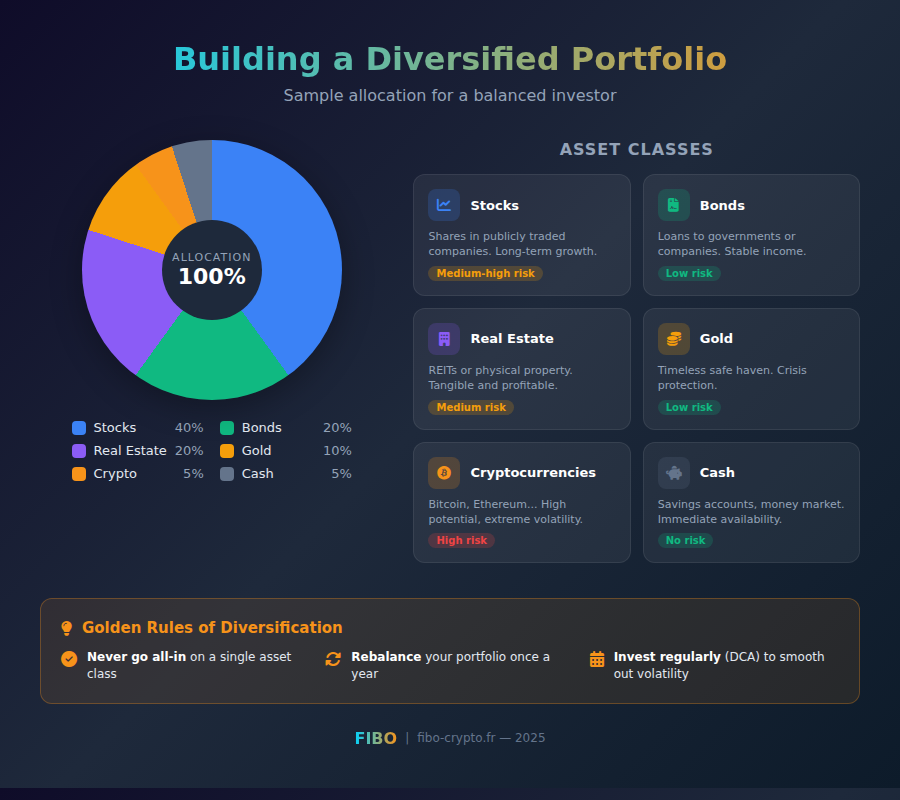
Stocks (40% recommended)
Stocks represent ownership shares in publicly traded companies. Historically, this is the best-performing asset class over the long term, with an average return of 7-10% per year.
Advantages: capital growth, dividends, high liquidity.
Disadvantages: significant volatility, risk of capital loss.
Bonds (20% recommended)
Bonds are loans you make to governments or corporations. In return, you receive regular interest payments (coupons) and the principal back at maturity.
Advantages: predictable income, less volatile than stocks.
Disadvantages: lower returns, sensitive to interest rates.
Real Estate (20% recommended)
Real estate can take two forms: direct investment (buying property) or indirect through REITs (Real Estate Investment Trusts).
Advantages: tangible asset, rental income, inflation protection.
Disadvantages: low liquidity, high entry costs, sometimes complex management.
Gold and Precious Metals (10% recommended)
Gold is a timeless safe haven. It doesn’t generate income but preserves value over the very long term, especially during crises.
Advantages: crisis protection, uncorrelated with financial markets.
Disadvantages: no yield, storage costs.
Cash (5% recommended)
Savings accounts, checking accounts, money market funds. This is your safety cushion, available immediately when needed.
Cryptocurrencies: What Place in Your Portfolio?
Here’s the central question of this article. Cryptocurrencies have unique characteristics that set them apart from all other assets.
Why Include Crypto?
The arguments for a small crypto allocation are solid:
- Partial decorrelation with traditional markets
- Significant growth potential over the long term
- Protection against monetary inflation (Bitcoin’s limited supply)
- Revolutionary technology with growing use cases
Why Limit Exposure?
The risks are equally important:
- Extreme volatility: 50-80% drops are common
- Regulatory risk: the legal framework is constantly evolving
- Technical risk: hacks, loss of private keys
- Still a young market: less than 20 years of history
Recommended Allocation: 2 to 5%
Most wealth management experts agree on an allocation of 2 to 5% maximum in cryptocurrencies for a non-specialized investor.
This proportion allows you to:
- Benefit from upside potential
- Limit impact in case of a crash
- Maintain a balanced portfolio
How to Build Your Portfolio Step by Step
Step 1: Define Your Investor Profile
First, evaluate:
- Your time horizon (5, 10, 20 years?)
- Your risk tolerance (can you handle seeing -30%?)
- Your financial goals (retirement, home purchase, etc.)
- Your monthly savings capacity
Step 2: Build Your Emergency Fund
Before investing, make sure you have 3 to 6 months of expenses in an accessible savings account. This is your safety net.
Step 3: Choose Your Investment Vehicles
For each asset class, prioritize simplicity:
- Stocks: Global ETF like MSCI World or S&P 500
- Bonds: Treasury bonds or bond ETFs
- Real Estate: Diversified REITs
- Gold: Physical gold ETF
- Crypto: Bitcoin (70%) + Ethereum (30%) to start
Step 4: Implement DCA
DCA (Dollar Cost Averaging) means investing a fixed amount at regular intervals, regardless of market price. This method:
- Eliminates the stress of “perfect timing”
- Smooths the average purchase price
- Automates investing
Step 5: Rebalance Annually
Once a year, check that your proportions still match your strategy. If your crypto has risen significantly and now represents 10% instead of 5%, sell some to get back to 5%.
Common Mistakes to Avoid
Investing Money You Need
Never invest your rent or living expenses. Investments can drop at the worst possible time.
Putting All Your Eggs in One Basket
Even if you’re convinced about Bitcoin, don’t put 50% of your wealth into it. Diversification is your protection.
Panic Selling During Drops
Crashes are part of the game. Selling at the bottom is the worst strategy. If you can’t handle the volatility, reduce your exposure.
Following Influencer Advice
“Tips” on social media are often biased. Do your own research and stick to investments you understand.
📚 Glossary
- Diversification : Strategy of spreading investments across different asset classes to reduce overall portfolio risk.
- Allocation : Percentage distribution of your portfolio among different asset classes (stocks, bonds, real estate, etc.).
- Volatility : Measure of the magnitude of price fluctuations of an asset. The more volatile an asset, the more its price swings.
- Correlation : Degree of relationship between two assets. Uncorrelated assets move independently of each other.
- DCA (Dollar Cost Averaging) : Investment method of buying regularly for a fixed amount, regardless of price.
- Bonds : Debt securities issued by governments or corporations. The investor lends money and receives interest.
- REITs : Real Estate Investment Trusts. Allows investing in real estate in a pooled and accessible way.
- ETF : Exchange Traded Fund. Investment fund traded on stock exchanges that tracks an index (S&P 500, MSCI World, etc.).
- Rebalancing : Action of readjusting portfolio proportions to return to target allocation.
- Inflation : General rise in prices that erodes the purchasing power of money over time.
- Time Horizon : The length of time an investor plans to hold investments before using them.
- Safe Haven : Asset that maintains or increases its value during economic or financial crises.
Frequently Asked Questions
What percentage of my portfolio should I invest in crypto?
Experts recommend between 2% and 5% maximum for a non-specialized investor. This proportion allows you to benefit from upside potential while limiting the impact in case of a significant drop. If you’re a crypto specialist, you can go up to 10%, but never beyond except in very particular cases.
Which cryptocurrencies should I start with for diversification?
To start, focus on the two leaders: Bitcoin (BTC) representing about 70% of your crypto allocation, and Ethereum (ETH) for the remaining 30%. These two assets are the most established, most liquid, and least risky in the crypto market (even though they remain highly volatile).
How often should I rebalance my portfolio?
Annual rebalancing is generally sufficient. Some investors prefer to rebalance when an asset class exceeds its target allocation by more than 5%. The key is not to rebalance too often (transaction costs) or too rarely (portfolio drift).
Does DCA really work for crypto?
Yes, DCA is particularly suited to cryptocurrencies because of their high volatility. Investing regularly allows you to smooth the average purchase price and avoid the stress of looking for the “right time.” Studies show that DCA outperforms market timing for the majority of investors.
How do I protect my crypto in my portfolio?
Use a hardware wallet (Ledger, Trezor) to store your crypto offline. Don’t leave large amounts on exchanges. Also diversify across platforms and storage methods. Carefully preserve your seed phrase (recovery key) offline.
Do I need to report crypto on my taxes?
Yes, in most countries, capital gains on cryptocurrencies are taxable when converting to fiat currency. Tax rates vary by jurisdiction. In the US, crypto is treated as property. Consult a tax professional for your specific situation and keep detailed records of all transactions.
📰 Sources
This article is based on the following sources:
- Modern Portfolio Theory – Nobel Prize
- BlackRock – Building Resilient Portfolios
- Fidelity – Asset Allocation
- CoinShares Research
- SEC – Crypto Assets
Comment citer cet article : Fibo Crypto. (2026). Building a Diversified Portfolio: Complete Guide to Integrating Crypto into Your Wealth. Consulté le 21 March 2026 sur https://fibo-crypto.fr/en/blog/building-diversified-portfolio-crypto-wealth-guide-2
The simplest way to buy, swap and manage your crypto
Join the first users and get priority access. No seed phrase, fees 3.5x lower, built-in DeFi yield.
Join the waitlist →