
What is Ethereum? Complete Guide 2026 for Beginners
📋 En bref (TL;DR)
- Ethereum = programmable blockchain platform created in 2015 by Vitalik Buterin
- Enables creation of decentralized applications (DApps) and smart contracts
- ETH (Ether) = native cryptocurrency, 2nd largest by market cap
- Since 2022: Proof of Stake → 99.95% less energy than Bitcoin
- Use cases: DeFi ($100B+), NFTs, stablecoins, DAOs
- Difference from Bitcoin: Bitcoin = digital gold; Ethereum = world computer
- Reading time: 12 minutes
You’ve probably heard of Ethereum, the cryptocurrency that’s making waves alongside Bitcoin. But Ethereum isn’t just a digital currency—it’s a technological revolution transforming finance, art, and the internet itself.
Created in 2015 by Vitalik Buterin, Ethereum has become the world’s second-largest cryptocurrency with over $400 billion in market capitalization. Thousands of applications run on its network, managing over $100 billion in decentralized finance.
In this complete guide, you’ll discover exactly what Ethereum is, how it works, and why it has become indispensable in the crypto ecosystem.
📖 Ethereum: Simple Definition
Ethereum is a programmable blockchain that functions as a decentralized world computer, allowing anyone to create and run applications without intermediaries. Unlike Bitcoin, which serves only as digital currency, Ethereum is a complete platform for developing automatic programs called “smart contracts.”
Imagine a massive computer shared by millions of machines worldwide. This computer:
- Never stops: operates 24/7 since 2015
- Belongs to no one: no company or government controls it
- Is transparent: everyone can see what happens
- Is secure: protected by cryptography and thousands of validators
Concrete example: With Bitcoin, you can send money to someone. With Ethereum, you can create a program that automatically sends money when a condition is met—like an automatic transfer on the 1st of the month, but without a bank.
🏛️ History of Ethereum: From Idea to Web3 Giant
Ethereum was conceived in late 2013 by Vitalik Buterin, a 19-year-old Russian-Canadian programmer frustrated by Bitcoin’s limitations. He dreamed of a blockchain capable of executing any program, not just financial transactions. His idea transformed the crypto industry forever.
Complete timeline:
- Late 2013: Vitalik publishes the Ethereum whitepaper. At 19, he proposes creating a “Turing-complete” blockchain—capable of executing any calculation.
- January 2014: Official presentation in Miami. Vitalik surrounds himself with co-founders: Gavin Wood (creator of Solidity), Joseph Lubin (future founder of ConsenSys), and others.
- July-August 2014: Historic ICO. The project raises $18.4 million in 42 days, in exchange for 60 million ETH—the largest crypto fundraise at the time.
- July 30, 2015: Ethereum network launch (Frontier). The first block (Genesis Block) is created.
- June 2016: The DAO hack. A hacker exploits a flaw and steals the equivalent of $60 million. The community votes for a “hard fork” to reverse the theft, creating Ethereum Classic (ETC)—the unmodified version.
- 2017: ICO explosion. Thousands of projects raise funds by creating ERC-20 tokens on Ethereum. ETH goes from $8 to $1,400.
- 2020: Birth of DeFi. Uniswap, Aave, Compound explode. Total Value Locked (TVL) exceeds $10 billion.
- 2021: Year of NFTs. CryptoPunks, Bored Apes… ETH reaches $4,800.
- September 15, 2022: The Merge. Ethereum transitions from Proof of Work to Proof of Stake, reducing energy consumption by 99.95%.
- 2024: Ethereum ETF approval in the United States. Institutional adoption accelerates.
- 2025-2026: Progressive deployment of scalability solutions (Layer 2, sharding).
⚙️ How Does Ethereum Work?
Ethereum functions as a distributed state machine: thousands of computers (nodes) maintain an identical copy of all data and execute the same calculations to validate each transaction. This consensus mechanism ensures no one can cheat.
The Ethereum Blockchain
A blockchain is a chain of blocks containing information. On Ethereum, each block contains:
- Transactions: ETH transfers between addresses
- Smart contract calls: program execution
- Network state: balances, contract data
- Cryptographic link to the previous block
A new block is created every 12 seconds approximately (versus 10 minutes for Bitcoin), making Ethereum much faster for transactions.
ETH: Ethereum’s Currency
ETH (or Ether) is Ethereum’s native cryptocurrency. It serves several essential functions:
- Pay “gas fees”: fees for each operation on the network
- Secure the network: via staking (32 ETH minimum to become a validator)
- Invest: as a speculative asset and store of value
- Exchange: currency of exchange in the DeFi ecosystem
ETH tokenomics:
- No fixed limit: unlike Bitcoin’s 21 million
- ~120 million ETH in circulation currently
- Sometimes deflationary: since The Merge and EIP-1559, part of gas fees is “burned,” reducing supply
Proof of Stake (PoS)
Since September 2022, Ethereum uses Proof of Stake to secure its network:
- Validators lock 32 ETH (approximately $100,000) as collateral
- They are randomly selected to propose and validate blocks
- They earn rewards (4-5% annually in ETH)
- If they cheat, they lose their ETH (“slashing”)
Advantages vs Proof of Work (Bitcoin):
- ✅ 99.95% less energy consumed
- ✅ More secure: attacking costs billions
- ✅ Passive income: staking accessible to everyone
- ✅ Less selling pressure: no miners to fund
💎 Smart Contracts: The Heart of Ethereum
Smart contracts are self-executing computer programs stored on the blockchain that automatically activate when predefined conditions are met—without human intervention or intermediaries. This is the fundamental innovation that distinguishes Ethereum from Bitcoin.
How Does a Smart Contract Work?
Imagine a vending machine:
- You insert $2
- You select “Coke”
- The machine gives you a Coke automatically
A smart contract works exactly the same way, but for any logic:
- If you send 1 ETH to this contract
- And if condition X is true
- Then the contract automatically executes action Y
Real example — Parametric insurance:
- A farmer subscribes to drought insurance via smart contract
- The contract monitors weather data via an “oracle”
- If rainfall < 50mm over 30 days → automatic compensation
- No claim, no dispute, no delay
Why Is It Revolutionary?
Smart contract advantages:
- No intermediary: eliminates banks, lawyers, notaries
- Automatic: executes without human intervention
- Transparent: public code, verifiable by all
- Immutable: impossible to modify once deployed
- Fast: execution in seconds vs days/weeks
Limitations to know:
- Bugs: a code error can be catastrophic (cf. DAO hack)
- Irreversibility: an executed transaction cannot be reversed
- Oracles: dependence on external data sources
- Gas fees: each operation costs ETH
Smart contracts are primarily written in Solidity, the programming language created specifically for Ethereum by Gavin Wood.
🌐 Ethereum Applications
Ethereum hosts an ecosystem of thousands of decentralized applications (DApps) representing over $100 billion in value, in domains ranging from finance to gaming to digital art. It’s the infrastructure of Web3.
1. DeFi (Decentralized Finance)
DeFi encompasses financial services operating without banks or intermediaries:
- Decentralized exchanges (DEX): Uniswap, Curve — swap cryptos without centralized platforms
- Lending/Borrowing: Aave, Compound — lend or borrow cryptos with algorithmic rates
- Stablecoins: DAI (MakerDAO) — create decentralized dollars
- Yield farming: optimize returns by providing liquidity
Key DeFi figures on Ethereum (2025):
- TVL (Total Value Locked): ~$60 billion
- Monthly DEX volume: ~$100 billion
- Active users: millions of wallets
2. NFTs (Non-Fungible Tokens)
NFTs are unique digital ownership certificates stored on Ethereum:
- Digital art: Beeple ($69M), CryptoPunks, Art Blocks
- Collectibles: Bored Ape Yacht Club, Azuki
- Music: Royal, Sound.xyz — automatic royalties
- Gaming: truly owned in-game items
- Virtual real estate: land in metaverses
Ethereum hosts ~70% of the NFT market, thanks to the ERC-721 standard.
3. Stablecoins
Stablecoins are cryptos pegged to the dollar:
- USDT (Tether): ~$110 billion — most used
- USDC (Circle): ~$35 billion — most transparent
- DAI (MakerDAO): ~$5 billion — decentralized
Stablecoins on Ethereum process over $10 trillion per year, surpassing Visa in volume.
4. DAOs (Decentralized Autonomous Organizations)
DAOs are organizations governed by code and community votes, without CEO or hierarchy:
- Uniswap DAO: UNI holders vote on protocol evolution
- MakerDAO: governs the DAI stablecoin
- Lido DAO: manages the largest liquid staking protocol
5. Layer 2 and Scalability
Layer 2 solutions build on Ethereum to offer faster and cheaper transactions:
- Arbitrum: largest L2 by TVL
- Optimism: used by Coinbase (Base)
- zkSync, Starknet: zero-knowledge technology
L2s enable transactions at less than $0.01 while inheriting Ethereum’s security.
🚀 Ethereum vs Bitcoin: Complete Comparison
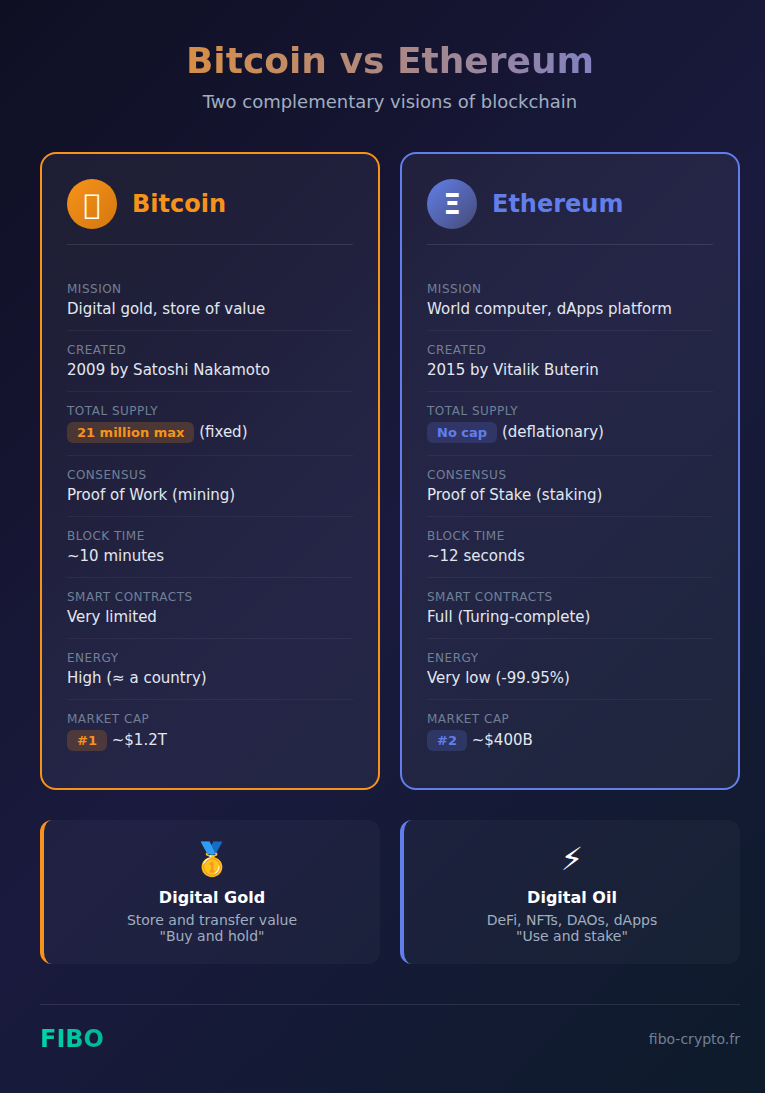
Bitcoin and Ethereum are complementary, not competitors: Bitcoin excels as a decentralized store of value, while Ethereum dominates as a programmable application platform. They are the two pillars of the crypto ecosystem.
In summary:
- Bitcoin = digital gold, “buy and hold,” store of value
- Ethereum = digital oil, “use and stake,” Web3 infrastructure
Both are essential and serve different purposes. A diversified crypto portfolio often contains both.
💡 How to Buy Ethereum
To buy ETH, the simplest and safest method is through a regulated exchange in your jurisdiction. The process takes less than 10 minutes.
1. Choose a Platform
Major exchanges:
- Coinbase: simple interface, beginner-friendly
- Kraken: security-focused, established
- Binance: low fees, wide selection
- Gemini: US-regulated, insurance coverage
2. Purchase Steps
- Create an account: email, secure password
- Verify your identity (KYC): ID + selfie
- Deposit funds: bank transfer (free) or credit card (2-3% fees)
- Buy ETH: market price or limit order
- (Optional) Transfer: to your personal wallet
3. Investment Strategies
- DCA (Dollar Cost Averaging): buy regularly (e.g., $50/month) to average the price
- Staking: lock your ETH to earn 4-5% annually
- HODL: invest long-term and wait for appreciation
🔐 How to Secure Your ETH
Your ETH security depends on the storage type chosen: exchanges are convenient but you don’t have control; personal wallets give you full ownership but security responsibility.
Types of Wallets
- Custodial wallet (exchange): Coinbase, Binance hold your keys. Simple but risky if the platform fails.
- Hot wallet (software): MetaMask, Rabby. You control your keys, but connected to internet.
- Cold wallet (hardware): Ledger, Trezor. Keys offline. Maximum security for large amounts.
Best Practices
- ✅ Seed phrase: write it on paper, never online
- ✅ Two-factor authentication (2FA): mandatory on exchanges
- ✅ Hardware wallet: for any amount > $1,000
- ✅ Diversify: don’t put everything in one place
- ❌ Never: share your seed phrase, click suspicious links
⚠️ Risks and Precautions
Investing in Ethereum carries significant risks that must be understood before getting started: extreme volatility, technical risks, uncertain regulatory evolution. An informed and prudent approach is essential.
Main Risks
Market risks:
- Extreme volatility: ETH can lose 50% in weeks (or double)
- Bitcoin correlation: often follows BTC movements
- Market cycles: multi-year bear markets possible
Technical risks:
- Smart contract bugs: billions have been lost in hacks
- High gas fees: sometimes $50-100 per transaction during congestion
- Key loss: no recovery possible if you lose your seed phrase
Regulatory risks:
- Unclear classification: SEC questions ETH’s status
- Taxation: rules evolve (varies by jurisdiction)
- Potential restrictions: some countries may ban or limit
Essential Precautions
- ✅ Only invest what you can afford to lose
- ✅ Use a regulated platform
- ✅ Diversify: not all in crypto, not all in ETH
- ✅ Educate yourself: understand before investing
- ✅ Report your gains: respect tax laws
🔮 The Future of Ethereum
Ethereum is pursuing an ambitious roadmap aiming to increase capacity to 100,000 transactions per second, reduce fees to near zero, and become the global infrastructure of Web3. Vitalik Buterin and the community are working on multiple fronts.
Roadmap 2025-2030
1. The Surge (Scalability):
- Danksharding: drastically increase data capacity
- Proto-danksharding (EIP-4844): already deployed, reduces L2 fees by 90%
- Goal: 100,000+ TPS on Layer 2s
2. The Scourge (Decentralization):
- Combat MEV (extractable value) centralization
- Propose fairer blocks
3. The Verge (Lightness):
- Verkle Trees: reduce proof sizes
- Enable phones to verify the blockchain
4. The Purge (Simplification):
- Remove unnecessary historical data
- Simplify the protocol
5. The Splurge (Finishing touches):
- Account abstraction (simpler wallets)
- EVM improvements
Institutional Adoption
- Ethereum ETF: approved in USA in 2024, facilitating institutional access
- Companies: JPMorgan, Visa, PayPal use Ethereum
- RWA Tokenization: BlackRock tokenizes funds on Ethereum
🎯 Conclusion
Ethereum isn’t just a cryptocurrency—it’s the programmable infrastructure revolutionizing finance, art, organizations, and the internet itself.
You now know:
- What Ethereum is: a programmable blockchain created by Vitalik Buterin in 2015
- How it works: smart contracts, Proof of Stake, gas fees
- Its applications: DeFi ($100B+), NFTs, stablecoins, DAOs
- The difference from Bitcoin: platform vs store of value
- How to buy: via a regulated exchange
- The risks: volatility, bugs, regulation
Ethereum is transforming how we exchange value, create organizations, and own digital assets. With its ambitious roadmap and growing adoption, it remains at the heart of the Web3 revolution.
Ready to go further? Discover DeFi, learn to secure your crypto, or explore price predictions for 2026.
Frequently Asked Questions
What is Ethereum in simple terms?
Ethereum is a decentralized world computer that allows you to create applications and programs (smart contracts) that run without any company or government controlling them. It’s the second-largest cryptocurrency by market cap, behind Bitcoin.
What's the difference between Ethereum and Bitcoin?
Bitcoin is designed to be a store of value (“digital gold”). Ethereum is a programmable platform that allows creation of decentralized applications. Bitcoin uses mining (Proof of Work), Ethereum uses staking (Proof of Stake), consuming 99.95% less energy.
How do I buy Ethereum?
Use a regulated exchange: create an account, verify your identity, deposit funds via bank transfer or card, then buy ETH. The process takes less than 10 minutes. Major platforms include Coinbase, Kraken, Binance, and Gemini.
What is 'gas' on Ethereum?
“Gas” represents the fees paid in ETH to execute transactions or smart contracts. These fees compensate validators who secure the network. They vary based on congestion: from a few cents to several tens of dollars during high activity.
Can you make money with Ethereum without trading?
Yes, several options exist: staking (4-5% annually by locking ETH), liquidity providing in DeFi, airdrops from new projects, or simply HODLing (long-term investment). DCA (regular investment) is recommended for beginners.
Is Ethereum environmentally friendly?
Since “The Merge” in September 2022, Ethereum consumes 99.95% less energy. The switch to Proof of Stake reduced its consumption from the equivalent of a country (Netherlands) to a few thousand households. It’s now one of the most eco-friendly major blockchains.
Is it risky to invest in Ethereum?
Yes, like any crypto investment. Main risks: volatility (ETH can lose 50%+), smart contract bugs, uncertain regulation. However, Ethereum is the most established blockchain with the most real applications. Only invest what you can afford to lose.
📚 Glossary
- Ethereum : Programmable blockchain created in 2015 by Vitalik Buterin, enabling execution of smart contracts and decentralized applications.
- ETH (Ether) : Ethereum’s native cryptocurrency, used to pay transaction fees (gas) and participate in staking.
- Smart contract : Self-executing program stored on the blockchain that automatically activates when predefined conditions are met.
- Gas : Unit of measurement for transaction fees on Ethereum, paid in ETH to compensate validators.
- Proof of Stake (PoS) : Consensus mechanism where validators lock ETH as collateral to secure the network and validate transactions.
- DApp : Decentralized application running on a blockchain, without centralized server or intermediary.
- DeFi : Decentralized finance, financial services (lending, exchanges, savings) operating via smart contracts.
- NFT : Non-fungible token, unique digital ownership certificate stored on the blockchain.
- Layer 2 : Scalability solution built on top of Ethereum to offer faster and cheaper transactions.
- Staking : Locking ETH to participate in network security and receive rewards (4-5% annually).
- ERC-20 : Technical standard for creating fungible tokens on Ethereum (used by USDT, USDC, UNI, etc.).
- Solidity : Programming language created to write smart contracts on Ethereum.
📰 Sources
This article is based on the following sources:
Comment citer cet article : Fibo Crypto. (2026). What is Ethereum? Complete Guide 2026 for Beginners. Consulté le 7 February 2026 sur https://fibo-crypto.fr/en/blog/what-is-ethereum-complete-guide-2026
How to cite this article:
Fibo Crypto. (2026). What Is Ethereum? Complete Guide 2026. https://fibo-crypto.fr/blog/what-is-ethereum