
Stablecoins: Complete Guide to Stable-Value Cryptocurrencies in 2026
📋 En bref (TL;DR)
- Definition: a stablecoin is a cryptocurrency pegged to a stable asset, typically the US dollar (1 stablecoin = $1).
- Market in 2026: total stablecoin market cap exceeds $230 billion, led by USDT (60% market share) and USDC (25%).
- Main types: fiat-backed (USDT, USDC), crypto-backed (DAI), algorithmic (UST, collapsed in 2022), and commodity-backed (PAXG).
- Use cases: trading pairs, DeFi (lending, yield farming), cross-border payments, dollar-denominated savings, and remittances.
- Risks: depeg events, opaque reserves, regulatory uncertainty, and censorship (issuers can freeze addresses).
- Regulation: MiCA in Europe bans non-compliant stablecoins; the US GENIUS Act aims to create a federal framework; Singapore and the UK are developing their own rules.
What is a stablecoin?
A stablecoin is a cryptocurrency designed to maintain a stable value, most commonly pegged to a fiat currency like the US dollar. While Bitcoin and Ethereum can swing 10–20% in a single day, a stablecoin aims to stay as close as possible to its reference value: 1 USDT = $1, 1 USDC = $1, 1 EURC = €1.
The crypto market’s extreme volatility created the need for a digital asset that combines blockchain speed with real-world price stability. Stablecoins fill that role: they let traders, investors, and DeFi users hold value, settle transactions cheaply, and participate in decentralized finance — without constant exposure to price swings.
In 2025, stablecoins processed over $33 trillion in transaction volume — surpassing Visa. That figure illustrates how central stablecoins have become, not just in crypto, but in the broader financial system.

The different types of stablecoins
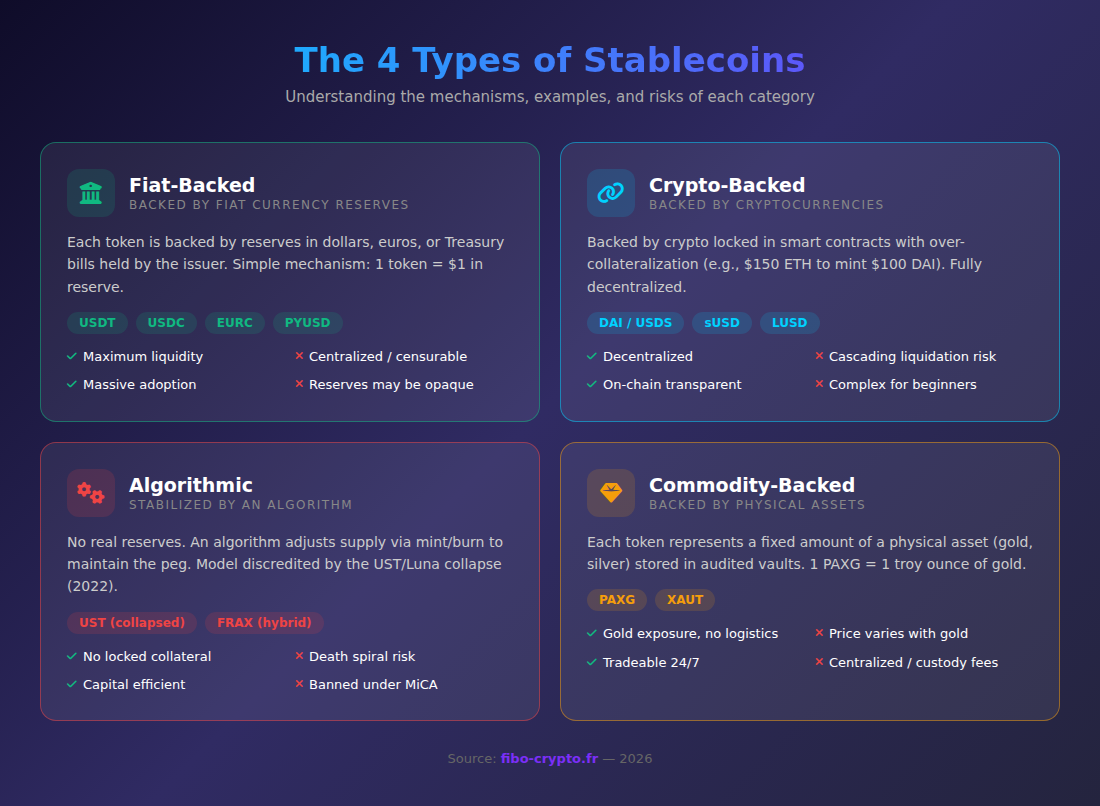
There are four major categories of stablecoins, each using a different mechanism to maintain price stability. Understanding these mechanisms is critical for evaluating the risks associated with each one.
Fiat-backed stablecoins
The most common type. For every stablecoin in circulation, the issuer holds an equivalent amount of fiat currency (or highly liquid assets such as US Treasury bills) in reserve. When you buy 1,000 USDC, Circle places $1,000 in an audited reserve account. You can redeem them for dollars at any time.
Examples: USDT (Tether), USDC (Circle), EURC (Circle, euro-pegged).
Pros: simple mechanism, high liquidity, massive adoption.
Cons: reliance on a centralized issuer, potential reserve opacity (Tether’s case), address-freezing capability.
Crypto-backed stablecoins
Instead of fiat reserves, these stablecoins are backed by other cryptocurrencies locked in smart contracts. To compensate for collateral volatility, the system requires over-collateralization: you might need to deposit $150 of ETH to mint $100 of stablecoins.
Example: DAI (now USDS under the Sky protocol, formerly MakerDAO).
Pros: decentralization, on-chain transparency, no single point of trust.
Cons: cascading liquidation risk during market crashes, technical complexity, slow governance response.
Algorithmic stablecoins
These stablecoins hold no reserves in the traditional sense. They use algorithms and arbitrage mechanisms (minting/burning a companion token) to adjust supply and maintain the peg.
The cautionary tale: the UST/Luna collapse of May 2022. Terra’s algorithmic stablecoin UST lost its dollar peg, triggering a death spiral that wiped out over $40 billion in market cap within days. Do Kwon, Terra’s founder, was ultimately sentenced to 15 years in prison. This event permanently damaged confidence in the algorithmic model.
Theoretical pros: no locked collateral, capital efficiency.
Cons: fragile mechanism, death-spiral risk, effectively banned under MiCA in Europe.
Commodity-backed stablecoins
A niche category, these stablecoins are pegged to commodities like gold. Each token represents a fixed quantity of the underlying asset, stored in audited vaults.
Example: PAXG (Paxos Gold) — 1 PAXG = 1 troy ounce of gold.
Pros: gold exposure without physical logistics, tradable 24/7.
Cons: gold price fluctuations, custody fees, centralized issuer.
The major stablecoins in 2026
The stablecoin market now exceeds $230 billion in total capitalization, dominated by two players: Tether (USDT) and Circle (USDC). Here’s an overview of the most important stablecoins today.
USDT (Tether): the undisputed leader
With approximately $186 billion in market cap and 60% market share, USDT remains the world’s most used stablecoin. It’s available on virtually every exchange and serves as the default trading pair for most crypto assets.
However, Tether has faced persistent controversy over its reserves. While the company has improved transparency — publishing quarterly attestation reports — it has never undergone a full independent audit. The 2021 CFTC settlement ($41 million fine for misrepresenting reserves) still weighs on its reputation. In 2026, Tether chose not to comply with Europe’s MiCA regulation, leading to its delisting from regulated European exchanges.
USDC (Circle): transparency as strategy
With roughly $72 billion in market cap and 25% market share, USDC is the second-largest stablecoin. Circle’s strategy is built on regulatory compliance: monthly audits by Deloitte, reserves held in US Treasury bills and bank deposits, strategic partnership with Coinbase, and an EMI license under Europe’s MiCA framework.
Circle is preparing its IPO on US markets, signaling long-term confidence in the regulated stablecoin model. USDC leads in DeFi transaction volumes and is the stablecoin of choice for institutional players.
EURC: the euro stablecoin
Also issued by Circle, EURC is pegged 1:1 to the euro. With MiCA in force, EURC has a significant competitive advantage in Europe: it’s natively compliant, making it the reference euro stablecoin for European businesses and investors. Its growth is accelerating as USDT exits the European market.
DAI / USDS (Sky, formerly MakerDAO)
DAI (rebranded USDS under MakerDAO’s Sky rebrand) is the leading decentralized stablecoin. Its value is maintained through over-collateralization managed by smart contracts on Ethereum. No centralized issuer can freeze your tokens.
With roughly $5 billion in market cap, DAI/USDS is essential in the DeFi ecosystem for those who prioritize decentralization over convenience.
PYUSD (PayPal): big tech enters the arena
Launched in 2023, PayPal’s PYUSD is a fiat-backed stablecoin issued by Paxos. With over 400 million PayPal accounts worldwide, PYUSD has the potential to bring stablecoins to the mainstream. Its adoption remains modest compared to USDT and USDC, but its integration into the PayPal/Venmo ecosystem gives it unmatched distribution power, particularly in the US market.

What are stablecoins used for?
Stablecoins are far more than a volatility hedge — they have become core infrastructure for digital finance, with real-world use cases spanning trading, DeFi, payments, and savings.
Trading pairs
On exchanges, most trading pairs are denominated in stablecoins (BTC/USDT, ETH/USDC). They allow traders to enter and exit positions quickly without converting back to fiat — which would be slower and more expensive.
DeFi: lending, yield farming, and beyond
Stablecoins are the backbone of DeFi. You can deposit them on lending protocols (Aave, Compound) to earn interest, provide liquidity in yield farming pools, or use them as collateral to borrow other assets. Yields on stablecoins typically range from 3% to 12% APY depending on the protocol and market conditions — well above traditional savings rates in most countries.
Cross-border payments and remittances
Sending stablecoins across borders costs cents and takes minutes, compared to 5–10% fees and several days for a traditional wire transfer or remittance service. For migrant workers sending money home, stablecoins are a game-changer — especially in corridors between the US and Latin America, or the Gulf states and South Asia.
Dollar-denominated savings
For residents of high-inflation countries (Argentina, Turkey, Nigeria), dollar-pegged stablecoins offer a simple way to protect purchasing power. No US bank account needed — just a crypto wallet. This use case alone is driving massive stablecoin adoption in emerging markets.
What are the risks of stablecoins?
Despite their name, stablecoins are not risk-free. Several threats can affect their stability and the funds of their holders.
Depeg risk
A depeg — losing the price anchor — is every stablecoin holder’s worst-case scenario. In May 2022, Terra’s UST lost its peg and fell to near zero. In March 2023, USDC briefly dropped to $0.87 after the Silicon Valley Bank collapse, where Circle held part of its reserves. The peg was restored within 48 hours, but the event proved that even top stablecoins aren’t invulnerable.
Reserve opacity
Trust in a fiat-backed stablecoin depends entirely on the quality and transparency of its reserves. Tether has faced criticism for years over reserves that once included commercial paper and loans to affiliated entities. If an issuer can’t honor redemptions, the stablecoin can break its peg.
Regulatory risk
Regulators worldwide are increasingly focused on stablecoins. New rules can restrict their use, impose costly reserve requirements, or outright ban certain models. The fragmented global regulatory landscape creates uncertainty for users and issuers alike.
Censorship and address freezing
Centralized stablecoin issuers (USDT, USDC) have a power that Bitcoin doesn’t: they can freeze addresses on demand. Both Circle and Tether have frozen millions of dollars in response to law enforcement requests. This is a strong argument for decentralized stablecoins like DAI, and a reminder that these assets are not as “permissionless” as native cryptocurrencies.
Global stablecoin regulation in 2026
The regulatory landscape for stablecoins is evolving rapidly across every major jurisdiction, with Europe, the US, the UK, and Asia each taking distinct approaches.
Europe: MiCA sets the standard
MiCA (Markets in Crypto-Assets), fully effective since 2025, is the world’s most comprehensive stablecoin regulatory framework. It requires issuers of e-money tokens (EMTs) to hold an EMI license, maintain 100% liquid reserves, guarantee redemption at par, and publish a detailed whitepaper. Algorithmic stablecoins are effectively excluded. USDT has been delisted from regulated European exchanges, while USDC and EURC have emerged as MiCA-compliant winners.
United States: the GENIUS Act and beyond
The US is advancing the GENIUS Act (Guiding and Establishing National Innovation for US Stablecoins), a bipartisan bill that would create the first federal framework for stablecoin issuers. Key provisions include reserve requirements, issuer registration, and consumer protection rules. The bill also clarifies that stablecoins are not securities — a critical distinction that the SEC has debated for years. If passed, the GENIUS Act could unlock institutional adoption at a scale that dwarfs current levels.
United Kingdom: FCA’s evolving framework
The UK Financial Conduct Authority (FCA) is in the final stages of its crypto regulatory consultation, with stablecoin-specific rules expected by late 2026. The UK approach focuses on consumer protection and reserve adequacy, with a framework designed to be compatible with — but distinct from — MiCA.
Singapore: the MAS framework
Singapore’s Monetary Authority (MAS) has implemented its Stablecoin Regulatory Framework, requiring single-currency pegged stablecoins to maintain full reserve backing, conduct regular audits, and meet capital adequacy standards. It’s one of the most advanced frameworks in Asia and positions Singapore as a regional stablecoin hub.

Tax implications of stablecoins
Stablecoin taxation varies significantly by jurisdiction, but one principle is nearly universal: converting stablecoins to fiat currency is a taxable event.
United States
The IRS treats stablecoins as property. Selling stablecoins for fiat, or using them to purchase goods and services, triggers a capital gains or loss event. Crypto-to-crypto swaps (including crypto-to-stablecoin) are also taxable events in the US, unlike in some European jurisdictions.
European Union
Under DAC8 (effective 2026), EU member states will receive automated reporting of crypto transactions from exchanges. In France, crypto-to-stablecoin swaps are not taxable events — only conversion to fiat triggers the 31.4% flat tax. This means investors can “lock in gains” by converting to stablecoins without incurring taxes, as long as they don’t cash out to euros.
United Kingdom
HMRC treats all crypto disposals — including stablecoin swaps — as potentially taxable events. Capital gains tax rates of 18% (basic rate) or 24% (higher rate) apply above the annual exemption (currently £3,000).
📚 Glossary
- Stablecoin : a cryptocurrency designed to maintain a stable value by pegging it to a reference asset (dollar, euro, gold) through reserves or algorithmic mechanisms.
- Peg : the fixed price anchor of a stablecoin to its reference asset (e.g., 1 USDT = $1).
- Depeg : the temporary or permanent loss of a stablecoin’s price anchor to its reference asset.
- Collateral : assets deposited as backing to issue a stablecoin (dollars, Treasury bills, cryptocurrencies).
- USDT : Tether, the largest stablecoin by market cap ($186B), issued by Tether Limited.
- USDC : USD Coin, the second-largest stablecoin ($72B), issued by Circle with monthly audits by Deloitte.
- Algorithm : in the stablecoin context, an automated program that adjusts token supply to maintain the peg.
- MakerDAO : a decentralized protocol (rebranded as Sky) behind the DAI/USDS stablecoin, functioning through over-collateralization.
- DeFi : decentralized finance — financial protocols running on blockchain without centralized intermediaries.
- Yield : returns earned by depositing assets in DeFi protocols (lending, staking, liquidity providing).
- Lending : a DeFi protocol that lets users lend crypto for interest or borrow against collateral.
- MiCA : Markets in Crypto-Assets, the EU regulation governing crypto-assets and stablecoins since 2025.
- EMI : Electronic Money Institution — a European license required to issue MiCA-compliant stablecoins.
- Smart contract : a self-executing program deployed on a blockchain that automatically enforces the terms of an agreement.
- Reserve : assets held by a stablecoin issuer to back the value of each token in circulation.
- Fiat : government-issued currency (USD, EUR, GBP) as opposed to cryptocurrencies.
- Blockchain : a distributed, immutable digital ledger that records all transactions transparently.
- Cryptocurrency : a digital asset using cryptography and blockchain technology to operate in a decentralized manner.
- Volatility : the degree of price variation of an asset over a given period.
- GENIUS Act : the proposed US federal law (Guiding and Establishing National Innovation for US Stablecoins) creating a regulatory framework for stablecoin issuers.
Frequently Asked Questions
What exactly is a stablecoin?
A stablecoin is a cryptocurrency designed to maintain a fixed value, typically pegged to a fiat currency like the US dollar (1 stablecoin = $1). Unlike Bitcoin, whose price fluctuates significantly, stablecoins provide price stability while retaining the speed and programmability of blockchain technology. They’re used for trading, DeFi, payments, and as a safe haven from crypto volatility.
Which stablecoin should I choose in 2026?
It depends on your use case and location. In Europe, USDC is the safest bet — it’s MiCA-compliant, monthly audited, and available on all regulated exchanges. EURC is ideal if you want euro-denominated stability. USDT remains the most liquid globally but is no longer available on regulated European platforms. For decentralization purists, DAI/USDS is the best option. In the US, USDC and PYUSD (PayPal) are the top regulated choices.
Are stablecoins safe?
Fiat-backed stablecoins like USDC and USDT are considered relatively safe, but not risk-free. Key dangers include depeg events, opaque reserves, and regulatory changes. The UST collapse in 2022 showed that algorithmic stablecoins can lose all value. Prefer audited, regulated stablecoins with transparent reserves. No stablecoin offers FDIC-like deposit insurance.
USDT vs USDC: what's the difference?
USDT (Tether) is the largest stablecoin ($186B market cap) with the best liquidity, but its reserves have historically been opaque. USDC (Circle) is smaller ($72B) but more transparent: monthly Deloitte audits, reserves in US Treasuries, and full MiCA compliance in Europe. In short, USDT wins on liquidity, USDC wins on transparency and regulatory compliance.
How are stablecoins taxed?
Tax treatment varies by country. In the US, all crypto disposals (including swaps to stablecoins) are taxable. In France and some EU countries, crypto-to-stablecoin swaps are not taxable — only conversion to fiat triggers tax. In the UK, all disposals are potentially taxable. Always consult a tax professional in your jurisdiction, as rules are evolving rapidly with DAC8 in Europe and new IRS guidance in the US.
Can a stablecoin lose its peg?
Yes, and it has happened. Terra’s UST lost its peg in May 2022, dropping from $1 to near zero and wiping out $40 billion. USDC briefly dropped to $0.87 in March 2023 during the SVB bank collapse. For well-managed fiat-backed stablecoins, the risk of permanent depeg is low but not zero. Algorithmic stablecoins are the most vulnerable to catastrophic depeg events.
What is the GENIUS Act?
The GENIUS Act (Guiding and Establishing National Innovation for US Stablecoins) is a bipartisan US bill that would create the first federal regulatory framework for stablecoin issuers. It establishes reserve requirements, consumer protections, and clarifies that stablecoins are not securities. If passed, it could significantly accelerate institutional adoption of stablecoins in the United States.
How does MiCA affect stablecoins in Europe?
MiCA requires stablecoin issuers in the EU to obtain an EMI (Electronic Money Institution) license, hold 100% reserves in liquid assets, guarantee redemption at par value, and publish a detailed whitepaper. Algorithmic stablecoins are effectively excluded. USDT chose not to comply and was delisted from regulated European exchanges. USDC and EURC, which are MiCA-compliant, have gained significant market share in Europe as a result.
📰 Sources
This article is based on the following sources:
- Tether Transparency
- Circle – USDC Transparency
- MiCA Regulation – EUR-Lex
- CoinGecko – Stablecoins
- DeFiLlama – Stablecoins
- Bloomberg – $33 Trillion in Stablecoin Transactions
Comment citer cet article : Fibo Crypto. (2026). Stablecoins: Complete Guide to Stable-Value Cryptocurrencies in 2026. Consulté le 7 February 2026 sur https://fibo-crypto.fr/en/blog/what-are-stablecoins