What Is a DAO? Complete Guide to Decentralized Autonomous Organizations 2026
📋 En bref (TL;DR)
- DAO: Decentralized organization managed by smart contracts, without central authority or traditional hierarchy
- Governance: Members vote with governance tokens (1 token = 1 vote) on all important decisions
- Smart contracts: Code is law — rules are programmed and execute automatically
- Types: Protocol DAOs, Investment DAOs, Grant DAOs, Collector DAOs, Social DAOs, Service DAOs, Media DAOs
- Examples: MakerDAO ($8B TVL), Uniswap, Aave, Gitcoin, Constitution DAO
- Treasuries: Over $25 billion managed collectively by DAOs in 2026
- Future: Emerging legal frameworks (Wyoming DAO LLC) and growing adoption by traditional companies
Imagine an organization without a CEO, without traditional hierarchy, where every important decision is made collectively by its members according to transparent and automated rules. Welcome to the world of DAOs — Decentralized Autonomous Organizations.
DAOs represent a revolution in organizational governance, combining blockchain, smart contracts, and participatory democracy to create entirely new structures. Unlike traditional companies where power is concentrated in the hands of a few executives, DAOs operate on a horizontal model where every token holder can participate in decisions.
In 2026, more than 15,000 DAOs collectively manage over $25 billion in treasury, with more than 12 million active members. In this complete guide, we’ll explore DAOs in depth: their technical workings, their different types, their revolutionary advantages, and their current limitations.
What Is a DAO? Complete Definition
A DAO (Decentralized Autonomous Organization) is an organization whose operating rules are coded in smart contracts on the blockchain, and whose decisions are made collectively by its members through a decentralized voting system. It’s the digital equivalent of a cooperative where each member has a voice proportional to their participation.
Let’s break down this acronym for better understanding:
- Decentralized: No central authority controls the DAO. Power is distributed among all members holding governance tokens.
- Autonomous: The DAO operates according to programmed rules that execute automatically via smart contracts, without human intervention.
- Organization: Collective structure bringing together members around common objectives — managing funds, developing projects, or making strategic decisions.
The 5 Key Characteristics of a DAO
- Decentralized governance: Every member holding governance tokens can propose and vote on important decisions.
- Total transparency: All transactions, votes, and decisions are recorded publicly on the blockchain.
- Automatic execution: Voted decisions are automatically executed by smart contracts.
- Collective ownership: Members own tokens that represent their share in the organization.
- On-chain treasury: Funds are stored in a smart contract, ensuring no single person can misappropriate them.
How Does a DAO Work?
A DAO operates through four pillars: smart contracts that define the rules, governance tokens that grant voting rights, a transparent proposal/vote/execution process, and a collective treasury managed on-chain. This system eliminates the need to trust human leaders.
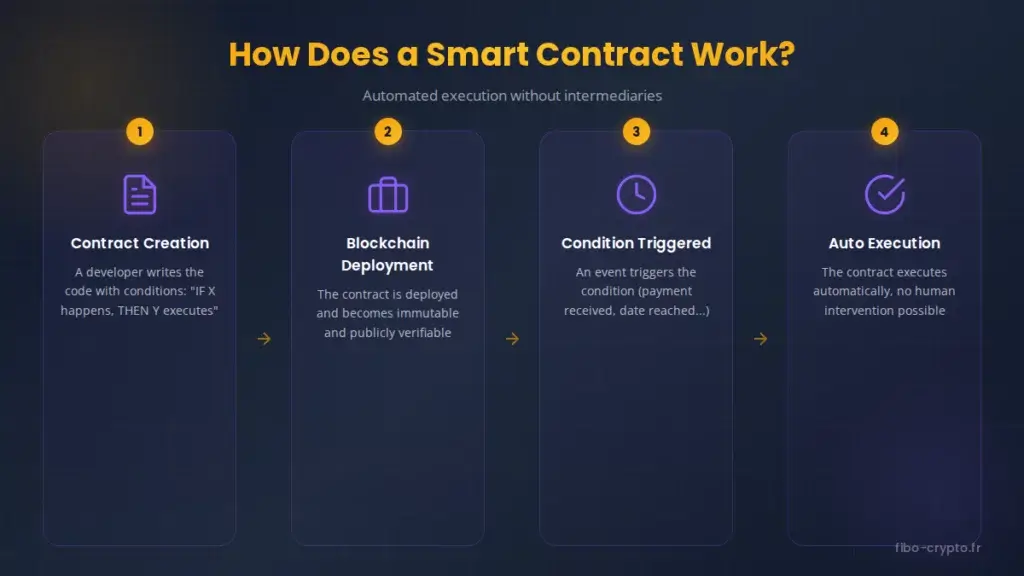
1. Smart Contracts: The Code Is Law
Smart contracts are the “legal code” of the DAO. They define and automatically enforce the rules: who can vote, how long a vote lasts, what quorum is required, how funds are released. Once deployed on the blockchain, these contracts are immutable (except by vote to modify them).
2. Governance Tokens: Your Right to Vote
Members receive governance tokens that represent:
- Voting rights: typically 1 token = 1 vote
- Proposal power: create new proposals (often a minimum is required)
- Ownership stake: in some DAOs, rights to revenues or assets
Examples of famous governance tokens:
- UNI (Uniswap): governs the largest decentralized exchange — $6 billion market cap
- AAVE: governs the leading lending/borrowing protocol — $12 billion TVL
- MKR (MakerDAO): governs the creation of the DAI stablecoin — $8 billion in collateral
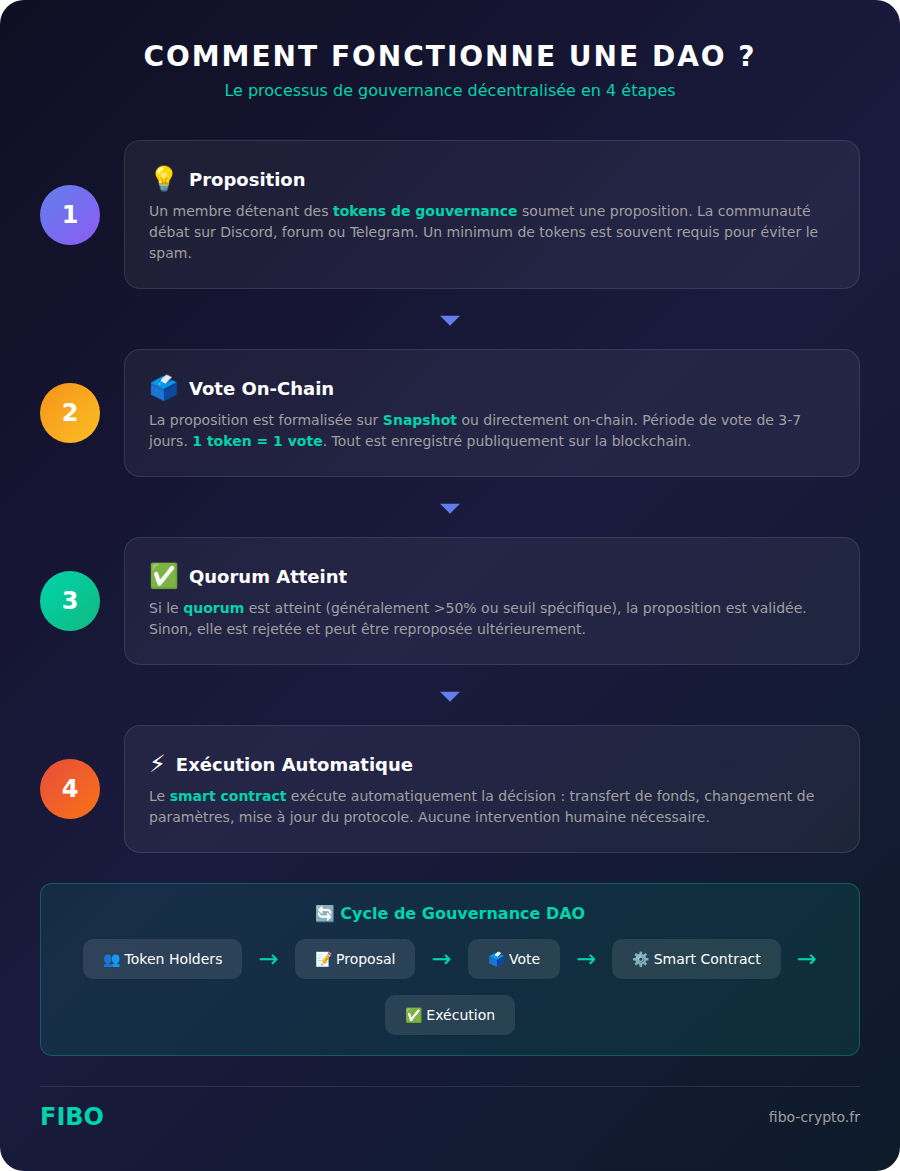
3. The Governance Process in 3 Steps
Step 1 — Proposal: A member submits a proposal (on Snapshot, Commonwealth, or Discord). The community debates. A minimum of tokens is often required to prevent spam.
Step 2 — Vote: The proposal is formalized on-chain. Voting period typically lasts 3-7 days. Members vote with their tokens, everything is recorded publicly.
Step 3 — Execution: If the quorum is reached (>50% or specific threshold), the proposal is automatically executed by smart contract or manually by a multisig.
4. The Treasury: Secured Collective Funds
The treasury contains the DAO’s funds — ETH, stablecoins, tokens, sometimes NFTs. It’s managed by a multisignature smart contract: multiple signatures are required for any transaction, preventing individual misappropriation.
DAO vs Traditional Organization: The Differences
The fundamental difference between a DAO and a traditional company lies in the distribution of power: horizontal and transparent for the DAO, hierarchical and opaque for the traditional company.
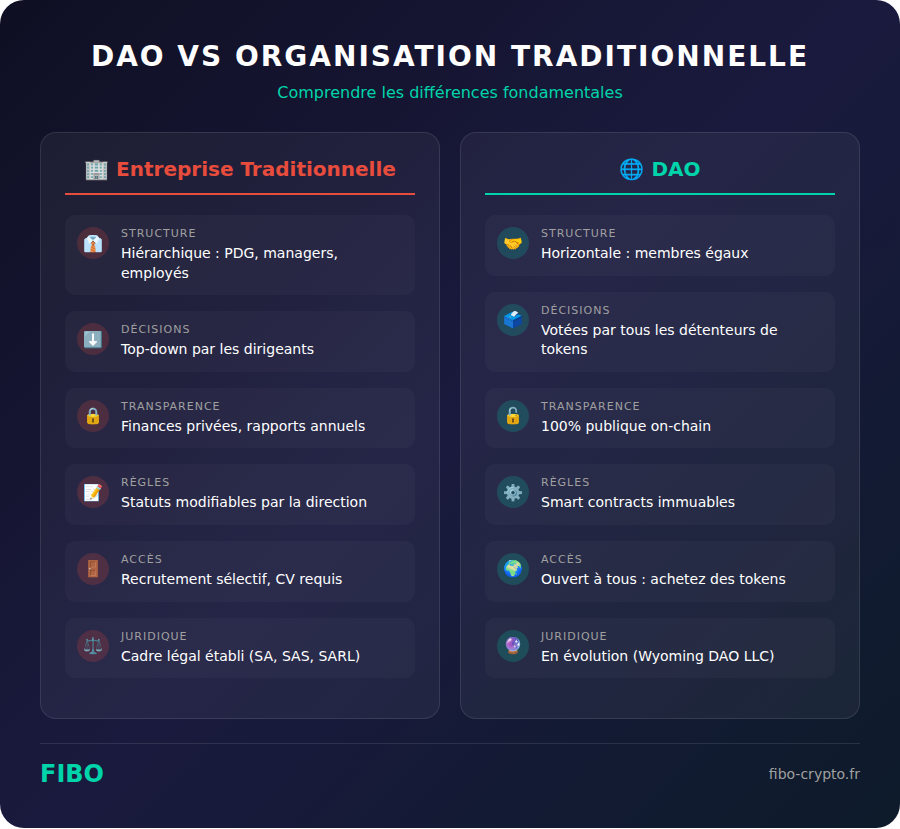
| Criteria | Traditional Organization | DAO |
|---|---|---|
| Structure | Hierarchical (CEO, managers) | Horizontal (equal members) |
| Decisions | Top-down by executives | Voted by all members |
| Transparency | Private finances | Everything is public on-chain |
| Rules | Bylaws modifiable by management | Immutable smart contracts |
| Access | Selective recruitment | Open to all (buy tokens) |
| Execution | Manual by employees | Automatic by code |
| Jurisdiction | Established legal framework | Legal uncertainty (evolving) |
The 7 Types of DAOs
DAOs have diversified into several categories based on their objectives: Protocol DAOs to govern DeFi protocols, Investment DAOs to invest collectively, Grant DAOs to fund projects, Collector DAOs to buy art, and Social/Service/Media DAOs to create communities.
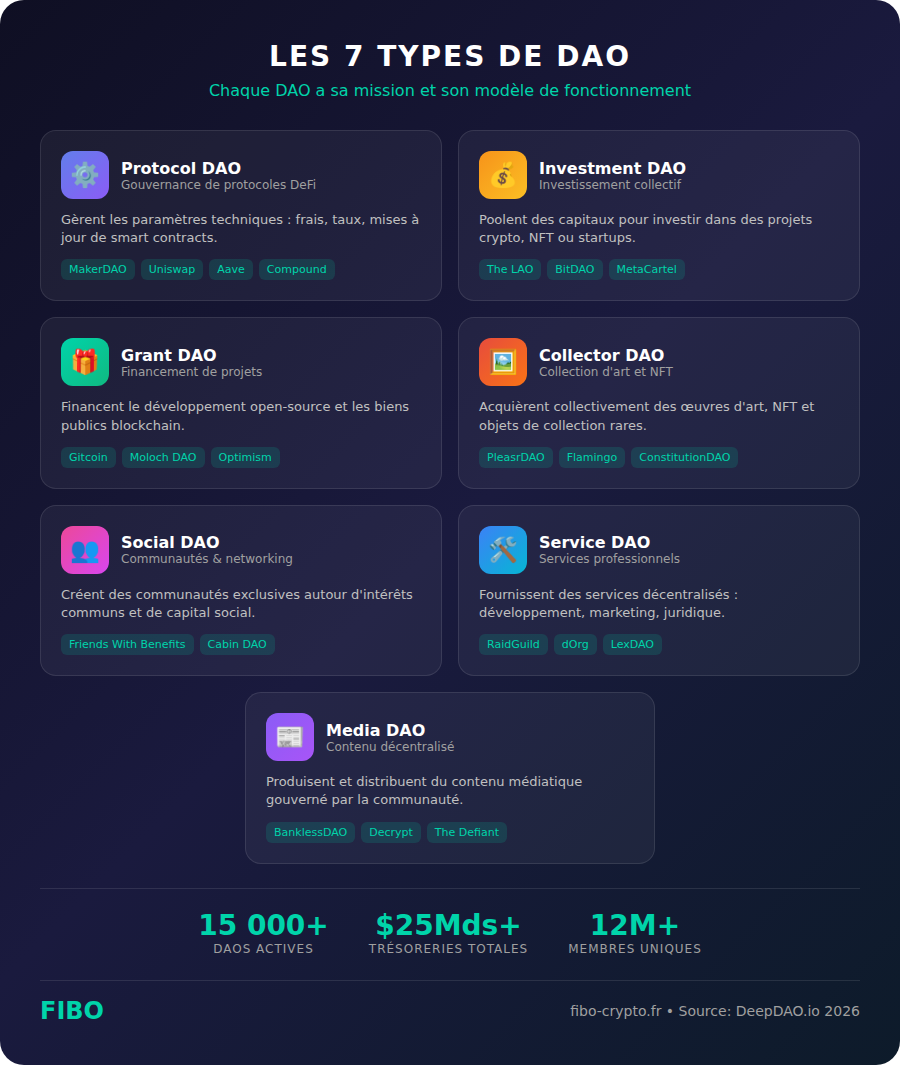
1. Protocol DAOs
Govern DeFi protocols and their technical parameters.
- Examples: MakerDAO, Uniswap, Aave, Compound
- Decisions: interest rates, protocol fees, smart contract upgrades
- Treasury: often billions of dollars
2. Investment DAOs
Pool capital to invest collectively in crypto projects, NFTs, or startups.
- Examples: The LAO, MetaCartel Ventures, BitDAO
- Advantages: access to exclusive deals, diversification, collective expertise
- Legal framework: often structured as LLCs in Wyoming
3. Grant DAOs
Dedicated to funding projects aligned with their mission (open-source development, public goods).
- Examples: Gitcoin, Moloch DAO, Optimism Collective
- Mechanisms: quadratic funding, grant rounds, retroactive public goods funding
4. Collector DAOs
Collect and manage NFTs, digital art, or collectibles.
- Examples: Flamingo DAO, PleasrDAO, Constitution DAO
- Notable fact: PleasrDAO bought the unique Wu-Tang Clan album for $4 million and fractionalized it into tokens
5. Social DAOs
Communities organized around common interests, networking, or social capital.
- Examples: Friends With Benefits (FWB), Cabin DAO
- Value: professional network, exclusive events, collaborations
6. Service DAOs
Provide professional services (development, marketing, design).
- Examples: RaidGuild, dOrg, LexDAO
- Model: decentralized talent collaborating on client projects
7. Media DAOs
Produce and distribute media content in a decentralized manner.
- Examples: BanklessDAO, Decrypt
- Innovation: shared monetization, community governance of content
Famous DAO Examples
The largest DAOs manage billions of dollars and have millions of users. Here are the most influential projects in the ecosystem.
MakerDAO — The Protocol DAO Reference
MakerDAO creates the decentralized stablecoin DAI, backed by crypto collateral. MKR holders vote on accepted collateral types, stability rates, and risk parameters. With over $8 billion in TVL, it’s one of the most influential DAOs.
Uniswap — Governing a DeFi Giant
Uniswap is the largest decentralized exchange, with over $5 billion in daily volume. UNI holders vote on fee allocation, new features, and strategic partnerships.
Constitution DAO — The Media Experiment
In 2021, Constitution DAO raised $47 million in just a few days to attempt to buy a rare copy of the US Constitution at Sotheby’s auction. Although it lost the bid, this DAO demonstrated the power of decentralized coordination.
How to Participate in a DAO?
To join a DAO, you typically just need to buy its governance tokens on a decentralized exchange and connect your wallet to voting platforms (Snapshot, Tally). To create a DAO, tools like Aragon, Colony, or Syndicate simplify deployment.
Joining an Existing DAO
- Research a DAO aligned with your interests (DeFi, investment, art, social)
- Buy the governance tokens on a DEX like Uniswap or a CEX
- Join the community (Discord, forum, Telegram)
- Participate in discussions and votes via Snapshot or on-chain
- Contribute actively to gain influence and reputation
Creating Your Own DAO
Several platforms facilitate creation:
- Aragon: simple interface for creating DAOs on Ethereum/Polygon
- Colony: oriented toward decentralized work organizations
- Syndicate: specialized in Investment DAOs
- Snapshot: free off-chain votes (no gas)
Advantages and Disadvantages of DAOs
The 6 Advantages of DAOs
DAOs offer total transparency (everything is on-chain), democratic governance, global permissionless access, efficient automation, censorship resistance, and alignment of incentives among all members.
- Total transparency: All operations are public and verifiable on the blockchain — transactions, votes, fund allocations.
- Democratic governance: Every member holding tokens can participate in decisions, unlike traditional companies.
- Global and permissionless access: Anyone can join and participate, without geographic discrimination.
- Automation and efficiency: Smart contracts automate administrative tasks, reducing costs.
- Censorship resistance: Once deployed, a DAO cannot be shut down by a central authority.
- Incentive alignment: Members own tokens that increase in value if the DAO prospers.
The 6 Limitations and Challenges of DAOs
DAOs face several challenges: slow decision-making, low voter turnout, plutocracy risk (the wealthy dominate), technical complexity, smart contract security risks, and legal uncertainty in most countries.
- Slow decisions: The democratic process can take weeks, hampering agility.
- Low participation (voter apathy): Often less than 10% of holders vote, concentrating power.
- Plutocracy: The “1 token = 1 vote” model favors “whales” who own more capital.
- Technical complexity: Participating requires a crypto wallet and specific skills.
- Security risks: Smart contracts can contain exploitable bugs (see The DAO 2016).
- Legal uncertainty: The legal status of DAOs remains unclear in most jurisdictions.
The History of DAOs: From 2016 to Today
DAOs were born with Ethereum in 2016. “The DAO,” the first major project, raised $150 million before being hacked — causing the Ethereum/Ethereum Classic fork. Since then, the ecosystem has matured with better tools, legal frameworks, and diversified use cases.
- 2013-2014: Vitalik Buterin conceptualizes “Decentralized Autonomous Corporations” in the Ethereum whitepaper
- 2016: Launch of “The DAO” which raises $150 million in ETH — a record
- June 2016: “The DAO” is hacked ($60M drained), causing the ETH/ETC fork
- 2017-2019: Development of more secure frameworks (Aragon, DAOstack, Moloch)
- 2020: DeFi explosion and emergence of Protocol DAOs (MakerDAO, Uniswap)
- 2021: Constitution DAO attempts to buy a copy of the US Constitution
- 2023-2026: Maturation with legal frameworks (Wyoming DAO LLC, Marshall Islands) and better tools
The Future of DAOs
The future of DAOs involves adapted legal frameworks (Wyoming has already created the DAO LLC status), improved governance tools, hybridization with traditional structures, and potentially application to real-world governance.
- Legal frameworks: More jurisdictions recognizing DAOs (Wyoming, Marshall Islands, Switzerland)
- Improved tools: Quadratic voting, delegation, reputation-based voting to counter plutocracy
- Hybridization: Traditional companies adopting DAO governance elements
- Real governance: Cities, local communities experimenting with DAOs (CityDAO)
- Professionalization: Emergence of “DAO operators,” specialized managers
📚 Glossary
- Blockchain : Distributed and immutable ledger where all transactions are recorded.
- Smart contract : Autonomous program executed on the blockchain, automatically applying predefined rules.
- Token : Digital asset representing value or a right on a blockchain.
- Governance token : Token granting voting and proposal rights in a DAO.
- Treasury : Collective treasury of a DAO, managed by multisig smart contract.
- Quorum : Minimum participation threshold for a vote to be considered valid.
- Proposal : Proposal submitted to the vote of DAO members.
- Snapshot : Popular off-chain voting platform without gas fees.
- Multisig : Wallet requiring multiple signatures to execute a transaction.
- Stablecoin : Cryptocurrency whose value is pegged to a fiat currency (e.g., USDC, DAI).
- NFT : Non-fungible token representing a unique digital asset.
- DeFi : Decentralized finance, financial services on blockchain without intermediaries.
- Ethereum : Decentralized blockchain enabling smart contract execution.
- Quadratic voting : Voting system where the cost of each additional vote increases exponentially.
- Wallet : Digital wallet for storing and managing cryptocurrencies.
- DEX : Decentralized exchange for trading tokens without a centralized intermediary.
Frequently Asked Questions
What is a DAO in crypto?
A DAO (Decentralized Autonomous Organization) is a decentralized organization whose operating rules are coded in smart contracts on the blockchain. Members vote with governance tokens to make all important decisions: fund allocation, protocol parameters, partnerships. Unlike a traditional company, there’s no CEO or hierarchy — power is distributed among all token holders.
Is it legal to create or join a DAO?
Yes, in most countries, joining a DAO is legal. However, the legal framework varies by jurisdiction. Wyoming (USA) created a specific “DAO LLC” status in 2021. In most of Europe, DAOs don’t have their own status but can organize as associations or companies. The Marshall Islands and Switzerland have also adopted DAO-friendly frameworks.
How do you make money with a DAO?
Several possibilities exist: appreciation of governance token value if the DAO prospers, distribution of protocol revenues (some DAOs redistribute fees to holders), compensation for active contributions (bounties, grants, token salaries), or dividends in Investment DAOs that share investment profits.
Do I need technical skills to join a DAO?
Basic skills are sufficient: knowing how to use a crypto wallet (MetaMask), buy tokens on an exchange, and navigate web3 interfaces. Advanced technical skills (coding, auditing) are only necessary for development contributions. Most DAOs welcome non-technical contributors: marketing, community management, content creation.
What's the difference between a DAO and a cryptocurrency?
A cryptocurrency is a digital asset serving as a medium of exchange or store of value (like Bitcoin). A DAO is an organization that may use a cryptocurrency or token for its governance. The DAO’s token grants voting and proposal rights, not just monetary value. Bitcoin is not a DAO because it has no formal on-chain governance.
What happens if a DAO gets hacked?
The community must decide on the response collectively: protocol fork to undo the hack (like Ethereum after The DAO in 2016), victim compensation via the treasury, or audit and vulnerability fixes. This is why security audits are essential before deployment, and why major DAOs have insurance and emergency funds.
Can DAOs replace traditional companies?
For some use cases (DeFi protocols, collective investment, creative communities), DAOs are more efficient. For others requiring speed of decision, clear legal liability, or operational hierarchy, traditional structures remain more suitable. The future is probably hybrid: companies adopting DAO governance elements for more transparency.
What are the most important DAOs in 2026?
By treasury and influence: Uniswap (UNI) with $3 billion treasury, MakerDAO (MKR) managing $8 billion TVL, Aave, Arbitrum, and Optimism. For investment: BitDAO, The LAO. For grants and public goods: Gitcoin and Optimism Collective. These DAOs have millions of members and process billions of dollars in transactions.
📰 Sources
This article is based on the following sources:
- Ethereum.org – Introduction to DAOs
- Vitalik Buterin – Moving beyond coin voting governance
- DeepDAO – DAO Analytics and Data
- Wyoming Secretary of State – DAO LLC FAQ
- Snapshot – Off-chain Governance Platform
- Aragon Research
Comment citer cet article : Fibo Crypto. (2026). What Is a DAO? Complete Guide to Decentralized Autonomous Organizations 2026. Consulté le 11 February 2026 sur https://fibo-crypto.fr/en/blog/what-is-a-dao-decentralized-autonomous-organization-guide