
Why Was Bitcoin Created? The Response to the 2008 Crisis
📋 En bref (TL;DR)
- Historical context: Bitcoin was born as a direct response to the 2008 financial crisis that exposed the flaws of the traditional banking system
- Mysterious creator: Satoshi Nakamoto, a pseudonym for an individual or group, published the whitepaper on October 31, 2008
- Main objective: Create a decentralized digital currency, without banking intermediaries, resistant to censorship and inflation
- Technical innovation: Blockchain enables peer-to-peer transactions verifiable without a trusted third party
- Founding message: The Genesis Block contains a reference to the 2009 bank bailout, highlighting criticism of the financial system
- Limited supply: Unlike fiat currencies, Bitcoin is capped at 21 million units, protecting against inflation
- Lasting legacy: Over 15 years after its creation, Bitcoin remains the leading cryptocurrency with a market cap exceeding $1 trillion
Why was Bitcoin created? Bitcoin was invented in 2008 by Satoshi Nakamoto as a direct response to the global financial crisis. Its goal: to create a decentralized digital currency, without banking intermediaries, resistant to censorship and inflation — an alternative to the traditional financial system that had just proven its flaws.
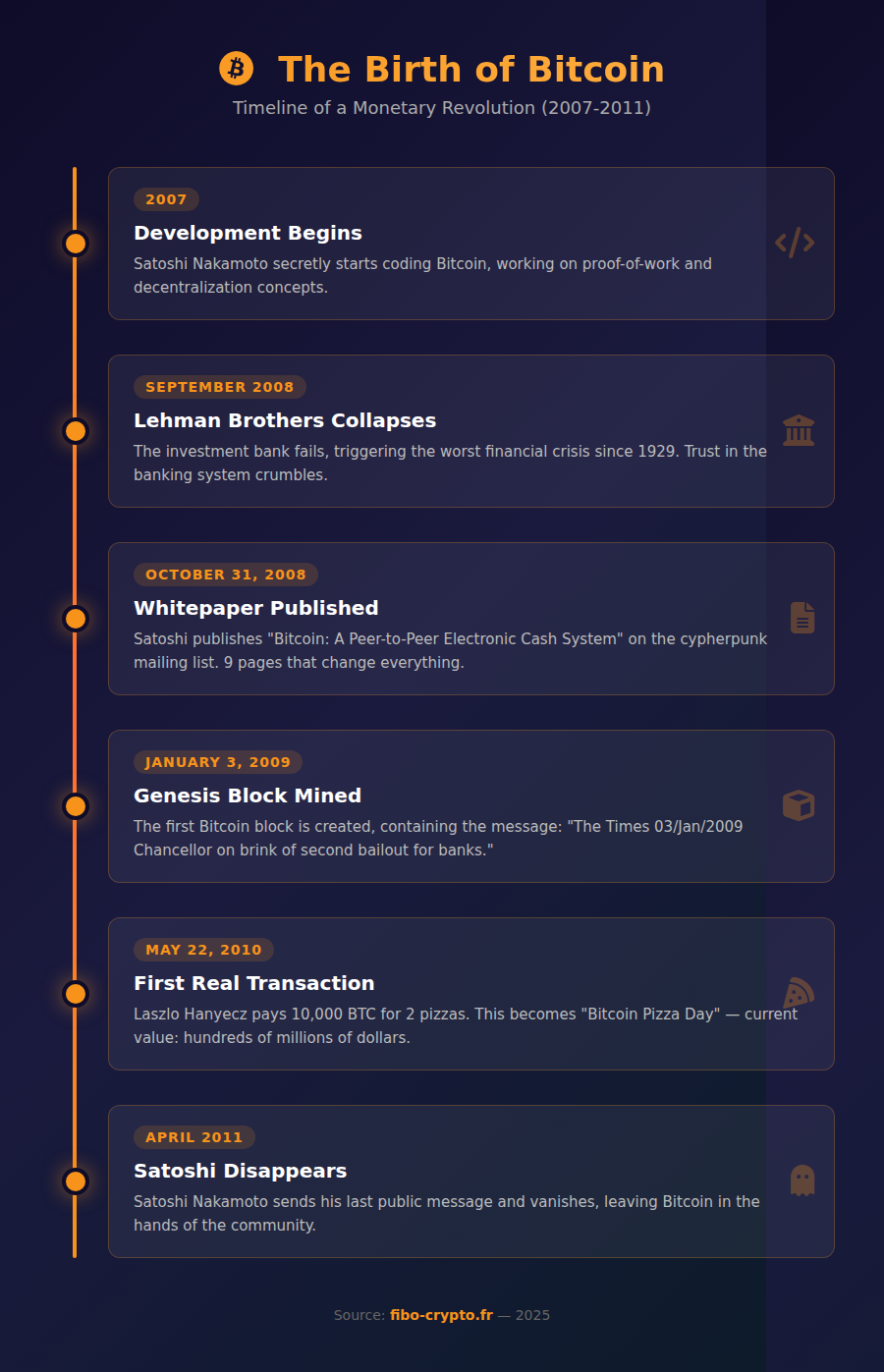
In September 2008, the collapse of Lehman Brothers marked the peak of an unprecedented financial crisis. Banks were failing, governments were injecting billions to save the system, and public trust in financial institutions hit an all-time low. It was in this context that Satoshi Nakamoto published, on October 31, 2008, a 9-page document that would change the world: the Bitcoin whitepaper.
The 2008 Crisis: Bitcoin’s Catalyst
To understand why Bitcoin was created, you must first understand what happened in 2008. The American subprime mortgage crisis triggered a cascading collapse of the global financial system. Century-old institutions like Lehman Brothers went bankrupt in a matter of days, revealing the extreme fragility of a system based on trust and intermediaries.
The Banking System’s Exposed Flaws
The crisis brought several major structural problems to light:
- Systemic risk: The interconnection between banks means that one failure can threaten the entire system
- Moral hazard: “Too big to fail” banks take excessive risks, knowing the government will bail them out
- Lack of transparency: Complex financial products (CDOs, CDSs) were incomprehensible even to regulators
- Expansionary monetary policy: Central banks printed trillions of dollars, diluting citizens’ savings
It was in this context of widespread distrust that the idea of an alternative currency, independent of banks and governments, found fertile ground.
Satoshi Nakamoto: Bitcoin’s Mysterious Creator
On October 31, 2008, a message appeared on the cypherpunk mailing list: “I’ve been working on a new electronic cash system that’s fully peer-to-peer, with no trusted third party.” The author signed under the pseudonym Satoshi Nakamoto.
Who Is Satoshi Nakamoto Really?
More than 15 years after Bitcoin’s creation, Satoshi’s identity remains a mystery. Several theories circulate:
- A genius individual: A cryptographer with expertise in economics, computer science, and mathematics
- A group of people: The project’s complexity suggests collaboration between multiple experts
- A government or academic project: Some speculate about involvement from agencies like the NSA
What’s certain: Satoshi mined approximately 1 million BTC during the network’s early months, then gradually disappeared in 2011, entrusting development to the community. These bitcoins, worth tens of billions of dollars, have never moved.
The Bitcoin Whitepaper Explained Simply
The original Bitcoin whitepaper is only 9 pages long, but it lays the foundation for a technological revolution. Here are the key concepts:
The Double-Spending Problem
Before Bitcoin, digital currency suffered from a fundamental problem: how do you prevent someone from spending the same digital money twice? The traditional solution: a trusted intermediary (bank) that verifies each transaction. Satoshi proposes an alternative: a decentralized network where all participants collectively verify transactions.
The Blockchain: A Public and Immutable Ledger
Each transaction is grouped into a block, which is then linked to the previous block by a unique cryptographic fingerprint. This chain of blocks — the blockchain — constitutes a complete and unalterable history of all transactions.
Proof of Work (PoW)
To add a new block, miners must solve a complex cryptographic puzzle. This proof of work mechanism secures the network and makes falsification economically irrational.
The Problems Bitcoin Solves
Bitcoin isn’t just a technological innovation: it’s a concrete answer to the dysfunctions of the traditional financial system.
1. Independence from Intermediaries
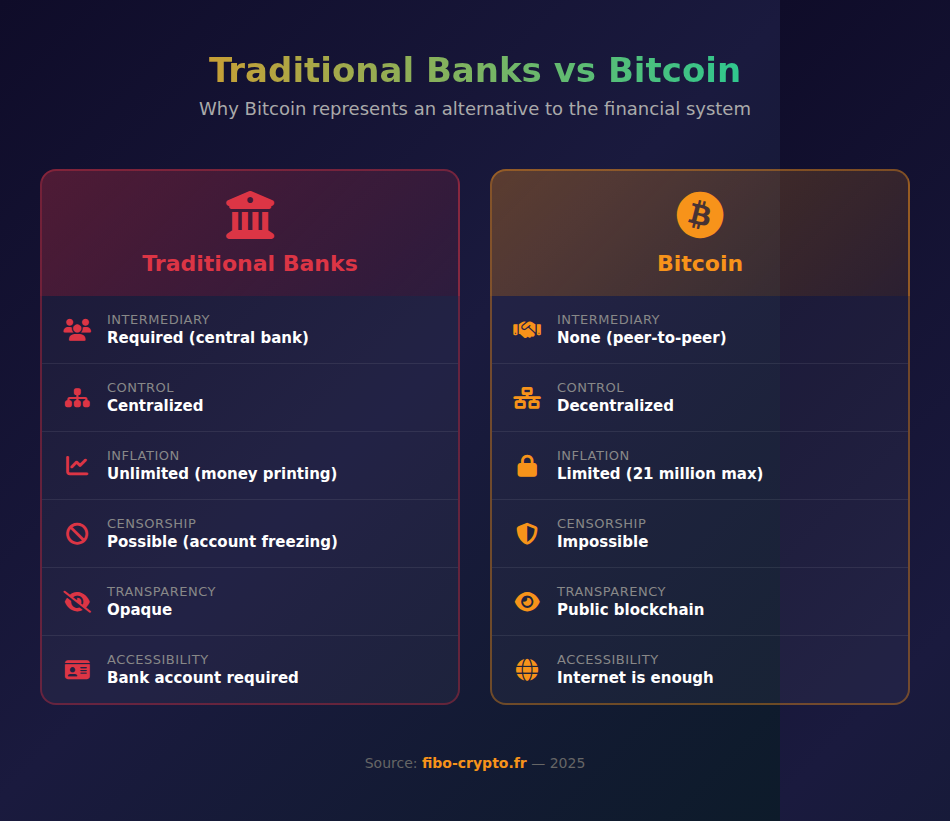
With Bitcoin, two people can exchange value directly, without going through a bank. This is the peer-to-peer principle: you are your own bank.
2. Censorship Resistance
No one can freeze your Bitcoin account or block your transactions. For people living under authoritarian regimes or facing financial sanctions, this characteristic is revolutionary.
3. Inflation Protection
Unlike fiat currencies whose supply can be increased indefinitely by central banks, Bitcoin is limited to 21 million units. This programmed scarcity makes it a potential store of value, sometimes nicknamed “digital gold.”
4. Total Transparency
All Bitcoin transactions are public and verifiable on the blockchain. This transparency contrasts with the opacity of traditional banking systems.
5. Global Accessibility
Nearly 1.4 billion people worldwide lack access to a bank account. With Bitcoin, all you need is a smartphone and an internet connection to participate in the global economy.
The Genesis Block: A Political Message
On January 3, 2009, Satoshi Nakamoto mined the first block of the Bitcoin blockchain, called the Genesis Block. He inscribed a message that would remain engraved forever:
“The Times 03/Jan/2009 Chancellor on brink of second bailout for banks”
— Message encoded in Bitcoin’s Genesis Block
This reference to The Times newspaper headline from that same day — announcing a second bank bailout plan in the United Kingdom — was no coincidence. It’s a statement of intent: Bitcoin was born as an alternative to a financial system in moral and economic bankruptcy.
Satoshi’s Legacy: Why Bitcoin Still Matters
More than 15 years after its creation, Bitcoin has exceeded all expectations:
- Market cap: Over $1 trillion, rivaling the world’s largest companies
- Institutional adoption: Companies like Tesla, MicroStrategy, and sovereign funds hold Bitcoin
- Legal recognition: El Salvador made Bitcoin legal tender in 2021
- Innovation: Thousands of cryptocurrencies and blockchain projects have emerged in Bitcoin’s wake
The mystery surrounding Satoshi Nakamoto and his decision to disappear have paradoxically strengthened Bitcoin. Without an identifiable leader, the network cannot be attacked through its creator. Bitcoin truly belongs to no one — and therefore to everyone.
📚 Glossary
- Bitcoin : First decentralized cryptocurrency, created in 2008 by Satoshi Nakamoto, operating on a peer-to-peer network without intermediaries.
- Blockchain : Distributed ledger technology that records all transactions chronologically, transparently, and immutably.
- Whitepaper : Technical document describing how a project works. Bitcoin’s whitepaper is 9 pages and was published on October 31, 2008.
- Satoshi Nakamoto : Pseudonym of Bitcoin’s creator(s). Their real identity remains unknown to this day.
- Genesis Block : The first block of the Bitcoin blockchain, mined on January 3, 2009, containing a message referencing the banking crisis.
- Proof of Work (PoW) : Consensus mechanism that secures the Bitcoin network by requiring miners to solve cryptographic puzzles.
- Miner : Network participant who validates transactions and secures the blockchain in exchange for bitcoin rewards.
- Decentralization : Bitcoin’s fundamental principle where no central entity controls the network, making it resistant to censorship.
- Halving : Programmed event every 210,000 blocks (~4 years) that halves miner rewards, limiting Bitcoin’s inflation.
- Cypherpunk : Movement of cryptographers and activists advocating for the use of cryptography to protect privacy and individual freedoms.
- Subprime : High-risk mortgage loans given to borrowers with poor credit, whose collapse triggered the 2008 crisis.
- Peer-to-peer (P2P) : Computer network where each participant can communicate directly with others without a central server.
Frequently Asked Questions
Who created Bitcoin and why?
Bitcoin was created by a person or group using the pseudonym Satoshi Nakamoto. The whitepaper was published on October 31, 2008, during the global financial crisis. The goal was to create a decentralized digital currency enabling peer-to-peer transactions without banking intermediaries, resistant to censorship and the monetary inflation caused by central bank policies.
What crisis inspired Bitcoin's creation?
The 2008 financial crisis, triggered by the collapse of the American subprime mortgage market, directly inspired Bitcoin’s creation. Lehman Brothers’ bankruptcy in September 2008 and the massive bank bailout plans demonstrated the flaws of the traditional financial system. The message inscribed in Bitcoin’s Genesis Block explicitly references a Times article about the UK bank bailout.
What is the Bitcoin whitepaper?
The Bitcoin whitepaper is a 9-page technical document published on October 31, 2008, by Satoshi Nakamoto, titled “Bitcoin: A Peer-to-Peer Electronic Cash System.” It describes how Bitcoin works: how to solve the double-spending problem without intermediaries using blockchain and proof of work. This founding document is available for free on bitcoin.org.
Why is Bitcoin limited to 21 million?
The 21 million bitcoin limit is hard-coded and cannot be changed. Satoshi Nakamoto chose this limit to create a deflationary currency, unlike fiat currencies whose supply can be increased indefinitely. This programmed scarcity protects against inflation and makes Bitcoin a potential store of value comparable to gold (hence the nickname “digital gold”).
Is Satoshi Nakamoto's identity known?
No, Satoshi Nakamoto’s real identity remains a mystery. Several people have been suspected (Hal Finney, Nick Szabo, Craig Wright) but no definitive proof has been provided. Satoshi disappeared in 2011 after entrusting development to the community, leaving approximately 1 million BTC (never moved) worth tens of billions of dollars.
Can Bitcoin replace banks?
Bitcoin doesn’t necessarily aim to replace banks but to offer an alternative. It enables transactions without intermediaries, censorship resistance, and inflation protection. However, banks provide services (loans, insurance, advice) that Bitcoin alone doesn’t offer. The future will likely see coexistence, with DeFi services on blockchain complementing or competing with certain traditional banking functions.
📰 Sources
This article is based on the following sources:
- Bitcoin Whitepaper
- The Times – Chancellor on brink of second bailout for banks
- Federal Reserve – Financial Crisis Timeline
- Blockchain.com – Genesis Block
- Nakamoto Institute
Comment citer cet article : Fibo Crypto. (2026). Why Was Bitcoin Created? The Response to the 2008 Crisis. Consulté le 10 February 2026 sur https://fibo-crypto.fr/en/blog/why-was-bitcoin-created-2008-financial-crisis