
SRI and Responsible Crypto Investing: Complete ESG Guide 2026
📋 En bref (TL;DR)
- SRI (Socially Responsible Investing): investment strategy integrating ESG criteria (Environmental, Social, Governance) to combine returns with positive impact
- Don’t confuse: SRI (responsible investing) ≠ SRRI (risk indicator 1-7) — two completely different concepts!
- Crypto and ESG: Ethereum post-Merge uses 99.95% less energy, Cardano and Solana show exemplary carbon footprints thanks to Proof of Stake
- Evaluation criteria: carbon footprint, decentralized governance, code transparency, financial accessibility, and social impact
- Top projects 2026: Algorand (carbon-negative), Chia (disk space), Hedera (carbon-offset), Polygon (carbon neutral since 2023)
- Current limitations: lack of standardized frameworks, greenwashing risk, varying calculation methods between analysts
- Strong trend: institutional funds now require ESG criteria for all crypto investments, accelerating the sector’s sustainable transition
Investing in crypto while respecting your environmental and social values is possible. As criticism of Bitcoin‘s ecological impact grows, a new generation of investors demands projects aligned with 21st-century challenges. Socially responsible investing (SRI), long reserved for traditional markets, is now establishing itself in the crypto universe. This comprehensive guide explains how to evaluate, select, and integrate responsible cryptocurrencies into your portfolio.
What Is SRI (Socially Responsible Investing)?
SRI (Socially Responsible Investing) is an investment approach that integrates extra-financial criteria into asset selection. Beyond simple financial performance, SRI evaluates the environmental, social, and ethical impact of an investment.
Born in the 1960s in the United States with movements against the Vietnam War and apartheid, SRI has evolved to become a pillar of modern finance. In 2026, over $35 trillion is managed according to ESG criteria worldwide, representing approximately 35% of professionally managed assets.
The Three Pillars of SRI
Responsible investing relies on multi-criteria analysis:
- Exclusion: avoiding controversial sectors (weapons, tobacco, fossil fuels)
- ESG Integration: weighting investments based on environmental, social, and governance scores
- Impact Investing: actively investing in projects with measurable positive impact
Why it matters: SRI is no longer a marginal choice. Studies show that companies with strong ESG scores outperform over the long term, with lower volatility during crises.
SRI vs SRRI: Two Indicators Not to Confuse
The confusion is common, but these two acronyms refer to radically different concepts:
- SRI (Socially Responsible Investing): responsible investment strategy based on ESG criteria
- SRRI (Synthetic Risk and Reward Indicator): European regulatory indicator measuring a financial product’s volatility on a scale of 1 to 7
The SRRI (replaced in 2023 by the SRI – Summary Risk Indicator in PRIIPs regulation) evaluates only financial risk. A fund rated 2/7 is less volatile than one rated 6/7. But this score says nothing about environmental or social impact!
Watch out: A product with low SRRI (low financial risk) can have disastrous ESG impact. Conversely, a low-carbon PoS crypto can be highly volatile. Always cross-reference both analyses!
ESG Criteria: Environmental, Social, Governance
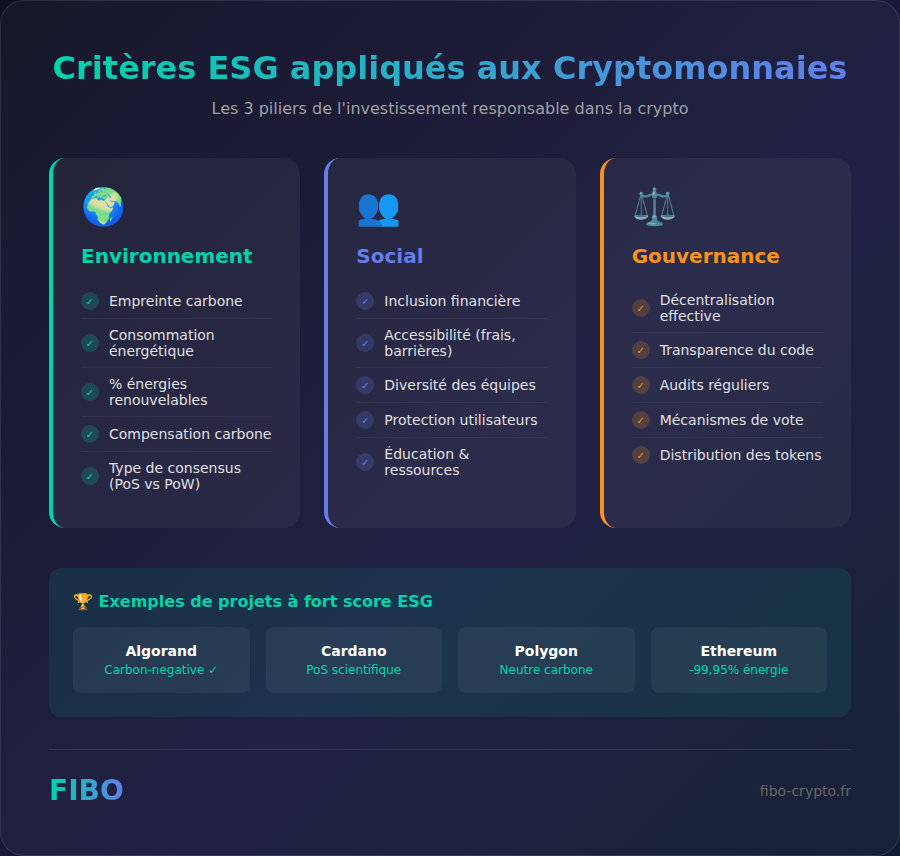
ESG criteria form the foundation of SRI analysis. They enable evaluation of an investment’s sustainability and ethics beyond simple financial metrics.
Environmental (E)
The environmental pillar analyzes an asset’s ecological impact:
- Carbon footprint: direct and indirect CO₂ emissions
- Energy consumption: source and amount of energy used
- Resource management: water and raw material usage
- Biodiversity: impact on natural ecosystems
- Circular economy: recycling, equipment reuse
Social (S)
The social pillar evaluates impact on people and communities:
- Financial inclusion: accessibility for unbanked populations
- Working conditions: treatment of employees and contributors
- Diversity and equity: representation in development teams
- Community impact: benefits for users and society
- Data protection: respect for user privacy
Governance (G)
The governance pillar examines management and transparency practices:
- Real decentralization: distribution of decision-making power
- Transparency: open source code, public audits, regular reports
- Voting mechanisms: community participation in decisions
- Conflict of interest management: founder independence
- Regulatory compliance: adherence to laws and standards
SRI Applied to Cryptocurrencies: A New Paradigm
Applying ESG criteria to cryptocurrencies presents unique challenges. Unlike traditional companies, crypto projects are often decentralized, pseudonymous, and operate in unclear regulatory frameworks.
Why Crypto SRI Is Different
The crypto sector’s specificities require adapted methodologies:
- No central entity: who evaluates governance for a protocol without a CEO?
- Fragmented data: energy consumption is difficult to measure for decentralized networks
- Rapid evolution: upgrades (like Ethereum’s Merge) can radically transform ESG profiles
- Pseudonymity: how to evaluate the social pillar without knowing the teams?
ESG Crypto Analysis Pioneers
Several organizations are developing adapted evaluation frameworks:
- Crypto Carbon Ratings Institute (CCRI): specialized in blockchain carbon footprints
- S&P Global: progressively integrating cryptos into ESG analyses
- MSCI: developing methodologies for digital assets
- Cambridge Centre for Alternative Finance: reference for Bitcoin energy data
Environmental Impact of Cryptos: PoW vs PoS
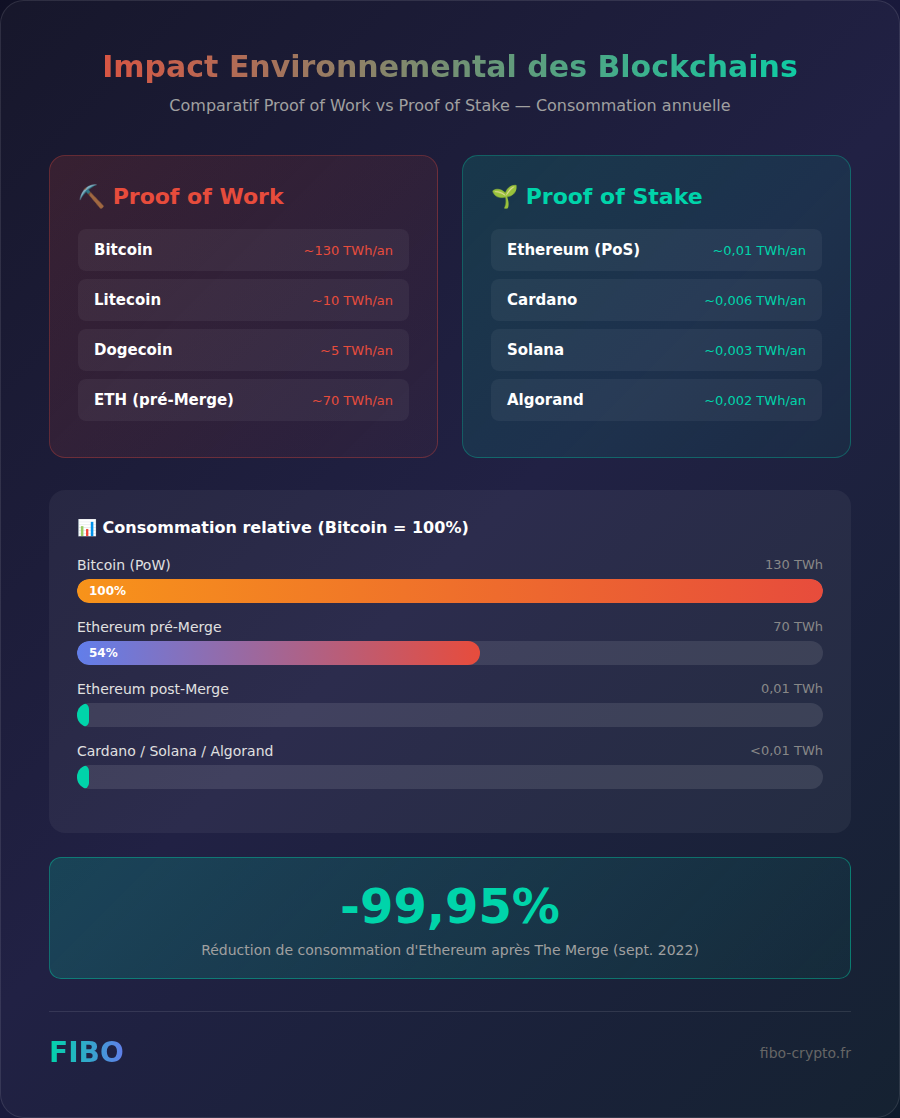
A blockchain’s consensus mechanism largely determines its environmental footprint. The distinction between Proof of Work (PoW) and Proof of Stake (PoS) is fundamental for any SRI investor.
Proof of Work: The Energy-Intensive Model
PoW, used by Bitcoin and a few other cryptocurrencies, relies on solving complex calculations by miners. This process secures the network but consumes enormous amounts of electricity:
- Bitcoin: approximately 130 TWh/year (equivalent to Argentina)
- Litecoin: ~10 TWh/year
- Dogecoin: ~5 TWh/year (merge-mined with LTC)
Important nuance: The Bitcoin debate is more complex than it appears. Nearly 55% of mining uses renewable energy, and some miners utilize stranded energy (flared gas, hydroelectric surpluses).
Proof of Stake: The Green Alternative
PoS replaces computing power with token staking. Validators are selected proportionally to their holdings, drastically reducing consumption:
- Ethereum (post-Merge): ~0.01 TWh/year (-99.95% vs PoW)
- Cardano: ~0.006 TWh/year
- Solana: ~0.003 TWh/year
- Polkadot: ~0.0001 TWh/year
Comparative Table: Carbon Footprint per Transaction
For context, here’s the average carbon footprint per transaction:
| Blockchain | Consensus | kgCO₂/transaction | Equivalent |
|---|---|---|---|
| Bitcoin | PoW | ~400 kg | 680 miles by car |
| Ethereum (pre-Merge) | PoW | ~35 kg | 62 miles by car |
| Ethereum (post-Merge) | PoS | ~0.03 kg | 330 feet by car |
| Cardano | PoS | ~0.02 kg | 200 feet by car |
| Solana | PoS/PoH | ~0.002 kg | 20 feet by car |
| Algorand | PPoS | ~0.0001 kg | 1 foot by car |
Criteria for Evaluating a “Responsible” Crypto
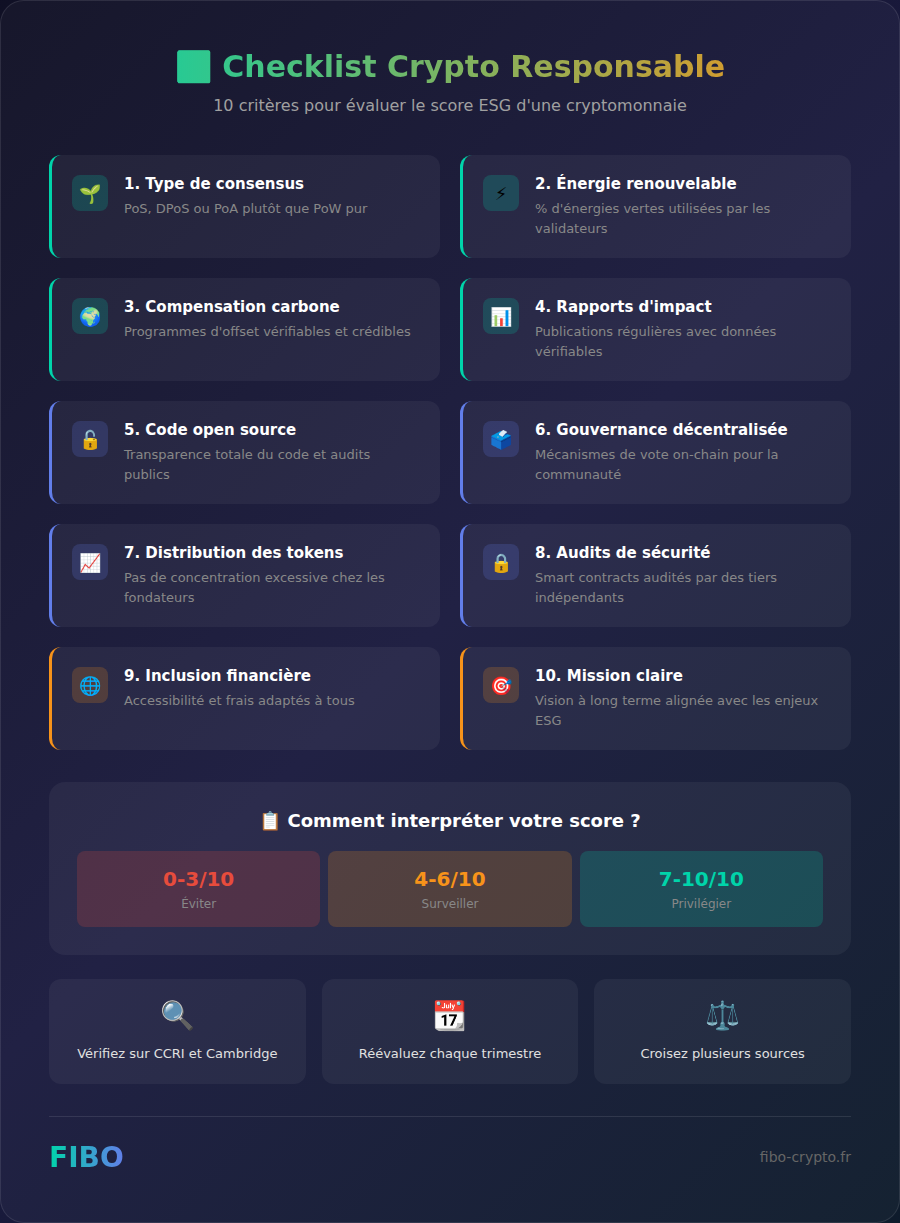
Beyond consensus mechanisms, several criteria help evaluate a crypto project’s responsibility:
Environmental Criteria
- Consensus type: PoS, DPoS, PoA preferred over pure PoW
- Validator energy source: % renewable energy
- Carbon compensation: credible offset programs
- Network efficiency: transactions per kWh consumed
- Climate commitments: dated carbon neutrality goals
Social Criteria
- Accessibility: transaction costs, barriers to entry
- Financial inclusion: usage in developing countries
- Education: resources for new users
- User protection: anti-fraud mechanisms, recourse options
- Team diversity: composition of founders and developers
Governance Criteria
- Effective decentralization: Nakamoto coefficient, token distribution
- Code transparency: open source, regular audits
- Voting mechanisms: on-chain governance, community participation
- Tokenomics: fair distribution, no excessive concentration
- Clear roadmap: commitments met, regular communication

Sustainability-Focused Crypto Projects in 2026
Several projects stand out for their concrete and verifiable ESG commitments:
Algorand: The Carbon-Negative Blockchain
Algorand achieved carbon neutrality in 2021 and became carbon-negative in 2022. The Pure Proof of Stake protocol consumes less than 0.01% of Bitcoin’s energy, and the foundation offsets more than its emissions through partnerships with ClimateTrade.
Cardano: The Scientific Blockchain
Cardano stands out for its academic and peer-reviewed approach. Its Ouroboros protocol is one of the most energy-efficient, and the project invests heavily in financial inclusion in Africa (partnership with the Ethiopian government for digital identity).
Polygon: The Zero-Carbon Commitment
The Ethereum Layer 2 network achieved carbon neutrality in 2023 through a $20 million investment in high-quality carbon credits. Polygon publishes regular and transparent impact reports.
Hedera Hashgraph: Energy Performance
Hedera claims the title of most energy-efficient public network, with consumption of 0.00017 kWh per transaction. The governance council includes companies like Google, IBM, and LG, ensuring structured governance.
Chia: The Alternative to Traditional Mining
Chia uses Proof of Space and Time, replacing energy-hungry GPUs with disk space. This approach drastically reduces consumption while using existing hardware (repurposed hard drives).
How to Integrate SRI Into Your Crypto Portfolio
Building a responsible crypto portfolio requires a structured methodology:
Step 1: Define Your ESG Priorities
Not all criteria have the same importance for each investor. Determine your “red lines”:
- Environmental priority? Exclude pure PoW, favor carbon-offset PoS
- Governance priority? Select projects with transparent on-chain governance
- Social priority? Target projects promoting financial inclusion
Step 2: Establish an Exclusion List
Define deal-breakers:
- PoW mining without carbon compensation
- Tokenomics excessively favoring insiders
- Lack of security audits
- Links to proven illicit activities
Step 3: Weight by ESG Scores
Assign weight to each criterion and score projects:
- Carbon footprint: 30%
- Decentralization: 20%
- Transparency: 20%
- Accessibility: 15%
- Impact innovation: 15%
Step 4: Diversify Intelligently
A balanced SRI crypto portfolio might look like:
- 40% Layer 1 PoS: ETH, ADA, SOL, ALGO
- 25% Layer 2: MATIC, ARB, OP
- 20% Responsible DeFi: protocols with transparent governance
- 15% Stablecoins: USDC (audited reserves), DAI
Step 5: Reassess Regularly
ESG profiles evolve. Ethereum went from “environmental problem” to “solution” in a single upgrade. Review your analysis quarterly.
Labels and Certifications for Responsible Cryptos
Unlike traditional markets where ESG labels are well-established, the crypto sector still lacks standardized certifications:
Existing Initiatives
- Crypto Climate Accord: commitment from 200+ companies for zero-carbon crypto by 2030
- Bitcoin Mining Council (BMC): quarterly reports on Bitcoin mining energy mix
- CCRI (Crypto Carbon Ratings Institute): carbon ratings for major blockchains
- ReFi (Regenerative Finance): movement promoting regenerative finance via blockchain
Current Certification Limitations
Several obstacles hinder credible label emergence:
- Decentralization: who certifies a protocol without a central entity?
- Rapid evolution: certifications struggle to keep up with updates
- Conflicts of interest: some “ratings” are sponsored by the projects themselves
- Data gaps: actual energy consumption is difficult to verify
Tip: In the absence of reliable labels, cross-reference multiple sources (CCRI, Cambridge, foundation reports) and favor projects that publish verifiable data.
Limitations and Criticisms of Crypto SRI
Responsible crypto investing is not without legitimate criticism:
The Greenwashing Risk
Some projects use ESG messaging as marketing without real commitment. Warning signs:
- Vague promises without quantified data
- Carbon compensation via low-quality credits
- Lack of verifiable impact reports
- Self-proclaimed “carbon neutrality” without external audit
Lack of Standards
Unlike traditional markets, no universal methodology exists for rating cryptos on ESG criteria. Two analysts can reach opposite conclusions on the same project.
The Bitcoin Paradox
Bitcoin illustrates the debate’s complexity:
- Negative arguments: massive energy consumption, high carbon footprint
- Positive arguments: incentive to develop renewables, stranded energy utilization, accessible decentralized store of value
The question remains open: Is Bitcoin an environmental problem or an inclusive financial infrastructure that justifies its consumption?
Decentralization Limitations
Ironically, the most “decentralized” blockchains are often the least efficient (PoW), while the most efficient (PoS) can concentrate power among large holders.
The Future of Responsible Crypto Investing
Several trends shape crypto SRI evolution:
Growing Regulatory Pressure
The European Union (MiCA) and global regulators are progressively integrating ESG requirements for digital assets. Non-compliant projects risk exclusion from regulated markets.
Institutional Requirements
Institutional investment funds, subject to ESG reporting obligations, require sustainability criteria for their crypto allocations. This pressure accelerates the sector’s transition.
Technological Innovation
New consensus mechanisms are emerging (improved Proof of Stake, Proof of History, DAG) further reducing environmental footprint while maintaining security.
Regenerative Finance (ReFi)
The ReFi movement uses blockchain to directly finance positive-impact projects: on-chain carbon tokens, tokenized biodiversity credits, participatory green project financing.
2030 Projection: Experts estimate that 80% of crypto market cap will be based on PoS or equivalent protocols. PoW projects without sustainability strategies may be marginalized from institutional markets.
📚 Glossary
- SRI (Socially Responsible Investing) : Investment strategy integrating environmental, social, and governance (ESG) criteria to select responsible and sustainable assets.
- ESG : Environmental, Social, and Governance criteria used to evaluate an investment’s sustainability and ethical impact.
- SRRI : Synthetic Risk and Reward Indicator, former European regulatory indicator (scale 1-7) measuring financial product volatility. Replaced by SRI (Summary Risk Indicator) in 2023.
- Proof of Work (PoW) : Consensus mechanism where miners solve complex calculations to validate transactions. Secure but energy-intensive.
- Proof of Stake (PoS) : Consensus mechanism where validators stake tokens to secure the network. Much less energy-intensive than PoW.
- Staking : Action of locking cryptocurrencies to participate in transaction validation on a PoS network, in exchange for rewards.
- Carbon footprint : Total greenhouse gas emissions directly or indirectly generated by an activity, measured in CO₂ equivalent.
- Carbon neutrality : State achieved when CO₂ emissions are offset by equivalent reduction or absorption actions.
- Greenwashing : Deceptive marketing practice of presenting oneself as environmentally responsible without concrete supporting actions.
- Consensus : Mechanism allowing decentralized network participants to agree on ledger state (blockchain) without central authority.
- Algorand : PoS blockchain founded by Silvio Micali (Turing Award), known for energy efficiency and carbon-negative status.
- Cardano : PoS blockchain developed by Charles Hoskinson, distinguished by its scientific peer-reviewed approach.
- ReFi (Regenerative Finance) : Movement using blockchain to finance projects with positive environmental and social impact.
- Bitcoin : First cryptocurrency created in 2009 by Satoshi Nakamoto, using Proof of Work mechanism.
- Miner : PoW network participant using computing power to validate transactions and secure the blockchain.
Frequently Asked Questions
What is the difference between SRI and SRRI?
SRI (Socially Responsible Investing) is a responsible investment strategy based on ESG criteria. SRRI (Synthetic Risk and Reward Indicator) is a European regulatory indicator (scale 1-7) measuring volatility and financial risk. These are completely different concepts: one evaluates responsibility, the other risk. An investment can have excellent SRI score (responsible) but high SRRI (volatile), or vice versa.
Is Bitcoin compatible with responsible investing?
The question is debated. Bitcoin consumes approximately 130 TWh/year via its Proof of Work mechanism, making it problematic on environmental criteria. However, 55% of mining uses renewable energy, and Bitcoin contributes to global financial inclusion. Some SRI investors exclude it entirely, others accept it with reservations. The approach depends on your personal ESG priorities.
What are the most eco-friendly cryptocurrencies in 2026?
Proof of Stake blockchains dominate the ranking: Algorand (carbon-negative), Cardano, Solana, Polygon (carbon neutral), and Ethereum post-Merge (99.95% consumption reduction). Hedera Hashgraph claims the best energy efficiency per transaction. These projects generally publish verifiable impact reports.
How to verify a crypto project's ESG commitments?
Cross-reference multiple sources: check CCRI (Crypto Carbon Ratings Institute) reports, Cambridge Centre for Alternative Finance data, and official foundation publications. Be wary of projects that self-proclaim “green” without quantified data or external audits. Favor those publishing regular and transparent impact reports.
Is there an ESG label for cryptocurrencies?
Not yet an official label equivalent to traditional ESG fund labels. Initiatives like the Crypto Climate Accord or CCRI ratings are emerging, but no universally recognized standard exists. This gap makes your own ESG analysis of projects essential.
Is Proof of Stake really more ecological?
Yes, the difference is massive. PoS consumes 99% to 99.99% less energy than PoW because it doesn’t require solving complex calculations. Ethereum post-Merge consumes about 0.01 TWh/year versus 70+ TWh/year before the transition. However, PoS can concentrate power among large token holders, raising governance questions.
How to build a responsible crypto portfolio?
Follow these steps: 1) Define your ESG priorities (environment, social, governance); 2) Establish an exclusion list (PoW without compensation, dubious tokenomics); 3) Weight projects by your criteria; 4) Diversify between Layer 1 PoS, Layer 2, responsible DeFi, and audited stablecoins; 5) Reassess quarterly as ESG profiles evolve.
What is the future of SRI in crypto?
The trend toward more responsibility is strong. Regulators (MiCA in Europe) are integrating ESG requirements, institutions demand sustainability criteria, and the ReFi (regenerative finance) movement is gaining importance. By 2030, experts estimate 80% of crypto market cap will be based on PoS or equivalent protocols. Projects without ESG strategy risk marginalization.
📰 Sources
This article is based on the following sources:
- Cambridge Centre for Alternative Finance – Bitcoin Electricity Consumption Index
- Crypto Carbon Ratings Institute (CCRI)
- Ethereum Foundation – Energy Consumption
- S&P Global – Sustainable Crypto Enterprise Framework
- World Economic Forum – ESG-Friendly Cryptocurrencies
- Morgan Stanley – ESG and Crypto
- PwC – Blockchain Environmental Impact
- ESG News – Sustainable Cryptocurrencies
Comment citer cet article : Fibo Crypto. (2026). SRI and Responsible Crypto Investing: Complete ESG Guide 2026. Consulté le 11 February 2026 sur https://fibo-crypto.fr/en/blog/sri-responsible-crypto-investing-esg