DeFi: What Is Decentralized Finance and How Does It Work?
📋 En bref (TL;DR)
- DeFi (Decentralized Finance) : a financial ecosystem that operates without banks or intermediaries, powered by smart contracts on the blockchain.
- Over $105 billion in Total Value Locked (TVL) across DeFi protocols in early 2026 — proof of the sector’s maturity.
- 24/7 accessible services : lending, borrowing, trading, staking and yield farming, all without opening a bank account.
- Key advantages : full transparency (open source code), higher yields than traditional finance, composability between protocols.
- Risks to know : smart contract vulnerabilities, hacks ($3.4 billion stolen in 2025), volatility and technical complexity.
- Getting started : begin with a secure wallet, small amounts and audited protocols like Aave or Lido.
- The future : real-world asset tokenization (RWA), institutional adoption (BlackRock, JPMorgan) and MiCA regulation in Europe.
What is DeFi (Decentralized Finance)?
DeFi — or Decentralized Finance — refers to the entire ecosystem of financial services that operate without centralized intermediaries (banks, brokers, insurers), powered by automated programs called smart contracts deployed on a blockchain. To understand DeFi, picture your current bank. When you apply for a loan, an advisor reviews your file, a committee approves the request, and the institution takes its cut along the way. DeFi removes all these intermediaries: a smart contract — an autonomous computer program — replaces the advisor, the committee and the bank itself. It enforces the rules automatically, transparently and impartially. The result? Financial services accessible to anyone with a wallet (digital wallet) and an internet connection. No forms to fill out, no waiting periods, no geographic discrimination. A farmer in Kenya and a professional in New York have access to exactly the same tools, under exactly the same conditions. DeFi has primarily developed on Ethereum, which alone accounts for over $99 billion in TVL in 2025. But other blockchains like Solana, Arbitrum and Base also host thriving DeFi ecosystems.How does DeFi actually work?
DeFi relies on three technological pillars: the blockchain as an immutable public ledger, smart contracts as the automatic execution engine, and wallets as the entry point for users.Blockchain: the tamper-proof ledger
The blockchain is a shared, decentralized accounting ledger. Every transaction is permanently recorded and verifiable by anyone. No one can modify or delete a record once it has been validated. This property is what makes DeFi possible: you don’t need to trust a third party, because the rules are embedded in the code and the evidence is accessible to all.Smart contracts: the automated bankers
A smart contract is a program that executes automatically when predefined conditions are met. Think of a vending machine: you insert a coin, press a button, and the product drops. No salesperson involved. In DeFi, the smart contract replaces the banker: it verifies conditions, executes the transaction and distributes funds — without human intervention.Wallets: your key to entry
To interact with DeFi, you need a wallet (digital wallet) such as MetaMask, Rabby or Ledger. This wallet holds your private keys — the digital equivalent of your bank password — and lets you sign transactions directly with DeFi protocols, without going through an intermediary.What are the main DeFi services?
The DeFi ecosystem replicates all traditional financial services — lending, borrowing, trading, saving — and invents new ones, such as yield farming and liquidity provision.Lending and Borrowing
Protocols like Aave and Compound let you lend your cryptocurrencies to earn interest, or borrow by depositing collateral. In practice, if you deposit $1,000 worth of ETH on Aave, you can borrow up to ~$750 in stablecoins while continuing to hold your ETH. No credit score needed, no appointment required.Decentralized Exchanges (DEX)
DEXs like Uniswap, Curve and Jupiter (Solana) allow you to swap tokens directly between users, without a centralized order book. The mechanism relies on liquidity pools funded by other users (liquidity providers or LPs). In return for their contribution, LPs earn a fee on every trade.Liquid Staking
Staking involves locking up crypto to help secure a blockchain and receive rewards in return. With liquid staking offered by Lido or Rocket Pool, you stake your ETH while receiving a representative token (stETH, rETH) that you can continue using in other DeFi protocols. Double usage, double opportunity.Stablecoins
Stablecoins are cryptocurrencies pegged to a fiat currency (usually the US dollar). DAI (MakerDAO) is a decentralized stablecoin generated through an over-collateralization system. USDC and USDT are centralized stablecoins backed by reserves. They serve as the reference currency throughout the DeFi ecosystem.
Stablecoins: Complete Guide to Stable-Value Cryptocurrencies in 2026
What is a stablecoin? USDT, USDC, DAI, EURC: discover the different types of stablecoins, their use cases (trading, DeFi, payments), risks, MiCA…
2x cheaper fees. Up to 6% yield. No seed phrase. Fibo, the wallet you've been waiting for.
Get early access →Yield Farming
Yield farming involves strategically moving your assets between different protocols to maximize returns. You deposit liquidity into a protocol, receive rewards in the form of tokens, then reinvest those tokens elsewhere. This is the principle behind DeFi’s “Money Legos”: protocols stack into one another to create increasingly sophisticated strategies.What are DeFi’s advantages over traditional finance?
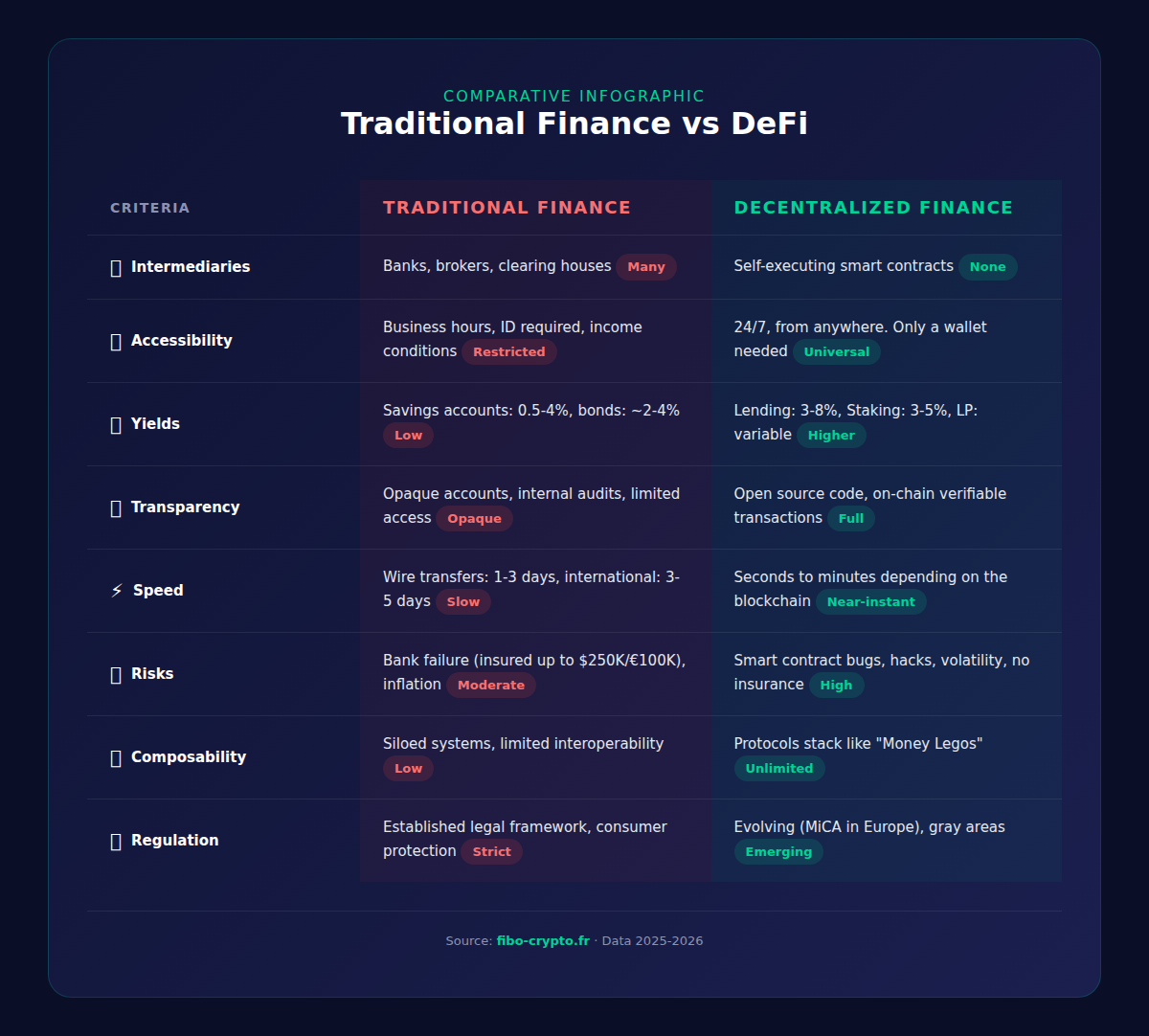
DeFi outperforms traditional finance across five key dimensions: universal accessibility, full transparency, potentially higher yields, protocol composability and the absence of discrimination.- Universal accessibility : no bank account, proof of income or residency needed. A smartphone and a wallet are enough. Over one billion unbanked people worldwide could theoretically access these services.
- Full transparency : every transaction is visible on-chain, smart contract code is open source and auditable by anyone. No more banking “black boxes.”
- Attractive yields : DeFi interest rates often exceed those of traditional finance (lending 3-8% vs savings accounts 0.5-4%), because there’s no intermediary to pay.
- Composability : DeFi protocols can interact with each other like Lego bricks. You can stake your ETH on Lido, use the stETH received as collateral on Aave, and borrow stablecoins — all in a few clicks.
- Permanent availability : DeFi runs 24/7, 365 days a year. No holidays, no “system downtime,” no closed counters.
What are the risks of DeFi?
DeFi carries significant risks: smart contract vulnerabilities, massive hacks, impermanent loss, rug pulls and technical complexity. In 2025, over $3.4 billion was stolen across the crypto ecosystem.- Smart contract vulnerabilities : a bug in the code can allow an attacker to drain an entire protocol. Even audited projects aren’t immune: the Bybit hack in February 2025 ($1.5 billion stolen by the Lazarus Group) hit a major player through a flaw in the transaction signing process.
- Hacks and breaches : $3.4 billion stolen in 2025 according to Chainalysis, with a significant portion linked to access control flaws. Individual wallet incidents surged to 158,000 cases affecting 80,000 victims.
- Impermanent loss : liquidity providers on DEXs face temporary losses when token prices in the pool diverge. The higher the volatility, the greater the potential loss.
- Rug pulls and fraudulent projects : some projects are created solely to attract funds before disappearing. An unverified smart contract or a project without an identified team should always raise red flags.
- Technical complexity : a mistake (sending funds to the wrong address, approving a malicious contract) can lead to irreversible loss. There’s no customer service to reverse a blockchain transaction.
- Regulatory risk : evolving regulations (MiCA in Europe, SEC in the United States) could change the rules and impact certain protocols.
How to get started with DeFi safely?
To get started with DeFi without excessive risk, take a progressive approach: install a secure wallet, begin with small amounts on audited protocols and prioritize staking as your first step. Here are the recommended steps for your first foray into DeFi:- Install a reliable wallet : MetaMask (browser-based) or Rabby are good choices for beginners. For maximum security, consider a hardware wallet like Ledger.
- Fund your wallet : buy ETH (or the native crypto of your target blockchain) on a centralized exchange (Coinbase, Binance), then transfer it to your wallet.
- Start with staking : it’s the simplest and least risky DeFi activity. Head to Lido to stake your ETH and receive stETH in return. Annual yield: approximately 3-4%.
- Explore gradually : once comfortable with staking, try lending on Aave (depositing stablecoins to earn interest) or a swap on Uniswap.
- Golden rules : never invest more than you can afford to lose. Always verify that the protocol has been audited (look for audit reports on their website). Never click on suspicious links and never share your seed phrase.
What does the future hold for DeFi?
DeFi’s future is shaped by three major trends: real-world asset tokenization (RWA), institutional adoption and convergence with traditional finance under the MiCA regulatory framework.Real-World Asset Tokenization (RWA)
DeFi’s next frontier is the real world. RWA (Real World Assets) tokenization brings traditional assets onto the blockchain: government bonds, real estate, stocks. Giants like BlackRock, Franklin Templeton and JPMorgan have already launched tokenized funds. Standard Chartered predicts this market could reach several trillion dollars by 2030.Institutional adoption
DeFi is no longer a playground exclusively for early adopters. Traditional financial institutions are actively exploring these protocols: institutional lending on Aave, treasury management via stablecoins, access to DeFi yields through regulated funds. The line between CeFi (centralized finance) and DeFi is becoming increasingly blurred.MiCA regulation and its impact
In Europe, the MiCA regulation (Markets in Crypto-Assets) finally provides a clear legal framework for crypto-assets. While “pure” DeFi (fully decentralized protocols) largely remains outside the regulatory perimeter, the bridges between CeFi and DeFi will be increasingly regulated. This legal clarity should paradoxically accelerate adoption by reassuring institutional investors and cautious retail users.📚 Glossary
- Smart contract : a self-executing computer program deployed on a blockchain that automatically enforces the terms of an agreement without intermediaries.
- Blockchain : a decentralized and immutable digital ledger that records all transactions transparently and verifiably.
- TVL (Total Value Locked) : the total value of assets deposited in DeFi protocols, a key indicator of the ecosystem’s size and health.
- DEX (Decentralized Exchange) : a decentralized exchange platform enabling direct cryptocurrency swaps between users, without a centralized intermediary.
- Stablecoin : a cryptocurrency pegged to a stable asset (usually the US dollar), used as a reference currency in DeFi.
- Staking : the act of locking up cryptocurrencies to participate in blockchain operations and receive rewards in return.
- Liquidity pool : a reserve of tokens deposited by users into a smart contract, used to facilitate trades on a DEX.
- Yield Farming : a strategy of moving assets between different DeFi protocols to maximize earned returns.
- Wallet : a digital wallet that stores a user’s private keys and allows them to interact with the blockchain and DeFi protocols.
- RWA (Real World Assets) : real-world assets (real estate, bonds, stocks) represented as tokens on the blockchain.
Frequently Asked Questions
Is DeFi legal?
Yes, DeFi is legal in most jurisdictions. The European MiCA regulation, gradually implemented since 2024, provides a framework for crypto-assets and service providers. Fully decentralized protocols remain in a regulatory gray area. Gains from DeFi are subject to capital gains tax in most countries — check your local regulations.
How much do I need to start with DeFi?
There’s no minimum amount required by protocols. However, transaction fees (gas fees) on Ethereum can make small operations unprofitable. To start comfortably, plan for at least $100-200 in ETH. Layer 2 blockchains (Arbitrum, Base) or Solana offer much lower fees, suitable for smaller amounts.
What are the safest DeFi protocols?
The most established and audited protocols like Aave, Uniswap, Lido, MakerDAO and Curve are generally considered the most reliable. Always check audit reports, the protocol’s TVL (a trust indicator) and the project’s track record. No protocol is 100% guaranteed against vulnerabilities, however.
What's the difference between DeFi and CeFi?
CeFi (centralized crypto finance) refers to platforms like Coinbase or Binance that offer crypto services through a centralized entity. DeFi eliminates this intermediary: you interact directly with smart contracts. CeFi advantage: simplicity and customer support. DeFi advantage: full control of your funds, transparency and no KYC.
Can I lose all my money in DeFi?
Yes, it’s possible. A protocol hack, a rug pull, a handling error or a position liquidation can result in total loss. That’s why it’s crucial to only invest what you’re prepared to lose, diversify your positions and favor audited, battle-tested protocols.
Can DeFi replace banks?
In the short term, no. DeFi doesn’t yet offer all banking services (mortgages, life insurance, personalized advice) and remains too complex for the general public. Long-term, the convergence between CeFi and DeFi could give rise to hybrid services combining smart contract efficiency with the user-friendliness of traditional banks.
📰 Sources
This article is based on the following sources:
- DefiLlama – DeFi Dashboard
- Chainalysis – Crypto Crime Report 2026
- Ethereum Foundation – Decentralized Finance
- CoinDesk – DeFi TVL holds despite crypto sell-off
- European Commission – MiCA Regulation
Comment citer cet article : Fibo Crypto. (2026). DeFi: What Is Decentralized Finance and How Does It Work?. Consulté le 24 March 2026 sur https://fibo-crypto.fr/en/blog/understanding-decentralized-finance-complete-guide-2/
The simplest way to buy, swap and manage your crypto
Join the first users and get priority access. No seed phrase, fees 3.5x lower, built-in DeFi yield.
Get early access →