What Are Smart Contracts? Complete Guide 2026
📋 En bref (TL;DR)
- Definition: A smart contract is an autonomous program that automatically executes on a blockchain when certain conditions are met — without intermediaries
- Analogy: Like a vending machine — you insert a coin (condition), the product drops (execution). No salesperson needed
- Advantages: Automation, transparency, security, speed, cost savings (no lawyer, notary, or bank required)
- Limitations: Bugs are permanent, oracle dependency, gas fees, unclear legal status
- Applications: DeFi (lending, DEX), NFTs, DAOs, insurance, tokenized real estate, supply chain, gaming
- Main blockchain: Ethereum (Solidity), but also Solana, Avalanche, Polygon, Arbitrum…
Smart contracts are one of the most revolutionary innovations in blockchain technology. Introduced by Ethereum in 2015, they enable the automatic execution of agreements without intermediaries. But how do these “intelligent contracts” actually work? What are their practical applications? This comprehensive guide explains everything.
What is a smart contract?
A smart contract is an autonomous computer program that automatically executes on a blockchain when certain predefined conditions are met. It operates on the principle “If X happens, then Y executes” — without human intermediaries.
In practical terms, it’s the digital equivalent of a traditional contract, but fully automated and tamper-proof.
The 5 main characteristics:
- Autonomous: Executes automatically without human intervention
- Immutable: Once deployed, the code cannot be modified
- Transparent: The code is publicly visible on the blockchain
- Deterministic: Always produces the same result with the same inputs
- Decentralized: Runs on thousands of nodes simultaneously
💡 Simple analogy: A smart contract works like a vending machine. You insert money (condition), the machine verifies the amount, and if everything is correct, it automatically dispenses the product (execution). No salesperson is needed, and the process is always identical.

The history of smart contracts: from 1994 to today
The concept of smart contracts was invented in 1994 by Nick Szabo, long before blockchain existed. But it was Ethereum, launched in 2015, that made these intelligent contracts truly functional and accessible to the general public.
1994: Nick Szabo’s concept
The term “smart contract” was coined by Nick Szabo, a computer scientist and cryptographer. He envisioned self-executing digital contracts, but the necessary technology didn’t exist yet.
2009: Bitcoin and early attempts
Bitcoin allowed simple scripts, but they were limited. Bitcoin’s scripting language is not Turing-complete, which restricts complex programming possibilities.
2015: Ethereum revolutionizes the concept
Vitalik Buterin launches Ethereum with a Turing-complete programming language (Solidity). For the first time, developers can create complex smart contracts with advanced conditional logic.
2017-2020: The application explosion
ICOs (Initial Coin Offerings), DeFi, and NFTs demonstrate the power of smart contracts. Billions of dollars are managed by autonomous contracts.
2020-2026: Maturity and institutional adoption
Smart contracts become mainstream with applications in traditional finance, insurance, real estate, and supply chain. Security audits and standards become professionalized.

How does a smart contract work?
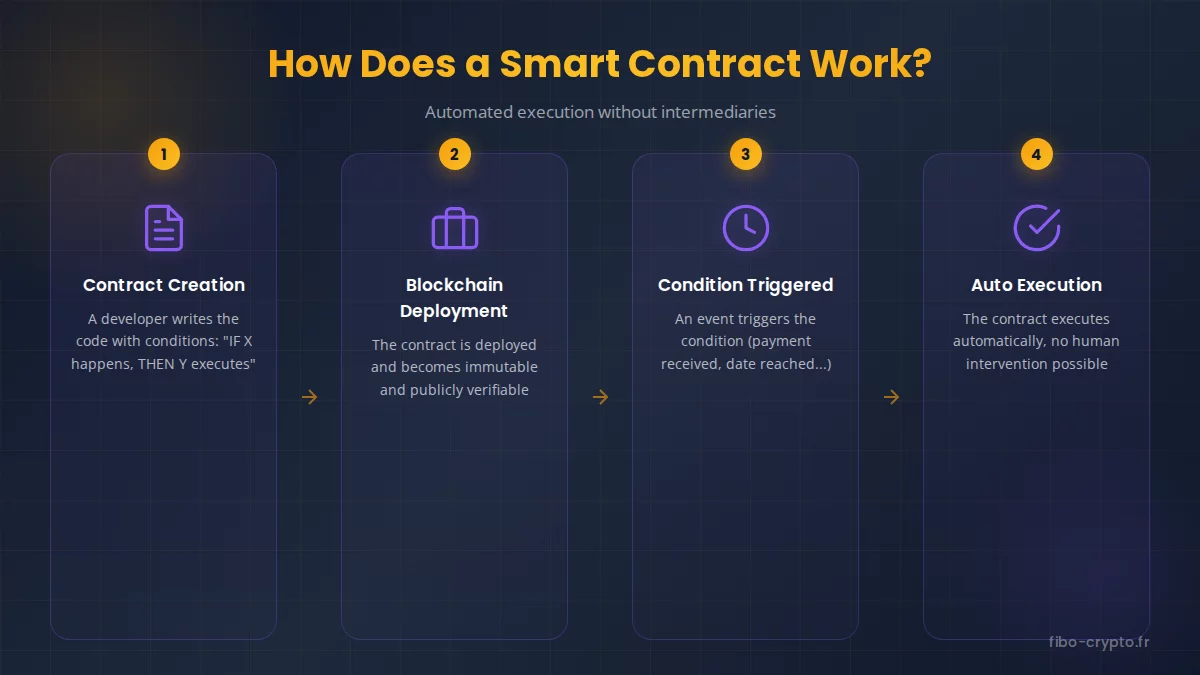
A smart contract works in 4 steps: code writing (in Solidity for Ethereum), compilation into bytecode, deployment on the blockchain with gas fee payment, then automatic execution when conditions are met. Everything is validated and permanently recorded.
1. Code writing
A developer writes the smart contract in a specialized programming language. For Ethereum, the most popular is Solidity. The code defines the rules: “If X happens, then do Y.”
// Simplified example
if (payment_received == 100 ETH) {
    transfer_ownership(buyer);
}
2. Compilation and deployment
The code is compiled into bytecode (machine language understandable by the blockchain). The developer deploys the contract on the blockchain by paying gas fees. Once deployed, the contract receives a unique address.
3. Automatic execution
When a user interacts with the contract (sends funds, calls a function), the network nodes execute the code. If conditions are met, the defined actions trigger automatically.
4. Validation and recording
Execution results are validated by the network through the consensus mechanism (Proof of Stake for Ethereum). State changes are permanently recorded on the blockchain.
The 6 major advantages of smart contracts
Smart contracts offer six key advantages: complete automation without intermediaries, total code transparency, cryptographic security, perfect execution precision, speed (seconds vs. days), and substantial savings by eliminating intermediary fees.
1. Complete automation
No more need for intermediaries (notaries, banks, lawyers) to execute a contract. The smart contract does everything automatically, reducing costs and delays.
2. Trust and transparency
The code is publicly visible. Anyone can verify what the contract does. No hidden clauses, no possible manipulation.
3. Enhanced security
Once deployed, the contract cannot be modified. Funds are protected by cryptography and blockchain decentralization.
4. Precision and accuracy
No human error: the contract executes exactly what is programmed. If conditions are A, the result will always be B.
5. Execution speed
Transactions occur in seconds or minutes, compared to days or weeks for traditional contracts.
6. Substantial savings
Elimination of intermediary fees. Only blockchain gas fees are necessary (a few cents on Layer 2).
Concrete use cases for smart contracts
Smart contracts are used in DeFi (lending, decentralized exchanges, yield farming), NFTs (digital ownership, automatic royalties), DAOs (decentralized governance), parametric insurance, tokenized real estate, supply chain, and blockchain gaming.
DeFi (Decentralized Finance)
The most popular use case. Smart contracts enable:
- Lending/borrowing: Aave, Compound automate collateralized loans
- Decentralized exchanges (DEX): Uniswap, PancakeSwap allow token swaps without intermediaries
- Yield farming: Automation of investment strategies
- Algorithmic stablecoins: DAI maintains its dollar peg via smart contracts
NFTs and digital ownership
Smart contracts manage the ownership and transfer of NFTs (artwork, collectibles, certificates). They also program automatic royalties for creators on each resale.
DAOs (Decentralized Autonomous Organizations)
Smart contracts automate governance: member voting, decision execution, treasury management. No centralized board of directors needed.
Parametric insurance
Automatic insurance: if a flight is delayed by more than 2 hours (verified via oracle), the smart contract automatically reimburses the insured. No forms, no claims.
Real estate tokenization (RWA)
Tokenization of real estate assets, automation of buy/sell transactions, rental management (rent payments, deposit releases).

Supply chain and traceability
Automated product traceability, conditional payments (supplier is automatically paid when delivery is confirmed).
Blockchain gaming
Games where items truly belong to players, decentralized in-game economies, virtual asset marketplaces.
Limitations and risks of smart contracts
Smart contracts present 6 major risks: bugs are permanent (immutable code), they depend on oracles for external data, gas fees can be high, legal status is unclear, they’re vulnerable to attacks (reentrancy, overflow), and they lack flexibility to adapt.
1. Bugs are permanent
Once deployed, a smart contract cannot be modified. If the code contains a bug, it will stay there forever. The DAO hack in 2016 cost $60 million due to a flaw.
2. The oracle problem
Smart contracts cannot directly access real-world data (asset prices, weather). They depend on oracles (Chainlink, Band Protocol) which can present points of failure.
3. Gas fee costs
Execution on Ethereum can be expensive during congestion periods. Alternatives like Solana, Polygon, or Arbitrum reduce these costs to a few cents.
4. Legal complexity
The legal status of smart contracts is unclear. In case of dispute, how can a court intervene on an immutable and decentralized contract?
5. Security risks
Programming errors can be exploited (reentrancy attacks, integer overflow). Security audits by specialized firms (CertiK, Trail of Bits) are essential.
6. No flexibility
A traditional contract can be renegotiated. A smart contract will execute its logic no matter what, even if it has become inadequate.
Concrete example: an NFT purchase with a smart contract
Here’s a concrete example: Alice wants to buy an NFT from Bob for 1 ETH. With a traditional intermediary, it requires 5-6 steps, several days, and 5-10% in fees. With a smart contract, 3 steps are enough, in seconds, for ~$5-20 in gas.
With a traditional intermediary:
- Alice sends 1 ETH to the intermediary
- The intermediary verifies the payment
- Bob sends the NFT to the intermediary
- The intermediary verifies receipt
- The intermediary transfers the NFT to Alice and the ETH to Bob
- Cost: intermediary fees (5-10%) + delays (several days)
With a smart contract:
- Alice sends 1 ETH to the smart contract
- The contract automatically verifies and transfers the NFT to Alice + the ETH to Bob
- Cost: only gas fees (~$5-20 on Ethereum, a few cents on Layer 2)
The smart contract acts as an automated trusted third party, without risk of fraud from either side.
The future of smart contracts
The future of smart contracts involves 5 major evolutions: hybrid contracts (on-chain/off-chain), upgradability patterns, cross-chain interoperability, AI integration, and progressive legal recognition by governments.
Hybrid smart contracts
Combination of on-chain contracts and off-chain logic for more flexibility while retaining the advantages of decentralization.
Upgradability patterns
Development of patterns (proxy contracts) allowing bug fixes while preserving security.
Cross-chain interoperability
Smart contracts capable of interacting between different blockchains (Ethereum, Polygon, Avalanche) through bridging protocols.
AI and smart contracts
Integration of artificial intelligence for more complex and adaptive decisions.
Regulatory adoption
Governments are beginning to legally recognize smart contracts (Wyoming, Switzerland, Singapore, and soon Europe with MiCA).
📖 Glossary
- Smart Contract: Autonomous program executing on a blockchain according to predefined rules “If X, then Y”
- Solidity: Main programming language for creating smart contracts on Ethereum, inspired by JavaScript
- Bytecode: Code compiled into machine language understandable by the blockchain
- Gas: Fees paid in ETH (or native token) to execute operations on the blockchain
- EVM (Ethereum Virtual Machine): Execution environment for smart contracts on Ethereum and compatible blockchains
- Oracle: Service providing real-world data (prices, weather, events) to smart contracts
- Security audit: Thorough code review by experts to detect flaws before deployment
- Reentrancy: Type of attack where a contract recursively calls a function before state is updated
- Proxy Contract: Pattern enabling smart contract upgrades by separating logic from state
- Turing-complete: Capable of executing any computational logic (unlike Bitcoin Script)
- Immutable: Cannot be modified once deployed on the blockchain
- Testnet: Test network where developers can test their contracts without financial risk
- Mainnet: Main production network of a blockchain where transactions are real
- DeFi: Decentralized Finance — set of financial applications built on smart contracts
- DAO: Decentralized Autonomous Organization — governance automated by smart contracts
❓ FAQ – Frequently Asked Questions
What is the difference between a smart contract and a traditional contract?
A traditional contract requires human intermediaries (lawyers, notaries) and can be subject to interpretation. A smart contract executes automatically via code, without intermediaries. Smart contract advantages: speed (seconds vs. days), reduced costs (no fees), transparency (visible code). Disadvantages: inflexibility, permanent bugs, difficulty handling complex or unforeseen cases.
Can smart contracts be modified after deployment?
No, by default a smart contract is immutable once deployed — this is a security feature, not a bug. No one can maliciously modify the code. However, upgradability patterns (proxy contracts) exist to allow controlled updates. These mechanisms must be implemented from the contract’s design phase.
How much does it cost to deploy a smart contract?
The cost depends on contract complexity and the network used. On Ethereum mainnet: $50 to $500 for a simple contract, thousands for a complex one (depending on congestion). On Layer 2 (Polygon, Arbitrum, Optimism): a few cents to a few dollars. On Solana or Avalanche: generally less than $1.
Do I need to know how to code to use smart contracts?
No, as an end user, you interact with web interfaces (DApps) that communicate with smart contracts in the background. Using Uniswap to swap tokens or Aave to lend crypto requires no programming knowledge — just a wallet. However, to create your own smart contracts, yes, you need to learn Solidity or another blockchain language.
What are the risks of using smart contracts?
The main risks are: code bugs (permanently locked funds), hacking (exploited security flaws), rug pulls (malicious developers), and lack of recourse (no customer support or authority to reverse transactions). To minimize risks: use audited protocols, verify project reputation, don’t put all your funds in one place, and start with small amounts.
Do smart contracts only work on Ethereum?
No, many blockchains support smart contracts. Ethereum remains the reference (largest DeFi/NFT ecosystem), but there’s also: Solana (very fast, low costs), Avalanche (EVM-compatible), Polygon (Ethereum Layer 2), Arbitrum/Optimism (Ethereum rollups), BNB Chain, Cardano, and many others. Each has its speed/cost/security tradeoffs.
Can a smart contract be hacked?
Yes, if the code contains vulnerabilities. The blockchain itself is very secure, but smart contract code can have exploitable bugs. Most common attacks: reentrancy (The DAO hack), overflow/underflow, flash loan attacks, poor permission management. That’s why professional security audits are essential before deploying a contract managing significant funds.
📚 Sources
- Szabo, N. (1997). “Formalizing and Securing Relationships on Public Networks”
- Buterin, V. (2013). “Ethereum White Paper” — ethereum.org/whitepaper
- Wood, G. (2014). “Ethereum Yellow Paper: A Formal Specification”
- Antonopoulos, A. M. & Wood, G. (2018). “Mastering Ethereum” — O’Reilly Media
- Ethereum Foundation — Official Smart Contracts Documentation
- OpenZeppelin — Security Best Practices
- ConsenSys Diligence — Smart Contract Best Practices
- DeFiLlama — TVL data and DeFi protocols
Article updated in January 2026 to reflect the latest smart contract developments and blockchain ecosystem changes.