
U.S. Supreme Court Strikes Down Trump Tariffs — Bitcoin Rebounds

📋 En bref (TL;DR)
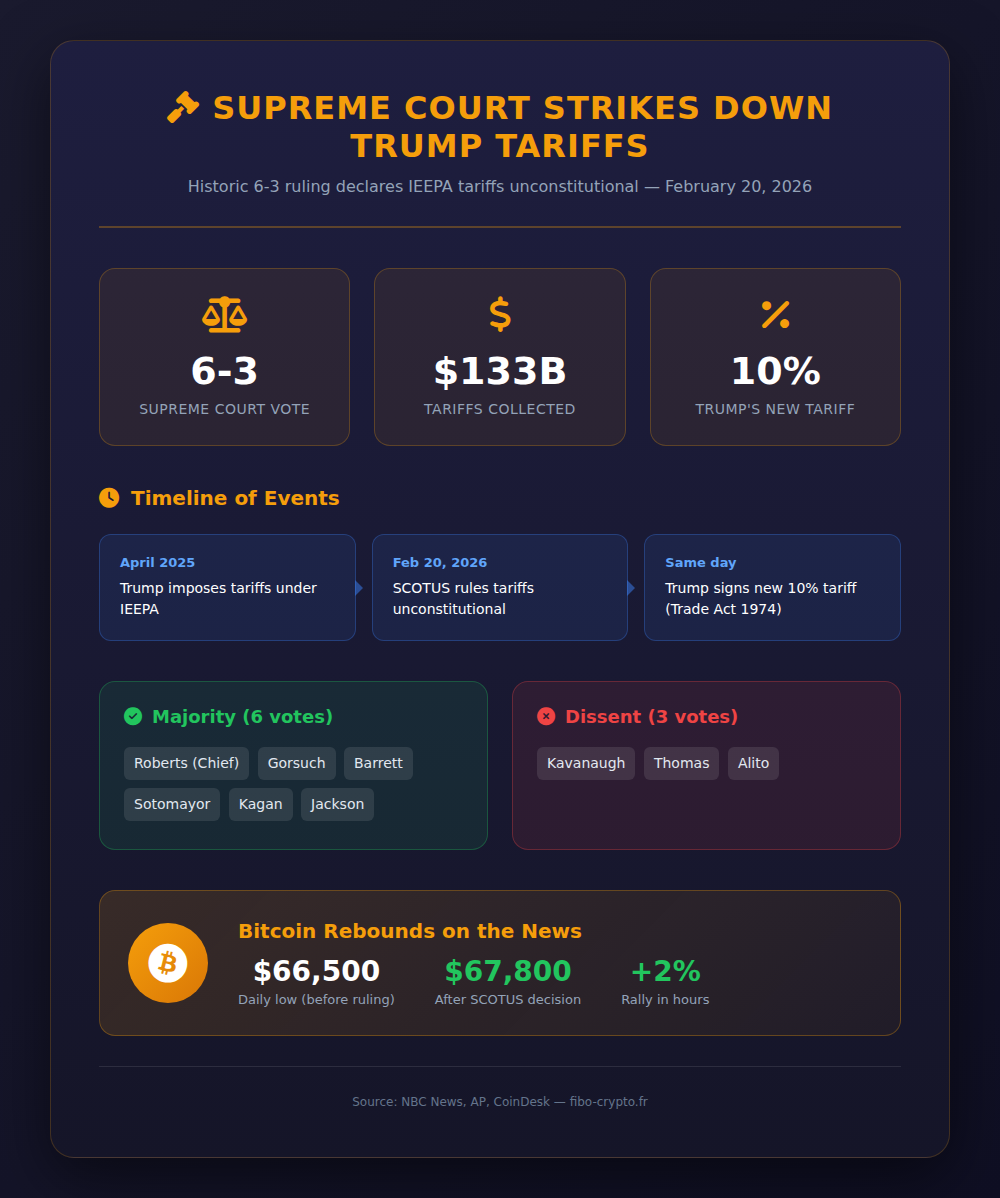
- Historic ruling: The U.S. Supreme Court voted 6-3 to strike down Trump’s tariffs imposed under IEEPA, declaring them unconstitutional
- Bitcoin rebounds: BTC surged above $67,000 following the announcement, erasing its daily losses
- $133 billion collected: The invalidated tariffs had generated over $130 billion since April 2025
- Immediate retaliation: Trump announced a new 10% global tariff through a different law (Trade Act of 1974)
- Markets surge: U.S. stocks and cryptocurrencies rallied on the decision
- Refund question: Hundreds of companies are seeking reimbursement for tariffs already paid
Friday, February 20, 2026 will be remembered as a pivotal moment in American economic and legal history. In a 6-3 decision, the U.S. Supreme Court invalidated the tariffs imposed by President Donald Trump since April 2025, ruling them unconstitutional. This landmark decision immediately triggered a rally across financial markets, with Bitcoin surging above the symbolic $67,000 threshold.
For crypto investors, this news provides a breath of fresh air after a particularly challenging start to 2026. BTC was still down 24% year-to-date before this rebound. Here’s our analysis of a decision that could reshape U.S. trade relations and have lasting effects on crypto markets.
A Historic Supreme Court Decision
Trump’s Tariffs Ruled Unconstitutional
Written by Chief Justice John Roberts, the Supreme Court’s decision is unequivocal: the president lacked the legal authority to impose tariffs under the International Emergency Economic Powers Act (IEEPA) of 1977. This law, designed to allow the president to regulate imports during national emergencies, had never been used to levy customs duties before Trump.
“The president claims the extraordinary power to unilaterally impose tariffs without limits on amount, duration, or scope,” writes Roberts in his opinion. “But the administration cites no statutory text where Congress previously authorized the use of IEEPA for tariffs.“
The decision relies notably on the “major questions doctrine,” which requires Congress to explicitly authorize policies with significant economic and political impact on the nation. This same doctrine was previously used to block Joe Biden’s student loan forgiveness program.
An Unusual Alliance on the Bench
Remarkably, the 6-justice majority united the three progressive justices (Sotomayor, Kagan, Jackson) with three conservative justices (Roberts, Gorsuch, Barrett). The three dissenters — Kavanaugh, Thomas, and Alito — defended the tariffs’ legality in a 63-page opinion that Trump called “brilliant.”
This bipartisan coalition demonstrates that the tariff question transcends traditional political divides. Even within a conservative-majority Court (6-3), the doctrine of separation of powers prevailed over partisan considerations.
Trump’s Immediate Response: New 10% Tariff
Furious after the announcement, President Trump didn’t mince words. He called the decision “a disgrace to our nation” and accused the majority justices of being “disloyal to the Constitution” and “influenced by foreign interests,” without providing evidence.
But beyond the rhetoric, Trump quickly counterattacked on legal grounds. That same evening, he signed a new 10% global tariff on all imports, this time relying on Section 122 of the Trade Act of 1974. This law allows the president to impose temporary customs duties (limited to 150 days) to address balance of payments imbalances.
“Their decision is incorrect,” Trump declared at a press conference. “But it doesn’t matter because we have very powerful alternatives.“

Bitcoin and Markets: Immediate Relief
BTC Surges Back Above $67,000
The crypto market’s reaction was immediate and positive. Bitcoin jumped to $67,800 in the hours following the announcement, after hitting a low of $66,500 earlier that day following the release of PCE inflation data.
For Matthew Sigel, Head of Digital Assets Research at VanEck, this decision is particularly bullish for Bitcoin: “Bitcoin rises as Trump tariffs are struck down by the Supreme Court. In the absence of tariff revenue, money printing and devaluation will accelerate.“
This analysis rests on simple economic logic: the tariffs were generating over $130 billion for the U.S. Treasury. Without this revenue, the budget deficit widens, which could push the Fed to maintain accommodative monetary policies longer — an environment traditionally favorable to risk assets like cryptocurrencies.
Altcoins Outperform
Notably, altcoins posted larger gains than Bitcoin in the hours following the announcement, with average increases of 3-4%. For some analysts, this phenomenon suggests the beginning of a possible “altcoin season,” where alternative cryptocurrencies outperform Bitcoin.
U.S. stock markets also celebrated the news. The S&P 500 and Nasdaq surged on the announcement, as investors anticipated reduced costs for importing companies and decreased trade uncertainty.

The Burning Question of Refunds
Beyond the future invalidation of tariffs, a major question remains unanswered: will companies be able to recover the billions already paid?
Since April 2025, tariffs imposed under IEEPA have generated over $133 billion for the U.S. Treasury, according to customs data. Hundreds of companies, including Costco and numerous SMEs, have already filed lawsuits seeking refunds.
The Supreme Court did not address this question in its ruling. Justice Kavanaugh, in his dissent, noted that the refund process “will probably be a mess,” as acknowledged during oral arguments.
On Polymarket, the decentralized prediction market, crypto traders are increasingly betting on forced tariff refunds. An outcome that could cost the Trump administration up to $150 billion.
Implications for the Crypto Industry
A Tense Legislative Environment
According to CoinDesk, the political implications of this decision could extend beyond purely economic considerations for the crypto industry. The tariff battle may consume lawmakers’ attention in the coming weeks, potentially at the expense of other priorities.
The Digital Asset Market Clarity Act, the flagship bill to regulate the U.S. crypto market, could see its adoption timeline disrupted. Senator Bernie Moreno, a strong supporter of both Trump and the crypto industry, called the Court’s decision “aberrant.”
Conversely, Senator Elizabeth Warren, a known crypto critic, celebrated the decision while noting that consumers will likely never recover the money lost to tariffs.
Bitcoin as a Safe Haven
In this context of political and economic uncertainty, Bitcoin’s narrative as a safe haven asset could strengthen. The potential weakening of the dollar, combined with potentially more accommodative monetary policy, creates a favorable environment for assets uncorrelated to the traditional financial system.
VanEck analysts suggest that investors may turn to Bitcoin and gold as hedges against monetary devaluation, a scenario reinforced by the upcoming absence of substantial tariff revenues.

What’s Next?
The Supreme Court decision doesn’t end the Trump tariff saga. With his new 10% tariff under the Trade Act of 1974, the president still has levers to pursue his aggressive trade policy, albeit in a more constrained manner.
For crypto markets, uncertainty remains. Bitcoin’s rebound is encouraging, but the coming weeks will be crucial in determining whether this decision marks a true turning point or merely a temporary reprieve. The midterm elections scheduled for this year could reshuffle the deck, both on tariffs and crypto regulation.
One thing is certain: this historic Supreme Court decision serves as a reminder that even in the United States, presidential power has its limits. A lesson that could prove valuable for the crypto industry, which has at times suffered from regulatory overreach by certain federal agencies.
📚 Glossary
- Supreme Court: The highest court in the United States, composed of 9 justices appointed for life. It rules on the constitutionality of laws and executive decisions.
- Tariffs: Taxes imposed on goods imported into a country. They increase the cost of foreign products and can cause inflation.
- Bitcoin (BTC): The first and largest cryptocurrency by market cap. Created in 2009, it’s a decentralized digital asset often considered a store of value.
- Altcoins: All cryptocurrencies other than Bitcoin. Includes Ethereum, Solana, and thousands of other projects.
- Safe Haven Asset: An asset that maintains or increases its value during periods of economic uncertainty. Gold and, increasingly, Bitcoin are considered as such.
- IEEPA: International Emergency Economic Powers Act (1977). A law allowing the U.S. president to regulate commerce during national emergencies.
Frequently Asked Questions
Why did the Supreme Court strike down Trump’s tariffs?
The Court ruled that IEEPA (International Emergency Economic Powers Act) of 1977 does not give the president authority to impose tariffs. Only Congress can levy taxes under the U.S. Constitution.
How did Bitcoin react to this decision?
Bitcoin immediately rebounded above $67,000, erasing its daily losses. Analysts see it as a positive signal because the absence of tariff revenue could accelerate money printing.
Will companies get refunds?
The Supreme Court did not rule on this question. Hundreds of companies have filed lawsuits to recover the $133 billion collected, but the process is expected to be lengthy and complex.
Can Trump still impose tariffs?
Yes, but through other more restrictive laws. He immediately signed a 10% global tariff under the Trade Act of 1974, limited to 150 days.
What’s the long-term impact on cryptocurrencies?
The potential weakening of the dollar and accommodative monetary policy could favor Bitcoin as a safe haven. However, political attention may delay crypto regulation in Congress.
📰 Sources
This article is based on the following sources:
- NBC News – Supreme Court strikes down most of Trump’s tariffs (February 20, 2026)
- Associated Press – Supreme Court strikes down Trump’s sweeping tariffs (February 20, 2026)
- CoinDesk – U.S. Supreme Court’s decision on Trump’s tariffs may not rock crypto — yet (February 20, 2026)
- CoinGape – U.S. Supreme Court Strikes Down Trump Tariffs, BTC Price Rises (February 20, 2026)
How to cite this article: Fibo Crypto. (2026). U.S. Supreme Court Strikes Down Trump Tariffs — Bitcoin Rebounds. Retrieved February 21, 2026 from https://fibo-crypto.fr/en/blog/supreme-court-strikes-down-trump-tariffs-bitcoin-rebounds