
Terraform Labs Sues Jane Street for Insider Trading: Inside the Terra/Luna Crash

📋 En bref (TL;DR)
- Historic lawsuit: Terraform Labs is suing Jane Street, one of the world’s largest high-frequency traders, for insider trading that allegedly accelerated the Terra/Luna crash in 2022
- $85 million: The amount of UST massively sold by Jane Street just 10 minutes after Terraform’s secret withdrawal of $150 million
- Central accusation: Jane Street allegedly obtained confidential information through a former Terraform intern who became an employee at the firm
- Jump Trading precedent: In December 2025, the administrator had already filed a $4 billion lawsuit against Jump Trading for similar market manipulation
- $40 billion in losses: A reminder of the Terra/Luna crash magnitude that triggered a cascade of bankruptcies across the crypto ecosystem
- Do Kwon convicted: Terraform’s founder pleaded guilty to two counts of fraud and is serving 15 years in prison
The bankruptcy administrator of Terraform Labs has just launched a major new legal offensive. This time, high-frequency trading giant Jane Street is in the crosshairs, accused of using confidential information to profit from the collapse of the Terra ecosystem in May 2022.
This complaint, filed in the federal court of Manhattan on February 24, 2026, reveals troubling new details about the mechanics of the crash that cost investors $40 billion. The accusations center on front-running and insider trading — practices that allegedly allowed Jane Street to sell hundreds of millions of dollars “at the precise moment” before the total collapse.
Jane Street at the Heart of the Terra/Luna Collapse
A Damning Timeline
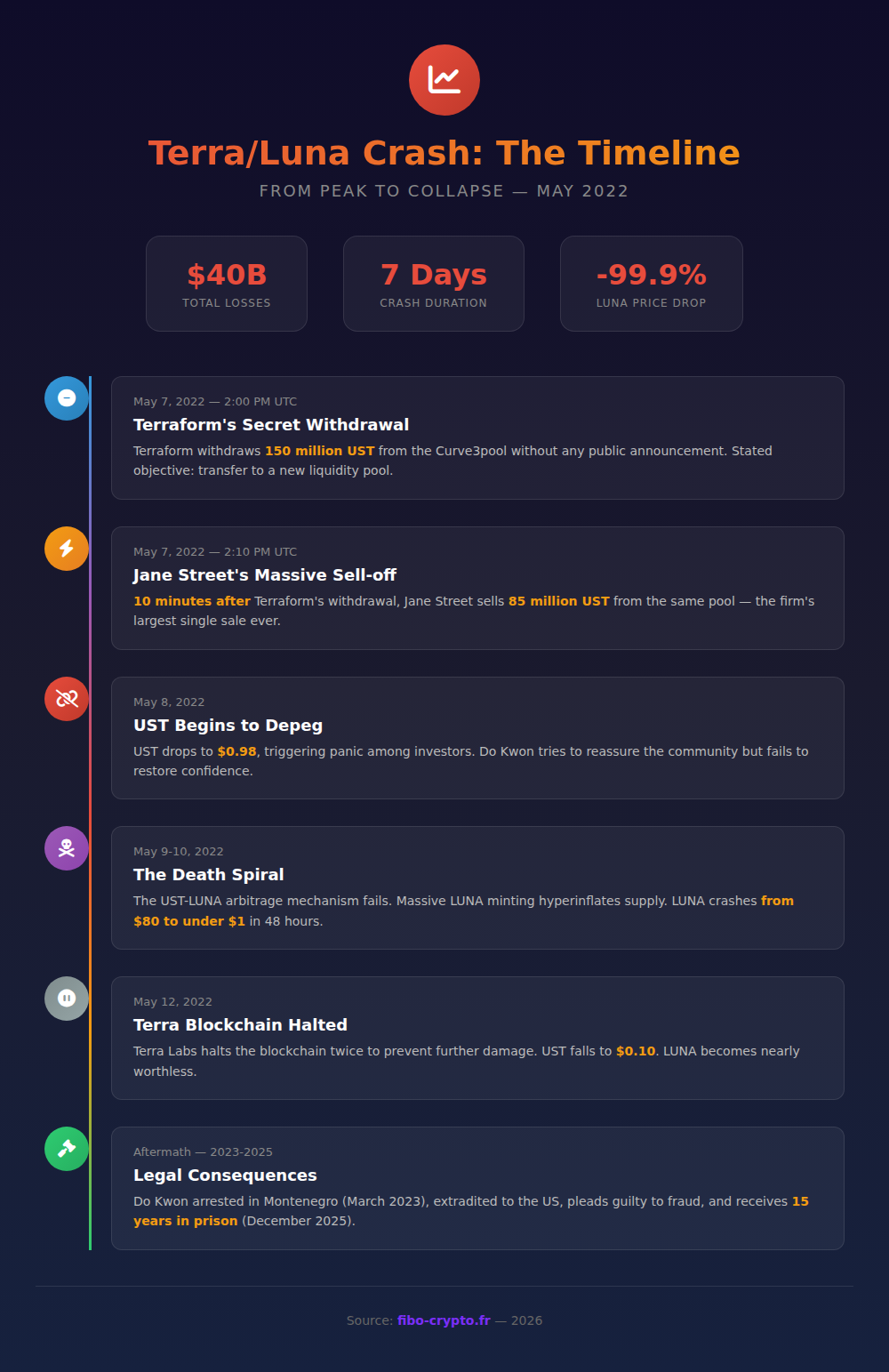
According to the complaint filed by Todd Snyder, the court-appointed administrator to liquidate Terraform Labs, the events of May 7, 2022 constitute irrefutable proof of insider trading. On that day, Terraform secretly withdrew 150 million TerraUSD (UST) from the Curve3pool liquidity pool without informing the public.
“Within 10 minutes of Terraform’s withdrawal, a wallet linked to Jane Street also withdrew 85 million UST from the same pool,” the complaint states. This massive sale allegedly triggered market panic and initiated the death spiral that would destroy the Terra ecosystem.
The heavily redacted complaint names three individuals in addition to Jane Street: Robert Granieri, co-founder of the firm, as well as Bryce Pratt and Michael Huang, employees of the company. Pratt is alleged to have played the role of key informant.
The Former Intern Turned Mole
The complaint reveals that Bryce Pratt was a former intern at Terraform Labs before joining Jane Street. According to the accusation, Pratt allegedly maintained close contacts with his former colleagues and used these relationships as “a backdoor channel to obtain material non-public information about Terraform.”
According to the legal document, it was in 2022 that Jane Street’s trading of Terra tokens “really took off,” precisely after Pratt reestablished contact with his former network at Terraform. This temporal coincidence suggests, according to the accusation, a deliberate strategy of exploiting privileged information.
The Depeg Mechanics: How UST Collapsed
A Fragile Algorithmic Stablecoin
To understand the scope of the accusation, we need to revisit how UST, Terra’s algorithmic stablecoin, worked. Unlike traditional stablecoins like USDT or USDC, backed by dollar reserves, UST maintained its dollar parity through an arbitrage mechanism with the LUNA token.
This system relied on trust: as long as arbitrageurs believed in the mechanism, they would restore parity in case of deviation. But a massive liquidity withdrawal could break this trust and trigger a “death spiral.”
On May 7, 2022, the simultaneous withdrawal of 235 million UST (150 million by Terraform + 85 million by Jane Street according to the complaint) created exactly this catastrophic scenario. The next day, Do Kwon tried to reassure by explaining that the 150 million were intended for a new liquidity pool, but it was already too late.
Troubling Communications with Do Kwon
The complaint also reveals direct exchanges between Jane Street and Do Kwon during the crisis. On May 9, 2022, as UST was beginning to lose its peg, Bryce Pratt allegedly created a group chat with Kwon and his team, proposing to buy Bitcoin or LUNA.
Kwon’s response reveals pre-existing tensions: he allegedly reproached Bill DiSomma, co-founder of Jump Trading, for not informing them earlier about Terraform’s fundraising efforts. This communication suggests coordination among several major market players during the critical hours of the collapse.
A Lawsuit Adding to the One Against Jump Trading
$4 Billion Claimed from Jump
This new lawsuit against Jane Street is part of Todd Snyder’s broader legal strategy. In December 2025, the administrator had already launched a landmark lawsuit against Jump Trading, seeking $4 billion in damages.
In that case, Snyder accuses Jump of having “actively exploited” the Terraform ecosystem by concluding a secret agreement to artificially inflate UST’s value before its implosion. Jump allegedly made approximately $1 billion in gains through this alleged manipulation.
Federal prosecutors in Manhattan had already examined Telegram conversations between employees of Jump Trading, Jane Street, and Alameda Research regarding a project to bail out UST. The investigation focused on whether these communications constituted market manipulation.
Jane Street Vigorously Contests
Facing these accusations, Jane Street responded forcefully, calling the complaint a “desperate and transparent attempt to extort money.” A spokesperson for the firm stated: “It is well established that the losses suffered by Terra and Luna holders resulted from a multi-billion dollar fraud perpetrated by Terraform Labs management.”
The firm promises to “vigorously defend against these opportunistic and unfounded allegations.” This defense rests on the argument that primary responsibility lies with Do Kwon and Terraform’s management, not with market players who would simply have reacted to market conditions.
The Context: Do Kwon and the Fall of the Terra Empire
A Historic Conviction
These lawsuits come after the conviction of Do Kwon, the founder of Terraform Labs. Arrested in Montenegro in March 2023 after months on the run, he was extradited to the United States where he pleaded guilty to two counts of fraud in August 2025.
In December 2025, Do Kwon was sentenced to 15 years in prison. The judge emphasized the seriousness of the founder’s false statements about the stablecoin’s stability mechanisms, which misled millions of investors.
Terraform Labs filed for bankruptcy in January 2024, and a liquidation trust took control of the company later that year. It is this trust, represented by Todd Snyder, that is now leading legal actions to recover funds for the benefit of creditors.
The Domino Effect of May 2022
The Terra/Luna collapse in May 2022 had repercussions far beyond its own ecosystem. Within days, $40 billion in market cap evaporated, triggering a cascade of bankruptcies: Three Arrows Capital, Voyager Digital, and later FTX — which had significant exposure to the Terra ecosystem.
This crash became a textbook case on the risks of algorithmic stablecoins and accelerated regulatory discussions worldwide. The European Union notably incorporated specific provisions on stablecoins in the MiCA regulation.
What Are the Implications for the Crypto Market?
Market Makers Under Scrutiny
These lawsuits raise a fundamental question for the crypto industry: what is the line between legitimate trading and market manipulation? Market makers like Jane Street and Jump Trading play an essential role in market liquidity, but can their informational advantages become abusive?
If the courts rule in favor of the Terraform administrator, it could set a major precedent for institutional players’ liability in crypto collapses. High-frequency trading firms could be required to prove they did not exploit privileged information.
Toward More Transparency?
These cases also highlight the need for stricter regulation of crypto markets. Private communications between major market players during crisis periods raise questions about market integrity and retail investor protection.
As the United States progressively adopts a clearer regulatory framework for cryptocurrencies, these lawsuits could influence future rules on conflicts of interest and disclosure obligations in the industry.
📚 Glossary
- Jane Street: A quantitative trading firm based in New York, one of the world’s largest market makers with over $20 billion in capital.
- Front-running: An illegal practice of executing orders with knowledge of significant pending orders, in order to profit from them.
- UST (TerraUSD): The algorithmic stablecoin of the Terra ecosystem, designed to maintain a 1:1 parity with the US dollar through an arbitrage mechanism with LUNA.
- Algorithmic stablecoin: A stable cryptocurrency that maintains its parity not through reserves, but through automatic supply adjustment mechanisms.
- Market maker: A market participant that provides liquidity by placing buy and sell orders, facilitating trades and reducing price spreads.
- Curve3pool: A liquidity pool on the Curve Finance platform, enabling stablecoin exchanges with low slippage.
Frequently Asked Questions
What is Jane Street accused of in the Terraform case?
Jane Street is accused of insider trading and front-running. The Terraform administrator alleges that the firm used confidential information obtained through a former intern to sell $85 million in UST just before the collapse.
What is the connection between this lawsuit and the 2022 Terra/Luna crash?
According to the complaint, Jane Street allegedly sold UST massively just 10 minutes after a secret $150 million withdrawal by Terraform, thus triggering the panic that led to UST’s depeg and the collapse of the entire Terra ecosystem.
How much did the Terra/Luna collapse cost investors?
The Terra/Luna collapse in May 2022 destroyed approximately $40 billion in market capitalization, causing cascading bankruptcies including Three Arrows Capital, Voyager Digital, and indirectly contributing to FTX’s downfall.
What happened to Do Kwon, Terraform’s founder?
Do Kwon pleaded guilty to two counts of fraud and was sentenced to 15 years in prison in December 2025, after being arrested in Montenegro and extradited to the United States.
Are there other lawsuits related to the Terra collapse?
Yes, in December 2025, the Terraform administrator also sued Jump Trading for $4 billion, accusing it of manipulating the market and generating approximately $1 billion in gains through a secret agreement with Terraform.
📰 Sources
This article is based on the following sources:
- CoinDesk – Jane Street faces claims of insider trading (February 24, 2026)
- Crypto Briefing – Jane Street sued for alleged front-running trades (February 24, 2026)
- Cointelegraph – Terraform Accuses Jane Street of Insider Trading (February 24, 2026)
- CourtListener – Full docket: Snyder v. Jane Street Group LLC
How to cite this article: Fibo Crypto. (2026). Terraform Labs Sues Jane Street for Insider Trading. Retrieved February 24, 2026 from https://fibo-crypto.fr/en/blog/terraform-labs-sues-jane-street-insider-trading