Bitcoin as a Hedge Against Inflation: Complete Analysis 2026

📋 En bref (TL;DR)
- Bitcoin and inflation : with a hard-capped supply of 21 million coins and an algorithmic monetary policy, Bitcoin has structural characteristics of an inflation hedge
- Historical performance : from 2015 to 2025, Bitcoin delivered an annualized return above 60%, vastly outperforming gold (+8%), real estate (+5%), and Treasury Inflation-Protected Securities (+2%)
- Limitations : short-term volatility (50-80% drawdowns) prevents Bitcoin from being a perfect hedge; its correlation with risk assets increases during market stress
- Spot ETFs : the approval of spot Bitcoin ETFs in January 2024 (IBIT, FBTC) opened access to institutional investors, with over $100 billion in cumulative inflows
- Recommended strategy : a 5-15% portfolio allocation to Bitcoin, acquired via DCA over a long-term horizon (4+ years), provides an asymmetric hedge against monetary depreciation
- 2026 context : BTC above $100,000, massive institutional adoption (Strategy: 713,000+ BTC), corporate and sovereign strategic reserves
Inflation in 2024-2026: a macro context that reignites the debate
Inflation has returned as a top concern for savers and investors worldwide since the post-Covid shock of 2021-2022. After reaching levels not seen in 40 years — 9.1% in the US in June 2022 and 10.6% in the Eurozone in October 2022 — inflation has retreated but its cumulative effects continue to erode purchasing power.
In 2024, the Federal Reserve began cutting its benchmark Fed funds rate from its peak of 5.25-5.50% to 4.25-4.50% by December 2024. The European Central Bank (ECB) followed a similar path, lowering its deposit rate from 4.0% to 3.15% by year-end. US CPI inflation settled around 2.7-3.0% in early 2025, while the PCE price index — the Fed’s preferred measure — hovered near 2.5%.
2x cheaper fees. Up to 6% yield. No seed phrase. Fibo, the wallet you've been waiting for.
Get early access →The problem is structural: global M2 money supply expanded by more than 40% between 2020 and 2025. Post-Covid stimulus packages, geopolitical tensions, and the energy transition have created an environment where inflation remains a persistent risk. It is in this context that an increasing number of investors are turning to Bitcoin as a potential hedge — a “digital gold” for the 21st century.
Why Bitcoin is compared to digital gold
Bitcoin possesses monetary characteristics that structurally align it with gold, the historical benchmark for inflation protection. Its maximum supply is capped at 21 million coins — a ceiling hardcoded into its protocol and impossible to change.
Unlike fiat currencies, whose central banks can expand supply at will, Bitcoin’s monetary policy is entirely algorithmic. The halving mechanism, which cuts miner rewards in half every 210,000 blocks (approximately every 4 years), creates a programmatic scarcity schedule:
- 2009: 50 BTC per block
- 2012: 25 BTC (1st halving)
- 2016: 12.5 BTC (2nd halving)
- 2020: 6.25 BTC (3rd halving)
- 2024: 3.125 BTC (4th halving)
- ~2028: 1.5625 BTC (5th halving projected)
As of mid-2025, approximately 19.85 million BTC are in circulation — 94.5% of the total supply. Bitcoin’s annual inflation rate has dropped to roughly 0.85% following the April 2024 halving — well below the inflation rate of most fiat currencies. This disinflationary model stands in stark contrast to the continuous monetary expansion by central banks and forms the foundational argument for Bitcoin as a store of value.

Bitcoin vs inflation: what do the numbers say?
Over the long term, Bitcoin has dramatically outperformed inflation and all traditional asset classes in terms of returns, albeit with considerably higher volatility. Here are the comparative figures across different timeframes:
10-year performance comparison (2015-2025)
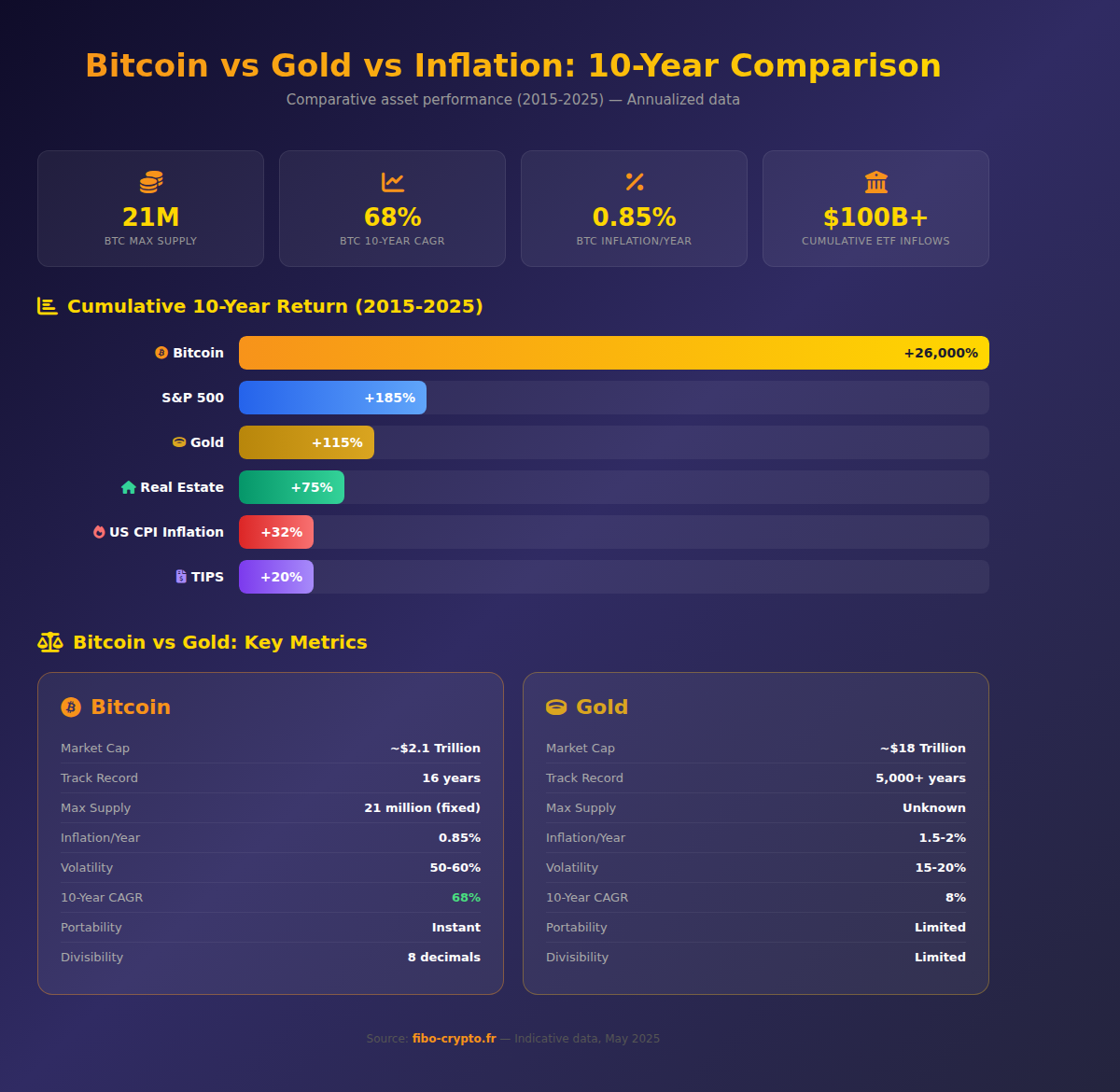
- Bitcoin: +26,000% (from ~$250 to ~$105,000), or a CAGR of approximately 68%
- Gold: +115% (from ~$1,150 to ~$2,500/oz), or a CAGR of approximately 8%
- S&P 500: +185% (from ~2,050 to ~5,850), or a CAGR of approximately 11%
- US Real Estate (Case-Shiller): +75%, or a CAGR of approximately 5.8%
- TIPS (Treasury Inflation-Protected Securities): +20%, or a CAGR of approximately 1.8%
- Cumulative US CPI (inflation): +32%, or ~2.8% annualized
Risk-adjusted returns: the Sharpe ratio perspective
When considering risk-adjusted performance, Bitcoin presents a unique profile. Its Sharpe ratio over 4+ year periods (covering a full cycle) has historically exceeded that of gold and equity indices. However, over shorter timeframes (1-2 years), this ratio deteriorates sharply due to volatility.
The critical insight: Bitcoin has never lost value over any 4-year holding period in its history. Every investor who purchased BTC and held for at least one full cycle has been profitable — and has significantly outpaced inflation.
The limitations: Bitcoin is not a perfect hedge
Despite its compelling fundamental properties, Bitcoin has significant limitations that prevent it from being considered a perfect inflation hedge, at least in the short term.
Short-term volatility
Bitcoin has experienced 50-80% drawdowns within its bull cycles. In 2022, during a historic inflation spike (the theoretical moment when a hedge should perform), Bitcoin dropped 65%, falling from $47,000 to $16,000. An asset that loses two-thirds of its value during the period it is supposed to protect capital is not a reliable short-term hedge.
Correlation with risk assets
Since 2020, Bitcoin’s correlation with the Nasdaq and tech stocks has increased significantly. During stress events (monetary tightening, banking crises), Bitcoin behaves more like a risk asset than a safe haven. Its correlation with gold, by contrast, remains low and inconsistent — oscillating between -0.1 and +0.3 depending on the period.
No income stream
Unlike TIPS or inflation-linked bonds, Bitcoin generates no coupons or regular yield. Its value proposition relies entirely on capital appreciation — making it fundamentally different from a traditional hedging instrument.
The nuanced thesis
The reality is that Bitcoin works as a hedge against monetary inflation (money supply expansion) rather than against consumer price inflation (CPI). Over the long run, the two are correlated, but in the short term, the distinction is critical.

Bitcoin vs gold: the real comparison
The comparison between Bitcoin and gold lies at the heart of the inflation hedge debate. Both assets share fundamental characteristics — scarcity, censorship resistance, government independence — but differ on essential points.
| Criteria | Bitcoin | Gold |
|---|---|---|
| Market cap | ~$2.1 trillion | ~$18 trillion |
| Track record | 16 years (since 2009) | 5,000+ years |
| Maximum supply | 21 million (fixed) | Unknown (ongoing extraction) |
| Annual inflation rate | ~0.85% | ~1.5-2% |
| Portability | Instant (digital) | Limited (physical, heavy) |
| Divisibility | 8 decimals (satoshis) | Limited |
| Verifiability | Instant (blockchain) | Costly (assay, testing) |
| Seizure resistance | Near impossible (private key) | Historically seized (e.g., Executive Order 6102, 1933) |
| Annual volatility | ~50-60% | ~15-20% |
| Institutional adoption | Growing (ETFs, treasuries) | Mature (central banks, jewelry) |
| 10-year CAGR | ~68% | ~8% |
The key takeaway: Bitcoin outperforms gold on virtually every performance and monetary property metric, except two — track record (and therefore battle-tested trust) and volatility. These two factors explain why institutional investors are increasingly viewing Bitcoin not as a replacement for gold, but as a complement in a diversified allocation.
Spot Bitcoin ETFs: a new accessible hedging tool
The SEC’s approval of spot Bitcoin ETFs in January 2024 marked a historic turning point, opening Bitcoin access to millions of institutional and retail investors through their traditional brokerage accounts.
Key ETF figures
- iShares Bitcoin Trust (IBIT) — BlackRock: the world’s largest Bitcoin ETF with over $60 billion in assets under management (AUM) in early 2025. It became the fastest-growing ETF in Wall Street history.
- Fidelity Wise Origin Bitcoin Fund (FBTC): ~$20 billion in AUM.
- Cumulative net inflows: over $40 billion in net inflows into spot Bitcoin ETFs in 2024, with acceleration in H2 2024 following the halving.
Why ETFs are game-changers for inflation hedging
Before ETFs, investing in Bitcoin required managing private keys, using crypto exchanges, and navigating regulatory uncertainty. ETFs eliminate these frictions:
- Accessibility: purchase through a standard brokerage account (401k, IRA, taxable accounts)
- Regulation: SEC oversight, regular reserve audits
- Liquidity: listed on NYSE/Nasdaq with tight spreads
- Tax clarity: treated as a standard security for capital gains purposes
For investors seeking Bitcoin exposure as an inflation hedge without the technical complexity, spot ETFs now represent the simplest and safest solution.

Practical strategy: how to use Bitcoin as an inflation hedge
Integrating Bitcoin into a portfolio as an inflation hedge doesn’t mean going all-in — it means adopting a calibrated allocation and a disciplined investment approach.
Recommended allocation
Research from BlackRock, Fidelity, and ARK Invest converges on a recommendation of 5 to 15% of the overall portfolio allocated to Bitcoin:
- 5%: conservative exposure, limited impact on overall portfolio volatility, improved risk-adjusted returns
- 10%: moderate allocation, recommended by BlackRock for multi-asset portfolios
- 15%: aggressive allocation, for investors with a long horizon and high risk tolerance
DCA as the preferred entry method
Dollar Cost Averaging (systematic periodic investment) is the most suitable method for building a Bitcoin position as an inflation hedge:
- Fixed weekly or monthly investment regardless of price
- Smoothing of entry-point volatility
- Emotional discipline (no market timing)
- Historically, DCA into Bitcoin has produced positive returns over every 3+ year period
Long-term horizon: 4 years minimum
For the inflation hedge thesis to work, the investment horizon must span at least one full Bitcoin cycle (4 years, between halvings). Over this timeframe:
- Intra-cycle volatility is absorbed
- The post-halving scarcity effect plays out fully
- Correlation with monetary inflation (M2) materializes

The 2026 context: unprecedented institutional adoption
In early 2026, Bitcoin trades above $100,000, supported by massive institutional adoption that reinforces its credibility as a long-term store of value.
Corporate strategic reserves
Strategy (formerly MicroStrategy), under Michael Saylor’s leadership, holds over 713,000 BTC — more than 3.3% of total supply, representing a value exceeding $75 billion. Other publicly traded companies have followed this approach:
- Tesla: holds approximately 11,500 BTC in its treasury
- Marathon Digital: over 46,000 BTC
- Block (Square): $220 million investment
- Metaplanet (Japan): active accumulation since 2024, dubbed “Asia’s Strategy”
Sovereign strategic reserves
A new phenomenon has emerged in 2025-2026: nation-states are building strategic Bitcoin reserves:
- El Salvador: over 6,000 BTC accumulated since 2021, with significant unrealized profits
- United States: President Trump signed an executive order creating a Strategic Bitcoin Reserve funded by judicial seizures (~200,000 BTC)
- Bhutan: the sovereign wealth fund Druk Holding holds BTC mined using hydroelectric power
This progressive institutionalization validates Bitcoin’s thesis as a store of value comparable to gold — and strengthens its potential role as a hedge against fiat currency depreciation.
How to assess if Bitcoin suits your inflation hedging needs
Before integrating Bitcoin into your inflation protection strategy, you should evaluate your investor profile and objectives.
Bitcoin is suitable if:
- Your investment horizon is 4 years or longer
- You can tolerate -50% fluctuations without panicking
- You seek an asymmetric hedge (risk limited to investment, high upside potential)
- You want to diversify beyond traditional assets (stocks, bonds, real estate)
- You believe in the thesis of growing Bitcoin adoption as a global store of value
Bitcoin is NOT suitable if:
- You need short-term stability (1-2 years)
- You seek regular income (coupons, dividends)
- Your allocation represents money you might need quickly
- You cannot tolerate volatility psychologically
The ideal inflation hedge combines multiple assets: inflation-linked bonds (TIPS) for short-term protection, gold for stability, real estate for income — and Bitcoin for the growth component and long-term protection against monetary depreciation.
Tax considerations for US investors
For US-based investors, Bitcoin is treated as property by the IRS. Key considerations include:
- Long-term capital gains: holding BTC for over one year qualifies for preferential rates (0%, 15%, or 20% depending on income)
- ETF tax treatment: spot Bitcoin ETFs are taxed similarly to gold ETFs (28% collectibles rate may apply, though IRS guidance is evolving)
- Tax-advantaged accounts: Bitcoin ETFs can be held in IRAs, 401(k)s, and HSAs for tax-deferred or tax-free growth
- Wash sale rules: as of 2025, crypto is not subject to wash sale rules (unlike stocks), though legislation may change this
📚 Glossary
- Inflation : a general and sustained increase in the price level of goods and services in an economy, resulting in a loss of purchasing power of the currency.
- CPI (Consumer Price Index) : the primary statistical indicator used to measure inflation in the United States, published monthly by the Bureau of Labor Statistics (BLS).
- PCE (Personal Consumption Expenditures) : an alternative inflation measure preferred by the Federal Reserve, which captures a broader basket of spending and adjusts for consumer substitution behavior.
- Halving : a programmed event in the Bitcoin protocol that cuts miner rewards in half every 210,000 blocks (approximately every 4 years), reducing the rate at which new bitcoins are created.
- Supply : the total quantity of bitcoins in circulation. The maximum supply is capped at 21 million BTC, an immutable limit encoded in the source code.
- Store of value : an asset capable of maintaining or increasing its purchasing power over time. Gold and Bitcoin are considered stores of value.
- Correlation : a statistical measure of the relationship between two assets. A correlation of +1 means they move identically, -1 means they move oppositely, and 0 means they move independently.
- ETF (Exchange-Traded Fund) : an investment fund listed on a stock exchange that tracks the performance of an underlying asset. Spot Bitcoin ETFs directly hold BTC.
- Hedge : an investment strategy aimed at reducing the risk of loss related to a specific factor, such as inflation or currency depreciation.
- Monetary policy : the set of decisions made by a central bank to influence the money supply, interest rates, and credit conditions in an economy.
- Fed funds rate : the target interest rate set by the Federal Reserve at which depository institutions lend reserves to each other overnight. It is the primary tool of US monetary policy.
- TIPS (Treasury Inflation-Protected Securities) : US Treasury bonds whose principal adjusts with CPI inflation, providing a guaranteed real return above inflation.
- DCA (Dollar Cost Averaging) : a systematic investment strategy involving purchasing a fixed dollar amount of an asset at regular intervals, regardless of price, to smooth entry-point volatility.
- Digital gold : a term describing Bitcoin as the digital equivalent of gold as a store of value, due to its programmatic scarcity and independence from government control.
Frequently Asked Questions
Does Bitcoin really protect against inflation?
Over the long term (4+ years), historical data shows that Bitcoin has vastly outpaced inflation. However, in the short term (1-2 years), its volatility can lead to significant losses, even during periods of high inflation. Bitcoin functions more as a hedge against monetary inflation (money supply expansion) than against immediate consumer price increases.
What is the difference between Bitcoin and gold as an inflation hedge?
Gold is a time-tested hedge with low volatility (~15-20% annually) and a historically negative correlation with equities during crises. Bitcoin offers superior return potential but with much higher volatility (~50-60%). Gold is mature and predictable; Bitcoin is young and asymmetric. Both are complementary in a diversified portfolio.
What percentage of my portfolio should I allocate to Bitcoin?
Research from BlackRock, Fidelity, and ARK Invest converges on 5 to 15% of the overall portfolio. 5% for a conservative approach, 10% for a moderate approach (BlackRock’s recommendation), and 15% for aggressive profiles with a long-term horizon. Beyond 15%, the impact on portfolio volatility becomes disproportionate.
Is it too late to buy Bitcoin as an inflation hedge?
No. The inflation hedge thesis rests on Bitcoin’s structural properties (limited supply, halvings, growing adoption), not its nominal price. At $100,000 per BTC, Bitcoin’s market cap (~$2.1 trillion) represents only 12% of gold’s (~$18 trillion). If Bitcoin continues its institutional adoption trajectory, the growth potential remains significant.
Are Bitcoin ETFs a good way to hedge against inflation?
Spot Bitcoin ETFs (BlackRock’s IBIT, Fidelity’s FBTC) are the most accessible tool for Bitcoin exposure in a traditional portfolio. They offer the simplicity of a listed security, regulatory oversight (SEC supervision), and high liquidity. The downside: management fees (~0.25%/year) and no direct Bitcoin ownership (“not your keys, not your coins”).
How does the Bitcoin halving strengthen inflation protection?
The halving cuts the rate of new bitcoin creation in half, reducing Bitcoin’s annual inflation from ~1.7% before April 2024 to ~0.85% after. This programmatic scarcity, combined with growing demand (ETFs, institutions), creates structural upward pressure on price. Historically, each halving has been followed by a major bull cycle within 12-18 months.
How are Bitcoin gains taxed in the United States?
The IRS treats Bitcoin as property. Long-term capital gains (held over 1 year) are taxed at 0%, 15%, or 20% depending on income. Short-term gains are taxed as ordinary income. Bitcoin ETFs may be subject to the 28% collectibles tax rate, though IRS guidance is still evolving. Bitcoin held in tax-advantaged accounts (IRA, 401k) can grow tax-deferred or tax-free.
📰 Sources
This article is based on the following sources:
- Federal Reserve Economic Data (FRED)
- Bureau of Labor Statistics — CPI
- CoinGecko — Bitcoin Market Data
- World Gold Council
- BlackRock — iShares Bitcoin Trust (IBIT)
- Bitcoin Treasuries
Comment citer cet article : Fibo Crypto. (2026). Bitcoin as a Hedge Against Inflation: Complete Analysis 2026. Consulté le 21 March 2026 sur https://fibo-crypto.fr/en/blog/bitcoin-hedge-against-inflation
The simplest way to buy, swap and manage your crypto
Join the first users and get priority access. No seed phrase, fees 3.5x lower, built-in DeFi yield.
Get early access →