
Fed Ends Operation Chokepoint 2.0: A Historic Victory for Crypto
📋 En bref (TL;DR)
- Elimination of “reputational risk”: the Fed removes this subjective criterion from banking supervision, opening doors to crypto services
- End of Operation Chokepoint 2.0: this informal Biden-era initiative aimed to financially isolate the crypto industry through administrative pressure
- 23 “pause letters” revealed: the FDIC had asked at least 23 banks to cease crypto activities between 2022 and 2024
- Regulatory framework in progress: the GENIUS Act (stablecoins) and the digital assets bill are advancing through Congress
- $188,440 paid by the FDIC: settlement of a FOIA lawsuit after illegal withholding of documents about the pressure campaign
- Concrete impact: American banks can now serve the crypto industry without fear of implicit sanctions
The U.S. Federal Reserve has just turned a decisive page in the regulatory history of cryptocurrencies. By announcing the permanent elimination of “reputational risk” from its banking supervision programs, the Fed officially puts an end to what the crypto industry called “Operation Chokepoint 2.0.” This decision marks a major turning point for companies in the sector that, for nearly four years, faced systematic banking pressure depriving them of access to traditional financial services.
What is “reputational risk” and why does its elimination change everything?
Reputational risk was a criterion used by American banking regulators to evaluate banks’ business relationships. In practice, Fed examiners could sanction a bank simply because it served clients deemed “controversial” — even if those activities were perfectly legal.
“This vague and inherently subjective standard introduced unnecessary variability into supervisory approaches and diverted attention from measurable financial risks such as credit, liquidity, and market risk,” said Michelle Bowman, Fed Vice Chair for Supervision, in an official statement.
In practice, this criterion allowed regulators to exercise informal pressure on banks to cut ties with the crypto industry, without ever having to formally justify this position. Senator Cynthia Lummis (R-Wyoming) had even presented to the Senate the Fed’s internal manual showing how this criterion was used against crypto companies.
Operation Chokepoint 2.0: anatomy of a coordinated stranglehold
The origins: 2021-2022
The term “Operation Chokepoint 2.0” refers to an unofficial but coordinated strategy among several U.S. federal agencies under the Biden administration. This operation aimed to financially isolate the crypto industry by complicating, or even making impossible, its access to banking services.
The timeline revealed by the House Committee on Financial Services report is revealing:
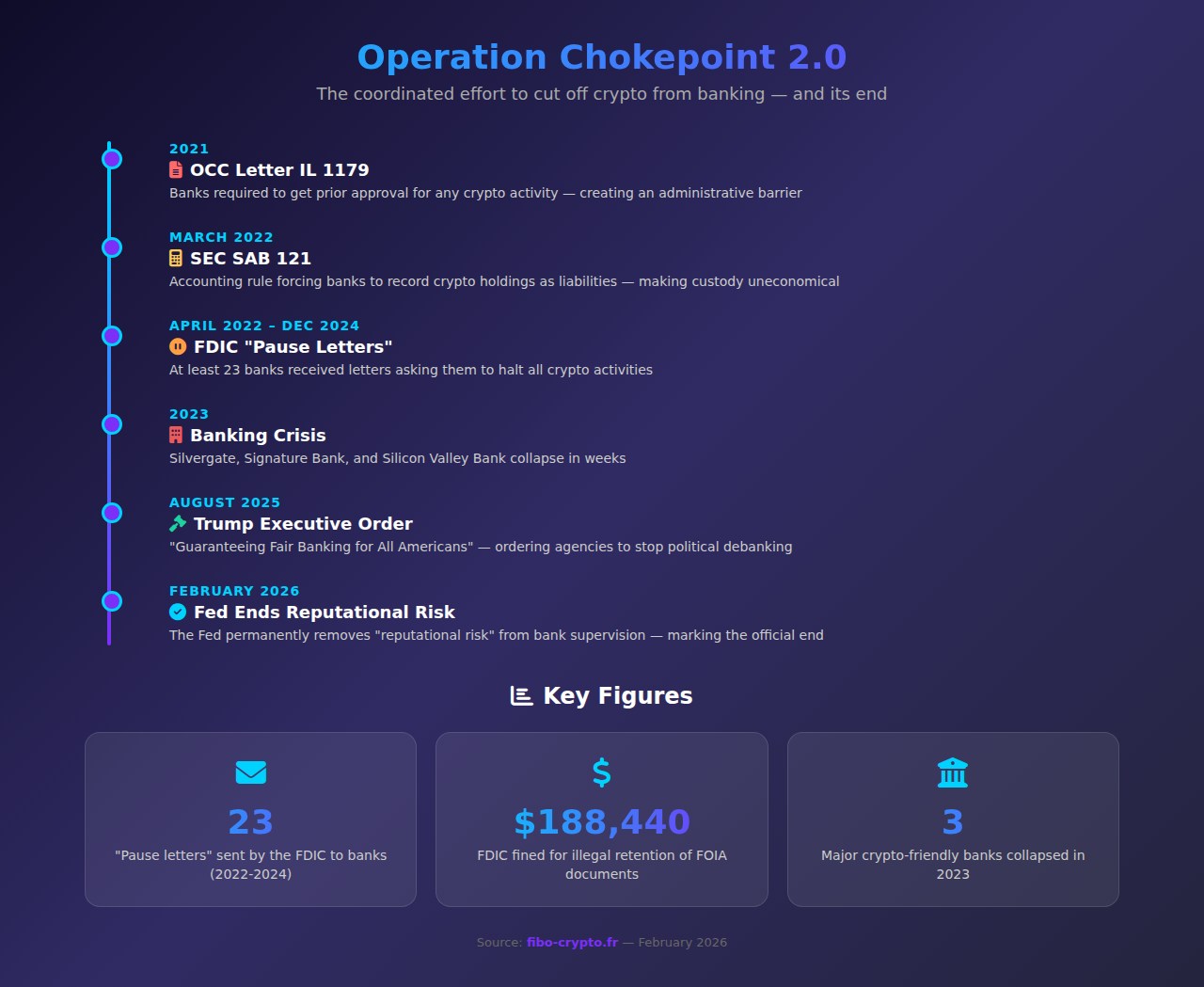
2021: The OCC (Office of the Comptroller of the Currency) publishes interpretive letter IL 1179, requiring prior authorization for any bank crypto activity — effectively creating an administrative barrier.
March 2022: The SEC adopts Staff Accounting Bulletin 121 (SAB 121), requiring banks to record held cryptocurrencies as liabilities. This exceptional accounting rule made crypto custody economically unviable for banks.
April 2022 – December 2024: The FDIC sends at least 23 “pause letters” to banking institutions, asking them to “suspend all crypto-asset related activities” pending regulatory clarification… that never came.
The consequences: the 2023 collapse
This coordinated pressure directly contributed to the 2023 banking crisis. Silvergate Bank, Signature Bank, and Silicon Valley Bank — the three main banks serving the crypto industry — all failed within weeks of each other.
By concentrating crypto clients in a reduced number of institutions and then weakening those same institutions through hostile examinations, regulators created the conditions for their collapse.
The counteroffensive: FOIA, lawsuits, and power shift
The Coinbase revelations
It was thanks to FOIA (Freedom of Information Act) requests initiated by Coinbase that the extent of the operation was revealed. The documents obtained show coordination between the Fed, the FDIC, and the OCC to systematically slow down any crypto integration into the banking system.
The FDIC was even ordered to pay $188,440 in legal fees after a court ruled that the agency had “violated the FOIA law” by categorically refusing to disclose the famous “pause letters.”
The Trump turnaround
Donald Trump’s election in November 2024 accelerated the dismantling of this repressive architecture. On August 7, 2025, the president signed an executive order titled “Guaranteeing Fair Banking for All Americans,” ordering regulators to adopt policies preventing “politicized or illegal debanking.”
The OCC was the first agency to act, removing reputational risk from its manuals in April 2025. The Fed is now following with a proposed final rule, open for public comment for 60 days.
What this concretely changes for the crypto industry
For crypto companies
Companies in the sector will finally be able to normally access basic banking services: checking accounts, wire transfers, treasury management. This may seem mundane for other industries, but it represents a revolution for a sector that sometimes had to juggle multiple offshore banks or resort to costly workarounds.
For traditional banks
American banks can now consider crypto services without fearing disguised regulatory retaliation. Rob Nichols, president of the American Bankers Association, welcomed this decision: “Banks should be able to make business decisions based on prudent risk management and the free market, not on individual regulators’ perspectives.”

The legislative framework under construction
This regulatory victory is part of a broader movement. In Congress, two major pieces of legislation are progressing:
The GENIUS Act: passed by the Senate, this bill establishes a federal framework for stablecoins, providing the legal clarity the sector lacked.
The digital assets bill: presented by the financial committees of Congress, it aims to clarify the respective jurisdictions of the SEC and the CFTC, and to create a unified registration regime for crypto platforms.
Critical voices
Not all reactions are positive. Elyse Schupak, from the organization Public Citizen, believes that “this move is motivated by politics, not consumer interests.” She argues that a bank’s reputation has consequences for its financial performance and stability, and that removing this supervision criterion only serves special interests.
It’s true that the notion of reputational risk is not inherently problematic — it was its use as a tool of political pressure that was the problem. The question remains open: how will regulators now assess risks related to legal but potentially controversial activities?
What’s next? The next steps
The 60-day public comment period will allow stakeholders to express themselves on the Fed’s proposal. A final rule should then be published in the Federal Register, permanently cementing these changes in regulatory stone.
For the American crypto industry, this is a moment to breathe after years of struggle. But challenges remain: market volatility, AML/KYC compliance requirements, and competition from more welcoming jurisdictions (UAE, Singapore, Switzerland) that managed to attract companies fleeing the United States during the Chokepoint era.
One thing is certain: the normalization of relations between the crypto sector and the traditional banking system is now underway. It remains to be seen whether American banks will seize this opportunity, or whether they will let crypto-native players like Coinbase, Circle, or Anchorage Digital consolidate their lead.
📚 Glossary
- Reputational Risk: A banking supervision criterion evaluating the potential impact on a bank’s image from its business relationships. It was abused to penalize banks serving the crypto industry.
- Debanking: The practice of closing or refusing bank accounts to individuals or companies for reasons other than direct financial risk, often for political or ideological reasons.
- FDIC (Federal Deposit Insurance Corporation): A U.S. federal agency that insures bank deposits and supervises commercial banks.
- SEC (Securities and Exchange Commission): The U.S. financial markets regulator, responsible for investor protection and market integrity.
- Stablecoin: A cryptocurrency whose value is pegged to a stable asset, usually the U.S. dollar, such as USDC or USDT.
- FOIA (Freedom of Information Act): A U.S. law allowing citizens to request access to documents held by federal agencies.
Frequently Asked Questions
What is Operation Chokepoint 2.0?
Operation Chokepoint 2.0 refers to a coordinated but unofficial strategy led by U.S. banking regulators under the Biden administration to financially isolate the crypto industry. Through pause letters, penalizing accounting requirements, and the use of reputational risk criteria, agencies pushed banks to stop serving crypto companies.
Why is the elimination of reputational risk important?
Reputational risk allowed regulators to penalize banks serving sectors deemed controversial, even if those activities were perfectly legal. Its elimination means banks will now be evaluated on objective financial criteria, not subjective or political considerations.
Will American banks immediately offer crypto services?
Not immediately. The Fed’s proposal is subject to a 60-day comment period before final adoption. Additionally, banks will need to develop their own technical and compliance capabilities. However, lifting this regulatory barrier clearly paves the way.
What impact for European crypto investors?
The impact is indirect but significant. The integration of crypto into the American banking system promotes global institutional adoption, which can support prices. Additionally, American crypto companies will be able to operate more normally, strengthening the global ecosystem.
Will other countries follow the American example?
Europe already has its own framework with MiCA. However, the American decision could accelerate discussions in other jurisdictions about banking integration of digital assets. A regulatory competition to attract crypto innovation is likely.
📰 Sources
This article is based on the following sources:
- Decrypt – Fed Moves to Permanently Drop ‘Reputational Risk’ – Article from February 23, 2026
- PYMNTS – Fed Drops ‘Reputational Risk’ Rule – Analysis of implications for banks
- Consumer Finance Monitor – Fed to end use of reputational risk – Regulatory context
- Blockspace Media – Operation Chokepoint 2.0: A Complete Timeline – Complete timeline of the operation
How to cite this article: Fibo Crypto. (2026). Fed Ends Operation Chokepoint 2.0: A Historic Victory for Crypto. Retrieved from https://fibo-crypto.fr