
Former Chainlink Executive Appointed SEC Crypto Task Force Chief Counsel
📋 En bref (TL;DR)
- New appointment : Taylor Lindman, former Deputy General Counsel at Chainlink Labs, becomes Chief Counsel of the SEC’s Crypto Task Force
- Succession : He replaces Michael Selig, who left to lead the CFTC in December 2025
- Policy shift : This appointment marks the Trump administration’s pro-crypto pivot
- Leadership : The Crypto Task Force, led by Hester Peirce (“Crypto Mom”), is now shaping U.S. crypto regulation
A Chainlink veteran joins the SEC
Taylor Lindman officially started his role as Chief Counsel of the Crypto Task Force at the Securities and Exchange Commission (SEC) on Monday, February 24, 2026.
The news, first reported by Fox Business journalist Eleanor Terrett on X, marks a symbolic turning point: for the first time, a legal executive coming directly from the crypto industry joins the core decision-making body of the U.S. regulator.
Lindman comes from Chainlink Labs, where he served as Deputy General Counsel for 5 years. At the world’s leading decentralized oracle network, he navigated regulatory gray areas surrounding smart contracts, on-chain data feeds, and DeFi infrastructure.
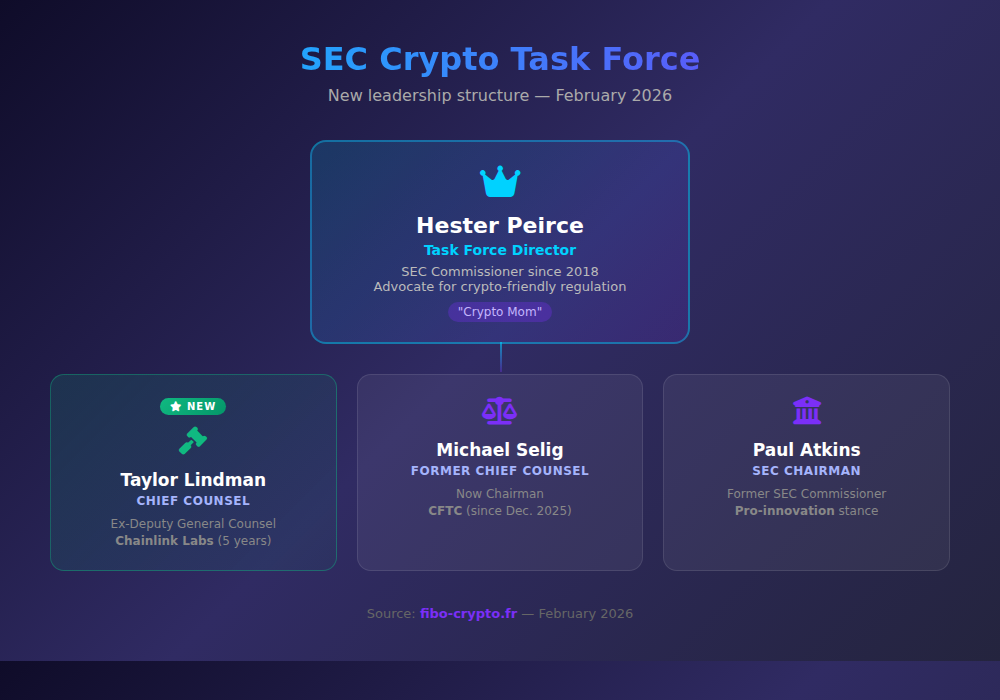
The SEC Crypto Task Force structure
The SEC’s Crypto Task Force now brings together profiles from both regulatory backgrounds and industry experience:
Who is Hester Peirce?
Hester Peirce, nicknamed “Crypto Mom” by the community, leads this task force. An SEC Commissioner since 2018, she has distinguished herself through her pro-innovation positions and criticism of the former leadership’s punitive approach.
Upon announcing Lindman’s appointment, Peirce posted on X: “Welcome Taylor! Great things ahead.” — a message that reflects the regulator’s enthusiasm for this new era.
Who does Lindman replace?
Taylor Lindman succeeds Michael Selig, who left the position in December 2025 to lead the Commodity Futures Trading Commission (CFTC). This rotation illustrates the growing professionalization of crypto regulation in the United States, with senior profiles moving between agencies and the private sector.
Why this appointment is historic
This appointment comes amid a radical transformation of U.S. crypto policy under the Trump administration:
1. End of “regulation by enforcement”
Under Gary Gensler, the former SEC Chair (2021-2025), the agency adopted an aggressive approach: lawsuits against Coinbase, Binance, Ripple, Kraken… without providing a clear regulatory framework. The result: billions of dollars in legal fees for the industry and a brain drain to more welcoming jurisdictions.
Under the new leadership, the SEC now favors dialogue and guidance over systematic enforcement.
2. Pro-industry profiles at the helm
Lindman’s appointment adds to a series of symbolic choices:
- Paul Atkins: new SEC Chairman, former commissioner favorable to crypto
- Hester Peirce: heading the Crypto Task Force
- Michael Selig: former Chief Counsel, now CFTC Chairman
- Taylor Lindman: directly from Chainlink
3. The GENIUS Act and regulatory clarity
Passed in July 2025, the GENIUS Act laid the groundwork for a legal framework for stablecoins. Issuers now hold over $150 billion in U.S. Treasury bonds, creating an unprecedented link between crypto and traditional monetary policy.
Lindman’s unique expertise
Taylor Lindman’s background positions him ideally for this role:
Oracle and infrastructure specialist
At Chainlink, Lindman worked on legal issues surrounding:
- Token classification (utility vs security)
- Decentralized data provider liability
- Cross-chain interoperability and its regulatory implications
- Smart contracts and their legal status
Chainlink (LINK), currently the 16th largest cryptocurrency by market cap at $5.8 billion, represents the mature infrastructure that regulators must now embrace — not fight.
Bridge between innovation and compliance
Lindman understands both worlds: the technical constraints of decentralized protocols AND the requirements of traditional financial regulators. This dual expertise was sorely lacking at the SEC until now.
What does this mean for the crypto industry?
For blockchain projects
Legal teams at crypto projects can expect:
- Clearer guidelines on token classification
- A consultation process before enforcement action
- Better understanding of technical specifics by the regulator
For Chainlink specifically
Lindman will need to recuse himself from any case directly involving Chainlink. However, his general expertise on oracles will inevitably influence how the SEC approaches this category of infrastructure.
For investors
A predictable regulatory framework is generally favorable for markets. The professionalization of SEC crypto oversight could:
- Reduce legal uncertainty
- Facilitate institutional entry
- Stabilize valuations in the long term
Key takeaways
Taylor Lindman’s appointment as Chief Counsel of the SEC’s Crypto Task Force symbolizes a new era in U.S. crypto regulation. For the first time, an expert coming directly from the industry — with 5 years of experience at a leader like Chainlink — joins the regulator’s decision-making core.
Under the leadership of Hester Peirce and with support from the Trump administration, the U.S. SEC is shifting from an adversarial stance to a collaborative approach. A development that Europe, bogged down in the complexities of MiCA, is probably watching closely.
📚 Glossary
- SEC : Securities and Exchange Commission, the U.S. federal agency responsible for regulating securities markets and protecting investors.
- Crypto Task Force : A specialized unit within the SEC dedicated to developing cryptocurrency regulation, led by Commissioner Hester Peirce.
- Oracle : A service that provides external data to smart contracts on a blockchain, enabling them to interact with real-world information.
- Smart Contract : A self-executing program stored on a blockchain that automatically enforces the terms of an agreement when predefined conditions are met.
- DeFi : Decentralized Finance, a financial ecosystem built on blockchain technology that operates without traditional intermediaries like banks.
- CFTC : Commodity Futures Trading Commission, the U.S. agency regulating derivatives markets including certain crypto products.
- Stablecoin : A cryptocurrency designed to maintain a stable value, typically pegged to a fiat currency like the U.S. dollar.
Frequently Asked Questions
Who is Taylor Lindman?
Taylor Lindman is the new Chief Counsel of the SEC’s Crypto Task Force. He previously served as Deputy General Counsel at Chainlink Labs for 5 years, where he specialized in regulatory issues surrounding oracles, smart contracts, and DeFi infrastructure.
What is the SEC Crypto Task Force?
The SEC Crypto Task Force is a specialized unit within the Securities and Exchange Commission dedicated to developing crypto regulation. Led by Commissioner Hester Peirce (“Crypto Mom”), it marks a shift from the agency’s previous enforcement-first approach to a more collaborative regulatory framework.
Why is this appointment significant for the crypto industry?
This is the first time a legal executive coming directly from a major crypto company joins the SEC’s decision-making core. It signals the Trump administration’s pro-crypto stance and suggests future regulations will be developed with deeper understanding of blockchain technology.
What happened to Gary Gensler's approach to crypto?
Under Gary Gensler (2021-2025), the SEC pursued “regulation by enforcement” — filing lawsuits against major exchanges like Coinbase and Binance without providing clear guidelines. The new leadership under Paul Atkins has shifted to dialogue and guidance instead.
📰 Sources
This article is based on the following sources:
- The Block – Chainlink’s Taylor Lindman joins SEC
- Blockchain Magazine – Former Chainlink Labs Executive Appointed
- Bitcoin World – SEC Crypto Task Force Gains Industry Veteran
Comment citer cet article : Fibo Crypto. (2026). Former Chainlink Executive Appointed SEC Crypto Task Force Chief Counsel. Consulté le 25 February 2026 sur https://fibo-crypto.fr/en/blog/taylor-lindman-chainlink-sec-crypto-task-force-en