
Crypto Portfolio: Complete Guide to Building and Diversifying in 2026
📋 En bref (TL;DR)
- Mandatory diversification: spread across 4-6 cryptos minimum with a 40% maximum cap per asset to reduce risk
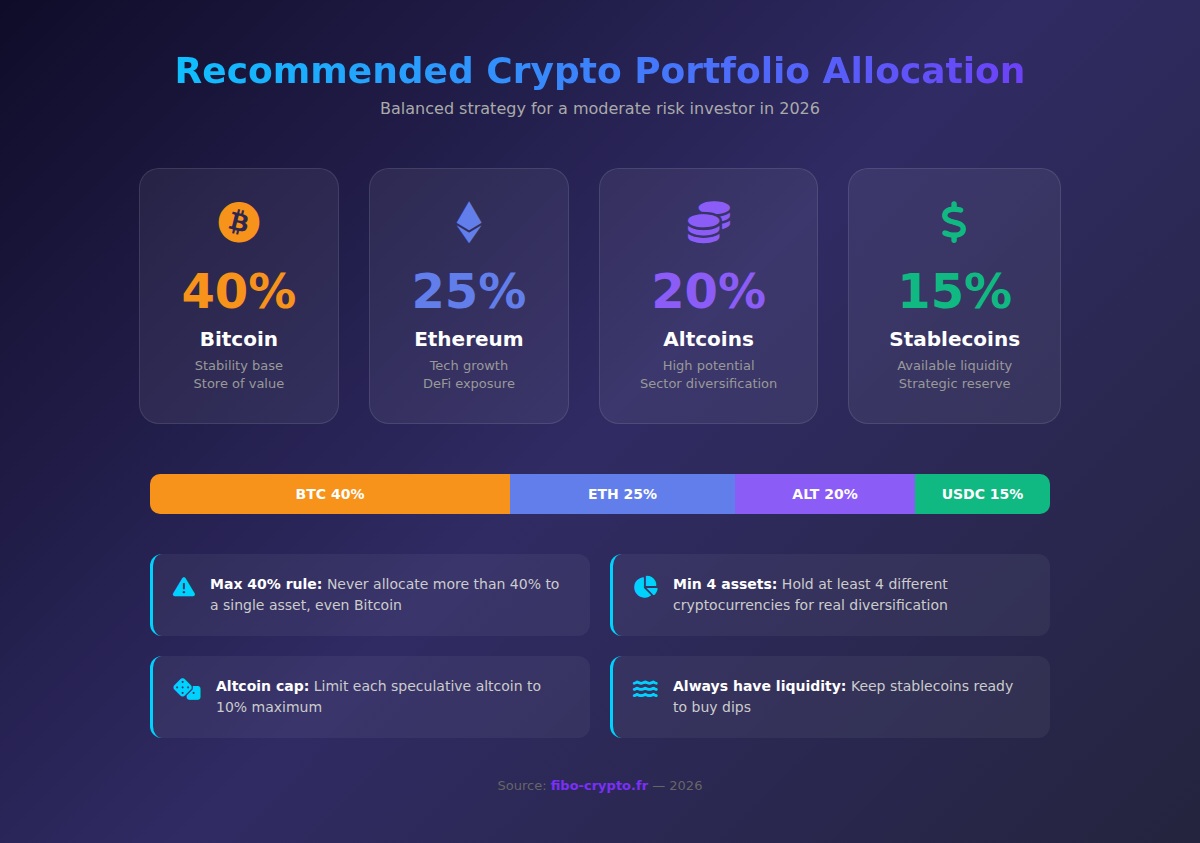
- Model 2026 allocation: 40% Bitcoin, 25% Ethereum, 20% promising altcoins, 15% stablecoins for liquidity
- Security first: use a cold wallet (Ledger, Trezor) once you have $5,000+ invested — $1.7 billion stolen from hot wallets in 2023
- Quarterly rebalancing: adjust positions to maintain your target allocation and lock in gains automatically
- Assess your risk tolerance: a crypto portfolio can lose 40-70% in weeks — adapt your strategy accordingly
- Avoid classic mistakes: no FOMO, no emotional trading, never store your seed phrase online
- Turnkey solution: Fibo managed portfolios offer diversification and automatic rebalancing without the hassle
Building a solid crypto portfolio isn’t about luck or following the latest tips on X (Twitter). It’s a methodical approach that requires thought, discipline, and a real investment strategy. In 2026, as the cryptocurrency market has matured but remains volatile, the difference between successful investors and those who lose everything often comes down to portfolio construction quality.
In this complete guide, we’ll explore together all the steps to build a diversified and resilient crypto portfolio: from assessing your risk profile to regular rebalancing, including asset selection and fund security. Whether you’re investing €500 or €50,000, these principles apply universally.
What Is a Crypto Portfolio and Why Diversify It?
A crypto portfolio refers to all the cryptocurrencies you hold. Unlike a wallet which is a technical storage tool, the portfolio represents your strategic allocation: which assets you own and in what proportions.
Portfolio diversification is the first principle of smart investing. It involves spreading your investments across several different assets to reduce overall risk. If one crypto collapses (like Terra Luna in 2022 or FTX the same year), other positions partially compensate for the loss.
Concrete Benefits of Crypto Diversification
- Reduced volatility: a diversified portfolio experiences less extreme fluctuations than one concentrated on a single asset
- Exposure to different sectors: DeFi, Layer 2, AI, NFT — each sector has its own cycles
- Protection against specific risks: protocol hacks, targeted regulatory issues, technical flaws
- Multiple growth opportunities: if you miss one crypto’s rally, you can benefit from another’s

Assessing Your Risk Tolerance: The Essential Starting Point
Before choosing any cryptocurrency, you must ask yourself a fundamental question: how much volatility can you handle emotionally AND financially?
The crypto market can lose 30 to 50% in weeks. In 2022, Bitcoin dropped from $69,000 to $16,000 in less than a year. If you’re not psychologically prepared to see your portfolio cut in half, you risk panic selling at the worst moment.
The 3 Crypto Investor Profiles
Conservative Profile
- Priority on capital preservation
- Allocation: 50% BTC, 20% ETH, 10% established altcoins, 20% stablecoins
- Ideal if investing emergency savings or approaching retirement
Balanced Profile (Moderate)
- Seeking a return/risk compromise
- Allocation: 40% BTC, 25% ETH, 20% promising altcoins, 15% stablecoins
- The most common profile for a 3-5 year horizon
Aggressive Profile
- Maximizing potential gains, accepting high volatility
- Allocation: 30% BTC, 25% ETH, 35% high-potential altcoins, 10% stablecoins
- Only recommended with money you can afford to lose entirely
To accurately assess your risk profile, we recommend taking our dedicated quiz that analyzes your financial situation, investment horizon, and stress resistance.
Asset Categories for Building a Balanced Crypto Portfolio
A well-constructed crypto portfolio isn’t just about “buying Bitcoin.” It incorporates different asset categories, each playing a specific role in your strategy.
1. Bitcoin (BTC): The Essential Foundation
Bitcoin remains the reference cryptocurrency. With a market cap exceeding $1.5 trillion in 2026, it’s the most liquid and institutionally adopted asset. Its volatility, while still present, is lower than altcoins.
Role in portfolio: relative stability base, store of value, exposure to institutional adoption (Bitcoin ETFs, corporate reserves).
Recommended allocation: 30-50% depending on your risk profile.
2. Ethereum (ETH): The Decentralized Application Infrastructure
Ethereum is much more than a cryptocurrency. It’s the platform hosting the majority of DeFi applications, NFTs, and smart contracts. Its transition to Proof of Stake in 2022 significantly reduced its energy consumption and introduced a deflationary mechanism.
Role in portfolio: exposure to DeFi growth and blockchain applications, yield potential via staking.
Recommended allocation: 20-30%.
3. High-Potential Altcoins: Sector Diversification
Altcoins (all cryptos other than Bitcoin) offer higher growth potential but with increased risk. The goal is to select solid projects across different sectors:
- Layer 2: Arbitrum, Optimism, Polygon — scalability solutions for Ethereum
- Alternative blockchains: Solana, Avalanche, Sui — complete ecosystems
- Oracles: Chainlink — critical infrastructure for DeFi
- Artificial intelligence: Fetch.AI, Render — crypto/AI convergence
- RWA (Real World Assets): real asset tokenization projects
Recommended allocation: 15-35% spread across 3-5 projects maximum.
4. Stablecoins: Your Strategic Reserve
Stablecoins (USDC, USDT, DAI) are cryptocurrencies pegged to the dollar. Far from being “useless,” they play a crucial strategic role:
- Available liquidity: ability to buy quickly during a crash
- Profit-taking without exiting the market: convert to stables without selling to fiat
- Yield generation: some DeFi protocols offer returns on stablecoins
Recommended allocation: 10-20%.
How to Concretely Allocate Your Crypto Portfolio?
Let’s move from theory to practice with concrete allocation examples based on different investment amounts.
Example 1: €1,000 Portfolio (Beginner)
- Bitcoin: €500 (50%)
- Ethereum: €300 (30%)
- 1 solid altcoin (Solana or Chainlink): €200 (20%)
With a small capital, focus on market leaders. Excessive diversification dilutes your positions and proportionally increases fees.
Example 2: €10,000 Portfolio (Intermediate)
- Bitcoin: €4,000 (40%)
- Ethereum: €2,500 (25%)
- 3 altcoins (Solana, Arbitrum, Chainlink): €2,000 (20%)
- Stablecoins (USDC): €1,500 (15%)
Example 3: €50,000+ Portfolio (Advanced)
- Bitcoin: €20,000 (40%)
- Ethereum: €12,500 (25%)
- 5-6 sector-diversified altcoins: €10,000 (20%)
- Stablecoins + DeFi positions: €7,500 (15%)
Golden Rules of Allocation
- Never more than 40% on a single asset — even Bitcoin
- Minimum 4 different assets for real diversification
- No more than 10% on a speculative altcoin
- Always keep a liquidity reserve (stablecoins or fiat)
Securing Your Crypto Portfolio: Hot Wallet vs Cold Wallet
Security is the often-neglected pillar of portfolio management. In crypto, you are your own bank — meaning you bear full responsibility for protecting your assets.
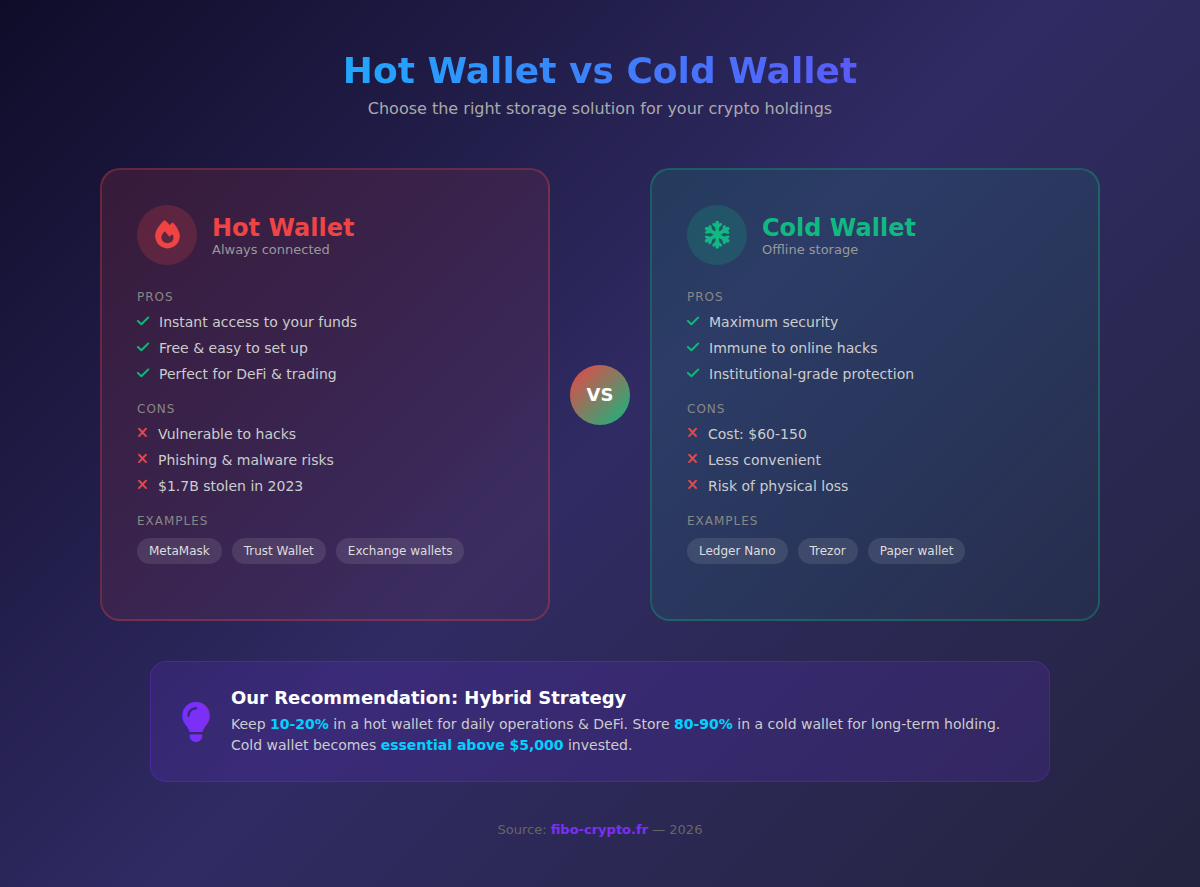
Hot Wallet: Convenient but Vulnerable
A hot wallet is permanently connected to the Internet. This includes applications like MetaMask, Trust Wallet, or exchange-integrated wallets.
Advantages: immediate access, free, ideal for active trading and DeFi interactions.
Risks: vulnerable to hacks, phishing, malware. More than $1.7 billion was stolen from hot wallets in 2023.
Cold Wallet: Maximum Security
A cold wallet stores your private keys offline, typically on a dedicated hardware device (Ledger Nano X, Trezor Model T).
Advantages: protection against 90% of hack types, institutional-grade security.
Disadvantages: cost ($60-150), less convenient for frequent transactions.
Our Recommendation: The Hybrid Strategy
- Hot wallet: 10-20% of your crypto for daily operations
- Cold wallet: 80-90% for long-term storage
- Critical threshold: above $5,000 invested, a cold wallet becomes essential
Protecting Your Seed Phrase: Vital Rules
Your seed phrase (12 or 24-word recovery phrase) is the ultimate key to your crypto. If someone obtains it, they can steal all your funds.
- Write on paper only — never in a digital file, never as a photo
- Store in 2 different physical locations — safe, trusted family member
- Never share it — no legitimate support will ever ask for it
- Consider a metal plate — fire and water resistant
Rebalancing: The Discipline That Makes the Difference
Building a portfolio isn’t enough. You need to maintain it over time through a process called rebalancing.
Why Rebalance?
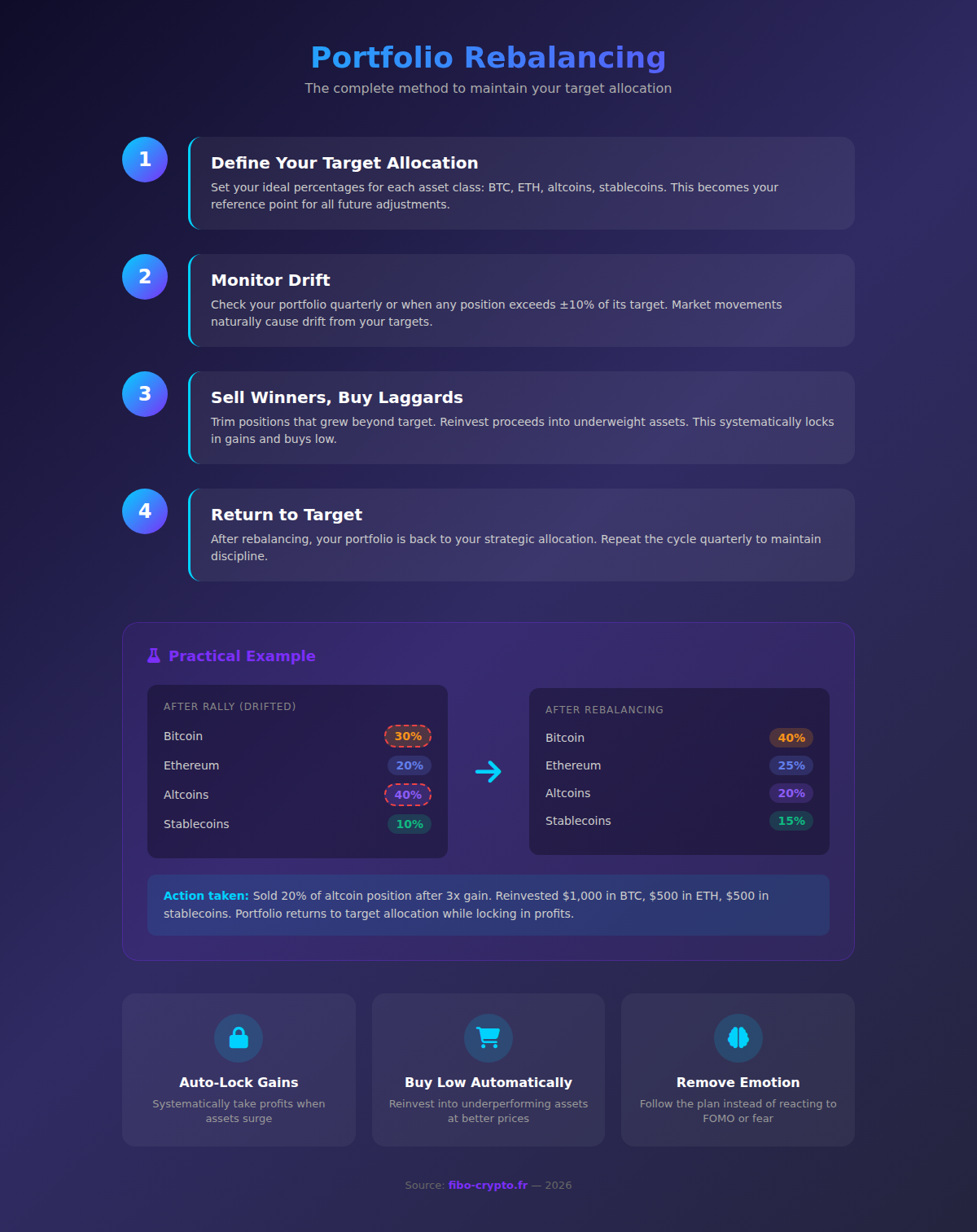
The crypto market is volatile. If you invested 20% in Solana and the token triples, that position could represent 40% of your portfolio. You’re then overexposed to a single asset without having consciously decided it.
Rebalancing involves selling part of positions that outperformed to reinforce underweight ones, thus returning your portfolio to its target allocation.
When to Rebalance?
- Fixed frequency: at least quarterly
- Trigger threshold: when any position exceeds ±10% of its target allocation
- After major events: bull run, crash, significant news
Concrete Rebalancing Example
Imagine a €10,000 portfolio with this target allocation: BTC 40%, ETH 25%, altcoins 20%, stables 15%.
After a rally, Solana (in altcoins) has tripled. The new distribution is: BTC 30%, ETH 20%, altcoins 40%, stables 10%.
Rebalancing action:
- Sell part of Solana to recover €2,000
- Reinvest: €1,000 in BTC, €500 in ETH, €500 in stablecoins
- Return to target allocation
This discipline allows you to automatically lock in gains and buy at lows for underperforming assets — the opposite of emotional behavior that leads to buying high and selling low.

Fatal Mistakes to Absolutely Avoid
After helping thousands of investors, here are the most common mistakes that destroy crypto portfolios.
1. Investing Under FOMO
FOMO (Fear Of Missing Out) pushes you to buy when everyone is talking about a crypto — usually at the top. Result: you buy at the high and watch your investment drop 50% in the following weeks.
Solution: define your investment plan BEFORE looking at prices. Stick to it.
2. Putting All Your Eggs in One Basket
“I’m putting everything on Solana, it’s the next Ethereum” — this phrase has preceded countless losses. Even the most promising projects can fail (Terra Luna was worth $100 before falling to $0).
Solution: never more than 10-15% on an altcoin, no matter how “safe” it seems.
3. Neglecting Security
Storing your seed phrase in phone notes, using the same password everywhere, clicking links received via DM… These basic negligences cause more losses than sophisticated hacks.
4. Not Having an Exit Strategy
At what price do you sell? To take what profit? Without clear answers to these questions, you’ll fall victim to greed (never selling) or panic (selling at the worst moment).
Solution: set price targets and stick to them. Ex: “I sell 25% of my BTC position at $150,000.”
5. Ignoring Tax Implications
Tax regulations vary by country. In many jurisdictions, every sale, exchange, or conversion is a taxable event. Not planning ahead can lead to a painful tax bill.

Alternative Solution: Fibo Managed Portfolios
Building and maintaining a crypto portfolio requires time, knowledge, and iron discipline. Not everyone has these resources — and that’s normal.
Fibo managed portfolios offer a professional alternative: diversified allocation, optimized by experts, with automatic rebalancing adapted to your risk profile.
Benefits of Managed Portfolios
- Professional expertise: allocation defined by crypto analysts
- Automatic rebalancing: you don’t have to do anything
- Market adaptation: adjustments based on conditions
- Institutional security: partnership with regulated custodians
- Total transparency: you remain owner of your assets
It’s the ideal solution for those who want exposure to cryptocurrency potential without dedicating hours every week.

Conclusion: Building a Crypto Portfolio Is a Long-Term Investment
Building a solid and smart crypto portfolio isn’t a one-time act but a continuous process. The principles are simple — diversify, secure, rebalance — but their rigorous application makes all the difference between investors who thrive and those who quit after their first loss.
Cryptocurrencies remain a young and volatile asset class. But with a structured approach, appropriate risk management, and the necessary discipline, they can play a significant role in building your wealth.
Ready to take action? Start by assessing your risk tolerance, define your target allocation, choose your assets carefully, and above all — never neglect the security of your funds.
📚 Glossary
- Crypto portfolio : All cryptocurrencies held by an investor, with their percentage distribution.
- Diversification : Strategy of spreading investments across several different assets to reduce overall risk.
- Allocation : Distribution of assets in a portfolio, expressed as percentages (e.g., 40% BTC, 25% ETH).
- Rebalancing : Action of returning a portfolio to its target allocation by selling overweight positions and reinforcing underweight ones.
- Hot wallet : Crypto wallet connected to the Internet, convenient but vulnerable to hacks (MetaMask, Trust Wallet).
- Cold wallet : Crypto wallet storing private keys offline, offering maximum security (Ledger, Trezor).
- Seed phrase : Sequence of 12 or 24 words allowing recovery of access to a crypto wallet. Must be absolutely protected.
- Stablecoin : Cryptocurrency whose price is pegged to a fiat currency (USDC, USDT pegged to the dollar).
- Altcoin : Any cryptocurrency other than Bitcoin. Generic term covering thousands of different projects.
- DeFi (Decentralized Finance) : Ecosystem of financial applications running on blockchain without centralized intermediaries.
- Layer 2 : Scalability solution built on top of a main blockchain to improve throughput and reduce fees.
- FOMO : “Fear Of Missing Out”, fear of missing an opportunity that leads to impulsive purchases at the wrong time.
- Volatility : Measure of price variation amplitude. Cryptos are known for their high volatility.
Frequently Asked Questions
How much should I invest in cryptocurrency to start?
There’s no minimum required — you can start with $50 or $100. The golden rule is to only invest money you can afford to lose entirely without impacting your daily life. Most experts recommend limiting crypto exposure to 5-15% of your total wealth depending on your risk profile. Start small, learn, then gradually increase.
How to effectively diversify a crypto portfolio?
Effective diversification relies on three axes: diversification by asset type (Bitcoin, Ethereum, altcoins, stablecoins), by sector (DeFi, Layer 2, AI, NFT), and by risk level. Aim for minimum 4-6 different cryptos with a 40% maximum cap on any single asset. Avoid over-diversification (more than 15 tokens) which dilutes your gains and complicates tracking.
What's the best crypto portfolio allocation for 2026?
For a moderate investor, the recommended allocation is: 40% Bitcoin (stability), 25% Ethereum (tech growth), 20% promising altcoins (potential), 15% stablecoins (liquidity). This distribution offers a balance between security and gain potential. Adjust according to your profile: more BTC if conservative, more altcoins if aggressive.
Do I need a cold wallet to secure my crypto?
Yes, once you exceed $5,000 invested. A cold wallet (Ledger, Trezor) stores your private keys offline, protecting you from 90% of hack types. The cost ($60-150) is negligible compared to the risk. Keep only 10-20% in a hot wallet for daily operations.
How often should I rebalance my crypto portfolio?
The recommended practice is quarterly rebalancing or whenever a position exceeds ±10% of its target allocation. For example, if your target for an altcoin is 15% and it reaches 25% after a rally, it’s time to sell part of it to return to balance. This disciplined process automatically locks in gains.
Bitcoin or Ethereum: which should I prioritize in a portfolio?
Both are complementary, not competitors. Bitcoin is a store of value, less volatile, institutionally adopted — it’s your stability base. Ethereum is an application platform with more growth potential but more risk. A balanced portfolio contains both: 40% BTC + 25% ETH is a solid foundation.
Are managed crypto portfolios a good option?
Yes, for those lacking time or expertise. Managed portfolios like those offered by Fibo provide professional allocation, automatic rebalancing, and institutional security. You remain owner of your assets while benefiting from expert management. It’s particularly suited for beginners and busy investors.
How to avoid losing my cryptocurrencies?
Three vital rules: 1) Use a cold wallet for significant amounts, 2) NEVER store your seed phrase online (photo, cloud, email), 3) Enable two-factor authentication (2FA) everywhere. Most crypto losses come from basic negligence (phishing, compromised seed phrase) rather than sophisticated hacks.
📰 Sources
This article is based on the following sources:
- CoinShares – Why Diversify with Crypto
- Chainalysis – 2024 Crypto Crime Report
- Kriptomat – Building a Balanced Portfolio
- Bitcoin Whitepaper – Satoshi Nakamoto
- Ethereum Foundation
Comment citer cet article : Fibo Crypto. (2026). Crypto Portfolio: Complete Guide to Building and Diversifying in 2026. Consulté le 22 February 2026 sur https://fibo-crypto.fr/en/blog/crypto-portfolio-guide-diversification