
Portfolio Diversification: Complete Guide for Crypto and Wealth (2026)

📋 Key Takeaways (TL;DR)
- Definition: portfolio diversification means spreading investments across multiple assets, sectors, and geographic regions to reduce overall risk
- Why it matters: a diversified portfolio reduces volatility by ~30% without sacrificing returns according to Vanguard
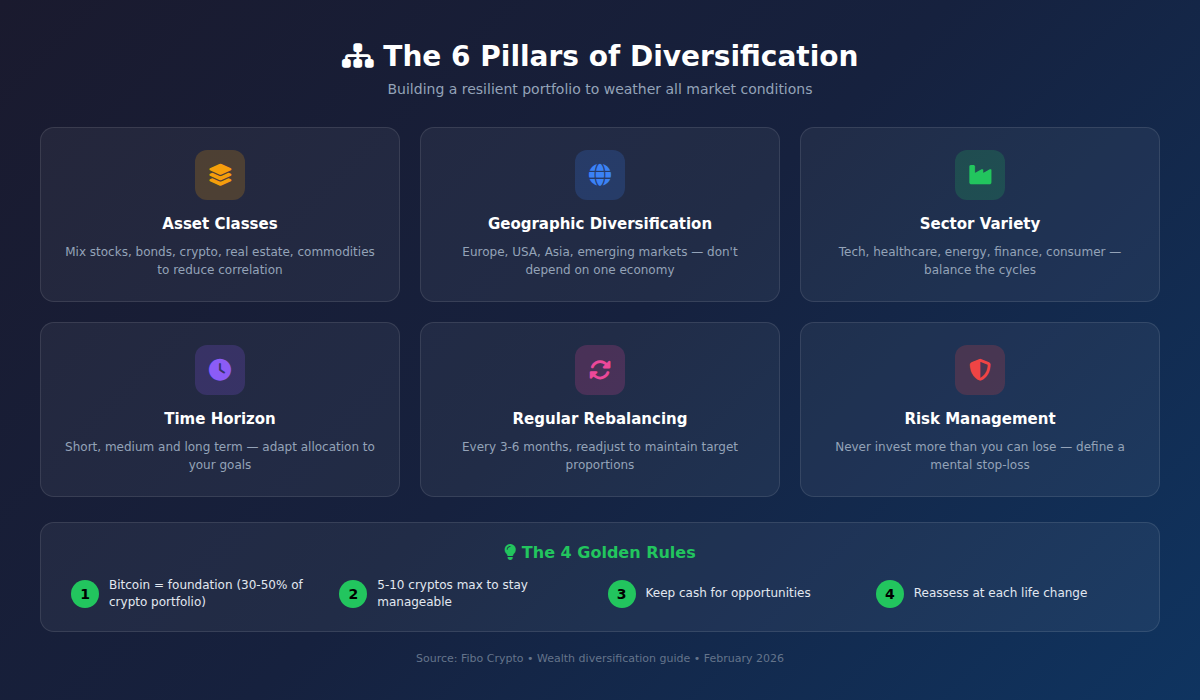
- The 3 axes: diversify by asset class (stocks, crypto, bonds), geography (Europe, USA, Asia), and sectors (tech, healthcare, energy)
- In crypto: Bitcoin = foundation (30-50%), complement with ETH, major altcoins, and keep 10-15% in stablecoins
- Golden rule: 5 to 10 cryptos maximum for a manageable, optimized portfolio
- Rebalancing: adjust every 3-6 months to maintain target proportions
- By profile: conservative (50% BTC), balanced (35% BTC + 25% alts), aggressive (25% BTC + 35% alts)
Portfolio diversification is an investment strategy that involves spreading capital across multiple assets, sectors, and geographic regions to reduce overall risk. Its fundamental principle: don’t put all your eggs in one basket.
In a financial world where crises multiply and correlations between assets evolve rapidly, diversification is no longer optional — it’s essential. This comprehensive guide explains how to build a resilient portfolio, whether you invest in crypto, stocks, or a mix of both.
Why Has Diversification Become Essential?
Today’s financial world no longer resembles yesterday’s. Market cycles are shortening, crises are multiplying, and correlations between assets form and dissolve within weeks.
The numbers speak for themselves:
- In 2022, Bitcoin dropped 65% while US bonds lost “only” 13%
- In 2024, the Nasdaq lost 10% in two days before Bitcoin rebounded 20%
- According to Vanguard, a multi-asset allocation reduces volatility by about 30% over 10 years
The 3 Fundamental Axes of Diversification
1. Asset Class Diversification
- Stocks: long-term growth, medium to high volatility
- Bonds: stability and regular income, low volatility
- Cryptocurrencies: high growth potential, very high volatility
- Real Estate (REITs): rental income, inflation protection
- Commodities (gold): safe haven during crises
2. Geographic Diversification
Don’t depend on a single economy: US, Europe, Asia, emerging markets.
3. Sector Diversification
Balance across tech, healthcare, energy, finance, and consumer sectors.

How to Diversify Your Crypto Portfolio
By Market Cap
- Large caps (Bitcoin, Ethereum): relative stability, portfolio foundation
- Mid caps (Solana, Avalanche, Chainlink): growth potential, moderate risk
- Small caps (emerging projects): high potential, high risk
Sample Allocations by Profile
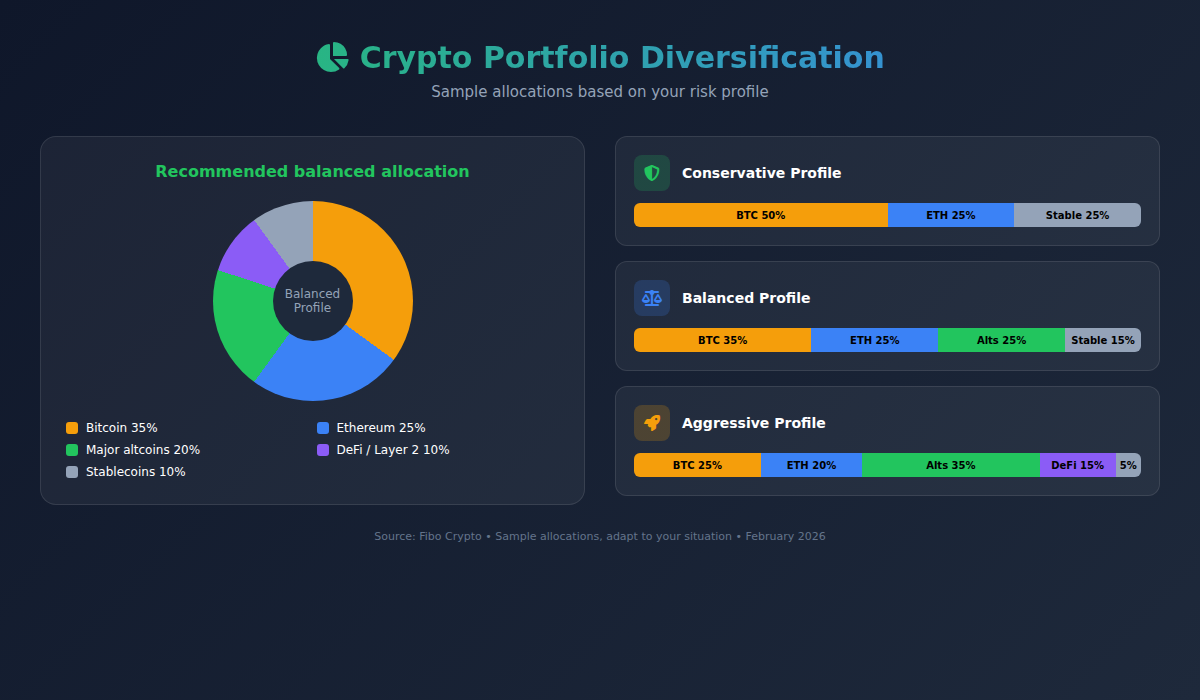
Conservative: Bitcoin 50%, Ethereum 25%, Stablecoins 25%
Balanced: Bitcoin 35%, Ethereum 25%, Altcoins 25%, Stablecoins 15%
Aggressive: Bitcoin 25%, Ethereum 20%, Altcoins 35%, DeFi 15%, Stablecoins 5%
Common Diversification Mistakes to Avoid
- Over-diversifying: 50 different cryptos isn’t diversification, it’s dispersion. Rule: 5-10 cryptos maximum.
- False diversification: buying 10 altcoins all correlated to Bitcoin doesn’t reduce risk.
- Neglecting rebalancing: if Bitcoin triples and becomes 80% of your portfolio, you’re no longer diversified.
- Ignoring your risk profile: align allocation with your actual risk tolerance.
Rebalancing: Key to Lasting Diversification
Rebalancing means periodically returning your portfolio to target proportions:
- Frequency: every 3-6 months, or when an asset deviates more than 5-10% from target
- Method: sell what has risen too much, buy what has fallen
- Benefit: mechanically enforces “buy low, sell high”
Integrating Crypto into a Global Portfolio
Crypto should represent only part of your overall wealth:
- 5-10% for conservative profiles
- 10-20% for balanced profiles
- 20-30% maximum for aggressive profiles
📚 Glossary
- Diversification: Strategy of spreading investments across multiple assets to reduce overall portfolio risk.
- Correlation: Statistical measure of the relationship between two assets. Uncorrelated assets (near 0) don’t move together.
- Rebalancing: Periodically returning a portfolio to target proportions by selling winners and buying losers.
- Volatility: Measure of how much an asset’s price fluctuates. Higher volatility means larger price swings.
- Asset Allocation: Distribution of capital among different asset classes based on goals and risk profile.
- Large cap: High-capitalization cryptocurrency (>$10B) like Bitcoin and Ethereum, generally more stable.
- Altcoin: Any cryptocurrency other than Bitcoin. Includes Ethereum and all other projects.
- Stablecoin: Cryptocurrency pegged to a stable asset (usually the dollar), like USDC or USDT.
Frequently Asked Questions
What is portfolio diversification?
Portfolio diversification is an investment strategy that involves spreading capital across multiple assets, sectors, and geographic regions to reduce overall risk. The goal is for losses on some assets to be offset by gains on others.
Why diversify a crypto portfolio?
Diversifying your crypto portfolio reduces risk tied to a single asset’s volatility. If Bitcoin drops 30%, a diversified portfolio with Ethereum, altcoins, and stablecoins will suffer smaller losses than a 100% Bitcoin portfolio.
How many cryptos should be in a portfolio?
The ideal is to hold between 5 and 10 different cryptocurrencies. Fewer than 5 means insufficient diversification. More than 10 spreads positions too thin and makes tracking each project difficult.
What percentage of Bitcoin in a crypto portfolio?
Bitcoin should form your crypto portfolio’s foundation: 30-50% for a balanced profile, up to 50% for conservative, and 20-30% for aggressive profiles seeking more growth through altcoins.
How often should you rebalance?
Rebalancing should occur every 3-6 months, or when an asset deviates more than 5-10% from its target. Sell assets that have grown too large, buy those that have shrunk.