
Crypto Bull Run: Understanding Market Cycles to Invest Smarter

📋 En bref (TL;DR)
- Crypto bull run: A prolonged period of market growth, typically lasting 12-18 months, where cryptocurrency prices rise dramatically
- 4-year cycle: The crypto market follows a predictable pattern tied to Bitcoin halving (mining rewards cut in half every 210,000 blocks)
- 4 distinct phases: Accumulation → Bull run → Distribution → Bear market, each phase offering different opportunities for investors
- Halving as catalyst: Historically, each halving (2012, 2016, 2020, 2024) has preceded a new all-time high within 12-18 months
- Institutional adoption: Bitcoin and Ethereum ETFs, traditional banks, and corporate treasuries are now accelerating bull market cycles
- Identification signals: Rising volume, resistance breakouts, positive sentiment (Fear & Greed Index), and increasing media coverage
- Risk management: Never invest more than you can afford to lose, diversify, and define your exit strategy before entering
The crypto bull run fascinates and frightens investors in equal measure. This bullish market period, characterized by spectacular price increases, can transform modest investments into substantial gains — or ruin those who enter at the wrong time. Understanding crypto market cycles is essential to navigating this volatile market successfully.
In this comprehensive guide, we analyze the cryptocurrency market cycles in depth, the crucial role of Bitcoin halving, the catalysts that trigger bull runs, and most importantly, how to position yourself intelligently to profit from these bullish phases while protecting your capital.
What is a crypto bull run?
A crypto bull run refers to a prolonged period of rising prices in the cryptocurrency market. The term comes from how a bull attacks: thrusting its horns upward, symbolizing the upward movement of prices.
Unlike traditional markets where a bull market can extend over several years in a relatively stable manner, crypto bull runs are characterized by their intensity: gains of 300%, 500%, or even over 1000% in just a few months are not uncommon for Bitcoin, and even more spectacular for certain altcoins.
Characteristics of a crypto bull run
Several elements distinguish a true bull run from a simple technical bounce:
- Significant duration: A bull run typically extends over 12 to 18 months, unlike rallies lasting only a few weeks
- New all-time highs (ATH): Bitcoin breaks its previous records, pulling the rest of the market along
- Growing volume: Trading increases massively, signaling an influx of new capital
- Media coverage: Mainstream media begins discussing crypto positively
- Widespread FOMO: Fear Of Missing Out attracts new investors
- Altseason: After Bitcoin, altcoins explode in turn, often with even more impressive performances

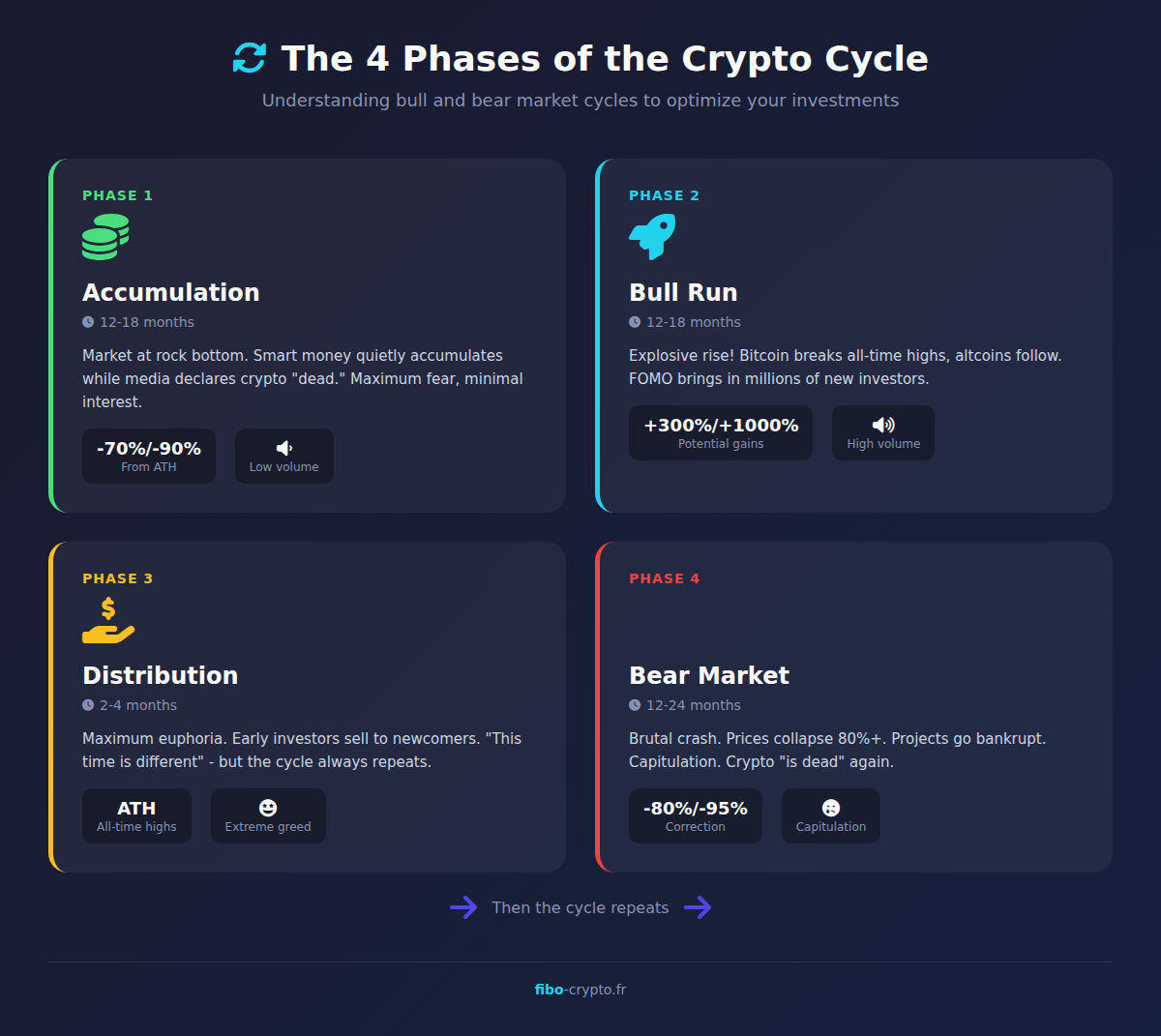
The 4 phases of the crypto cycle
The cryptocurrency market follows a 4-phase cycle that repeats with remarkable regularity. Understanding these phases allows you to anticipate market movements and adapt your strategy accordingly.
Phase 1: Accumulation (12-18 months)
After a devastating bear market, the market enters a period of stabilization and accumulation. The characteristics of this phase:
- Prices stagnate at low levels, often 70-90% below previous highs
- Trading volume is low, public interest nearly nonexistent
- Media declares crypto “dead” (for the umpteenth time)
- Savvy investors (“smart money”) quietly accumulate
- Many weak projects disappear; only the strongest survive
- Overall sentiment is pessimistic, sometimes desperate
This is paradoxically the best phase to invest, as prices are at their lowest and upside potential is maximum. However, it requires patience and conviction, as nothing seems to move for months.
Phase 2: The bull run (12-18 months)
The bull market often starts quietly before exploding. This phase typically unfolds in several waves:
Wave 1 — The silent rise: Bitcoin begins climbing slowly, breaking key resistance levels. Experienced traders notice the movement, but the general public remains absent.
Wave 2 — Acceleration: Bitcoin reaches new all-time highs (ATH). Media coverage intensifies. Institutional investors enter massively through ETFs and other regulated products.
Wave 3 — Altseason: Capital begins migrating from Bitcoin to altcoins. Ethereum performs strongly, followed by other large caps, then small caps. Gains of 10x, 50x, even 100x occur on certain projects.
Wave 4 — Euphoria: Everyone talks about crypto. Your colleagues, your family, the taxi driver. Valuations reach irrational levels. This is often the signal that the top is near.

Phase 3: Distribution (2-4 months)
This transition phase is the hardest to identify. Early investors begin selling their positions to newcomers:
- Price forms a “plateau” near the highs, with high volatility
- Euphoria is at maximum: “this time is different,” “we’re going to 1 million”
- Media is unanimously bullish (contrarian signal)
- New projects raise millions in minutes
- First warning signs appear but are ignored
- “Whales” (large holders) gradually distribute their tokens
This is the most dangerous moment for late investors who buy at the top, convinced the rally will continue indefinitely.
Phase 4: The bear market (12-24 months)
The brutal correction following the top is devastating:
- Prices collapse 70% to 90% from the highs
- Altcoins often lose 95% or more of their value
- Exchanges and projects go bankrupt (Mt.Gox, FTX, Terra…)
- Capitulation: the last “hodlers” sell in panic
- Media announces (again) the death of crypto
- The cycle can then restart with a new accumulation phase
Bitcoin halving: The major bull run catalyst
The Bitcoin halving is the most predictable and arguably the most important event on the crypto calendar. Every 210,000 blocks (approximately 4 years), the reward given to miners for each validated block is cut in half.
Why does the halving impact price?
The mechanism is simple: supply shock. Before the 2024 halving, miners received 6.25 BTC per block. After, only 3.125 BTC. This means daily creation of new bitcoins was halved, dropping from approximately 900 BTC to 450 BTC per day.
With stable or growing demand (ETFs, institutional adoption, new users) and reduced supply, basic economics applies: the price rises.
Halving history and performance
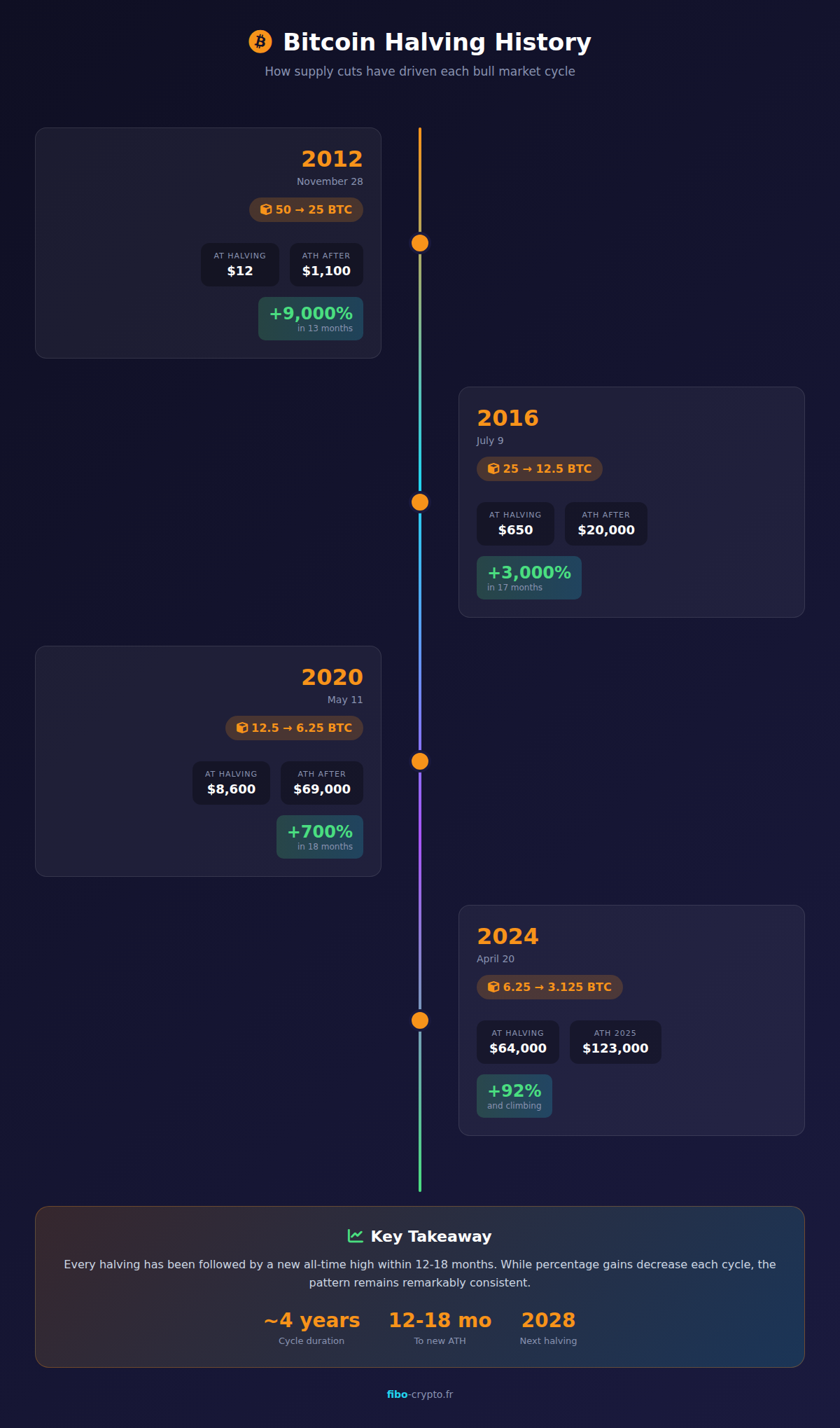
Every halving has preceded a new all-time high:
- 1st halving (2012): Price at halving ~$12 → Following ATH ~$1,100 (+9,000%)
- 2nd halving (2016): Price at halving ~$650 → Following ATH ~$20,000 (+3,000%)
- 3rd halving (2020): Price at halving ~$8,600 → Following ATH ~$69,000 (+700%)
- 4th halving (2024): Price at halving ~$64,000 → 2025 ATH ~$123,000 (+92%)
We observe diminishing returns with each cycle, which is logical: as Bitcoin’s market cap grows, more capital is needed to move the price. A +9,000% gain on a $100 million asset is very different from a similar gain on a $1 trillion asset.
Timing of the post-halving bull run
Historically, the market top arrives 12 to 18 months after the halving:
- 2012 halving (November) → Top December 2013 (13 months)
- 2016 halving (July) → Top December 2017 (17 months)
- 2020 halving (May) → Top November 2021 (18 months)
- 2024 halving (April) → Expected top late 2025?
This pattern is not a guarantee, but it provides a useful timeframe for investors.

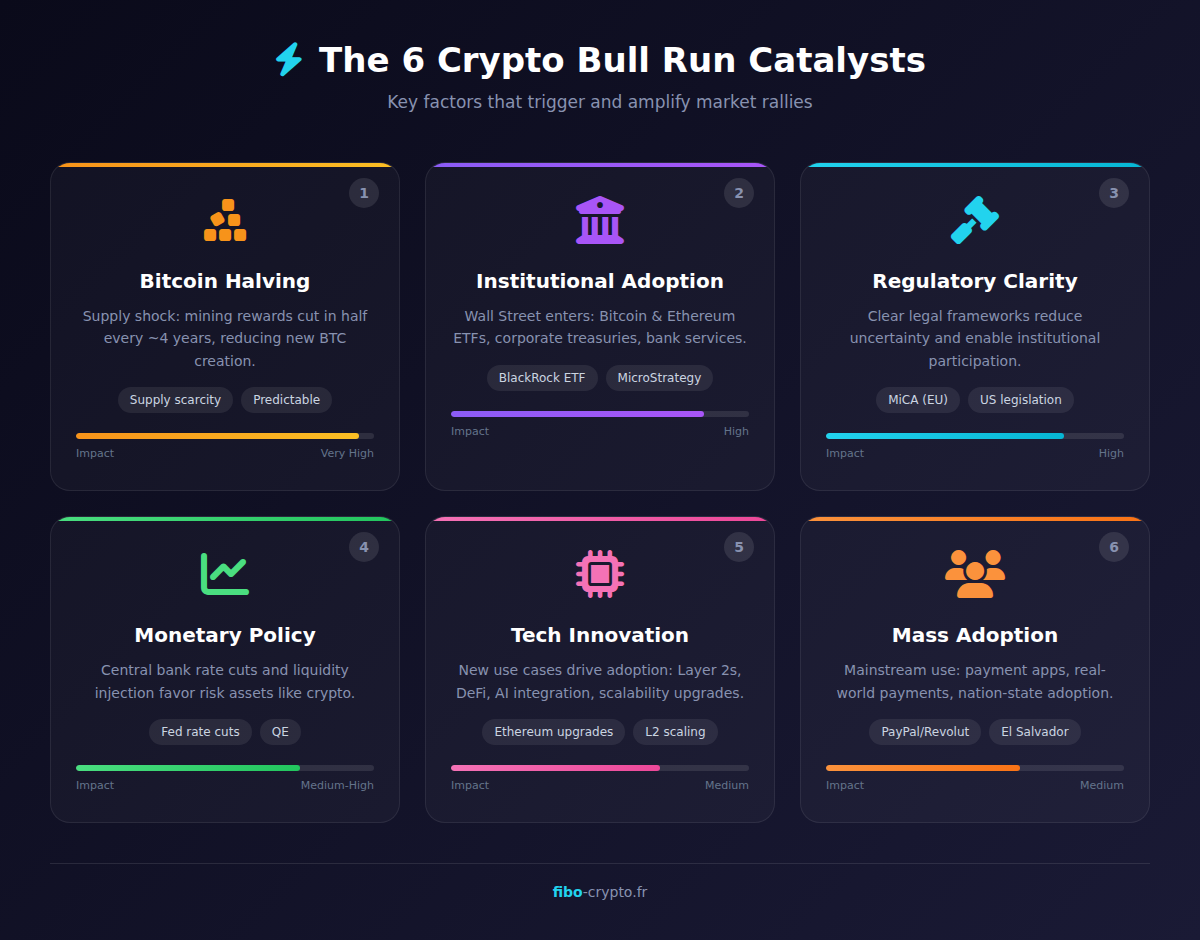
The 6 crypto bull run catalysts
Beyond the halving, several factors can trigger or amplify a bull market. In 2024-2025, we witnessed an exceptional confluence of these catalysts.
1. Institutional adoption
The entry of institutional investors has transformed the crypto market:
- Bitcoin and Ethereum ETFs: Funds from BlackRock, Fidelity, and other giants allow traditional investors to access crypto through regulated products. BlackRock’s Bitcoin ETF has accumulated over $90 billion in assets.
- Corporate BTC holdings: MicroStrategy holds over 200,000 BTC; Tesla, Square, and others follow.
- Traditional banks: Goldman Sachs, Morgan Stanley now offer crypto services to their clients.
2. Regulatory clarity
A clear legal framework reassures investors:
- The GENIUS Act in the US legitimizes stablecoins
- MiCA in Europe provides a harmonized framework
- End of SEC lawsuits against Ripple and other major projects
- Recognition of Bitcoin as a legitimate investment asset
3. Accommodative monetary policy
Central bank decisions directly impact crypto:
- Interest rate cuts: Makes risky assets more attractive
- Quantitative easing: Injects liquidity into the economy
- Inflation: Drives investors toward limited-supply assets like Bitcoin
- Dollar weakness: Favors alternatives
4. Technological innovations
Technical advances create new use cases:
- Ethereum upgrades (scalability, staking)
- Layer 2 solutions (Arbitrum, Optimism, Base)
- AI/blockchain integration
- DeFi innovations (restaking, liquid staking)
5. Mass adoption
Everyday use of crypto is becoming mainstream:
- PayPal, Revolut, CashApp integrate crypto payments
- El Salvador and other countries adopt Bitcoin as legal tender
- Crypto cards enable real-time spending
6. Sentiment and momentum
Psychological factors amplify movements:
- Short squeezes: Forced liquidation of short positions
- FOMO: Influx of new investors
- Positive media coverage
- Network effects on social media

How to identify a bull run
Recognizing the start of a bull run allows you to position yourself early. Here are the key indicators to monitor:
Technical indicators
- Resistance breakouts: Bitcoin breaks key levels that blocked it for months
- Moving averages: Price moves above the 50 and 200-day MAs (“golden cross”)
- Growing volume: Rallies are accompanied by significant volume
- Higher highs, higher lows: Confirmed bullish market structure
On-chain indicators
- Whale accumulation: Large wallets increase their positions
- Exchange outflows: Investors withdraw their BTC for long-term holding
- MVRV ratio: Indicates whether Bitcoin is undervalued or overvalued
- NUPL (Net Unrealized Profit/Loss): Measures the market’s unrealized profit
Sentiment indicators
- Fear & Greed Index: Shift from “Fear” to “Greed”
- Google Trends: “Bitcoin” searches increasing
- Media coverage: Positive tone in mainstream media
- Social media activity: Rising crypto mentions on Twitter/X
How to invest during a bull run
Profiting from a bull run requires a clear strategy and rigorous risk management.
Entry strategies
- DCA (Dollar Cost Averaging): Invest a fixed amount regularly, regardless of price. Reduces volatility impact and the risk of poor timing.
- Buy the dip: Wait for 10-20% corrections to strengthen your position. Even in a bull run, temporary pullbacks occur.
- Core position + trading: Hold a long-term position (60-80%) and trade a portion (20-40%) to optimize entries/exits.
Exit strategies
The exit is more important than the entry. Many investors turn huge unrealized gains into actual losses for lack of an exit strategy:
- Progressive profit-taking: Sell 10-20% at each price milestone reached (2x, 3x, 5x…)
- Trailing stop: Place a stop-loss that follows the price (e.g., -20% from the high)
- Fixed targets: Define an exit price before entering and stick to it
- Rotation to stablecoins: Secure gains in USDC/USDT before the bear market
Allocation and diversification
A typical bull run allocation might be:
- Bitcoin (40-50%): The safest foundation
- Ethereum (20-30%): DeFi ecosystem and smart contracts
- Large caps (15-25%): Solana, Cardano, Avalanche…
- Small caps (5-15%): High potential but maximum risk

Mistakes to avoid during a bull run
Bull market euphoria leads to costly mistakes:
1. Investing more than you can lose
FOMO pushes people to borrow, sell assets, mortgage their house… Never invest money you need. An -80% bear market can last 2 years.
2. No exit strategy
“I’ll sell when it hits 1 million” — and you end up panic selling at -70%. Define your targets BEFORE investing.
3. Chasing pumps
Buying a token that just did +500% hoping it continues. This is often the best way to buy the exact top.
4. Going all-in on a single project
Even the most promising projects can fail. Diversification is essential.
5. Ignoring security
During bull runs, hackers are particularly active. Use a hardware wallet, enable 2FA everywhere, beware of scams.
6. Believing “this time is different”
Every cycle produces this phrase. And every time, a bear market eventually arrives. Cycles repeat.

2024-2025 bull run: Current cycle analysis
The current cycle presents unique characteristics that distinguish it from previous ones:
Positive factors
- ETFs approved: For the first time, institutional investors have simple, regulated access
- Pro-crypto administration: In the US, the political tone shift is radical
- Market maturity: More robust infrastructure, fewer major hacks
- Corporate adoption: More companies integrating crypto
Caution factors
- High valuations: Bitcoin above $100,000 represents massive market cap
- Diminishing returns: Percentage gains decrease each cycle
- Macro correlation: Crypto is increasingly correlated with traditional markets
- Geopolitical risks: Trade tensions, conflicts can impact all markets
Outlook
If the historical pattern holds, the cycle top could occur between late 2025 and mid-2026. However, market institutionalization could also extend cycles, as some analysts suggest with talk of “super-cycles” or “more gradual, less explosive” cycles.
📚 Glossary
- Bull run : A prolonged period of rising prices in financial markets, characterized by investor optimism and high trading volumes.
- Bear market : A bearish market, a prolonged period of declining prices (typically -20% or more from highs).
- Halving : A programmed event in the Bitcoin protocol that halves miner rewards every 210,000 blocks (approximately 4 years).
- ATH (All-Time High) : The highest price ever reached by an asset.
- FOMO (Fear Of Missing Out) : Fear of missing an opportunity, leading to impulsive purchases often at the wrong time.
- Altseason : A period when altcoins (cryptos other than Bitcoin) outperform Bitcoin, typically at the end of a bull run.
- Whale : An investor holding a very large amount of cryptocurrency, capable of influencing the market through their transactions.
- DCA (Dollar Cost Averaging) : An investment strategy involving regular fixed-amount purchases regardless of price.
- Smart money : Capital from institutional or experienced investors, often considered better informed.
- Market cap : Total value of an asset (price × number of units in circulation).
- ETF (Exchange-Traded Fund) : An exchange-traded fund allowing investment in an asset (like Bitcoin) through a traditional financial product.
- On-chain : Data and metrics directly from the blockchain, such as transaction count or wallet movements.
- Liquidation : Forced closure of a leveraged position when losses exceed available margin.
- Stablecoin : A cryptocurrency whose value is pegged to a fiat currency (usually the US dollar).
- Layer 2 : Scalability solutions built on top of a main blockchain to improve speed and reduce costs.
Frequently Asked Questions
When will the next crypto bull run happen?
It’s impossible to predict exactly when a bull run will occur, but history shows that major bull markets follow Bitcoin halvings by 12 to 18 months. With the last halving in April 2024, the current cycle could peak between late 2025 and mid-2026. However, increasing market institutionalization could modify this historical pattern.
How long does a crypto bull run last?
Historically, crypto bull runs last between 12 and 18 months. This period includes the initial acceleration phase, the euphoria peak, and the final bullish waves before the reversal. The distribution phase (top) typically lasts an additional 2 to 4 months before the bear market begins.
How do you know if we're in a bull run?
Several indicators help identify a bull run: Bitcoin breaks its previous all-time highs, trading volumes increase significantly, the Fear & Greed Index moves to “Greed” or “Extreme Greed,” mainstream media discusses crypto positively, and on-chain data shows accumulation by large wallets (whales).
Should you invest during a bull run or wait for the bear market?
Both approaches have advantages. Investing in a bear market offers the best prices but requires patience and conviction (the decline can last 1-2 years). Investing in a bull run can capture quick gains but carries the risk of buying near the top. DCA (regular investment) is often recommended as it neutralizes timing.
What triggers a crypto bull run?
Crypto bull runs are generally triggered by a combination of factors: Bitcoin halving (supply reduction), institutional adoption (ETFs, corporations), regulatory clarity, accommodative monetary policy (rate cuts), technological innovations, and widespread positive sentiment (FOMO).
Do altcoins perform better than Bitcoin in a bull run?
Generally yes, but with higher risk. In bull runs, altcoins tend to outperform Bitcoin percentage-wise, especially late in the cycle (“altseason”). However, they’re also the first and hardest hit during the reversal, often losing 90-99% of their value in bear markets versus “only” 70-80% for Bitcoin.
How do you protect your gains during a bull run?
Several strategies exist: take progressive profits at each milestone (sell 10-20% at each 2x), use trailing stops, convert a portion to stablecoins, diversify into less volatile assets, and most importantly define an exit strategy BEFORE investing and stick to it despite the euphoria.
Is the crypto bull run over if Bitcoin corrects 20%?
No, 20-30% corrections are normal even during a full bull run. Bitcoin experienced several corrections of this magnitude during previous cycles before heading to new highs. A bull run typically ends with a more severe correction (50%+) and a change in market structure (shift to “lower highs, lower lows”).
📰 Sources
This article is based on the following sources:
- Bitcoin Halving Report – CoinMetrics
- Bitcoin ETF Flows – Bloomberg
- Fear & Greed Index – Alternative.me
- Bitcoin Stock-to-Flow Model – PlanB
- On-Chain Analysis – Glassnode
- Crypto Market Structure – Messari
- Market Cycles – CoinGecko Research
Comment citer cet article : Fibo Crypto. (2026). Crypto Bull Run: Understanding Market Cycles to Invest Smarter. Consulté le 22 February 2026 sur https://fibo-crypto.fr/en/blog/crypto-bull-run-market-cycles