
Crypto Custody: Self-Custody vs Custodial Wallets Guide (2026)
📋 En bref (TL;DR)
- Crypto custody refers to how and where you secure your cryptocurrency private keys — the codes that prove ownership of your digital assets
- Self-custody means you control your own private keys through hardware or software wallets, giving you full ownership but also full responsibility
- Custodial solutions let third parties (exchanges, banks) hold your keys, offering convenience but introducing counterparty risk
- “Not your keys, not your coins” is the Bitcoin community’s warning: if you don’t control your private keys, you don’t truly own your crypto
- Hardware wallets (Ledger, Trezor) provide the highest security for long-term storage by keeping keys offline
- 59% of crypto users now prefer self-custody, while 41% use custodial solutions (2025 statistics)
- Institutional custody is evolving rapidly, with U.S. banks now permitted to offer crypto custody services following OCC guidelines in 2025
Crypto custody is the foundation of cryptocurrency ownership. Unlike traditional banking where institutions hold your money, cryptocurrencies give you the option to be your own bank. But with that power comes responsibility. Whether you’re holding $100 or $1 million in Bitcoin, understanding how to properly secure your digital assets can mean the difference between financial sovereignty and devastating loss.
In 2024 alone, over $2.2 billion was lost to crypto hacks and exchange failures. The collapse of FTX reminded millions of investors that keeping assets on an exchange carries real risks. Yet self-custody isn’t without challenges — lost seed phrases have locked away billions of dollars in Bitcoin forever.
This comprehensive guide will explain everything you need to know about crypto custody: the different methods available, how to choose the right solution for your needs, and the security best practices that protect your digital wealth.
What Is Crypto Custody? Definition and Fundamentals
Crypto custody refers to the secure storage and management of cryptocurrency private keys. In the cryptocurrency world, “custody” doesn’t mean holding physical coins — it means controlling the cryptographic keys that prove ownership of digital assets on a blockchain.
Every cryptocurrency wallet consists of two components: a public key (like an email address, used to receive funds) and a private key (like a password, used to authorize transactions). Whoever controls the private key controls the assets. This fundamental principle is what makes crypto custody so important.
There are three main approaches to crypto custody:
- Self-custody (non-custodial): You personally control your private keys using hardware or software wallets
- Custodial: A third party (exchange, bank, or custodian) holds your private keys on your behalf
- Hybrid/Multi-signature: Multiple parties must approve transactions, distributing control and risk
The custody method you choose affects your security, accessibility, and legal protections. Each has trade-offs that we’ll explore in detail throughout this guide.

Self-Custody vs Custodial Wallets: Complete Comparison
The choice between self-custody and custodial solutions is the most important decision any crypto investor makes. Understanding the differences helps you make an informed choice based on your priorities.
Self-Custody (Non-Custodial) Wallets
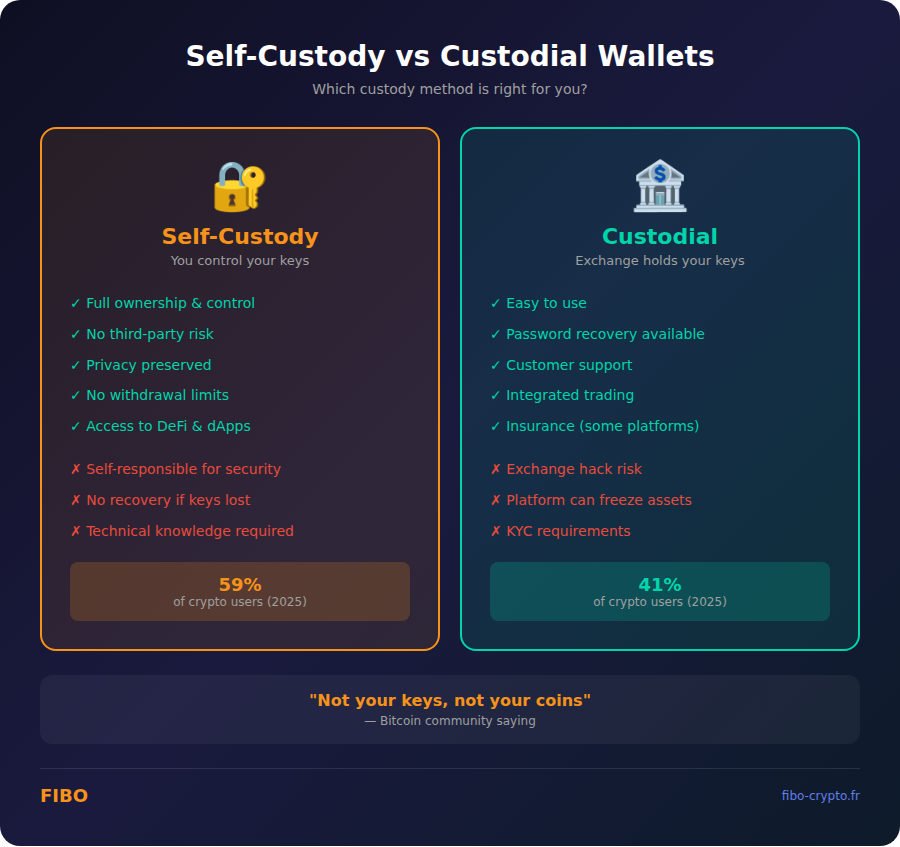
With self-custody, you hold your own private keys. No company, exchange, or government can freeze your assets or prevent you from accessing them. This is the principle behind the famous phrase “not your keys, not your coins”.
Advantages of self-custody:
- Full ownership and control over your assets
- No counterparty risk — you don’t depend on any company staying solvent
- Privacy — no KYC requirements, no data shared with third parties
- No withdrawal limits or delays
- Direct access to DeFi protocols, NFT marketplaces, and Web3 applications
- Assets cannot be frozen by governments or platforms
Disadvantages of self-custody:
- You are 100% responsible for security — no customer support if something goes wrong
- Lost seed phrases mean permanently lost funds (estimated $140 billion in lost Bitcoin)
- Requires technical knowledge and careful security practices
- No insurance or fraud protection
- Inheritance planning is more complex
Custodial Wallets (Exchange Custody)
Custodial solutions mean a third party — typically a cryptocurrency exchange like Coinbase, Kraken, or Binance — holds your private keys. You access your funds through your account, protected by a password and two-factor authentication.
Advantages of custodial wallets:
- Easy to use — familiar login experience like online banking
- Password recovery available — you can reset access if you forget credentials
- Customer support for issues
- Integrated trading — buy, sell, and exchange without moving funds
- Some platforms offer insurance coverage
- Regulatory compliance may provide legal protections
Disadvantages of custodial wallets:
- Exchange hack risk — Mt. Gox, FTX, and dozens of other exchanges have lost user funds
- Platform can freeze your account or restrict withdrawals
- KYC requirements mean sharing personal information
- You don’t truly “own” your crypto — you have a claim on the custodian
- Withdrawal limits may apply
- Dependent on company solvency
According to recent statistics, 59% of cryptocurrency users now prefer self-custody wallets, while 41% keep their assets on custodial platforms. This shift accelerated following high-profile exchange collapses in 2022-2024.
Types of Crypto Custody Solutions Explained
Understanding the specific custody tools available helps you make the right choice for your situation. Here’s a detailed breakdown of each option.
Hardware Wallets (Cold Storage)
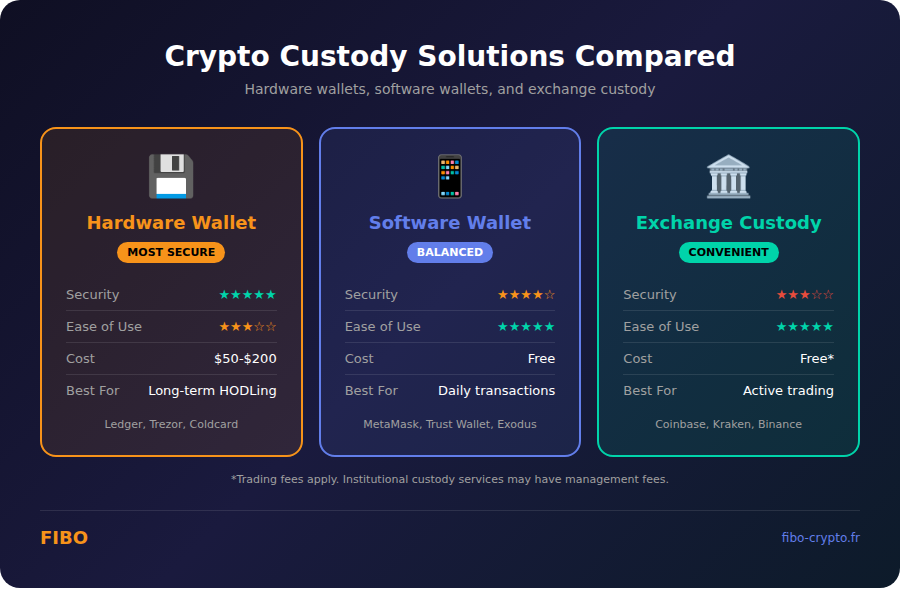
Hardware wallets are physical devices that store your private keys offline, disconnected from the internet. They’re considered the gold standard for cryptocurrency security.
How hardware wallets work: The device generates and stores your private keys in a secure element chip. When you want to make a transaction, you connect the wallet to your computer or phone, verify the transaction details on the device screen, and physically press a button to approve. The private key never leaves the device.
Popular hardware wallets:
- Ledger Nano X / Nano S Plus: Most popular choice, supports 5,500+ cryptocurrencies, Bluetooth connectivity (Nano X), prices from $79-$149
- Trezor Model T / Safe 3: Open-source firmware, touchscreen interface, strong security track record, prices from $69-$179
- Coldcard Mk4: Bitcoin-only, maximum security features, air-gapped operation, $147
- BitBox02: Swiss-made, minimalist design, excellent security, $139
Best for: Long-term holders (HODLers), anyone with significant crypto holdings ($1,000+), security-conscious users.
Software Wallets (Hot Wallets)
Software wallets are applications installed on your computer or smartphone. They’re called “hot wallets” because they’re connected to the internet.
Types of software wallets:
- Mobile wallets: Trust Wallet, MetaMask Mobile, Exodus — convenient for daily use and DeFi access
- Desktop wallets: Electrum (Bitcoin), Exodus, Atomic Wallet — more features than mobile apps
- Browser extensions: MetaMask, Phantom (Solana), Rabby — essential for interacting with Web3 applications
Advantages: Free, convenient, immediate access, excellent for DeFi and dApp interaction.
Risks: Vulnerable to malware, phishing attacks, and device compromise. If your phone or computer is hacked, your funds could be stolen.
Best for: Active traders, DeFi users, smaller amounts needed for regular transactions.
Exchange Custody
Keeping crypto on an exchange like Coinbase, Kraken, or Binance is the simplest option but carries the highest counterparty risk.
Best for: Active traders who need instant liquidity, beginners still learning, very small amounts.
Important consideration: Major exchanges like Coinbase hold customer funds separately and have significant insurance coverage. However, even well-regulated exchanges can face issues — always consider the risk.
Multi-Signature (Multisig) Wallets
Multi-signature wallets require multiple private keys to authorize a transaction. For example, a 2-of-3 multisig wallet needs any two of three keys to sign.
Use cases:
- Business treasury management (requires multiple executives to approve)
- Family inheritance planning (distribute keys among family members)
- Enhanced personal security (store keys in different locations)
Popular multisig solutions: Gnosis Safe, Casa, Unchained Capital.
Institutional Crypto Custody: How Big Money Secures Digital Assets
Institutional custody has evolved dramatically. Professional custodians serve hedge funds, corporations, and asset managers who need enterprise-grade security and regulatory compliance.
Regulatory Developments in 2025
The U.S. regulatory landscape for crypto custody shifted significantly in 2025:
- OCC Interpretive Letter 1183 (March 2025): Permitted national banks to offer cryptocurrency custody services without prior approval
- SEC Rule 15c3-3 guidance (December 2025): Clarified how broker-dealers can custody crypto asset securities
- CFTC tokenization guidance: Addressed custody arrangements for tokenized collateral
These changes mean traditional banks like BNY Mellon, State Street, and major financial institutions can now compete with crypto-native custodians.
Major Institutional Custodians
- Coinbase Custody: Largest crypto custodian, holds over $200 billion in assets, serves institutions and ETF providers
- BitGo: Pioneer in institutional custody, offers multi-signature solutions and $250M insurance
- Fidelity Digital Assets: Backed by traditional finance giant Fidelity Investments
- Fireblocks: MPC (multi-party computation) technology, serves 1,800+ institutions
- Anchorage Digital: First federally chartered crypto bank in the U.S.
Institutional custody typically includes: insurance coverage, regulatory compliance (SOC 2, ISO 27001), segregated cold storage, and white-glove service.
Not Your Keys, Not Your Coins: Understanding the Principle
The phrase “not your keys, not your coins” emerged from the Bitcoin community as a warning about custodial risk. It encapsulates a fundamental truth about cryptocurrency: ownership is determined by who controls the private keys.
Historical Examples That Proved the Point
Mt. Gox (2014): The world’s largest Bitcoin exchange lost 850,000 BTC ($460 million at the time, over $85 billion at 2025 prices). Users who kept Bitcoin on the exchange lost everything.
QuadrigaCX (2019): When the founder allegedly died, $190 million in customer crypto was locked away because only he had the private keys.
FTX (2022): The spectacular collapse revealed customer funds had been misappropriated. Billions in customer assets were frozen, and recovery took years.
The lesson: When you leave crypto on an exchange, you’re trusting that company to remain solvent, honest, and secure. Self-custody eliminates this trust requirement.
When Custodial Makes Sense
Despite the risks, custodial solutions aren’t always wrong:
- Active traders who need instant execution
- Users in jurisdictions with strong consumer protections
- Those who can’t safely manage their own keys (technical limitations, health issues)
- Institutions requiring regulatory compliance

Hardware Wallet Guide: Securing Your Crypto with Cold Storage
If you’re serious about cryptocurrency security, a hardware wallet is essential. Here’s how to set one up and use it safely.
Setting Up a Hardware Wallet
- Buy from official sources only — Never buy a hardware wallet from Amazon resellers or eBay. Tampered devices have been used to steal funds.
- Verify the package is sealed — Check for any signs of tampering before opening.
- Initialize the device — Follow the manufacturer’s instructions to set up a new wallet.
- Write down your seed phrase — The device will display 12-24 words. Write these on paper (the wallet includes recovery cards). NEVER type them on a computer or phone.
- Verify the seed phrase — Most devices will ask you to confirm words to ensure you wrote them correctly.
- Set a PIN — Choose a strong PIN that you won’t forget.
- Test with a small amount first — Send a small transaction to verify everything works before transferring large amounts.
Seed Phrase Security: The Most Critical Step
Your seed phrase (also called recovery phrase or mnemonic) is the master key to your funds. With these 12-24 words, anyone can restore your wallet and steal your assets.
Seed phrase best practices:
- Write it on paper or stamp it into metal (fire and water resistant)
- Store in multiple secure locations (safe, bank safe deposit box, trusted family member)
- NEVER store digitally — no photos, no cloud storage, no text files, no password managers
- Never share with anyone, including “support” representatives
- Consider splitting using Shamir’s Secret Sharing for large amounts
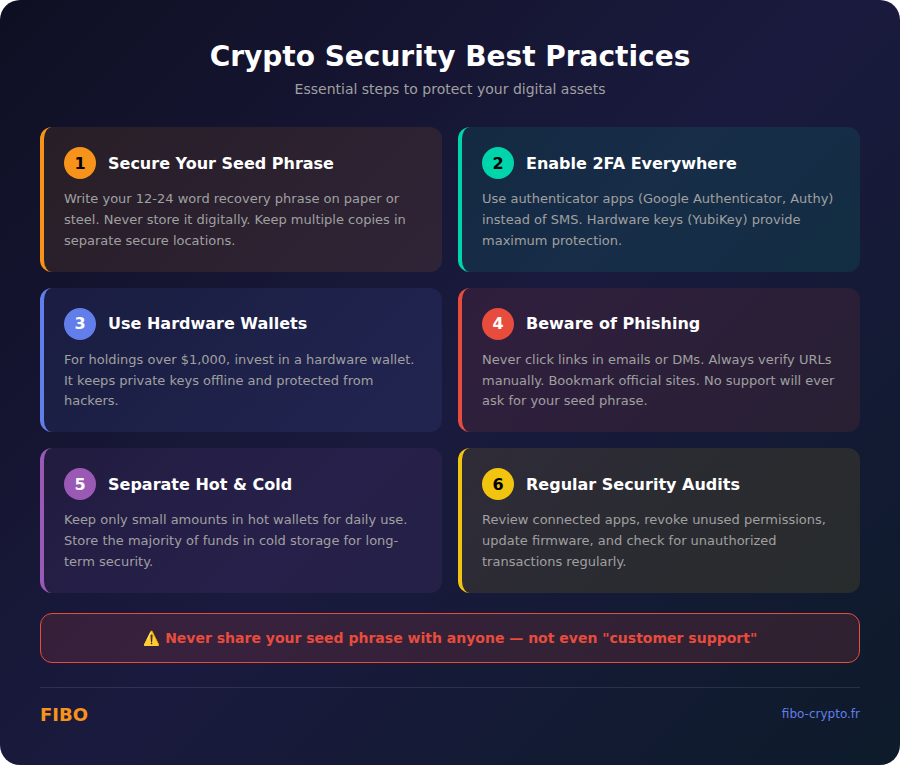
Crypto Security Best Practices: Protecting Your Digital Assets
Whether you choose self-custody or custodial solutions, these security practices protect your cryptocurrency investments.
1. Enable Two-Factor Authentication (2FA) Everywhere
Use authenticator apps like Google Authenticator, Authy, or Aegis — never SMS-based 2FA, which can be bypassed through SIM swapping attacks. For maximum security, use hardware security keys like YubiKey.
2. Use Strong, Unique Passwords
Every crypto account should have a unique, complex password. Use a password manager like Bitwarden, 1Password, or KeePass.
3. Beware of Phishing Attacks
The vast majority of crypto theft comes from social engineering, not sophisticated hacks:
- Never click links in emails or direct messages claiming to be from exchanges or wallet providers
- Bookmark official websites and only access them through your bookmarks
- Verify URLs carefully — scammers use lookalike domains
- No legitimate support will ever ask for your seed phrase or private keys
4. Separate Hot and Cold Storage
Keep only small amounts in hot wallets for daily transactions. Store the majority of your holdings in cold storage (hardware wallets). Think of it like keeping spending money in your wallet while the rest stays in a safe.
5. Regular Security Audits
Periodically review your security setup:
- Check connected applications and revoke access you don’t need (revoke.cash for Ethereum)
- Update firmware on hardware wallets
- Review transaction history for unauthorized activity
- Rotate passwords if any service you use has been breached
6. Plan for Inheritance
If something happens to you, will your loved ones be able to access your crypto? Create a clear inheritance plan that includes instructions for accessing your wallets without compromising current security.
![Cypherpunk History: Complete Guide to the Movement Behind Bitcoin [2026]](https://fibo-crypto.fr/wp-content/uploads/2025/12/l-histoire-des-cypherpunk-impact-et-h-ritage-1024x585.webp)
Hot Wallet vs Cold Wallet: Understanding the Difference
The terms “hot” and “cold” refer to internet connectivity:
Hot wallets are connected to the internet. This includes exchange accounts, mobile apps, browser extensions, and desktop wallets running on an internet-connected computer. They’re convenient but more vulnerable to attacks.
Cold wallets are disconnected from the internet. Hardware wallets are the most common form, but paper wallets and air-gapped computers also qualify. They’re more secure but less convenient for frequent transactions.
The Optimal Strategy: Layered Security
Most experienced crypto users adopt a layered approach:
- Cold storage (hardware wallet): 80-90% of holdings for long-term security
- Hot wallet (mobile/browser): 5-15% for DeFi, dApps, and regular transactions
- Exchange: 0-5% only for active trading, never for storage
Crypto Custody in 2026: Trends and Future Developments
The crypto custody landscape continues to evolve rapidly:
MPC (Multi-Party Computation): New technology that splits private keys across multiple parties without ever assembling them. Companies like Fireblocks and Qredo use MPC to provide institutional-grade security with better user experience.
Social Recovery: Pioneered by wallets like Argent, this approach lets trusted friends or family help you recover access without holding your actual keys.
Account Abstraction: Ethereum’s ERC-4337 standard enables smart contract wallets with advanced features like spending limits, recovery mechanisms, and gas sponsorship.
Bank Integration: Following 2025 regulatory changes, expect traditional banks to launch crypto custody services, potentially bringing institutional-grade security to retail customers.

How to Choose the Right Crypto Custody Solution
Your ideal custody solution depends on several factors:
Consider Your Holdings Value
- Under $500: Exchange or free software wallet is acceptable
- $500-$5,000: Consider a hardware wallet for primary storage
- $5,000+: Hardware wallet is strongly recommended
- $50,000+: Consider multisig or professional custody solutions
Consider Your Use Case
- Long-term holding: Hardware wallet with robust backup procedures
- Active DeFi user: Hot wallet with hardware wallet integration
- Active trader: Exchange custody for trading capital, cold storage for savings
- Business/Institution: Professional custody with multisig and insurance
Consider Your Technical Comfort
Self-custody requires technical competence. If you’re not confident managing seed phrases and understanding transaction verification, start with a reputable custodial solution while learning. Many users begin on exchanges and gradually transition to self-custody as their knowledge grows.

📚 Glossary
- Private Key : A secret cryptographic code that proves ownership of cryptocurrency and authorizes transactions. Must be kept secure — anyone with your private key controls your funds.
- Public Key : A cryptographic code derived from the private key, used as your wallet address to receive cryptocurrency. Safe to share publicly.
- Seed Phrase : A sequence of 12-24 words that can restore an entire wallet. Also called recovery phrase or mnemonic. The most critical security element.
- Self-Custody : Holding your own private keys without relying on third parties. Also called non-custodial.
- Custodial Wallet : A wallet where a third party (exchange, bank) holds your private keys on your behalf.
- Hardware Wallet : A physical device that stores private keys offline, providing cold storage security. Examples: Ledger, Trezor.
- Hot Wallet : A cryptocurrency wallet connected to the internet, providing convenience but increased attack surface.
- Cold Storage : Keeping cryptocurrency private keys offline, disconnected from the internet, for maximum security.
- Multi-Signature (Multisig) : A security feature requiring multiple private keys to authorize a transaction, distributing control and reducing single points of failure.
- MPC (Multi-Party Computation) : Advanced cryptographic technique that splits key management across multiple parties without ever reconstructing the full key.
- Two-Factor Authentication (2FA) : Security measure requiring two forms of verification to access an account.
- KYC (Know Your Customer) : Identity verification requirements imposed by regulated exchanges and custodians.
- Counterparty Risk : The risk that a third party holding your assets (exchange, custodian) fails, becomes insolvent, or acts maliciously.
- Air-Gapped : A device completely isolated from the internet, providing maximum security for cryptocurrency storage.
Frequently Asked Questions
What is the safest way to store cryptocurrency?
The safest way to store cryptocurrency is using a hardware wallet (cold storage) for the majority of your holdings. Hardware wallets like Ledger or Trezor keep your private keys offline, protected from online attacks. For optimal security, store your seed phrase backup in multiple secure locations (fireproof safe, bank safe deposit box), never digitally. For very large holdings ($100K+), consider multisignature setups or institutional-grade custody solutions with insurance coverage.
What does 'not your keys, not your coins' mean?
This phrase is a fundamental warning in the cryptocurrency community: if you don’t personally control your private keys, you don’t truly own your cryptocurrency. When you keep crypto on an exchange, you’re trusting that company to remain honest, solvent, and secure. History has shown this trust can be misplaced — Mt. Gox, FTX, and many other exchanges have lost user funds. Self-custody eliminates this counterparty risk by putting you in direct control of your assets.
Is it safe to keep crypto on Coinbase or Binance?
Keeping crypto on major exchanges like Coinbase or Binance is relatively safe for small amounts and active trading, but carries inherent risks. These platforms invest heavily in security and often have insurance coverage, but they remain targets for hackers and can face regulatory issues. The general recommendation is: only keep on exchanges what you’re actively trading, and move long-term holdings to self-custody. Coinbase Custody, for example, holds customer assets separately and has significant insurance, but even well-regulated platforms can face problems.
What happens if I lose my hardware wallet?
If you lose your hardware wallet, your cryptocurrency is NOT lost — as long as you have your seed phrase backup. Your seed phrase (the 12-24 words you wrote down during setup) can restore your entire wallet on a new device. Simply purchase a new hardware wallet (same or different brand) and choose “Restore wallet” during setup, then enter your seed phrase. This is why securely storing your seed phrase is the most critical aspect of crypto security. Without it, a lost or broken device means permanently lost funds.
What is the difference between hot and cold wallets?
Hot wallets are connected to the internet (mobile apps, browser extensions, exchange accounts), making them convenient but vulnerable to online attacks. Cold wallets store private keys offline (hardware wallets, paper wallets, air-gapped computers), providing superior security but less convenience for frequent transactions. Most experts recommend keeping 80-90% of crypto in cold storage and only small amounts in hot wallets for daily use.
How do institutional investors custody their crypto?
Institutional investors use specialized custody solutions that combine enterprise-grade security with regulatory compliance. Major custodians include Coinbase Custody, BitGo, Fidelity Digital Assets, and Fireblocks. These services typically offer: insured cold storage, multi-signature or MPC technology, SOC 2 compliance, segregated accounts, and dedicated support. Following 2025 regulatory changes (OCC Interpretive Letter 1183), traditional banks can now also offer crypto custody services, bringing additional options for institutions.
Should I use a hardware wallet for small amounts of crypto?
For holdings under $500, a reputable software wallet or exchange may be adequate — the cost of a hardware wallet ($70-$200) might not be justified. However, hardware wallets become strongly recommended once holdings exceed $1,000. Consider it like insurance: the $100 spent on a Ledger or Trezor is minimal compared to the security it provides. If you’re serious about cryptocurrency long-term, investing in a hardware wallet early teaches good security habits regardless of current balance.
Can the government seize crypto in self-custody?
Government seizure of self-custody cryptocurrency is extremely difficult without your cooperation. Unlike bank accounts that can be frozen with a court order, cryptocurrency in self-custody cannot be accessed without your private keys. However, governments can compel disclosure through legal processes, and refusing to comply can result in contempt charges. Additionally, while authorities can’t directly seize self-custody crypto, they can pursue asset forfeiture if you’re convicted of crimes. Self-custody provides sovereignty, not immunity from legal processes.
📰 Sources
This article is based on the following sources:
- SEC Investor Bulletin: Crypto Asset Custody Basics
- OCC Interpretive Letter 1183
- Kraken Learn: What is Crypto Custody?
- CoinLaw Self-Custody Wallet Statistics 2025
- Investopedia: Cryptocurrency Custody Solutions
- BitGo: Custodial vs Non-Custodial Wallets
Comment citer cet article : Fibo Crypto. (2026). Crypto Custody: Self-Custody vs Custodial Wallets Guide (2026). Consulté le 4 March 2026 sur https://fibo-crypto.fr/en/blog/crypto-custody-self-custody-guide