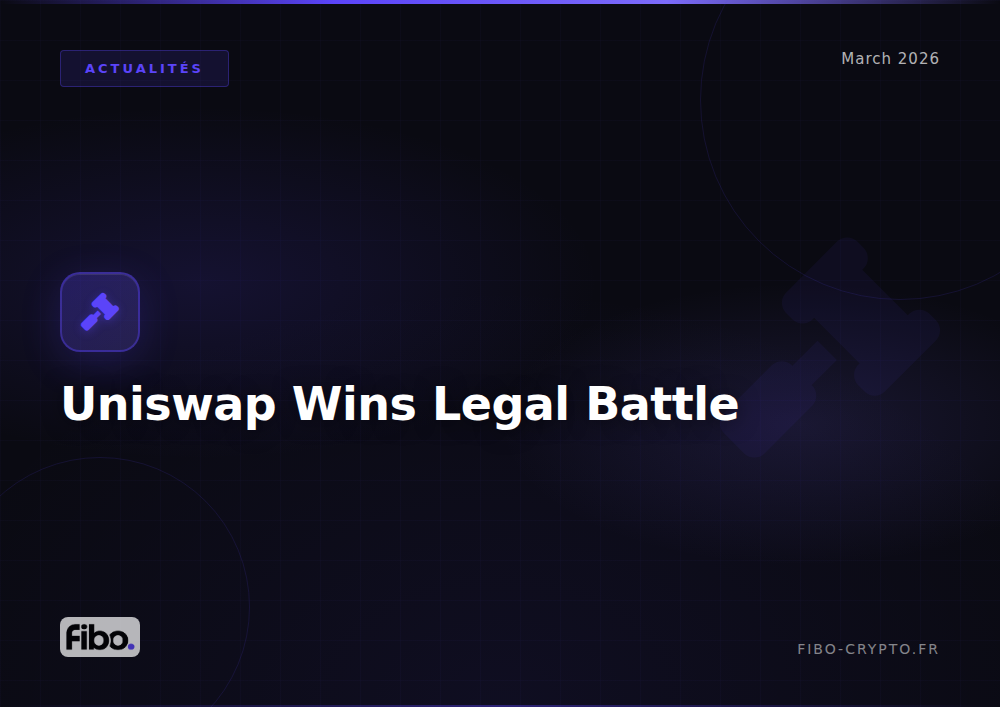
Uniswap Wins Legal Battle: A Landmark Precedent for DeFi
📋 TL;DR
- Class action dismissed: Judge Failla of the Southern District of New York has definitively dismissed all claims against Uniswap Labs
- Historic precedent: DeFi protocol developers are not liable for third-party fraud conducted through their platforms
- 4 years of litigation: The Risley v. Universal Navigation Inc. case, filed in 2022, has been closed permanently
- Legal comparison: The court drew parallels with Venmo and Zelle — platforms aren’t responsible for fraudulent use
- Complete victory: Uniswap Labs, Hayden Adams, the Uniswap Foundation, and VC investors are all cleared of accusations
- Market reaction: UNI token surged 6% following the announcement
March 2, 2026 will go down in DeFi history. Federal Judge Katherine Polk Failla of the Southern District of New York has delivered a definitive ruling: the class action lawsuit against Uniswap Labs has been dismissed in its entirety. This comprehensive legal victory establishes a fundamental precedent for the entire DeFi industry.
After four years of legal battles, the world’s largest decentralized exchange can finally move forward. But beyond Uniswap, this ruling validates the very philosophy of decentralization with unprecedented legal recognition in the United States.
The Risley Case: Four Years of Legal Warfare
Origins of the Lawsuit (2022)
It all began in April 2022, when a group of investors filed a class action lawsuit against Uniswap Labs in the federal court of New York. The plaintiffs, led by Nessa Risley, claimed they lost money purchasing “scam tokens” — fraudulent tokens — through the Uniswap protocol.
Their core argument: Uniswap Labs was effectively operating as an unregistered securities exchange and an unlicensed broker-dealer. According to them, the platform should have prevented these fraudulent tokens from circulating and therefore bore responsibility for their losses.
The Plaintiffs’ Claims
The aggrieved investors advanced several allegations:
- Uniswap functioned as an unregistered exchange under SEC regulations
- The platform acted as a broker-dealer without proper licensing
- Uniswap Labs generated revenue through liquidity fees while enabling fraudulent tokens to circulate
- The protocol’s smart contracts actively facilitated scams
The case raised a fundamental question: can creators of decentralized technology tools be held liable for malicious uses of their creations?
A Three-Stage Victory
First Victory: Federal Claims Dismissed (August 2023)
In August 2023, Judge Failla dealt the first major blow to the plaintiffs’ case by dismissing all federal accusations. The court established that Uniswap’s developers could not be classified as traditional exchange operators.
The Appeal and Remand (February 2025)
The plaintiffs appealed this decision. In February 2025, the Second Circuit Court of Appeals upheld the dismissal of federal claims but remanded the case back to the trial court to examine state law accusations.
This appellate decision was already a major win, as it established that smart contract creators are not responsible for fraudulent uses by third parties.
The Final Ruling (March 2026)
On March 2, 2026, Judge Failla put a definitive end to the matter. In her ruling, she dismissed the remaining state law claims “with prejudice” — meaning the plaintiffs can never bring these accusations again.
The court determined that the plaintiffs had failed to demonstrate:
- Actual knowledge of the frauds by Uniswap Labs
- Deceptive conduct under consumer protection laws
- Unjust enrichment by the developers
The Venmo-Zelle Analogy: A Decisive Comparison
One of the court’s most powerful arguments rests on a comparison with mainstream payment services. Judge Failla drew a direct parallel with Venmo and Zelle: if someone uses these apps to scam another person, nobody would think to sue PayPal or the banks operating these services.
This analogy is particularly significant because it anchors DeFi protocols within an already established legal framework for traditional financial technologies. Developers who create neutral tools cannot be held responsible for malicious uses of those tools.
The Doctrine of Technological Neutrality
The court explicitly referenced peer-to-peer technologies that can be misused for illicit purposes. This doctrine echoes precedents established during lawsuits against file-sharing platforms: technology creators are not responsible for how their technology is used, as long as that technology has substantial legitimate applications.
For Uniswap, this means its AMM (Automated Market Maker) model — which enables legitimate decentralized trading — protects it from accusations related to fraudulent tokens transiting through the protocol.
Implications for the DeFi Ecosystem
A Historic Legal Precedent
Hayden Adams, Uniswap’s founder, immediately reacted on X (formerly Twitter), highlighting the significance of this ruling: “If open source smart contract code is used by bad actors, the liability lies with those bad actors, not the developers.”
This statement captures the fundamental stakes of this lawsuit. Until now, the DeFi industry operated in a legal gray zone regarding protocol liability. This decision clearly establishes that:
- Decentralized protocol developers are not responsible for user actions
- Venture capital investors who fund these protocols don’t bear this responsibility either
- The open-source nature of code doesn’t create surveillance obligations
Who Is Protected by This Ruling?
The decision explicitly clears several parties:
- Uniswap Labs — the company that develops the interface and tools
- Hayden Adams — the founder and CEO
- The Uniswap Foundation — the non-profit organization managing governance
- VC investors — notably Andreessen Horowitz, Union Square Ventures, and Paradigm, who were also named in the lawsuit
The Broader Regulatory Context
The SEC Threat Remains
It’s important to distinguish this class action from potential SEC actions against Uniswap. In April 2024, Uniswap Labs received a Wells Notice from the SEC — a formal notification that the regulator was considering enforcement action.
At the time, Hayden Adams stated he was “ready to fight,” criticizing the SEC’s approach which, according to him, preferred to attack “good actors” rather than create clear rules for the industry.
This class action victory doesn’t determine the outcome of any potential SEC proceedings, but it significantly strengthens Uniswap’s legal position.
A Signal for the Industry
For the entire crypto ecosystem, this ruling arrives at a pivotal moment. As regulators worldwide seek to regulate DeFi, this American judgment establishes an important standard: technical decentralization provides real legal protection.
Other DeFi protocols — Aave, Compound, SushiSwap, Curve and others — can rely on this precedent to defend their operational model.

Market Reaction
Following the ruling announcement, the UNI token posted a 6% gain, trading around $3.97. This move reflects investor relief at the elimination of this major legal risk.
Beyond the immediate price action, this victory could have lasting positive effects on UNI’s valuation by significantly reducing the regulatory risk premium associated with the token.
Key Takeaways from This Historic Ruling
Judge Failla’s decision marks a turning point in the legal history of decentralized finance. It establishes that creators of neutral technological infrastructure — even when that infrastructure is used for fraudulent activities — don’t automatically bear responsibility for third-party actions.
For DeFi investors and users, this ruling provides much-needed clarity. It confirms that technological innovation can coexist with a reasonable legal framework, where liability remains where it belongs: on malicious actors, not on builders of tools.
Uniswap emerges from this ordeal strengthened, with a legal precedent that will benefit the entire decentralized ecosystem for years to come.
📚 Glossary
- DeFi (Decentralized Finance): A set of financial services (trading, lending, savings) operating on blockchain without centralized intermediaries like banks.
- DEX (Decentralized Exchange): A cryptocurrency exchange platform operating via smart contracts, without a central authority managing orders or user funds.
- Smart Contract: A self-executing computer program deployed on a blockchain that automatically executes when predefined conditions are met.
- AMM (Automated Market Maker): An algorithmic mechanism that automatically determines asset prices in a liquidity pool, enabling trades without a traditional order book.
- Scam Token: A fraudulent token created to defraud investors, often through “rug pulls” where creators disappear with the funds.
- SEC (Securities and Exchange Commission): The U.S. securities regulator responsible for overseeing financial markets and protecting investors in the United States.
Frequently Asked Questions
Why was the class action against Uniswap dismissed?
The court established that decentralized protocol developers cannot be held liable for fraudulent activities committed by third parties on their platform. The judge compared Uniswap to Venmo or Zelle: the platform isn’t responsible for malicious uses.
What does this mean for other DeFi protocols?
This decision creates an important legal precedent. Other DeFi protocols like Aave, Compound, or Curve can rely on this ruling to defend their operational model against similar lawsuits.
Is Uniswap now protected from all lawsuits?
This victory concerns only the investor class action. Uniswap Labs received a Wells Notice from the SEC in April 2024, suggesting possible separate regulatory action. However, this ruling significantly strengthens their legal position.
What does “dismissed with prejudice” mean?
A dismissal “with prejudice” means the case is permanently closed and the plaintiffs can never bring the same accusations again. It’s the most complete form of legal victory possible.
How does this ruling affect the UNI token?
The UNI token gained 6% following the announcement. Long-term, eliminating this major legal risk could reduce the regulatory risk premium associated with the token and support its valuation.
📰 Sources
This article is based on the following sources:
- Court Listener – Risley v. Universal Navigation Inc. – Full court decision (March 2026)
- The Defiant – Court Dismisses Class Action Lawsuit Against Uniswap
- Crypto Briefing – Uniswap secures full dismissal in scam token class action lawsuit
- Hayden Adams on X – Official reaction from Uniswap’s founder
How to cite this article: Fibo Crypto. (2026). Uniswap Wins Legal Battle: A Landmark Precedent for DeFi. Retrieved from https://fibo-crypto.fr/blog/uniswap-class-action-dismissed-defi-precedent