
Cypherpunk History: Complete Guide to the Movement Behind Bitcoin [2026]

📋 En bref (TL;DR)
- Cypherpunk movement: activist group founded in 1992 by Eric Hughes, Timothy May, and John Gilmore to defend digital privacy through cryptography
- Cypherpunk Manifesto: foundational 1993 text declaring that “privacy is necessary for an open society in the electronic age”
- Bitcoin precursors: cypherpunks invented DigiCash, Hashcash, b-money, and RPOW — the technological building blocks later used by Satoshi Nakamoto
- Satoshi Nakamoto: anonymous Bitcoin creator who published the whitepaper on the cypherpunk mailing list on October 31, 2008
- Hal Finney: legendary cypherpunk who received the first Bitcoin transaction on January 12, 2009
- Current legacy: the movement spawned Bitcoin ($1.8T market cap), end-to-end encryption used by billions, and the Tor network
- Principles still alive: “Code is Law,” “Don’t Trust, Verify,” decentralization — these cypherpunk ideas shape the entire crypto ecosystem in 2026
The cypherpunk movement is behind one of the most important technological revolutions of the 21st century. Without these cryptography activists who gathered in the 1990s, Bitcoin probably wouldn’t exist. Their vision of a world where privacy is protected by mathematics rather than laws gave birth to a crypto ecosystem worth nearly $2 trillion.
But who are the cypherpunks really? How did a group of mathematicians, programmers, and libertarians meeting in the San Francisco Bay Area manage to change the course of technological history? And most importantly, what is their legacy in today’s digital world?
In this comprehensive guide, we explore the fascinating history of the cypherpunk movement, its iconic figures, major achievements, and lasting impact on Bitcoin, blockchain, and digital privacy protection.

What is a cypherpunk? Definition and philosophy
A cypherpunk is an activist who advocates for the widespread use of strong cryptography and privacy-enhancing technologies to bring about social and political change. The term, coined by Jude Milhon in 1992, is a wordplay combining “cipher” (encryption) and “cyberpunk” (the science fiction literary genre).
Cypherpunk philosophy rests on several fundamental principles:
- Privacy is a fundamental right: contrary to what some governments believe, cypherpunks hold that every individual has the right to control their communications and transactions.
- Cryptography is a defensive weapon: it allows citizens to protect themselves against mass surveillance, whether from governments or corporations.
- Code is more powerful than laws: rather than trusting institutions to protect our rights, it’s better to build systems where protection is mathematically guaranteed.
- Action over words: cypherpunks write code. They don’t just theorize—they build working tools.
This pragmatic approach distinguishes cypherpunks from mere theoretical privacy advocates. As Eric Hughes wrote: “Cypherpunks write code. We know that someone has to write software to defend privacy, and (…) we’re going to write it.”
The history of the cypherpunk movement: from origins to Bitcoin
Cryptographic roots (1970-1991)
Before the official creation of the cypherpunk movement, several cryptographic advances laid the necessary foundations. In 1976, Whitfield Diffie and Martin Hellman published “New Directions in Cryptography,” a revolutionary paper introducing the concept of public key cryptography. For the first time, two people could communicate securely without having previously exchanged a secret key.
A year later, in 1977, Ron Rivest, Adi Shamir, and Leonard Adleman created the RSA algorithm, the first truly usable asymmetric encryption system. These innovations brought cryptography out of the exclusive domain of militaries and governments.
In 1985, David Chaum—often called the “father of digital currency”—invented DigiCash, the first electronic payment system preserving anonymity. Although DigiCash failed commercially in the 1990s, the concepts it introduced (blind signatures, anonymous digital tokens) would be adopted by cryptocurrency creators.
Phil Zimmermann made history in 1991 by releasing PGP (Pretty Good Privacy), email encryption software accessible to the general public. This decision earned him a three-year criminal investigation by the U.S. government—at the time, exporting strong cryptography was considered arms trafficking. The PGP affair galvanized the nascent movement defending civilian cryptography.
The official birth of the movement (1992-1993)
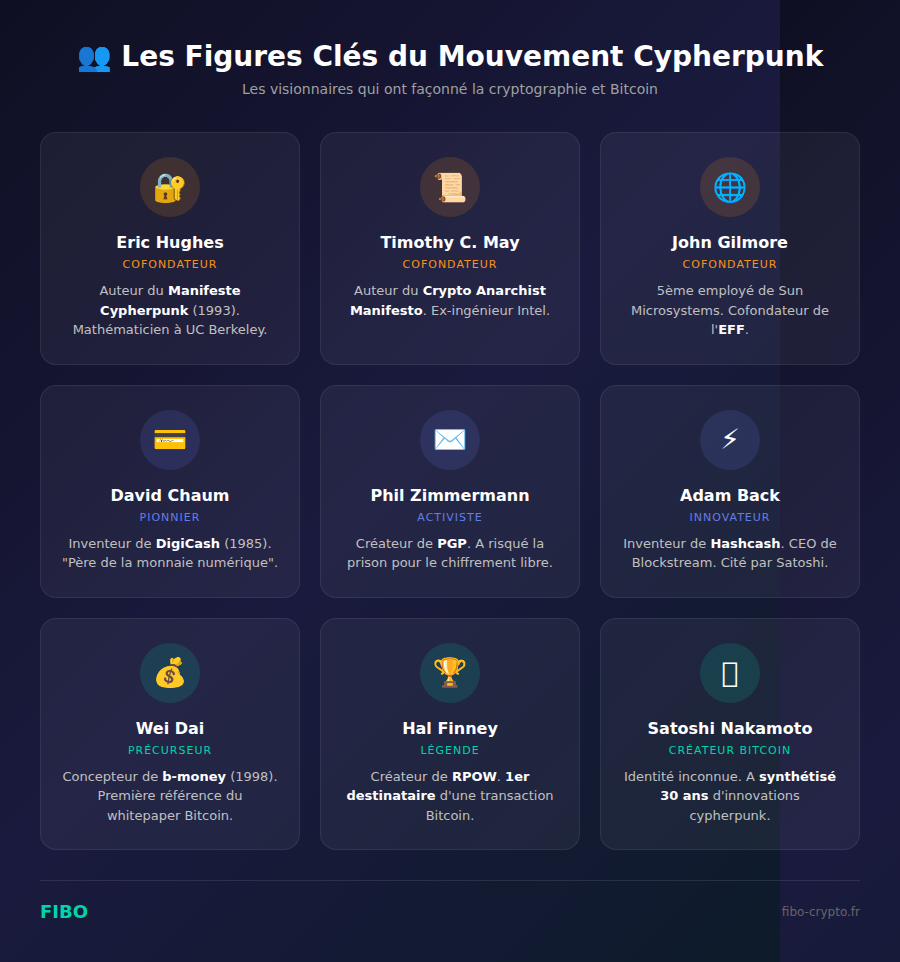
The cypherpunk movement was officially born in 1992 when three friends—Eric Hughes (mathematician at UC Berkeley), Timothy C. May (former senior engineer at Intel), and John Gilmore (5th employee of Sun Microsystems and co-founder of the Electronic Frontier Foundation)—began organizing regular meetings in the San Francisco Bay Area.
They launched a cypherpunk mailing list that quickly attracted hundreds of participants. Within the first year, over 700 people joined the discussions. The list became a forum for revolutionary ideas about cryptography, privacy, and digital money.
In March 1993, Eric Hughes published the movement’s founding text: “A Cypherpunk’s Manifesto.” This barely two-page document established the principles that would guide 30 years of innovation:
“Privacy is necessary for an open society in the electronic age. Privacy is not secrecy. A private matter is something one doesn’t want the whole world to know, but a secret matter is something one doesn’t want anybody to know. Privacy is the power to selectively reveal oneself to the world.”
— Eric Hughes, A Cypherpunk’s Manifesto (1993)
Hughes also made a crucial distinction: privacy is not secrecy. Wanting to keep certain information private doesn’t mean you have something to hide—it simply means wanting to control what you reveal and to whom.
The golden age and early digital currencies (1994-2008)
The 1990s saw dozens of digital currency experiments flourish, all from the cypherpunk community:
In 1997, Adam Back created Hashcash, a proof-of-work system initially designed to fight email spam. The idea was simple but brilliant: force email senders to perform a computationally expensive calculation before sending their message. This mechanism would be directly reused by Satoshi Nakamoto to secure Bitcoin mining.
In 1998, Wei Dai published a theoretical proposal called b-money on the cypherpunk mailing list. This document described for the first time a system of “money that cannot be regulated by governments” using proof of work. B-money is the first reference cited in the whitepaper“>Bitcoin whitepaper.
That same year, Nick Szabo conceptualized Bit Gold, another direct precursor to Bitcoin combining proof of work, cryptographic chaining, and a distributed ledger. Szabo is also the inventor of the smart contract concept (1994), now at the heart of Ethereum and DeFi.
In 2004, Hal Finney—a cypherpunk from the early days and key PGP developer—launched RPOW (Reusable Proofs of Work). This system allowed creating transferable digital tokens based on Hashcash. RPOW is the missing link between Hashcash and Bitcoin.
2008-2009: Bitcoin, the fulfillment of the cypherpunk dream
On October 31, 2008, a mysterious individual (or group) calling themselves Satoshi Nakamoto sent an email to the cryptography mailing list descended from the cypherpunks. The subject: “Bitcoin P2P e-cash paper.” The message contained a link to a 9-page document that would change the world: the Bitcoin whitepaper.
This document brilliantly synthesized 30 years of cypherpunk innovations: Diffie-Hellman public key cryptography, Hashcash proof of work, b-money and Bit Gold concepts, all assembled into a functional peer-to-peer electronic cash system without trusted third parties.
On January 3, 2009, Satoshi mined the first Bitcoin block (the “genesis block”) containing a symbolic message: “The Times 03/Jan/2009 Chancellor on brink of second bailout for banks”—a reference to the 2008 financial crisis and a clear statement about Bitcoin’s purpose.
On January 12, 2009, Hal Finney received the first Bitcoin transaction in history: 10 BTC sent by Satoshi himself. Finney tweeted that day: “Running bitcoin”—a message that has become legendary in the crypto community.
Hal Finney was always one of Bitcoin’s most fervent supporters in its early days. Unfortunately struck by ALS (Lou Gehrig’s disease), he passed away in 2014, leaving an immense legacy in the cypherpunk and crypto community.
The Cypherpunk Manifesto: founding text decoded
The “Cypherpunk’s Manifesto” written by Eric Hughes in March 1993 remains one of the most influential texts in Internet history. In barely 1,500 words, Hughes laid the ideological foundations of a movement that would transform the digital world.
Key ideas from the manifesto
1. Privacy is necessary for an open society
Hughes argues that privacy is not a luxury but a necessity. In a world where every transaction, every communication can be monitored, individuals lose their freedom of expression and action. Privacy enables dissent, experimentation, and freedom of thought.
2. We cannot expect governments to grant us privacy
Cypherpunks reject the idea that privacy must be “granted” by authorities. They consider it a natural right that citizens must defend themselves, with their own technological tools.
3. Only cryptography can guarantee privacy
Laws can change, corporate promises can be broken, but mathematics are immutable. A properly encrypted message is unbreakable, regardless of the adversary’s power—even a nation-state.
4. Cypherpunks write code
This phrase, repeated several times in the manifesto, captures the movement’s essence. Cypherpunks are not armchair philosophers—they build working tools and distribute them freely.
Satoshi Nakamoto: the ultimate cypherpunk
Satoshi Nakamoto remains one of the most mysterious figures in technological history. Bitcoin’s creator communicated exclusively via email and forums for about two years (2008-2010) before disappearing completely.
Cypherpunk clues in the Bitcoin whitepaper
The Bitcoin whitepaper (titled “Bitcoin: A Peer-to-Peer Electronic Cash System”) clearly reveals its author’s cypherpunk roots:
- Bibliography references: Satoshi explicitly cites Wei Dai’s b-money and Adam Back’s Hashcash
- Technical vocabulary: use of terms familiar to the cypherpunk community (proof-of-work, timestamps, digital signatures)
- Stated objective: create a payment system “without requiring a trusted third party”—the cypherpunk Holy Grail
- Distribution channel: sent to the cryptography mailing list, direct heir to the original cypherpunk mailing list
The usual suspects
Many theories exist about Satoshi’s true identity. The main “suspects” are almost all longtime cypherpunks:
- Hal Finney: first BTC recipient, lived near a certain Dorian Nakamoto (troubling coincidence), similar writing style
- Nick Szabo: Bit Gold creator, concept very close to Bitcoin, perfect expertise in cryptography and contract law
- Adam Back: Hashcash inventor, one of Bitcoin’s fundamental building blocks
- Wei Dai: b-money creator, first reference in the whitepaper
Whatever their identity, Satoshi chose to remain anonymous—a choice perfectly consistent with cypherpunk values of privacy protection.
Key figures of the cypherpunk movement
The three founders
Eric Hughes — Mathematician at UC Berkeley, author of the Cypherpunk Manifesto. Hughes emphasized the importance of concrete code rather than pure theory. He developed the first anonymous remailers allowing untraceable email.
Timothy C. May — Former senior engineer at Intel, author of the “Crypto Anarchist Manifesto” (1988). May theorized a society where cryptography would make the State obsolete. Although radical, his writings profoundly influenced the libertarian philosophy that permeates the crypto ecosystem.
John Gilmore — 5th employee of Sun Microsystems (became a millionaire through stock options), co-founder of the Electronic Frontier Foundation (EFF) and the Internet Archive. Gilmore funded many cypherpunk projects and fought legally for cryptography freedom.
Technical pioneers
David Chaum — Inventor of DigiCash (1985), blind signatures, and numerous privacy protocols. Chaum is considered the “father of digital currency.” His 1980s work directly inspired Bitcoin.
Phil Zimmermann — Creator of PGP (1991). Zimmermann took enormous legal risks to democratize strong encryption. His fight established citizens’ right to use cryptography without restriction.
Adam Back — Inventor of Hashcash (1997), currently CEO of Blockstream, one of the most influential companies in the Bitcoin ecosystem. Back is one of the rare historic cypherpunks still active in Bitcoin development.
Bitcoin precursors
Wei Dai — Cryptographer and computer scientist, creator of b-money (1998). His theoretical proposal contains many elements reused by Bitcoin. Dai is also the inventor of the Crypto++ cryptographic library.
Hal Finney — PGP developer, RPOW creator (2004), first Bitcoin recipient (2009). Finney embodies the perfect continuity between the cypherpunk movement and Bitcoin. His death in 2014 was a moment of mourning for the entire community.
Nick Szabo — Computer scientist and cryptographer, inventor of smart contracts (1994) and Bit Gold (1998). Szabo is one of the community’s deepest thinkers, with writings on law, economics, and history in addition to cryptography.
The cypherpunk legacy in today’s world
 E2E encryption, Tor, and principles that became standards (Code is Law, Don’t Trust Verify, Privacy by Design)” />
Bitcoin and cryptocurrencies
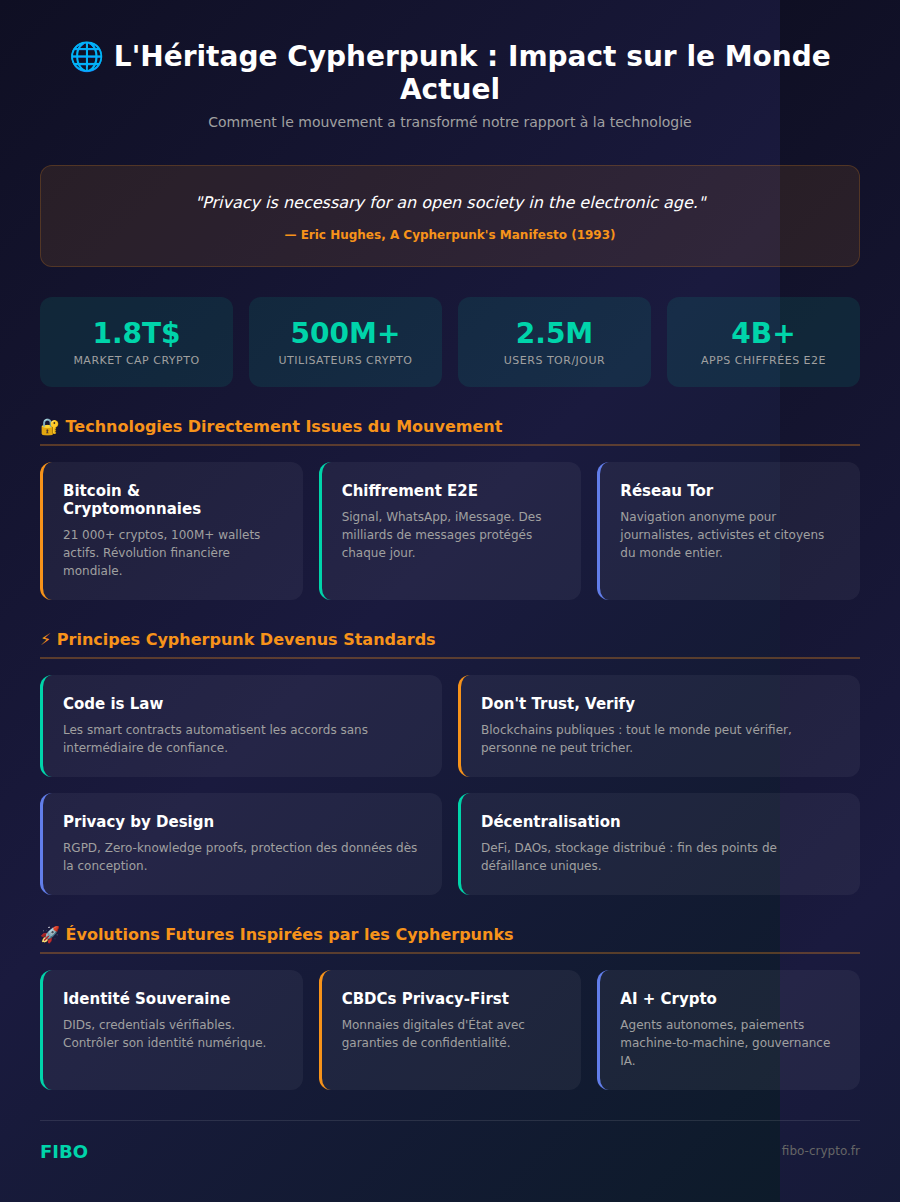
The most visible cypherpunk legacy is undoubtedly Bitcoin and the cryptocurrency ecosystem it spawned. With a market cap exceeding $1.8 trillion and over 500 million users worldwide, Bitcoin has realized the cypherpunk dream of money beyond state control.
Cypherpunk principles permeate the entire ecosystem:
- “Don’t Trust, Verify”: anyone can verify the blockchain without trusting a third party
- Decentralization: no single point of control
- Pseudonymity: transactions are not directly linked to civil identity
- Open source: code is open to audit and contribution from everyone
End-to-end encryption (E2E)
When you use Signal, WhatsApp, or iMessage, you directly benefit from the cypherpunk legacy. End-to-end encryption—where only the sender and recipient can read messages—has become the standard in modern messaging apps.
This evolution would have seemed impossible in the 1990s, when governments tried to criminalize strong cryptography. The cypherpunks won this cultural and legal battle.
The Tor network and online anonymity
The Tor network, used daily by 2.5 million people, enables anonymous Internet browsing. Although initially developed by the U.S. Navy, Tor perfectly embodies cypherpunk ideals of privacy protection.
Tor is crucial for journalists in conflict zones, political dissidents, whistleblowers, and anyone who needs to communicate without being monitored.
WikiLeaks and forced transparency
Julian Assange, WikiLeaks founder, was an active member of the cypherpunk mailing list. WikiLeaks represents the application of the cypherpunk principle of “privacy for the weak, transparency for the powerful”: using cryptography to protect sources while exposing government and corporate secrets.
Cypherpunk movement vs crypto anarchism: what’s the difference?
Although often confused, the cypherpunk movement and crypto anarchism have important nuances.
Crypto anarchism, theorized primarily by Timothy C. May in his “Crypto Anarchist Manifesto” (1988), goes further than the general cypherpunk movement. May envisioned a world where cryptography would make the State completely obsolete: untraceable black markets, anonymous contracts, collapse of governments’ ability to tax and regulate.
Most cypherpunks share a distrust of the State but don’t necessarily embrace May’s radical anarchist vision. The common denominator is defending privacy through cryptography—the political conclusions drawn vary by individual.
In practice, the Bitcoin and crypto ecosystem harbors a broad spectrum of political opinions: from hardcore libertarians to moderate reformists who simply see the technology as a tool for financial inclusion.
Why are cypherpunks important in 2026?
In 2026, the cypherpunk movement remains urgently relevant. The issues they identified in the 1990s—mass surveillance, centralization of digital power, loss of privacy—are more pressing than ever.
Surveillance is intensifying
Edward Snowden’s 2013 revelations confirmed the scale of state surveillance anticipated by cypherpunks. Since then, the situation has only worsened: ubiquitous facial recognition, smartphone tracking, large-scale metadata analysis.
Cypherpunk tools—encryption, cryptocurrencies, anonymous networks—are the main defenses available to citizens.
CBDCs threaten financial freedom
Central Bank Digital Currencies (CBDCs) being developed in many countries could create systems of total financial surveillance. Every transaction recorded, every purchase potentially censorable.
Against this threat, decentralized cryptocurrencies like Bitcoin represent an alternative preserving financial privacy—exactly what cypherpunks had been advocating for 30 years.
AI amplifies risks
Artificial intelligence now enables analyzing massive volumes of personal data. Social scoring systems in China show what’s possible when surveillance and AI converge.
Cypherpunk principles of data minimization, encryption by default, and decentralization become essential shields against these abuses.
Conclusion: the living legacy of cypherpunks
Thirty years after the Cypherpunk Manifesto’s publication, the movement has profoundly transformed our digital world. From the first PGP-encrypted emails to Bitcoin and its billions of users, cypherpunks have proven that a few determined individuals, armed with code and convictions, can change the course of history.
Their legacy extends beyond the technologies they created. It’s a philosophy—the idea that privacy is a fundamental right and that citizens must have the technical means to defend it. This philosophy now permeates the entire crypto ecosystem and influences millions of developers worldwide.
In 2026, as threats to digital privacy have never been greater, cypherpunk ideas are more relevant than ever. As Eric Hughes wrote: “Cypherpunks write code.” Thirty years later, that code continues to protect our freedom.
📚 Glossary
- Cypherpunk : Activist advocating the use of strong cryptography to protect privacy and bring about social change. The term combines “cipher” (encryption) and “cyberpunk.”
- Asymmetric cryptography : Encryption system using a key pair (public and private). Enables secure communication without prior secret exchange.
- Cypherpunk mailing list : Email distribution list created in 1992 by Eric Hughes, Timothy May, and John Gilmore. Birthplace of the cypherpunk movement and incubator for ideas that led to Bitcoin.
- Cypherpunk Manifesto : Founding text written by Eric Hughes in March 1993, declaring that “privacy is necessary for an open society in the electronic age.”
- PGP (Pretty Good Privacy) : Email encryption software created by Phil Zimmermann in 1991. First strong cryptography tool accessible to the general public.
- Hashcash : Proof-of-work system invented by Adam Back in 1997 to fight spam. Technology directly reused in Bitcoin mining.
- b-money : Theoretical proposal for decentralized currency published by Wei Dai in 1998. First reference cited in the Bitcoin whitepaper.
- Bit Gold : Digital currency concept based on proof of work, proposed by Nick Szabo in 1998. Direct precursor to Bitcoin.
- RPOW (Reusable Proofs of Work) : Transferable digital token system created by Hal Finney in 2004. Missing link between Hashcash and Bitcoin.
- DigiCash : First anonymous electronic payment system, invented by David Chaum in 1985. Pioneer of cryptocurrencies.
- Proof of Work : Consensus mechanism requiring computationally expensive calculation to validate transactions. Used by Bitcoin to secure the network.
- End-to-end encryption (E2E) : Communication method where only participants can read messages. Intermediate servers cannot decrypt content.
- Crypto anarchism : Ideology derived from the cypherpunk movement, theorized by Timothy May. Predicts State obsolescence through cryptography.
- Tor network : Network enabling anonymous Internet browsing via onion routing. Essential tool for privacy protection.
- Bitcoin whitepaper : 9-page document published by Satoshi Nakamoto on October 31, 2008, describing Bitcoin’s operation.
- Smart contract : Self-executing program stored on a blockchain. Concept invented by Nick Szabo in 1994.
Frequently Asked Questions
What is a cypherpunk?
A cypherpunk is an activist who advocates for the widespread use of strong cryptography to protect privacy and bring about social change. The term, coined by Jude Milhon in 1992, combines “cipher” (encryption) and “cyberpunk.” Cypherpunks distinguish themselves through their pragmatic approach: they don’t just theorize—they write working code. The movement gave birth to PGP, Bitcoin, the Tor network, and many other privacy-protecting technologies.
What is the connection between cypherpunks and Bitcoin?
Bitcoin is the direct culmination of the cypherpunk movement. Satoshi Nakamoto published the Bitcoin whitepaper on the cryptography mailing list descended from the cypherpunks on October 31, 2008. The document explicitly cites work by cypherpunks like b-money (Wei Dai) and Hashcash (Adam Back). Hal Finney, an early cypherpunk, was the first recipient of a Bitcoin transaction. Bitcoin’s fundamental principles (decentralization, censorship resistance, pseudonymity) directly reflect cypherpunk philosophy.
Who wrote the Cypherpunk Manifesto?
The Cypherpunk Manifesto (“A Cypherpunk’s Manifesto”) was written by Eric Hughes in March 1993. Hughes was a mathematician at UC Berkeley and one of the three co-founders of the cypherpunk movement along with Timothy May and John Gilmore. This 1,500-word text establishes the movement’s fundamental principles, including the famous phrase: “Privacy is necessary for an open society in the electronic age.”
Was Satoshi Nakamoto a cypherpunk?
While Satoshi Nakamoto’s identity remains unknown, everything indicates deep roots in cypherpunk culture. They published the Bitcoin whitepaper on the cryptography mailing list, cite work by famous cypherpunks (b-money, Hashcash), and Bitcoin perfectly embodies the movement’s ideals. The main “suspects” (Hal Finney, Nick Szabo, Adam Back, Wei Dai) are all longtime cypherpunks. Their choice to remain anonymous is also consistent with cypherpunk values of privacy protection.
What technologies did the cypherpunks create?
Cypherpunks created or inspired many major technologies: PGP (email encryption, 1991), DigiCash (anonymous electronic payment, 1985), Hashcash (proof of work, 1997), b-money and Bit Gold (Bitcoin precursors, 1998), RPOW (transferable tokens, 2004), Bitcoin (2008), and the Tor network (anonymous browsing). More broadly, end-to-end encryption used by Signal, WhatsApp, and iMessage directly stems from their work and their fight for civilian cryptography.
Does the cypherpunk movement still exist in 2026?
Yes, although in different forms. The original mailing list is no longer active, but the cypherpunk spirit lives on in many communities: Bitcoin and crypto developers, privacy protocol creators (Zcash, Monero), organizations like the Electronic Frontier Foundation, and movements like “Bitcoiners” who defend values of decentralization and censorship resistance. Adam Back (Hashcash creator) remains very active as CEO of Blockstream.
What is the difference between cypherpunk and crypto anarchism?
Cypherpunk is a broad movement advocating the use of cryptography to protect privacy. Crypto anarchism is a more radical ideology, theorized by Timothy May, envisioning the complete collapse of the State through cryptography. All crypto anarchists are cypherpunks, but not all cypherpunks are anarchists. The common denominator is defending privacy through technology; political conclusions vary.
Who was Hal Finney and why is he important?
Hal Finney (1956-2014) was an American computer scientist and cryptographer, one of the most influential cypherpunks. He was a PGP developer, RPOW creator (2004), and most importantly the first recipient of a Bitcoin transaction (10 BTC sent by Satoshi Nakamoto on January 12, 2009). Finney supported Bitcoin from its earliest days and contributed to its code. Some believe he might be Satoshi himself. He died in 2014 from ALS (Lou Gehrig’s disease).
Why did cypherpunks defend privacy?
Cypherpunks consider privacy a fundamental right, necessary for freedom of expression and democracy. As the Cypherpunk Manifesto explains, privacy is not secrecy: it’s the power to choose what you reveal and to whom. Without privacy, individuals self-censor, dissent becomes impossible, and power concentrates in the hands of those who control information. Cryptography is the tool that guarantees this right against governments and corporations.
How did the cypherpunk mailing list work?
The cypherpunk mailing list was created in 1992 by Eric Hughes, Timothy May, and John Gilmore. It was an email distribution list where members shared ideas about cryptography, privacy, and digital money. Within the first year, over 700 people participated. The list saw discussions about b-money, Hashcash, and countless other innovations. The Bitcoin whitepaper was published on a descendant list in 2008. The original list fragmented in the 2000s but its influence persists.
📰 Sources
This article is based on the following sources:
- A Cypherpunk’s Manifesto – Eric Hughes (1993)
- Bitcoin Whitepaper – Satoshi Nakamoto (2008)
- The Crypto Anarchist Manifesto – Timothy C. May (1988)
- b-money – Wei Dai (1998)
- Hashcash – Adam Back (1997)
- Cypherpunks – Wikipedia
- Bitcoin and the Rise of the Cypherpunks – CoinDesk
Comment citer cet article : Fibo Crypto. (2026). Cypherpunk History: Complete Guide to the Movement Behind Bitcoin [2026]. Consulté le 4 March 2026 sur https://fibo-crypto.fr/en/blog/cypherpunk-history-movement-bitcoin