
Top 10 Largest Assets in the World 2026: Bitcoin’s Rise in the Rankings
Introduction: An Unprecedented Transformation
In just 15 years, the global financial landscape has undergone a radical metamorphosis. Who would have imagined in 2010 that a graphics chip company would surpass Apple and Microsoft? Or that a cryptocurrency worth $0.27 would become the 8th most valuable asset in the world with a market capitalization of $1.86 trillion?
Between 2010 and 2025, we witnessed three simultaneous revolutions: the explosion of Big Tech driven by artificial intelligence, the emergence of cryptocurrencies as a new asset class, and the remarkable persistence of gold as the ultimate safe haven. Our analysis of the top 10 largest global assets reveals staggering growth, spectacular disruptions, and crucial insights about the future of finance.
📊 In this article, discover our exclusive interactive chart allowing you to explore the evolution of these assets year by year, with precise data and surprising comparisons.
🥇 The Undisputed Reign of Gold: $25.5 Trillion in 2025
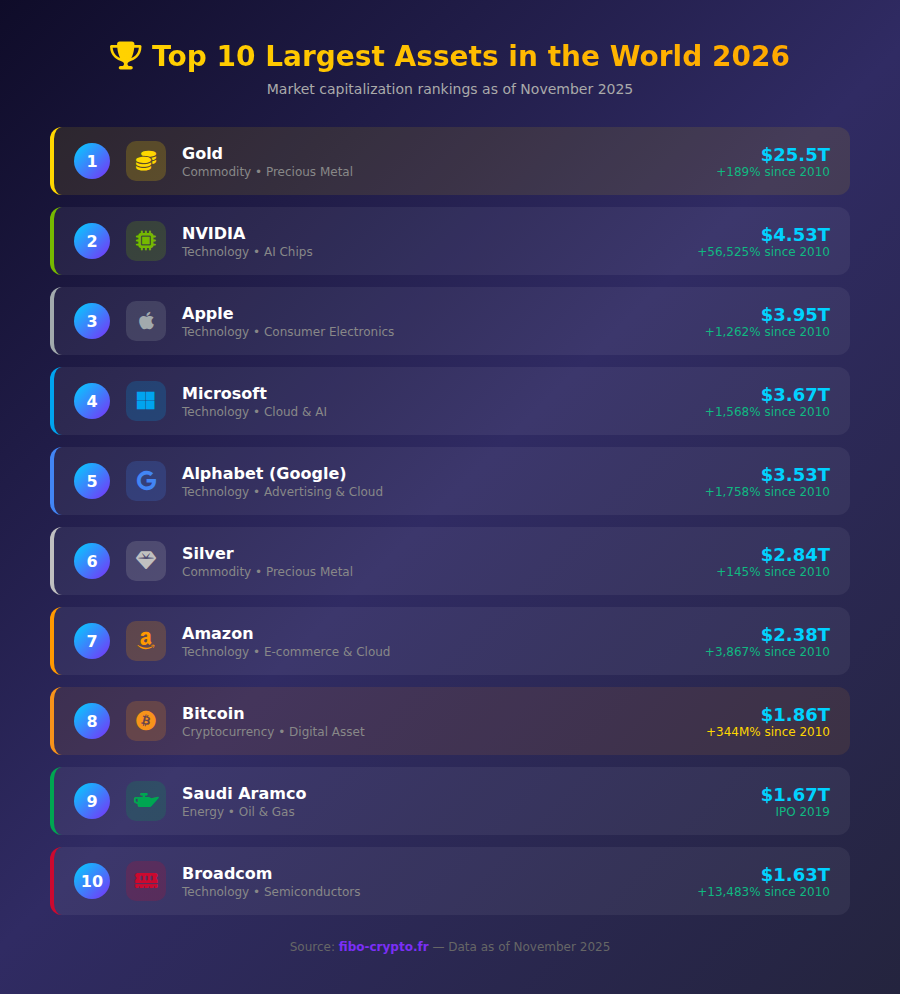
Despite the meteoric rise of tech and crypto, gold retains its crown with a market capitalization of $25.5 trillion in November 2025. That’s more than 5 times NVIDIA’s market cap, the world’s second-largest asset!
Why Does Gold Still Dominate?
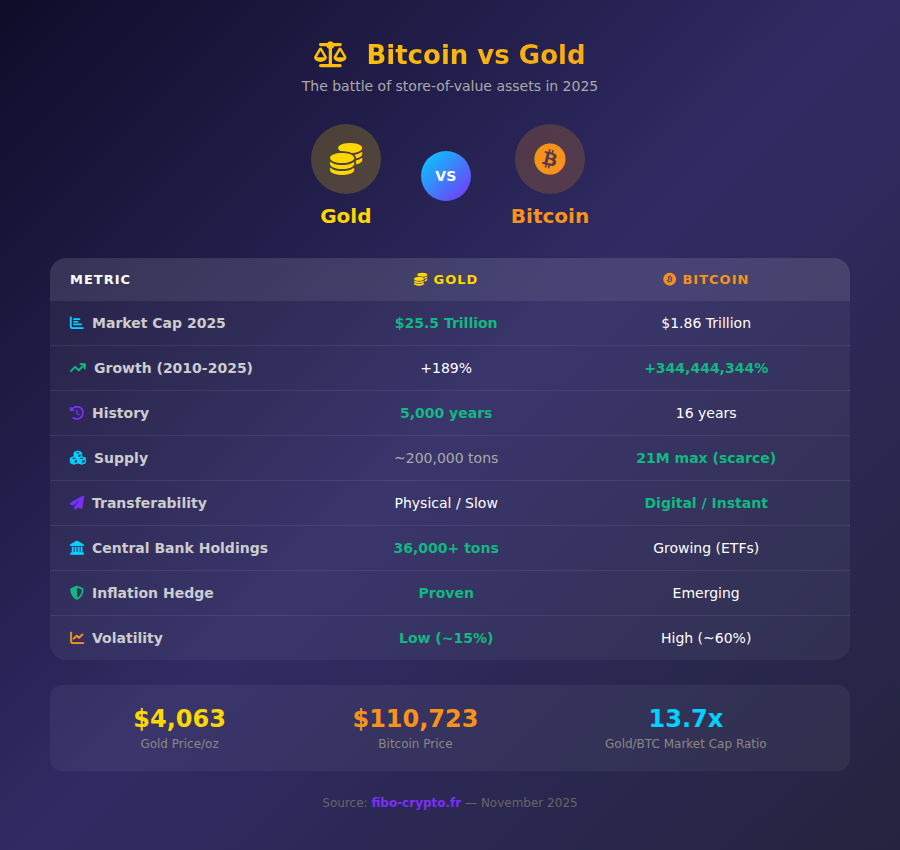
Gold remains the preferred choice of central banks and institutional investors during periods of uncertainty. In 2025, with a spot price of $4,063/ounce (compared to $1,405 in 2010), the precious metal recorded growth of +189% over 15 years. This performance may seem modest compared to tech giants, but it reflects unmatched stability and liquidity.
Unlike tech stocks that can experience brutal corrections (like in 2022), gold offers protection against inflation and geopolitical turmoil. Its total value of $25.5T represents approximately 6.5 billion ounces in above-ground circulation, a tangible physical mass that reassures traditional investors.
Gold isn’t just a financial asset: it’s 5,000 years of monetary history, a universally accepted guarantee, and a bulwark against the devaluation of fiat currencies. In 2025, as central banks continue to print money massively, gold proves its relevance once again.
🚀 The Big Tech Revolution: When AI Redefines Value
NVIDIA: The Meteoric Rise of the AI Giant
The undisputed star of the past 15 years is NVIDIA. From $8 billion in 2010 to $4.53 trillion in 2025, representing a staggering growth of +56,525%. To put this in perspective: $1,000 invested in 2010 would be worth $565,250 today!
The Numbers Behind the AI Revolution
- +171% increase in 2024 alone
- +239% in 2023 (before the ChatGPT boom)
- 80% market share in AI chips for data centers
- $5 trillion peak reached in November 2025 (all-time record)
NVIDIA didn’t become the leader by accident. The company dominated the AI market thanks to its GPUs (Graphics Processing Units) that became essential for training artificial intelligence models. Every tech giant – OpenAI, Microsoft, Google, Meta, Amazon – is scrambling for NVIDIA chips to build their own AI systems.
In the last reported quarter, NVIDIA’s data center revenue exploded by +427% year-over-year, reaching $22.6 billion and representing 86% of the company’s total sales. It’s a complete transformation: NVIDIA evolved from a gaming graphics card manufacturer to the indispensable equipment supplier for the AI revolution.
Apple, Microsoft, Google: The Race to $4 Trillion
The three historic tech giants have all crossed the symbolic $4 trillion threshold in market cap in 2025, a feat still unthinkable just 5 years ago.
Apple: $3.95T – The Pioneer of $2T and $3T
In August 2020, Apple became the first American company to reach $2 trillion. In June 2023, it crossed $3T. Now at $3.95T, Apple remains a behemoth despite more moderate growth (+1,262% since 2010) compared to NVIDIA. Its strength? A closed ecosystem (iPhone, Mac, services) generating exceptional margins and unparalleled customer loyalty.
Microsoft: $3.67T – Cloud and AI as Growth Engines
With a $3.67T market cap, Microsoft proves that its cloud transformation (Azure) and massive bet on AI (OpenAI/ChatGPT) are paying off. From $220 billion in 2010 to $3.67T in 2025 (+1,568%), the Redmond giant has reinvented its business model by transitioning from perpetual licenses to cloud subscriptions.
Google/Alphabet: $3.53T – Advertising + Cloud + AI
At $3.53T (+1,758% since 2010), Google shows that the advertising duopoly with Meta remains extremely profitable. The company is investing heavily in AI (Google DeepMind, Bard/Gemini) while consolidating Google Cloud as the third player in the market after AWS and Azure.
Amazon: $2.38T – The E-commerce and Cloud Giant
Amazon experienced spectacular growth of +3,867% since 2010 (from $60B to $2.38T). Its success rests on two pillars:
- Amazon.com: Global e-commerce leader
- AWS (Amazon Web Services): Pioneer and leader in cloud computing, generating most of the group’s profits
⚠️ Important note: Amazon suffered a severe correction in 2022 (-39.3%) during the tech bear market, dropping from $1.32T in 2020 to $860B. But the rebound was swift, demonstrating the solidity of the model.
The Alarming Concentration of the S&P 500
One figure to remember: NVIDIA, Apple, Microsoft, Google, and Amazon alone represent $14.5 trillion, or 32% of the total S&P 500 market capitalization. This unprecedented concentration raises questions about market health and systemic risks of a tech correction.
₿ The Emergence of Bitcoin: From $0.27 to $1.86 Trillion
The Most Spectacular Performance in Financial History
While NVIDIA impresses with +56,525%, Bitcoin crushes all records with growth of +344,444,344% since 2010. Yes, you read that right: 344 million percent.
The Vertiginous Evolution
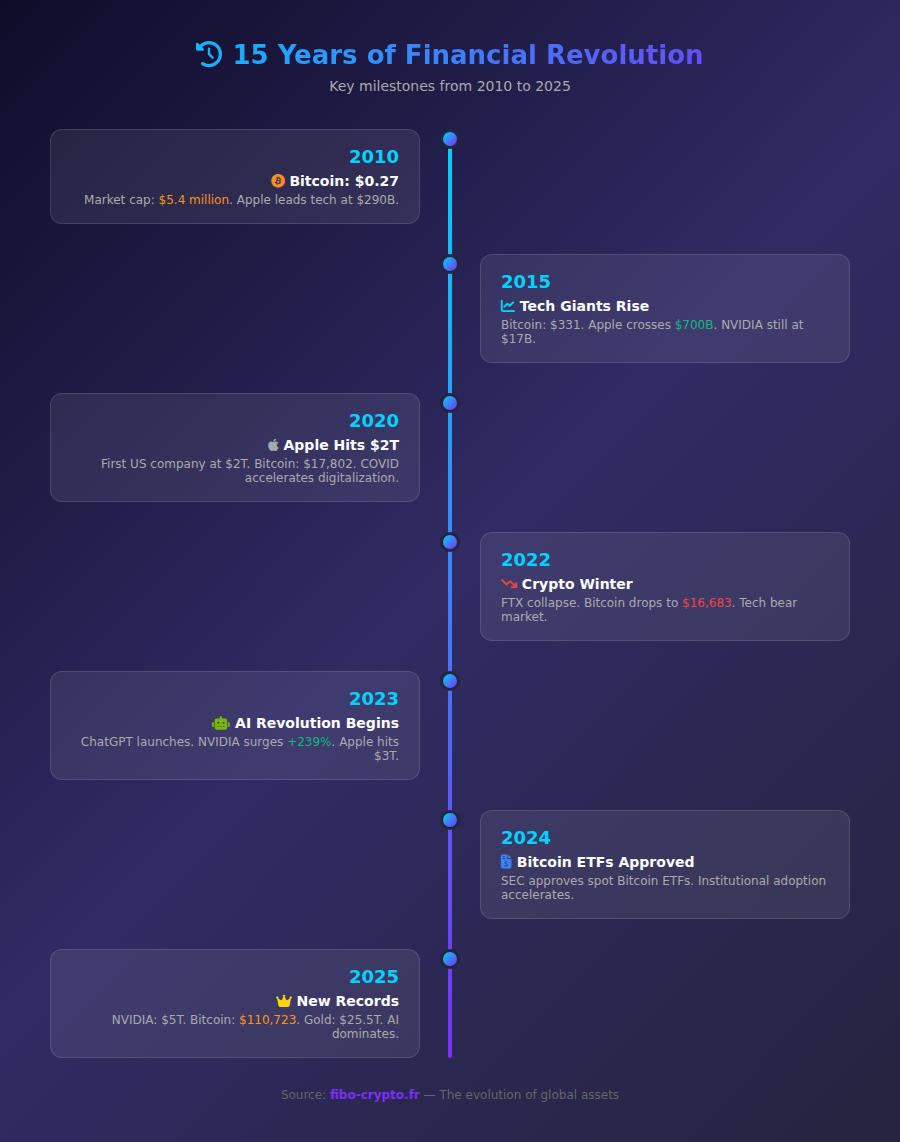
- 2010: Bitcoin worth $0.27 – Total market cap of $5.4 million
- 2015: $331/BTC – Market cap $5.1 billion
- 2020: $17,802/BTC – Market cap $340 billion
- 2022: $16,683/BTC after the FTX crash – Market cap $320 billion
- 2025: $110,723/BTC – Market cap $1.86 trillion
The 8th Most Valuable Asset in the World
With $1.86T in market capitalization, Bitcoin now ranks as the 8th largest global asset, behind Amazon but ahead of Broadcom and Saudi Aramco. For context:
- Bitcoin > Russia’s GDP
- Bitcoin = 3x the combined market cap of Visa + Mastercard
- Bitcoin = 66% of all gold held by central banks worldwide
The FTX Crash and Resilience
November 2022 will remain etched in crypto memory. The collapse of FTX, the world’s second-largest exchange, sent Bitcoin plunging from $21,000 to $16,683 (-21%), triggering a massive loss of confidence and a market cap drop to $320B.
But Bitcoin demonstrated its exceptional resilience. In two years, the cryptocurrency multiplied its value by 5.8x, proving that institutional demand and retail adoption have become structural. The spot Bitcoin ETFs approved in the USA in 2024 played a major catalytic role.
📊 Interactive Chart: Visualize 15 Years of Evolution
🎯 Exclusive Interactive Chart
Explore the detailed evolution of the top 10 largest global assets from 2010 to 2025. Click on assets in the legend to hide/show them. The scale adapts automatically for better readability!
💡 Tip: Click on an asset in the legend to hide it and better analyze the others. The Y-axis adjusts automatically!
Technical note: This chart uses an adaptive scale. Hide Gold to see other assets expand automatically. You can also zoom in on specific periods with your mouse.
💎 Broadcom and Aramco: The Top 10 Outsiders
Broadcom: The Unsung Champion of Semiconductors
$1.63 trillion in market cap for Broadcom (AVGO), representing growth of +13,483% since 2010. The company became the 12th to cross $1 trillion in December 2024.
Broadcom isn’t as famous as NVIDIA, but it equips most tech infrastructure: 5G networks, data centers, IoT, smartphone semiconductors. In 2015, the acquisition of Broadcom Corp by Avago for $77B created a giant now valued 21x higher.
Saudi Aramco: The Largest IPO in History
$1.67 trillion in 2025 for the Saudi oil company, which went public in December 2019 at $1.88T, setting the absolute record for the largest IPO ever conducted.
Aramco briefly surpassed Apple in May 2022 to become the world’s most valuable company at $2.4T, benefiting from the post-COVID oil price surge. But since then, the oil giant has lost ground to Big Tech, illustrating the ongoing energy transition.
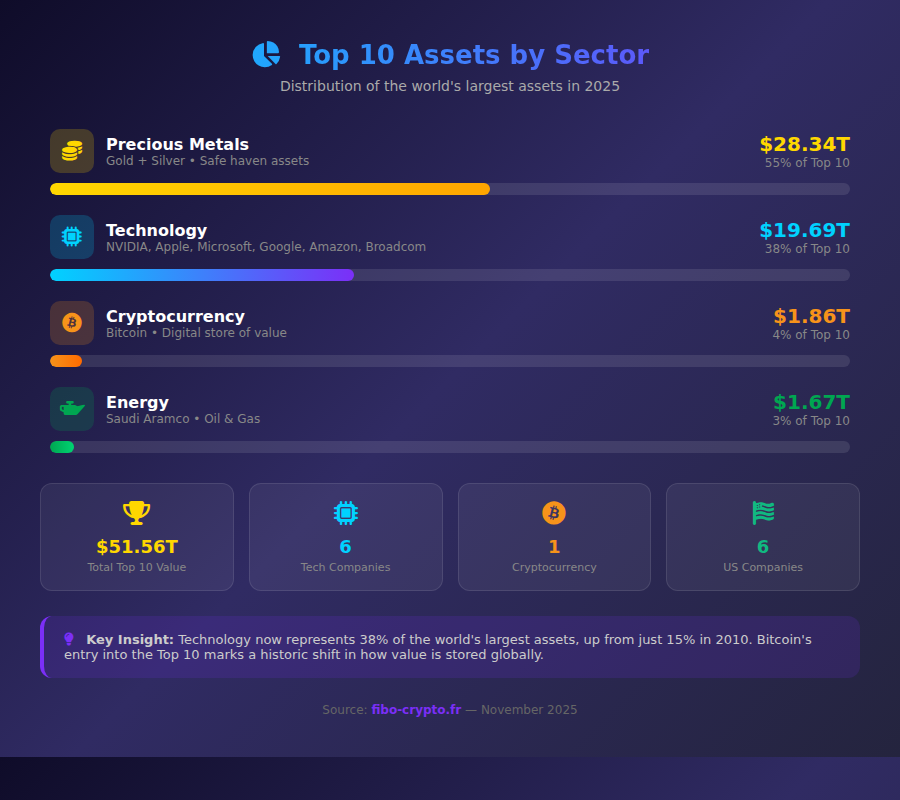
📊 Analysis: What Does This Evolution Teach Us?
Three Parallel Revolutions
Studying the top 10 largest global assets reveals three major transformations:
1. The Technological Revolution (AI, Cloud, Semiconductors)
NVIDIA, Microsoft, Google, Amazon, Broadcom: all benefited from digital acceleration. Artificial intelligence is no longer science fiction – it’s the #1 growth driver of the 2020s.
Key insight: Markets now value the ability to process and analyze massive data. Data is the new oil, and AI is the refining that transforms this crude oil into high-performance fuel.
2. The Monetary Revolution (Crypto, Digital Assets)
Bitcoin evolved from a geek curiosity to a macroeconomic asset in 15 years. Its presence in the global Top 10 validates the “digital natives” thesis: an entire generation prefers Bitcoin to gold for storing long-term value.
3. The Persistence of Safe Havens (Gold, Silver)
Gold at $25.5T and silver at $2.84T remind us that during uncertainty (wars, inflation, crises), tangible assets retain their appeal. Central banks accumulate gold, not tech stocks.
🔮 Conclusion and 2025-2030 Outlook
Trends to Watch
- The race to $5 trillion: NVIDIA reached $5T in November 2025. Will Apple and Microsoft follow in 2026-2027?
- The rise of sovereign AI: European and Asian countries are developing their own AI champions to reduce dependence on US Big Tech.
- Bitcoin’s maturity: The massive arrival of Bitcoin ETFs and reduced volatility could push BTC into the global Top 5 ($5T+).
- The energy transition: Will Aramco and oil companies lose ground to renewable energy? Tesla could enter the Top 10.
- Tech giant regulation: Europe (DMA, DSA) and the USA (antitrust) could fragment the GAFAM.
Will Gold Maintain Its Dominance?
In the short term (2025-2027), yes. Geopolitical instability (wars, US-China tensions) and persistent inflation favor gold. Central banks are accumulating massively (China, Russia, India).
In the medium-long term (2027-2030), perhaps not. If NVIDIA reaches $10T with the AI explosion, if Bitcoin crosses $300,000 (market cap $6T+), gold could lose its crown for the first time since… the dawn of civilization.
Final Thoughts
The past 15 years have redefined what “value” means. In 2010, value was physical (gold, oil), industrial (automobiles, banks). In 2025, value is data-driven (AI, cloud), digital (crypto), and intangible (software, platforms).
The winners of the coming decades will be those who master:
- Artificial intelligence (like NVIDIA)
- Network effect platforms (like the GAFAM)
- Digital scarcity (like Bitcoin)
Gold retains its place because it represents 5,000 years of history. But history is accelerating. The future belongs to those building the rails of the digital economy.
Sources
- CompaniesMarketCap.com (market cap data)
- CoinGecko, CoinMarketCap (Bitcoin and crypto data)
- Yahoo Finance, MacroTrends (stock data)
- World Gold Council (gold data)
- Silver Institute (silver data)
- Morningstar, Bloomberg, Financial Times (analysis and insights)
Article written on November 20, 2025 for Fibo Crypto • Data as of November 20, 2025