
Crypto Self-Custody: The Ultimate Guide to Taking Control of Your Assets
📋 En bref (TL;DR)
- Self-custody: storage method where you hold your own private keys, without any intermediary
- Core principle: “Not your keys, not your coins” — without your keys, your crypto isn’t truly yours
- Types of wallets: hot wallets (connected) for daily use, cold wallets (offline) for maximum security
- Seed phrase: sequence of 12 or 24 words allowing you to recover access to all your funds — must be protected at all costs
- Benefits: total control, no exchange bankruptcy risk, DeFi access, financial sovereignty
- Responsibility: you alone are responsible for securing your assets — no recourse if lost
What is crypto self-custody?
Self-custody is the practice of holding your own cryptocurrency private keys, without entrusting them to a third party like an exchange. It’s the very foundation of Bitcoin’s philosophy: taking back control of your money by eliminating intermediaries.
When you buy crypto on a platform like Binance or Coinbase, those assets are actually held by the exchange. You see a balance displayed, but you don’t have real control. It’s like having money in a bank account: the bank can freeze it, go bankrupt, or get hacked.
With self-custody, you hold a private key that mathematically proves the crypto belongs to you. No one else can access or move it without this key.
Why is self-custody important?
Self-custody eliminates counterparty risk: if you’re the only one holding your keys, no third party can lose, steal, or freeze your funds. Cryptocurrency history is full of examples illustrating this risk.
Lessons from history
In 2014, Mt. Gox — then the world’s largest exchange — went bankrupt after 850,000 BTC were stolen. Thousands of users lost everything. In 2022, FTX collapsed: $8 billion in customer funds vanished. More recently, exchanges have frozen withdrawals for months during liquidity crises.
These catastrophes share one thing in common: users had entrusted their private keys to third parties. Those who practiced self-custody weren’t affected.
Not your keys, not your coins
This saying summarizes the self-custody philosophy. If someone else holds your private keys, your crypto doesn’t truly belong to you — you have a claim, not possession. It’s the difference between having a bill in your pocket and having a promise that someone will give you a bill.
Different types of wallets for self-custody
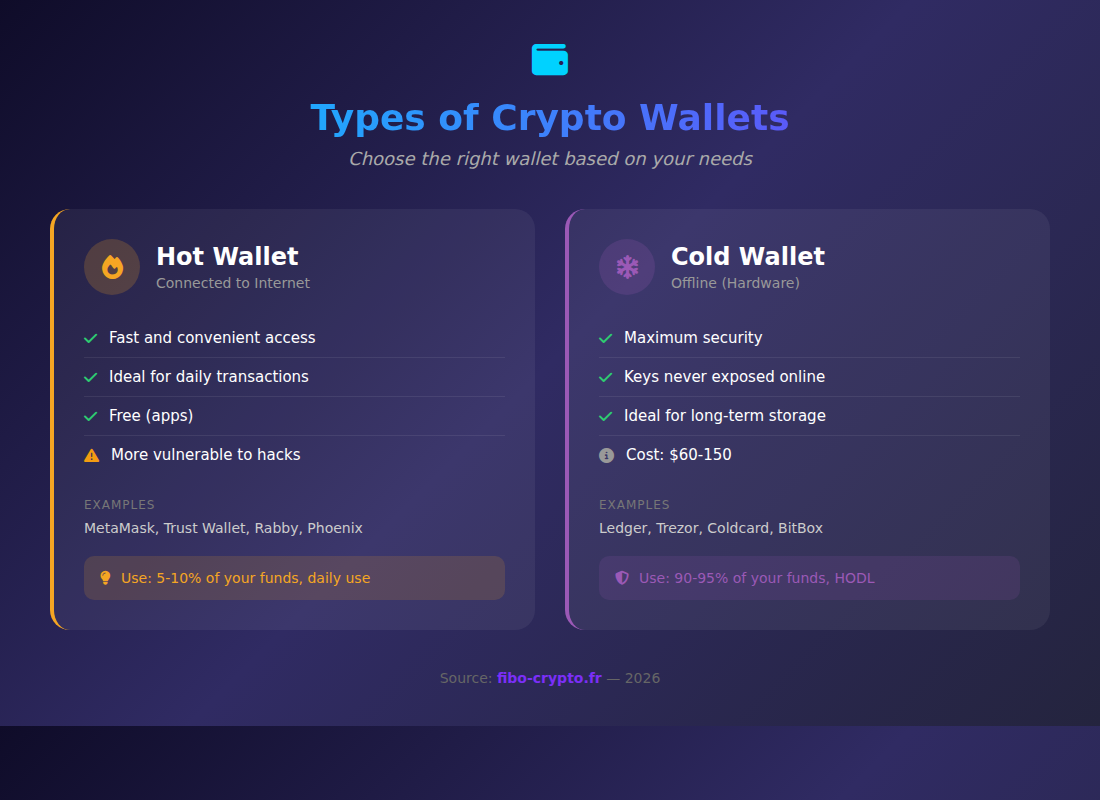
There are two main categories of non-custodial wallets: hot wallets (connected to the Internet) and cold wallets (offline), each suited to different uses.
Hot wallets: accessibility and convenience
Hot wallets are applications installed on your smartphone or computer. They’re connected to the Internet, making them convenient for daily transactions but more vulnerable to attacks.
Popular examples:
- MetaMask: most widely used for Ethereum and DeFi
- Trust Wallet: multi-chain, easy to use
- Rabby: security-focused with transaction simulation
- Phoenix Wallet: specialized for Bitcoin and Lightning Network
Recommended use: small amounts for daily transactions, DeFi interaction, everyday payments.
Cold wallets: maximum security
Cold wallets store your private keys on a physical device that’s never connected to the Internet. It’s the equivalent of a safe for your crypto.
Popular hardware wallets:
- Ledger (Nano S Plus, Nano X, Stax): most widespread, intuitive interface
- Trezor (Model T, Safe 3): open source, solid reputation
- Coldcard: Bitcoin-only, for security purists
- BitBox02: Swiss, minimalist and secure
Recommended use: long-term storage (HODL), significant amounts, crypto savings.
What allocation to adopt?
A common strategy is to split your funds:
- 5-10% on a hot wallet for daily use
- 90-95% on a cold wallet for security
Understanding private keys and seed phrases
Your private key is a string of characters that proves you own your crypto. The seed phrase (recovery phrase) is a readable version of this key, consisting of 12 or 24 words.
How does it work?
When you create a wallet, it generates:
- A seed phrase (e.g., “abandon ability able about above absent…”)
- A private key derived from this seed (cryptographic sequence)
- A public key (your address, which you can share)
The seed phrase is the “master key”: with it, you can regenerate all your private keys and therefore access all your funds, even if you lose your device.
The critical importance of the seed phrase
Anyone who has your seed phrase has your crypto. That’s why protecting it is the absolute priority of self-custody.
If you lose both your seed phrase AND your wallet, your funds are lost forever. There’s no customer service, no recourse, no possible recovery. That’s the price of sovereignty: total responsibility.
How to secure your seed phrase?
Your seed phrase must be stored offline, in a safe place, and ideally on a fire and water-resistant medium. Never store it on an Internet-connected device.
What you should NEVER do
- ❌ Take a photo of your seed phrase
- ❌ Store it in a text file on your computer
- ❌ Send it by email or messaging
- ❌ Save it in the cloud (iCloud, Google Drive, Dropbox)
- ❌ Share it with anyone, even “tech support”
Recommended storage methods
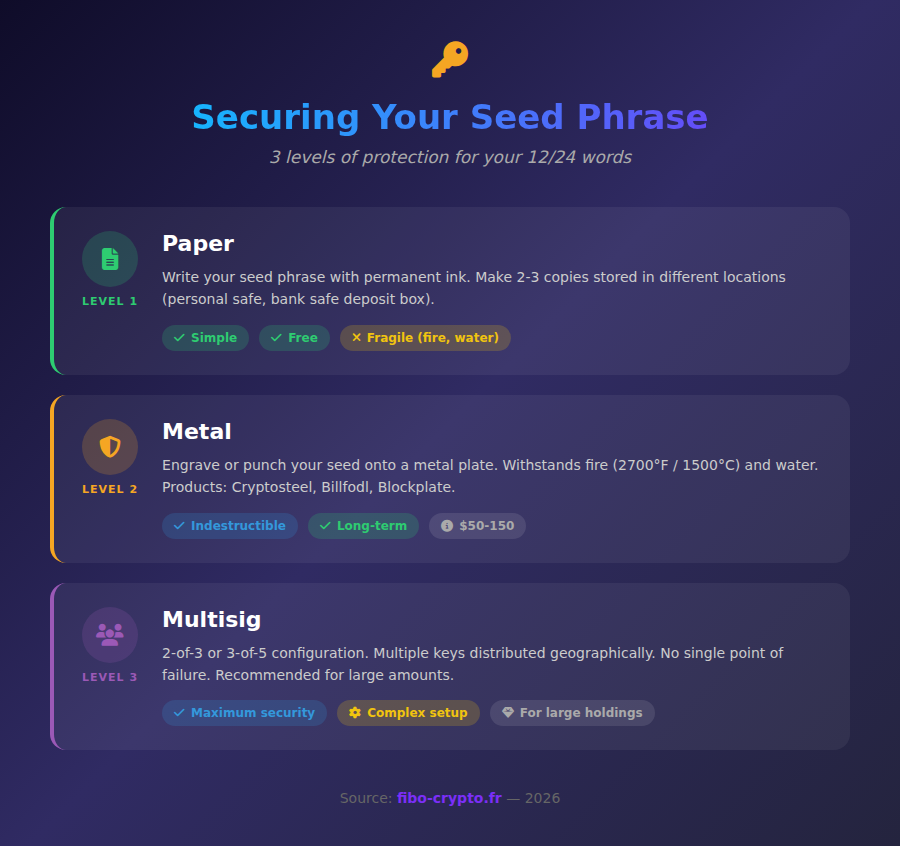
Level 1: Paper (basic)
- Write the seed on paper with permanent ink
- Make 2-3 copies
- Store in different locations (personal safe, bank safe deposit box)
- ⚠️ Vulnerable to fire, water, degradation
Level 2: Metal (recommended)
- Engrave or punch the seed on a metal plate
- Specialized products: Cryptosteel, Billfodl, Blockplate
- Withstands fire up to 2700°F (1500°C) and water
- Ideal for long-term storage
Level 3: Multisig (advanced)
- 2-of-3 or 3-of-5 configuration
- Multiple keys distributed geographically
- No single point of failure
- Complex to set up, recommended for large amounts
The passphrase concept (25th word)
Some wallets allow you to add a custom 25th word (passphrase) to your seed. This creates a hidden wallet: even if someone finds your 24-word seed, they can’t access the wallet protected by the passphrase.
This technique is useful as protection against physical theft, but adds risk: forgetting the passphrase = losing access.
Transitioning to self-custody: step-by-step guide
The transition to self-custody happens gradually. Start by securing a small amount before transferring all your assets.
Step 1: Choose your wallet
For beginners, a hot wallet like MetaMask or Trust Wallet is sufficient. For larger amounts (>$1,000), invest in a hardware wallet (Ledger or Trezor, around $60-150).
Step 2: Create the wallet and write down the seed phrase
- Download the official application (never through a suspicious link)
- Create a new wallet
- Write down the 12 or 24 words in exact order
- Verify by reading several times
- Don’t take a photo, don’t use copy-paste
Step 3: Test with a small amount
Before transferring all your funds:
- Send a small amount ($10-20) to your new wallet
- Verify that reception works
- Test a send to another address
- If you have a hardware wallet, test restoration with the seed
Step 4: Transfer from the exchange
- Copy your receiving address from your wallet
- On the exchange, initiate a withdrawal to this address
- Double-check the address before confirming
- Wait for blockchain confirmations
Step 5: Secure the seed phrase
Once your funds are transferred, secure your seed phrase using the methods described above. It’s now your only recovery point.
Self-custody and DeFi: the gateway to decentralized finance
Self-custody is the entry key to DeFi: without a non-custodial wallet, you can’t interact with decentralized finance protocols.
DeFi (decentralized finance) offers financial services — loans, borrowing, exchanges, yields — without banking intermediaries. To access it, you connect your non-custodial wallet directly to the protocols.
What self-custody enables in DeFi:
- Swap tokens on DEXes (Uniswap, dYdX)
- Generate yields through staking or lending
- Participate in protocol governance
- Use stablecoins without a bank account
In return, you’re responsible for your interactions: a transaction error or interaction with a malicious smart contract can result in losses.
Fatal mistakes to avoid
In self-custody, some mistakes are irreversible. Knowing these pitfalls helps you avoid them.
Mistake 1: Losing your seed phrase
Without your seed phrase and without access to your wallet, your funds are lost permanently. Always have at least two copies in different locations.
Mistake 2: Sharing your seed phrase
No legitimate service will ever ask for your seed phrase. It’s the number one scam technique. If someone asks for it, it’s a theft attempt.
Mistake 3: Sending to the wrong address
Blockchain transactions are irreversible. Always check the first and last characters of the address. Use copy-paste and verify visually.
Mistake 4: Choosing the wrong network
Sending tokens on the wrong network (e.g., ETH on the BSC network) can make your funds inaccessible or lost. Always verify the network before sending.
Mistake 5: Neglecting security updates
Keep your wallet and its firmware up to date. Updates often fix security vulnerabilities.
Self-custody vs custody: making the right choice
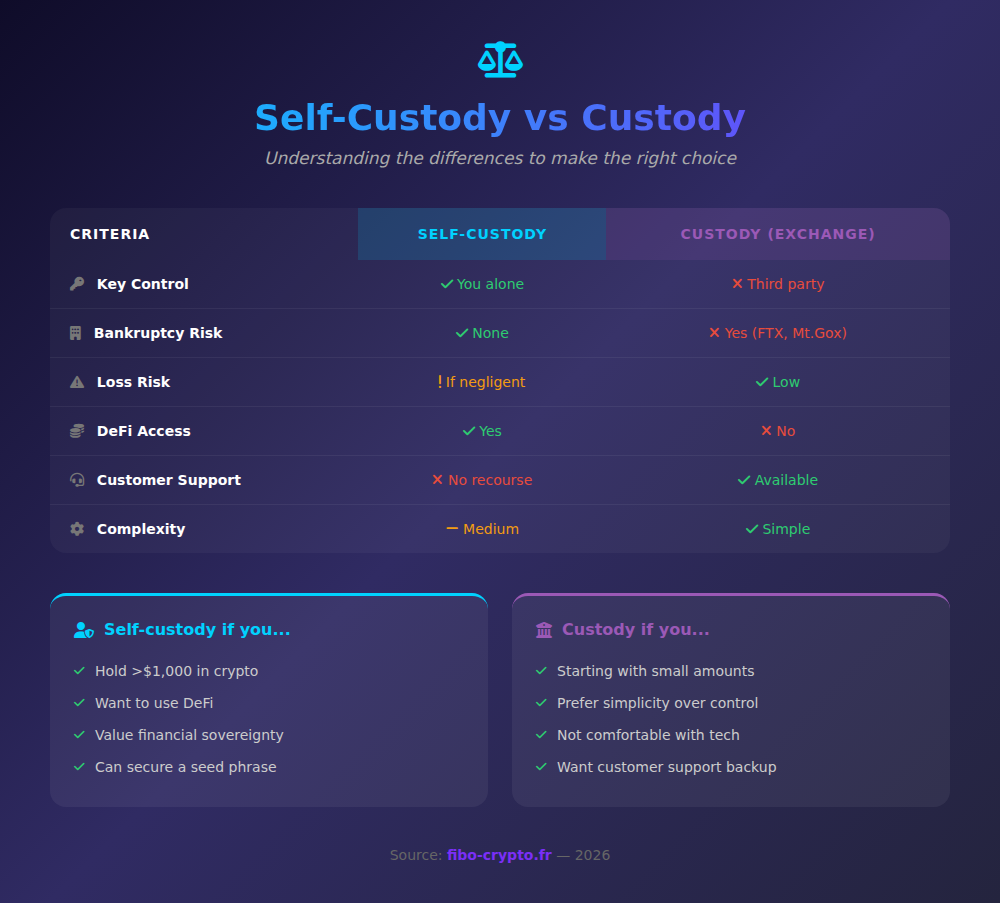
Self-custody isn’t for everyone. It’s important to understand the trade-offs before making your choice.
| Criteria | Self-Custody | Custody (Exchange) |
|---|---|---|
| Control | Total | Dependent on third party |
| Bankruptcy risk | None | Yes |
| Personal loss risk | High if negligent | Low |
| DeFi access | Yes | No |
| Complexity | Medium to high | Low |
| Recourse in case of problem | None | Customer support |
Self-custody is recommended if you:
- Hold significant amounts (>$1,000)
- Want to use DeFi
- Are willing to take responsibility for your keys
- Have a robust backup strategy
Custody may be suitable if you:
- Are starting with small amounts
- Prefer simplicity over sovereignty
- Aren’t comfortable with technical management
📚 Glossary
- Self-custody: Storage method where the user holds their own private keys, without intermediary. Synonyms: self-custody, non-custodial.
- Private key: Secret cryptographic code that proves cryptocurrency ownership and allows signing transactions. Must never be shared.
- Seed phrase: Sequence of 12 or 24 words generated when creating a wallet, allowing recovery of access to all funds. Also called recovery phrase or mnemonic phrase.
- Hot wallet: Crypto wallet connected to the Internet (mobile or desktop app). Convenient but more vulnerable to attacks.
- Cold wallet: Offline crypto wallet (hardware wallet, paper wallet). Maximum security for long-term storage.
- Hardware wallet: Physical device dedicated to secure storage of private keys. Examples: Ledger, Trezor, Coldcard.
- DeFi: Decentralized Finance. Set of financial services (loans, exchanges, yields) operating on blockchain without banking intermediaries.
- Multisig: Configuration requiring multiple signatures (keys) to validate a transaction. E.g., 2-of-3 means 2 keys out of 3 are needed.
Frequently Asked Questions about Self-Custody
What is crypto self-custody?
Self-custody is the practice of holding your own cryptocurrency private keys, without entrusting them to an exchange or third party. This gives you total control over your assets but implies total responsibility for their security.
What’s the difference between hot wallet and cold wallet?
A hot wallet is connected to the Internet (mobile/desktop app), convenient for daily transactions but more vulnerable. A cold wallet is offline (hardware wallet), offering maximum security for long-term storage.
What happens if I lose my seed phrase?
If you lose both your seed phrase and access to your wallet, your funds are lost permanently. There’s no possible recourse. That’s why it’s crucial to make multiple copies of your seed phrase and store them safely.
How to store your seed phrase securely?
Never store it digitally (photo, file, cloud). Prefer: paper with permanent ink in a safe, or better, engraving on a metal plate (fire/water resistant). Make 2-3 copies in different locations.
Is self-custody suitable for beginners?
Beginners can start with small amounts on a simple hot wallet (MetaMask, Trust Wallet). For larger amounts, a hardware wallet is recommended. The key is to properly understand seed phrase management before transferring significant funds.
Can I use DeFi without self-custody?
No. To interact with DeFi protocols (Uniswap, Aave, etc.), you must connect a non-custodial wallet. Centralized exchanges don’t offer direct DeFi access.
📰 Sources
This article is based on the following sources:
- Bitcoin Whitepaper – Satoshi Nakamoto – Foundational document establishing the principle of ownership through cryptographic keys
- SEC Investor.gov – Crypto Asset Custody Basics – Official guide on different forms of custody
- Ledger Academy – Educational resources on cryptocurrency security
- Bitcoin Magazine – Dos and Don’ts of Self-Custody – Best practices for Bitcoin self-custody
How to cite this article: Fibo Crypto. (2026). Crypto Self-Custody: The Ultimate Guide to Taking Control of Your Assets. Retrieved February 13, 2026 from https://fibo-crypto.fr/en/blog/crypto-self-custody-ultimate-guide