How to Invest a Small Amount of Money in Cryptocurrencies
📋 En bref (TL;DR)
- You don’t need to buy a whole Bitcoin: you can invest as little as $1 thanks to fractional shares (satoshis) on platforms like Coinbase, Kraken, or Robinhood
- DCA is the best strategy: investing $50/month in Bitcoin since January 2020 would have turned $3,000 into over $13,000 by early 2025
- Three sample portfolios: $100 (80% BTC/ETH), $500 (diversified with altcoins), and $1,000 (full allocation with stablecoins)
- Fees matter: compare spreads and commissions before choosing your platform — the gap can reach 2% per transaction
- US tax implications: crypto gains are taxed as capital gains — short-term (up to 37%) vs. long-term (0-20%) depending on holding period
- Avoid common traps: memecoins, leveraged trading, and FOMO are the leading causes of losses among beginners
Why investing a small amount in crypto is accessible to everyone
Contrary to popular belief, you don’t need thousands of dollars to start investing in cryptocurrency. In 2025, a single Bitcoin is worth over $100,000, but you can buy a fraction for just a few dollars. This is the principle behind satoshis: each Bitcoin is divisible into 100 million units.
The same applies to Ethereum and virtually every other crypto asset. Modern platforms allow you to invest as little as $1 (Robinhood, Coinbase) or $10 (Kraken, Binance). This accessibility has democratized crypto investing: over 50 million Americans now hold some form of cryptocurrency, with similar growth seen worldwide.
2x cheaper fees. Up to 6% yield. No seed phrase. Fibo, the wallet you've been waiting for.
Get early access →Investing a small amount offers a dual advantage: you limit your financial risk while getting familiar with the space. Even with $50 per month, you can progressively build a solid portfolio through DCA (Dollar Cost Averaging).

Getting started: choosing the right platform
Selecting the right platform is the first practical step when investing with a small budget. Look for regulated exchanges that comply with your country’s financial regulations — in the US, this means SEC-registered or FinCEN-compliant platforms.
Best platforms for small budgets
Here are the most suitable platforms for beginners investing small amounts:
- Coinbase: invest from $1, beginner-friendly interface, FDIC-insured USD balances. Fees: approximately 1.49% per trade (or lower on Coinbase Advanced).
- Robinhood: commission-free crypto trading, no minimum investment, intuitive mobile app. Revenue from spread (approximately 0.5-1%).
- Kraken: from $10, strong security track record, competitive fees (0.16-0.26% on Kraken Pro). Available worldwide.
- eToro: social trading features, available in 100+ countries, minimum $10 deposit for crypto. Spread: approximately 1%.
Pro tip: always verify that your chosen platform is properly licensed in your jurisdiction. In the US, check for FinCEN registration; in the UK, look for FCA authorization; in the EU, ensure MiCA compliance.
Understanding fees
Fees can eat into your returns, especially on small amounts. There are three main types to watch:
- Spread: the difference between the buy and sell price displayed on the platform. This ranges from 0.5% to 2.5% depending on the exchange.
- Trading commission: a fixed percentage charged per buy or sell order (0% to 1.5%).
- Network fees: the cost of transferring crypto to a cold wallet. This varies by blockchain (pennies on Solana, $2-5 on Ethereum).
For a $50 investment with a 1.49% fee, you lose $0.75 right away. On Kraken Pro with 0.26% fees, that drops to $0.13. Over a year of monthly purchases, the difference adds up significantly.
The DCA strategy: investing regularly on a small budget
DCA (Dollar Cost Averaging) involves investing a fixed amount at regular intervals, regardless of the current price. This strategy is particularly well-suited to small budgets because it removes the stress of timing the market and smooths out your average entry price over time.
Real DCA examples with Bitcoin
Here’s what different DCA strategies on Bitcoin would have produced:
- $50/month since January 2020 (60 months): $3,000 invested → approximately $13,000 in value by early 2025 (4.3× return)
- $100/month since January 2022 (36 months): $3,600 invested → approximately $7,500 by early 2025 (2.1× return)
- $25/month since January 2024 (12 months): $300 invested → approximately $460 by early 2025 (1.5× return)
The beauty of DCA is that it works across all market conditions. During downturns, you buy more crypto for the same dollar amount. During rallies, your existing portfolio gains value. Platforms like Coinbase and Robinhood offer recurring buy features that automate this approach entirely.
Bitcoin spot ETFs: a simplified alternative
Since January 2024, Bitcoin spot ETFs have been available in the US (BlackRock’s IBIT, Fidelity’s FBTC, etc.) and are expanding globally. These exchange-traded funds track Bitcoin’s price without requiring you to manage crypto directly. Benefits: no wallet to secure, no private keys to store, and seamless integration with your existing brokerage account.
The trade-off: you don’t actually own the underlying bitcoin, and you pay annual management fees (0.15% to 0.25% depending on the issuer). For small budgets, this is nonetheless an attractive option to gain Bitcoin exposure without technical complexity.
Three sample portfolios based on your budget
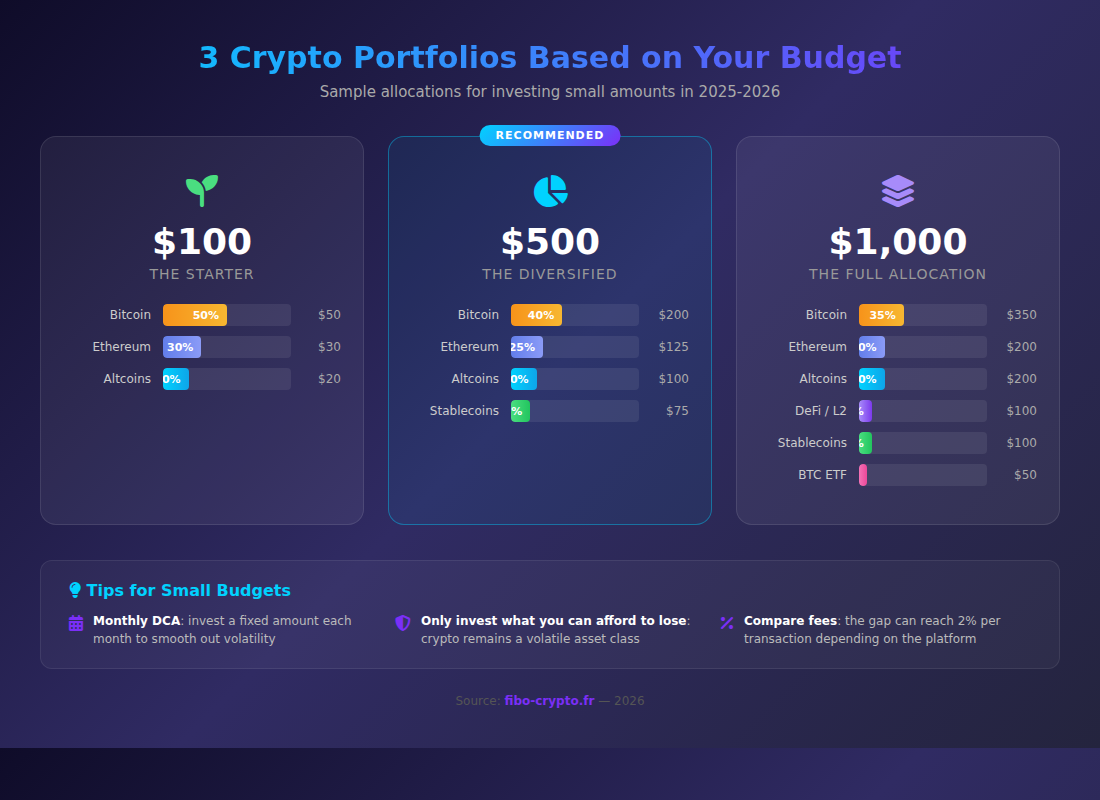
There’s no one-size-fits-all portfolio: the ideal allocation depends on your budget, risk tolerance, and investment horizon. Here are three practical examples to guide you.
$100 portfolio: the starter
- Bitcoin (BTC): $50 (50%) — the market’s store of value
- Ethereum (ETH): $30 (30%) — second-largest by market cap, powers the DeFi ecosystem
- Established altcoins: $20 (20%) — Solana, Chainlink, or another top-20 project
With $100, stick to the most established cryptocurrencies. They offer less explosive upside than small-cap projects, but far less risk of total loss.
$500 portfolio: the diversified
- Bitcoin (BTC): $200 (40%)
- Ethereum (ETH): $125 (25%)
- Major altcoins: $100 (20%) — Solana, Avalanche, Polkadot
- Stablecoins: $75 (15%) — USDC or USDT, to seize dip-buying opportunities
The stablecoin portion acts as a reserve. When the market drops sharply, you can redeploy these funds at discounted prices — a form of opportunistic DCA.
$1,000 portfolio: the full allocation
- Bitcoin (BTC): $350 (35%)
- Ethereum (ETH): $200 (20%)
- Major altcoins: $200 (20%) — 3 to 5 projects from the top 30
- DeFi / Layer 2: $100 (10%) — protocol tokens like Aave, Arbitrum
- Stablecoins: $100 (10%) — tactical reserve
- Bitcoin spot ETF: $50 (5%) — exposure via a brokerage account
With $1,000, you have enough room to diversify without spreading too thin. Keep at least $50 per position so that fees remain proportional.
Crypto taxation: what you need to know
Cryptocurrency gains are taxable in most jurisdictions, and the rules vary significantly depending on where you live. Understanding tax obligations early helps you avoid costly surprises.
United States
- Capital gains tax: crypto held for less than one year is taxed as short-term capital gains (at your ordinary income tax rate, up to 37%). Held for more than one year, it qualifies for long-term rates (0%, 15%, or 20% depending on income).
- Taxable events: selling crypto for USD, exchanging one crypto for another, and using crypto to purchase goods or services.
- Reporting: the IRS requires reporting all crypto transactions on Form 8949 and Schedule D. Exchanges like Coinbase issue Form 1099-MISC for certain activities.
- Wash sale rule: as of 2025, the wash sale rule does not officially apply to crypto (unlike stocks), though legislation to close this loophole is pending.
United Kingdom
- Capital Gains Tax (CGT): crypto gains above the £3,000 annual exemption (2025-2026) are taxed at 10% (basic rate) or 20% (higher rate).
- Income tax: staking rewards and airdrops may be treated as income.
European Union
- Tax treatment varies by country. France applies a 30% flat tax on crypto gains; Germany exempts gains if held for more than one year; Portugal recently introduced a 28% rate on short-term gains.
- The MiCA regulation (effective 2025-2026) standardizes crypto service provider rules across the EU but does not harmonize taxation.
Tip: if your portfolio is modest, consider strategies to stay within tax-free thresholds. In the UK, for example, realizing gains up to £3,000 annually incurs no tax.

Securing your cryptocurrency
Security is a fundamental aspect of crypto investing, even with a small budget. Adopting good habits from the start will save you from regrettable losses.
Security basics
- Enable 2FA: two-factor authentication (via an app like Google Authenticator, not SMS) protects your account from unauthorized access.
- Unique password: use a strong, dedicated password for each platform. A password manager is highly recommended.
- Watch for phishing: never click links in emails or texts claiming to be from your exchange. Always navigate directly to the platform.
Do you need a hardware wallet for a small amount?
A cold wallet (hardware wallet like Ledger or Trezor) costs between $60 and $150. For a $100-500 investment, that’s a proportionally high cost. As long as your capital remains modest (under $1,000), keeping your crypto on a regulated exchange with all account protections enabled is reasonable.
However, once your portfolio exceeds $1,000 or you plan to hold long-term, a hardware wallet becomes a wise investment in security.
Common mistakes to avoid
Beginners tend to make the same mistakes, and these are amplified with a small budget where every dollar counts.
FOMO and memecoins
FOMO (Fear Of Missing Out) drives people to buy a crypto after a sharp rally, often at the worst possible time. Memecoins (Dogecoin, Shiba Inu, and the hundreds of tokens launched weekly) are particularly dangerous: 95% of them lose more than 90% of their value within months.
With a small budget, putting $50 into a memecoin “just to see” might seem harmless, but these small losses accumulate and erode your starting capital.
Leveraged trading
Leveraged trading (5×, 10×, 50×) amplifies your gains… and your losses. With $100 and 10× leverage, a 10% drop is enough to liquidate your entire position. Over 70% of retail traders using leverage lose money.
Other common pitfalls
- Lack of diversification: putting your entire budget into a single altcoin is extremely risky.
- Panic selling: the crypto market is volatile. Drops of 20-30% are normal, even during bull markets.
- Ignoring taxes: failing to report crypto transactions can result in penalties and interest from the IRS.
- Following “influencers”: much social media content is paid promotion in disguise. Always do your own research (DYOR).

📚 Glossary
- Satoshi : the smallest unit of Bitcoin (0.00000001 BTC). Named after Satoshi Nakamoto, Bitcoin’s pseudonymous creator. Allows you to buy fractions of Bitcoin for just a few cents.
- DCA (Dollar Cost Averaging) : an investment strategy that involves buying a fixed dollar amount of cryptocurrency at regular intervals, regardless of price. Reduces the impact of volatility on your average purchase price.
- Spread : the difference between the buy and sell price of a cryptocurrency on a platform. It represents a hidden cost for the investor, typically expressed as a percentage.
- Altcoin : any cryptocurrency other than Bitcoin. The term comes from “alternative coin.” Examples: Ethereum, Solana, Cardano, Polkadot.
- Stablecoin : a cryptocurrency pegged to a traditional currency (US dollar, euro). Examples: USDC, USDT, DAI. Used as a stable store of value within the crypto ecosystem.
- ETF (Exchange-Traded Fund) : a fund traded on stock exchanges that tracks the price of an asset (here, Bitcoin). Allows exposure to Bitcoin without directly holding cryptocurrency, through a standard brokerage account.
- Cold wallet : a hardware device (Ledger, Trezor) that stores your private keys offline. Offers the highest level of security against hacks, but requires self-custody.
- FOMO (Fear Of Missing Out) : the fear of missing an investment opportunity. Drives investors to buy impulsively after a rapid price increase, often at the worst possible time.
- Memecoin : a cryptocurrency created from an internet meme or joke (Dogecoin, Shiba Inu, PEPE). Highly volatile and speculative, generally with no real technical utility.
- Bitcoin : the first and largest cryptocurrency by market capitalization. Created in 2009, it operates on a decentralized network with a supply capped at 21 million units.
- Ethereum : the second-largest cryptocurrency by market cap. A smart contract platform that powers the DeFi ecosystem, NFTs, and numerous decentralized applications.
Frequently Asked Questions
What is the minimum amount needed to invest in crypto?
There is no universal minimum — it depends on the platform. Coinbase and Robinhood allow investments starting from $1, while Kraken requires $10. Technically, a Bitcoin is divisible into 100 million satoshis, meaning you can buy a fraction for just pennies. In practice, a budget of $50 to $100 per month is enough to start building a portfolio through DCA.
Which platform is best for small crypto investments?
For small budgets, look for platforms with low fees and low minimums. Robinhood (commission-free, no minimum) and Coinbase (from $1, beginner-friendly) are particularly suited for newcomers. Kraken offers lower fees via its Pro interface but has a steeper learning curve. Always verify that the platform is properly regulated in your country.
Is DCA really effective for crypto investing?
Yes, Dollar Cost Averaging is one of the most effective strategies for individual investors. By investing a fixed amount each month, you buy more crypto when prices are low and less when they’re high, which smooths your average entry price. Historically, a $50/month DCA into Bitcoin since 2020 would have generated a return greater than 4× by early 2025.
Do I have to pay taxes on cryptocurrency in the US?
Yes. In the US, cryptocurrency is treated as property by the IRS. You owe capital gains tax when you sell, trade, or spend crypto. Short-term gains (held less than 1 year) are taxed at your ordinary income rate (up to 37%). Long-term gains (held over 1 year) benefit from lower rates (0%, 15%, or 20%). You must report all transactions on Form 8949.
Is it risky to invest $50 in crypto?
All investments carry risk, but $50 is a manageable amount. The crypto market is volatile — swings of 20-30% are common. The main risk with a small amount is being tempted by highly speculative assets (memecoins, leverage) in an attempt to “hit it big.” By focusing on Bitcoin and Ethereum with a DCA strategy, you significantly reduce your risk.
Do I need a hardware wallet to secure $100 in crypto?
For $100, a hardware wallet isn’t essential. These devices cost $60-150, which would be disproportionate. Keep your crypto on a regulated exchange with 2FA enabled. Once your portfolio exceeds $1,000, consider purchasing a Ledger or Trezor for maximum security.
What crypto should I buy first with a small budget?
Bitcoin (BTC) is the safest choice for a first investment. It’s the oldest, most capitalized, and most liquid cryptocurrency. Ethereum (ETH) is the natural second pick thanks to its ecosystem. For a $100 budget, a 50/30/20 split (BTC/ETH/top-20 altcoins) offers a good balance between safety and growth potential.
📰 Sources
This article is based on the following sources:
- IRS — Virtual Currency Guidance
- Bitcoin.org — Official Documentation
- SEC — Crypto Assets and Securities
- CoinGecko — Market Data
- Investopedia — Dollar-Cost Averaging
Comment citer cet article : Fibo Crypto. (2026). How to Invest a Small Amount of Money in Cryptocurrencies. Consulté le 24 March 2026 sur https://fibo-crypto.fr/en/blog/how-to-invest-small-amount-money-cryptocurrencies/
The simplest way to buy, swap and manage your crypto
Join the first users and get priority access. No seed phrase, fees 3.5x lower, built-in DeFi yield.
Get early access →