Is Crypto Investment Profitable? Data-Driven Analysis and Complete Guide 2026

📋 En bref (TL;DR)
- Bitcoin’s historical return: a CAGR of approximately 60% per year since 2013, vastly outperforming the S&P 500, gold, and real estate
- Extreme volatility: drawdowns of -77% to -85% between each bull cycle, with recovery periods of 2 to 3 years
- Spot Bitcoin ETFs: the January 2024 approval attracted over $100 billion in AUM, legitimizing crypto as an institutional asset class
- DCA vs Lump Sum: dollar-cost averaging significantly reduces timing risk and smooths out volatility
- Tax implications: capital gains treatment varies by jurisdiction — US short-term vs long-term rates, UK CGT allowance, EU harmonization under MiCA
- Conditional profitability: crypto investing can be profitable provided you adopt a long-term horizon, disciplined risk management, and a reasonable allocation within your portfolio
Introduction: is crypto a profitable investment?
Investing in cryptocurrency can be highly profitable, but that profitability depends on several key factors: your investment horizon, strategy, risk management approach, and ability to withstand significant volatility. Since Bitcoin’s creation in 2009, crypto assets have delivered returns unmatched in modern financial history. But those exceptional gains come with equally exceptional risks.
In 2026, the question “is crypto investment profitable?” deserves a nuanced answer. The ecosystem has matured significantly: spot Bitcoin ETFs now manage over $100 billion, regulators in the US, Europe, and Asia are actively framing markets, and institutional investors have become major players. Yet structural volatility remains, and the risks are real.
2x cheaper fees. Up to 6% yield. No seed phrase. Fibo, the wallet you've been waiting for.
Get early access →This article presents hard data, comparisons with traditional asset classes, and strategies that have historically generated returns — while objectively measuring the risks involved.
Bitcoin’s historical performance: the numbers speak for themselves
Bitcoin has delivered a compound annual growth rate (CAGR) of approximately 60% since 2013, making it the best-performing asset of the past decade. Past performance doesn’t guarantee future returns, but it provides a factual basis for evaluating potential profitability.
Bitcoin price evolution by cycle
Here are Bitcoin’s major valuation phases:
- 2013-2017: from ~$100 to ~$20,000 at the December 2017 peak — a 200x increase
- 2018-2021: after dropping to ~$3,200 in late 2018, climbing back to ~$69,000 in November 2021
- 2022-2024: correction to ~$15,500 in late 2022, then recovery above $100,000 in 2024
- 2025-2026: consolidation around $85,000 – $110,000, with an ATH above $109,000 in early 2025
Comparison with traditional asset classes (2015-2025)
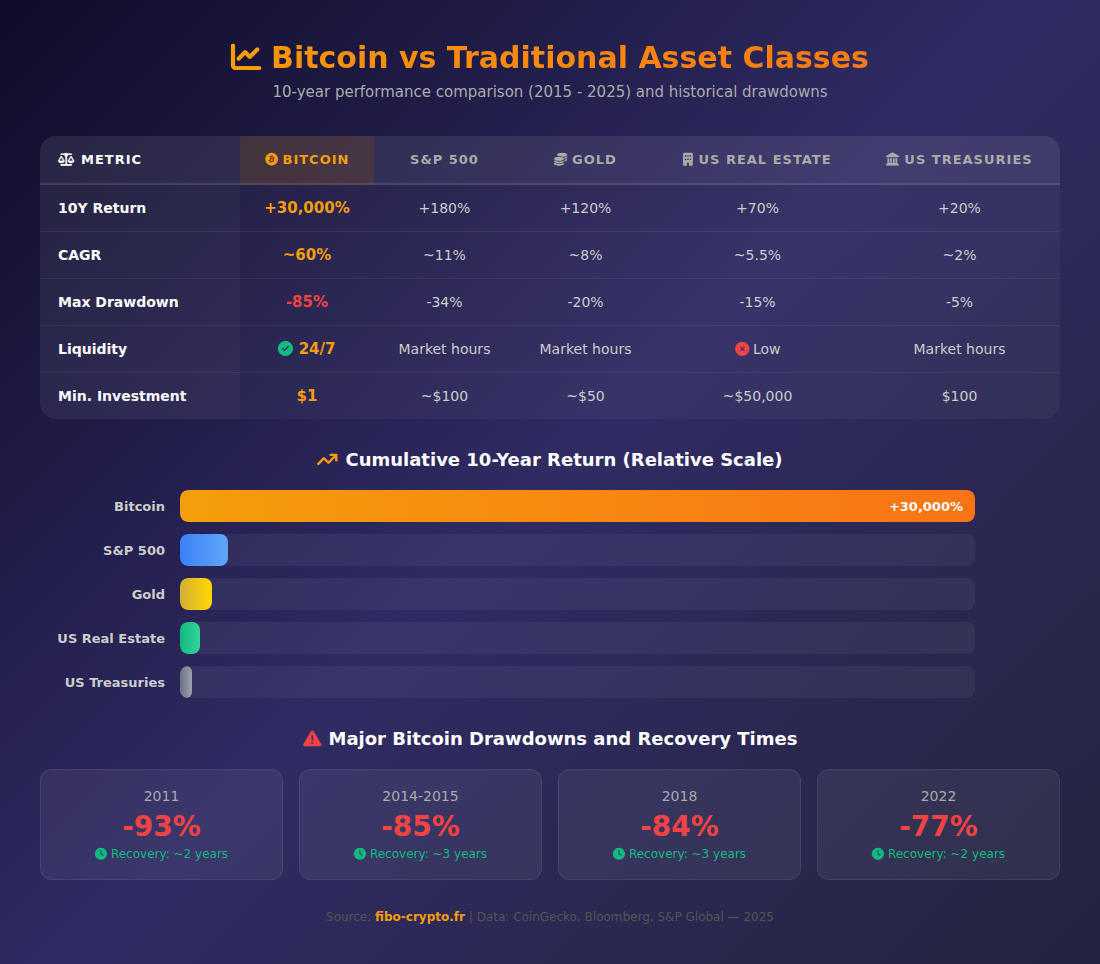
Over 10 years (2015-2025), here are the approximate cumulative returns of major asset classes:
- Bitcoin: +30,000% (from ~$300 to ~$100,000)
- S&P 500: +180% (from ~2,050 to ~5,750 points)
- Gold: +120% (from ~$1,200 to ~$2,650 per ounce)
- US Real Estate (Case-Shiller): +60 to +80% depending on market
- US Treasuries (10Y): +20% cumulative (average ~2% per year)
Even an investor who bought Bitcoin at the worst possible moment — the December 2017 peak at $20,000 — would be up over 400% by 2026. This illustrates the power of a long-term horizon with this asset.

Spot Bitcoin ETFs: a turning point for profitability
The SEC’s approval of spot Bitcoin ETFs in January 2024 was a historic milestone, attracting over $100 billion in assets under management within just over a year and legitimizing Bitcoin as an institutional asset class.
Impact on flows and prices
Spot Bitcoin ETFs, led by BlackRock’s iShares Bitcoin Trust (IBIT) and Fidelity’s Wise Origin Bitcoin Fund (FBTC), have channeled massive institutional flows:
- BlackRock IBIT: over $55 billion in AUM, becoming the fastest ETF launch in history
- Fidelity FBTC: approximately $18 billion in AUM
- Cumulative net inflows: over $40 billion in net inflows during 2024-2025
These institutional flows have helped support Bitcoin’s price and gradually reduce its structural volatility. The ETFs also provide simplified access for traditional investors through standard brokerage accounts, without the need to manage private keys directly.
What ETFs mean for individual investors
For the everyday investor, spot Bitcoin ETFs offer:
- Simplified access: invest through your existing brokerage — no need to open an account on a crypto exchange
- Enhanced security: no risk of losing private keys, as assets are custodied by regulated institutions
- Institutional legitimacy: when BlackRock and Fidelity manage Bitcoin, the “it’s too risky” argument loses much of its force
- FASB ASU 2023-08: the new fair-value accounting standard makes it easier for corporations to hold crypto on their balance sheets
Volatility and drawdowns: the price of profitability
The trade-off for Bitcoin’s exceptional returns is volatility that dwarfs traditional assets: corrections of 50 to 85% occur in every cycle, and it typically takes 2 to 3 years to recover previous highs.
Historical major drawdowns
- 2011: drawdown of -93% ($32 to $2) — recovery in ~2 years
- 2014-2015: drawdown of -85% ($1,150 to $170) — recovery in ~3 years
- 2018: drawdown of -84% ($19,700 to $3,200) — recovery in ~3 years
- 2022: drawdown of -77% ($69,000 to $15,500) — recovery in ~2 years
The pattern is clear: after every brutal correction, Bitcoin has not only recovered its previous all-time high but significantly exceeded it. However, withstanding a 77% decline in your investment requires solid conviction and battle-tested investor psychology.
What this means for your portfolio
If you invest $10,000 in Bitcoin and experience a -77% drawdown, your position drops to $2,300. Even though historical data shows systematic recovery, you need to:
- Not need that money for at least 3 to 5 years
- Limit your crypto allocation to a tolerable percentage of your portfolio (5 to 15% depending on your risk profile)
- Never invest money you can’t afford to lose entirely

DCA vs Lump Sum: which strategy maximizes profitability?
Dollar-cost averaging (DCA) means investing a fixed amount at regular intervals. This strategy has proven particularly well-suited to the crypto market by neutralizing volatility and eliminating the risk of poor timing.
DCA results on Bitcoin (hard numbers)
A monthly DCA of $100 into Bitcoin would have produced the following results:
- DCA since January 2020 (6 years): $7,200 invested → value at end of 2025 approximately $25,000 (+250%)
- DCA since January 2018 (8 years, starting at the peak): $9,600 invested → value at end of 2025 approximately $45,000 (+370%)
- DCA since January 2015 (11 years): $13,200 invested → value at end of 2025 exceeding $200,000
The critical point: even starting at the worst possible moment (the December 2017 peak), DCA would have been highly profitable over a 5-year or longer horizon.
Lump Sum: more profitable on average, but riskier
Studies show that lump-sum investing outperforms DCA approximately 65% of the time in traditional markets. On Bitcoin, the dynamic is similar but amplified:
- Lump sum is more profitable if you invest early in a bull cycle
- It can be devastating if you invest at the peak (a -77% drawdown)
- DCA remains the recommended strategy for most investors because it eliminates the emotional factor
Bitcoin halving and cycles: a built-in profitability engine
The Bitcoin halving, which cuts the mining reward in half every 210,000 blocks (approximately every 4 years), has historically preceded major price rallies. The latest halving occurred in April 2024, reducing the block reward from 6.25 to 3.125 BTC.
Historical impact of halvings on price
- 2012 Halving (November): price ~$12 → ATH ~$1,150 in 2013 (+9,500%)
- 2016 Halving (July): price ~$650 → ATH ~$19,700 in 2017 (+2,930%)
- 2020 Halving (May): price ~$8,700 → ATH ~$69,000 in 2021 (+690%)
- 2024 Halving (April): price ~$64,000 → ATH ~$109,000 in early 2025 (+70% to date, cycle ongoing)
We can observe diminishing post-halving returns, which is logical as market capitalization grows. But even with a lower multiplier, the 2024-2025 cycle has still produced significant returns.
How to leverage cycles
Understanding cycles doesn’t mean you can time them perfectly. However, you can:
- Increase investments during bear market phases (accumulation)
- Take partial profits when the market reaches historically extreme ROI levels
- Maintain a steady baseline DCA regardless of market conditions
Real risks: what can destroy your returns
Bitcoin’s theoretical profitability only materializes if you avoid the pitfalls that have cost many investors their money. The risks are very real and extend well beyond simple market volatility.
Market risks
- Extreme volatility: corrections of -30% within days are possible, triggering panic selling
- Altcoins and fraudulent projects: the majority of altcoins ever created have never recovered their highs. Collapses like Terra/LUNA (2022, -99.99%) destroyed billions of dollars
- Crisis correlation: during broad market panics, crypto often falls faster than traditional markets
Operational risks
- Exchange hacks: Mt. Gox (2014, 850,000 BTC stolen), FTX (2022, $8 billion fraud). Always prefer regulated platforms
- Loss of private keys: approximately 20% of all bitcoins in circulation are estimated to be permanently lost (3 to 4 million BTC)
- User errors: sending to wrong addresses, interacting with malicious smart contracts
Regulatory risks
- Regulatory tightening: potential bans in certain countries, restrictions on decentralized exchanges
- Evolving tax frameworks: IRS is increasing enforcement, MiCA is reshaping European regulation, and global coordination is increasing

Tax implications: impact on your net profitability
Tax treatment of cryptocurrency gains varies significantly by jurisdiction but is a critical factor in calculating your actual net return. Understanding your local tax obligations can make or break the profitability of your crypto investments.
United States: capital gains framework
- Short-term capital gains (held less than 1 year): taxed as ordinary income, up to 37% for the highest bracket
- Long-term capital gains (held more than 1 year): preferential rates of 0%, 15%, or 20% depending on income
- IRS reporting: crypto transactions must be reported on Form 8949 and Schedule D; exchanges now issue 1099 forms
- FASB ASU 2023-08: since December 2024, companies can report crypto at fair value, making corporate adoption easier
United Kingdom
- Capital Gains Tax (CGT): 10% or 20% depending on income band, with a reduced annual exempt amount of £3,000 since 2024
- Mining and staking income: treated as income tax, not capital gains
European Union under MiCA
- MiCA regulation: the Markets in Crypto-Assets regulation took effect in 2024-2025, harmonizing rules across the EU
- Tax treatment varies by country: Germany offers tax-free gains after 1 year of holding, Portugal recently introduced capital gains tax on crypto, France applies a 30% flat tax
Optimizing your tax position
- Hold for long-term rates: in the US, holding for over 1 year can cut your tax rate in half
- Tax-loss harvesting: sell losing positions to offset gains (crypto is not subject to wash sale rules in many jurisdictions)
- Keep detailed records: cost basis, dates, amounts — essential for accurate tax reporting

How much to invest and how to get started
The question isn’t “should I invest in crypto?” but rather “what percentage of my portfolio should I allocate to this asset class?” Wealth management consensus points to an allocation of 1 to 10% of total portfolio value, depending on your risk profile.
Recommended allocation by profile
- Conservative profile: 1 to 3% of portfolio — minimal exposure to capture upside potential without significant risk
- Balanced profile: 5 to 10% — meaningful allocation but still a minority position
- Aggressive profile: 10 to 15% — for investors who understand and accept the volatility
Ground rules for getting started
- Build an emergency fund first: 3 to 6 months of expenses in liquid savings before any crypto investment
- Start small: $50 to $100 per month in DCA to familiarize yourself with volatility
- Prioritize Bitcoin and Ethereum: the two largest assets represent over 65% of total market cap and offer the best risk-return profile for beginners
- Use a regulated platform: choose a licensed and regulated exchange in your jurisdiction for fund safety
Conclusion: yes, crypto can be profitable — under the right conditions
The historical data is unequivocal: Bitcoin has been the best-performing asset of the past decade, and even investors who bought at the worst possible moments have been in significant profit after 4-5 years. The arrival of spot ETFs, institutional adoption, and regulatory maturation are strengthening the legitimacy of this investment.
However, profitability is not automatic. It depends on:
- A long investment horizon (5 years minimum)
- A disciplined strategy (DCA rather than speculation)
- A reasonable allocation (don’t put all your savings in crypto)
- Rigorous risk management (diversification, asset security)
- A clear understanding of tax obligations in your jurisdiction
Investing in crypto in 2026 means investing in an asset class that has proven its return potential, while accepting that the journey will be turbulent. Profitability is at the end of the road — for those with the patience and discipline to stay the course.
📚 Glossary
- ROI : Return on Investment. Measures the profitability of an investment as a percentage of the initial capital.
- CAGR : Compound Annual Growth Rate. Measures the smoothed annualized return of an investment over a given period.
- DCA : Dollar Cost Averaging, a strategy of investing a fixed amount at regular intervals regardless of price movement.
- Volatility : A measure of the magnitude of price fluctuations for an asset. Higher volatility means larger swings.
- Drawdown : The maximum decline from a peak to a trough. Expressed as a percentage, it measures the maximum potential loss an investor could have experienced.
- Halving : A programmed event in the Bitcoin protocol that cuts the mining reward in half approximately every 4 years, reducing the rate at which new bitcoins are created.
- ETF : Exchange-Traded Fund, a fund listed on a stock exchange that replicates the performance of an underlying asset (here, Bitcoin). Allows investing without directly holding the asset.
- ATH : All-Time High, the highest price ever reached by an asset.
- Bear market : A prolonged period of falling prices (generally -20% or more from the peak).
- Bull market : A prolonged period of rising prices following a significant bottom.
- MiCA : Markets in Crypto-Assets, the EU regulation harmonizing crypto rules across member states, fully effective since 2025.
- FASB ASU 2023-08 : An accounting standard update that allows companies to report crypto assets at fair value on their balance sheets, effective December 2024.
Frequently Asked Questions
Is it too late to invest in crypto in 2026?
No, it’s not too late. If we compare with Internet adoption, the crypto market would still be in its early growth phase, with approximately 500 million users worldwide versus several billion potential users. The arrival of spot Bitcoin ETFs and institutional adoption shows the asset class is still being democratized. However, the exceptional returns of the early days (1,000x) are likely behind us.
How much should a beginner invest in crypto?
The common recommendation is to start with an amount you can afford to lose entirely, typically 1 to 5% of your total portfolio. A DCA of $50 to $100 per month is a good starting point to familiarize yourself with the market. It’s essential to first have an emergency fund (3 to 6 months of expenses) in secure savings.
What return can I reasonably expect from Bitcoin?
The more conservative analysts project a CAGR of 20 to 40% for the next 5 years, which still significantly outpaces traditional assets. However, these projections are uncertain, and past performance does not guarantee future results. A minimum 5-year horizon is recommended to maximize your chances of a positive return.
Should I invest in Bitcoin or altcoins?
Bitcoin remains the least risky asset in the crypto ecosystem due to its dominant market cap, longest track record, and institutional adoption (ETFs). Altcoins potentially offer higher returns but come with a much greater risk of total loss. For beginners, an allocation of 60 to 80% in Bitcoin and 15 to 30% in Ethereum is generally recommended.
Is crypto a safe investment?
No investment is “safe” in the strict sense, and crypto is less so than most traditional asset classes due to its volatility. However, risk can be considerably reduced by using regulated platforms, diversifying your portfolio, adopting a DCA strategy, and limiting crypto allocation to a reasonable percentage of your total wealth.
How are crypto gains taxed in the US?
In the United States, cryptocurrency is treated as property by the IRS. Short-term gains (held under 1 year) are taxed at ordinary income rates up to 37%. Long-term gains (held over 1 year) benefit from preferential rates of 0%, 15%, or 20% depending on your income level. All crypto transactions must be reported on Form 8949 and Schedule D.
Is DCA really the best strategy for crypto investing?
DCA is the most recommended strategy for the majority of investors because it eliminates timing stress and smooths out volatility. Historical data shows that even a DCA started at a cycle peak was profitable over a 3 to 5-year horizon. Lump-sum investing can outperform in bull markets, but DCA offers far better psychological management of risk.
📰 Sources
This article is based on the following sources:
Comment citer cet article : Fibo Crypto. (2026). Is Crypto Investment Profitable? Data-Driven Analysis and Complete Guide 2026. Consulté le 21 March 2026 sur https://fibo-crypto.fr/en/blog/is-crypto-investment-profitable
The simplest way to buy, swap and manage your crypto
Join the first users and get priority access. No seed phrase, fees 3.5x lower, built-in DeFi yield.
Get early access →