Bitcoin Mining: Complete Guide to Understanding Mining in 2026
📋 En bref (TL;DR)
- Bitcoin mining is the process of validating transactions and creating new BTC by solving complex cryptographic calculations
- Current reward: 3.125 BTC per block since the April 2024 halving (halved every 4 years)
- Cost in Europe: Mining 1 BTC costs approximately €130,000-200,000 with electricity at €0.25/kWh — not profitable
- Profitable only in regions with cheap electricity: Kazakhstan ($0.068/kWh), Texas, Paraguay
- Required hardware: Specialized ASIC (Antminer S21, Whatsminer M60) — cost $2,000-15,000
- Alternative: Join a mining pool to share computing power and stabilize income
- Environmental impact: ~150 TWh/year (comparable to Poland), but transitioning to renewable energy
How Does Bitcoin Mining Work?
The process in 5 steps
Users send BTC, transactions wait in the mempool
Each miner creates a candidate block with ~2,000-3,000 transactions
Miners test billions of combinations (nonce) to find a valid hash
The fastest miner receives 3.125 BTC + transaction fees
Nodes verify and propagate the block — cycle restarts (~10 min)
What Is Bitcoin Mining? Complete Definition
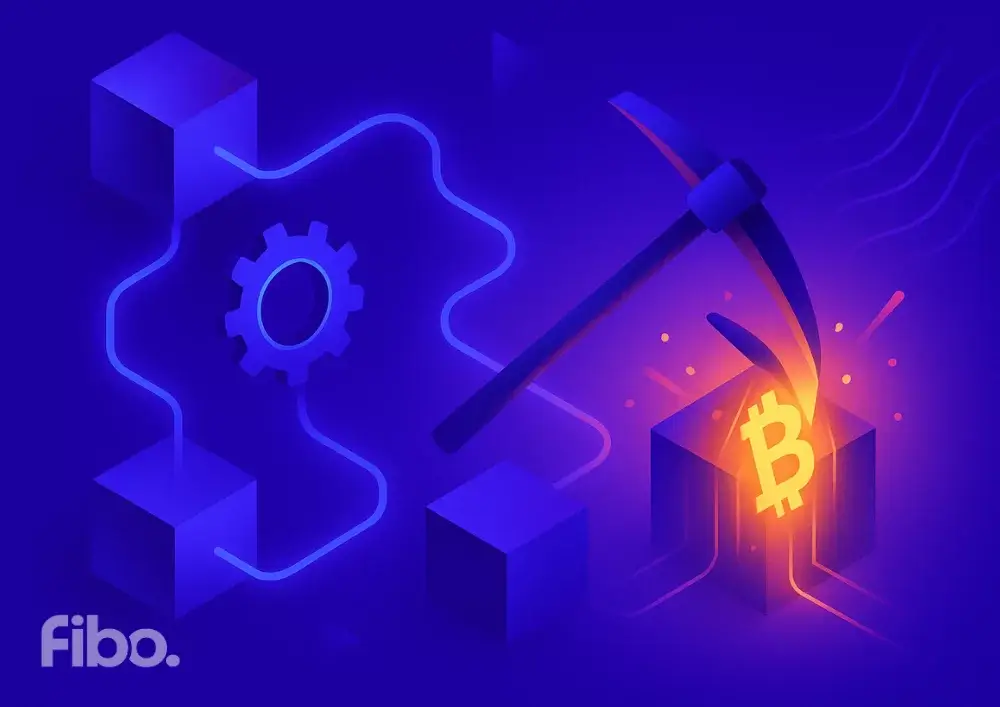
Bitcoin mining is the process by which specialized computers validate transactions on the Bitcoin network and create new BTC by solving complex cryptographic problems. It’s the fundamental mechanism that has secured the Bitcoin blockchain since its creation in 2009.
Mining serves three essential functions:
- Transaction validation: Miners verify that each transaction is legitimate (sufficient balance, valid signature)
- Network security: The enormous cost of mining makes any attack economically unviable
- Monetary creation: It’s the only way to put new bitcoins into circulation
The term “mining” refers to gold extraction: just as gold miners invest time and resources to extract the precious metal, Bitcoin miners invest computing power and electricity to “extract” new BTC.
Proof of Work: The Heart of Mining
Bitcoin uses a consensus mechanism called Proof of Work. This system requires miners to prove they’ve performed significant computational work before they can add a block to the blockchain.
The principle is simple but ingenious:
- Miners collect pending transactions from the mempool
- They create a candidate block containing these transactions
- They must find a number (the nonce) that, combined with the block data, produces a hash starting with a certain number of zeros
- The first to find this valid hash “wins” and can add their block to the blockchain
This search for the right nonce requires billions of attempts per second, which explains the colossal computing power required.
How Much Does Bitcoin Mining Earn in 2026?
In 2026, each mined block yields 3.125 BTC (approximately $270,000 at current prices) plus transaction fees, but this reward is shared among thousands of miners in pools, and operating costs can exceed revenue depending on your location.
Bitcoin Mining by the Numbers (2026)
Key network statistics
Block Rewards
The block reward consists of two components:
- Block subsidy: Currently 3.125 BTC (since the April 2024 halving)
- Transaction fees: Variable depending on network congestion (0.5 to 2 BTC per block on average)
The Halving’s Impact on Profitability
The halving is a programmed event that halves the block reward every 210,000 blocks (approximately 4 years):
| Year | Reward | BTC Created/Day | Event |
|---|---|---|---|
| 2009-2012 | 50 BTC | 7,200 | Bitcoin launch |
| 2012-2016 | 25 BTC | 3,600 | 1st halving |
| 2016-2020 | 12.5 BTC | 1,800 | 2nd halving |
| 2020-2024 | 6.25 BTC | 900 | 3rd halving |
| 2024-2028 | 3.125 BTC | 450 | 4th halving (current) |
| 2028-2032 | 1.5625 BTC | 225 | 5th halving (projected) |
How to Mine Bitcoin: The 3 Main Methods
To mine Bitcoin in 2026, you have three options: solo mining (very difficult), pool mining (recommended), or cloud mining (risky). The choice depends on your budget, technical skills, and risk tolerance.
1. Solo Mining
Solo mining means mining independently, without joining a group. If you find a block, you keep the entire reward (~$270,000).
Pros:
- 100% of the reward if you find a block
- No pool fees
- Complete independence
Cons:
- Extremely low probability of finding a block
- Very irregular income (possibly zero for years)
- Requires massive hardware investment
Verdict: Not recommended for individuals. With a single ASIC, you could wait decades before finding a block.
2. Pool Mining (Recommended)
A mining pool combines the computing power of thousands of miners. Rewards are shared proportionally to each contributor’s hashrate.
Pros:
- Regular and predictable income
- Accessible even with a single ASIC
- Reduces variance and risk
Cons:
- Pool fees (1-3%)
- Shared rewards
- Dependence on the pool
Major mining pools in 2026:
| Pool | Hashrate Share | Fees | Minimum Payout |
|---|---|---|---|
| Foundry USA | ~28% | 2.5% | 0.005 BTC |
| AntPool | ~18% | 2.5% | 0.001 BTC |
| F2Pool | ~12% | 2.5% | 0.005 BTC |
| ViaBTC | ~10% | 2% | 0.001 BTC |
| Binance Pool | ~8% | 2.5% | 0.001 BTC |
3. Cloud Mining
Cloud mining involves renting computing power from a company that owns the machines.
Pros:
- No hardware to buy or maintain
- No electricity bill
- Accessible to beginners
Cons:
- Numerous scams in the sector
- Often low or negative profitability
- Often disadvantageous contracts
- No control over machines
Verdict: Extreme caution required. Many cloud mining services have turned out to be scams (Ponzi schemes). If you choose this option, only use established providers with verified reputations.
What Hardware for Bitcoin Mining in 2026?
To mine Bitcoin efficiently in 2026, you must use an ASIC (Application-Specific Integrated Circuit), a machine specifically designed for mining. Graphics cards (GPU) and processors (CPU) are completely obsolete for BTC mining.
Bitcoin ASIC Comparison 2026
Top performing machines on the market
Note: Efficiency (J/TH) is the most important metric — lower means less electricity consumption per hash.
Is Bitcoin Mining Profitable in the US/Europe?
No, Bitcoin mining is not profitable in most of Europe and many US states for individuals due to high electricity costs. Producing 1 BTC in France would cost approximately €130,000-200,000, more than its market value.
Cost to Mine 1 BTC by Region
Using Antminer S21 (200 TH/s, 3500W)
BTC price: ~$87,000 — Profitable only if cost < BTC price
Environmental Impact of Bitcoin Mining
Bitcoin mining consumes approximately 150 TWh of electricity per year, comparable to countries like Poland. However, more than 50% of this energy now comes from renewable sources, and the industry is innovating to reduce its carbon footprint.
| Activity | Annual Consumption | Comparison |
|---|---|---|
| Bitcoin Mining | ~150 TWh | – |
| Global Data Centers | ~250 TWh | 1.7x more |
| US Air Conditioning | ~600 TWh | 4x more |
| Global Banking System | ~260 TWh | 1.7x more |
| Gold Mining | ~130 TWh | Comparable |
Securing Your Mining Operation
Securing your mining operation involves protecting your hardware, income, and personal data from physical risks (fire, theft) and digital risks (hacking, malware).
Essential Security Measures
- Physical security: Secure location, fire detector, ventilation system
- Electrical security: Up-to-code installation, UPS, appropriate circuit breaker
- Network security: VPN, firewall, updated firmware
- Secure wallet: Hardware wallet to store your BTC
- Monitoring: 24/7 monitoring of your machines (temperature, hashrate)
Conclusion: Should You Start Mining?
Bitcoin mining remains a fascinating activity that combines technology, economics, and strategy. However, in 2026, it’s no longer accessible to everyone:
- For individuals in Europe/US: Not recommended due to electricity costs
- For investors: Consider direct BTC purchase or investing in mining companies
- For enthusiasts: A small setup can be educational and serve as heating
- For professionals: Profitable only with access to very cheap electricity
If you want exposure to Bitcoin without the constraints of mining, check out our guides on how to buy Bitcoin and the best crypto platforms.
📚 Glossary
- ASIC: Application-Specific Integrated Circuit. A circuit specifically designed for Bitcoin mining, much more efficient than CPUs or GPUs.
- Blockchain: A distributed and immutable ledger containing the history of all Bitcoin transactions since 2009.
- Block: A set of transactions grouped and validated by a miner, added to the blockchain approximately every 10 minutes.
- Mining Difficulty: A measure of the complexity of calculations needed to mine a block. Automatically adjusts every 2,016 blocks.
- Halving: A programmed event that halves the block reward every 210,000 blocks (~4 years). The last one occurred in April 2024.
- Hash: A unique digital fingerprint produced by a cryptographic hashing function (SHA-256 for Bitcoin).
- Hashrate: Computing power of a miner or network, measured in hashes per second (H/s, TH/s, EH/s).
- Mempool: Memory area containing transactions waiting to be confirmed by miners.
- Nonce: Random number that miners modify to try to find a valid hash. “Number used only once.”
- Mining Pool: A group of miners who combine their computing power and share rewards proportionally.
- Proof of Work (PoW): Bitcoin’s consensus mechanism requiring miners to prove computational work to validate a block.
- Block Reward: Newly created BTC (currently 3.125 BTC) + transaction fees awarded to the miner who finds a block.
Frequently Asked Questions
Is Bitcoin mining profitable in 2026?
Bitcoin mining can be profitable in 2026, but only in regions where electricity costs less than $0.08/kWh. This includes Kazakhstan ($0.05/kWh), Texas ($0.05-0.08/kWh), and Paraguay ($0.03-0.05/kWh). In most of Europe and many US states with high electricity prices, mining is not profitable for individuals.
How much does it cost to mine one Bitcoin?
The cost to mine 1 BTC varies dramatically by location due to electricity prices. With an Antminer S21: approximately $16,000 in Kazakhstan, $27,000 in Texas, $43,000 in Iceland, but over $185,000 in Germany or the UK. These figures include only electricity costs—add $2,000-5,000 for hardware depreciation over 3 years.
What equipment do I need to mine Bitcoin?
To mine Bitcoin efficiently in 2026, you need an ASIC (Application-Specific Integrated Circuit). The best models are the Antminer S21 XP Hyd (473 TH/s, ~$16,000), Antminer S21 (200 TH/s, ~$5,500), and Whatsminer M60S (186 TH/s, ~$5,000). Graphics cards (GPUs) and processors (CPUs) are completely obsolete for Bitcoin mining.
Can I mine Bitcoin with a regular computer?
No, it has been impossible to profitably mine Bitcoin with a regular computer since 2012-2013. Network difficulty has increased so much that only ASICs (specialized machines costing thousands of dollars) are competitive. A regular CPU produces about 0.0001 TH/s compared to 200+ TH/s for an ASIC—2 million times less powerful.
What is the halving and how does it affect mining?
The halving is an event programmed into Bitcoin’s code that halves the block reward every 210,000 blocks (approximately 4 years). Since April 2024, the reward is 3.125 BTC per block. The next halving in 2028 will reduce it to 1.5625 BTC. Each halving is an economic shock for miners: their BTC income decreases while costs remain the same.
Is Bitcoin mining bad for the environment?
Bitcoin mining consumes approximately 150 TWh of electricity annually, comparable to Poland. However, more than 50% of this energy now comes from renewable sources. The industry continues to innovate: heat recovery for heating buildings, electrical grid stabilization, methane capture from oil wells. The actual environmental impact depends heavily on the energy source used.
How long does it take to mine 1 Bitcoin?
With a single Antminer S21 (200 TH/s) in a mining pool, you would accumulate approximately 0.00001 BTC per day, meaning about 274 years to reach 1 complete BTC. Solo mining gives you near-zero probability of finding a block (once every millions of years). Only industrial farms with hundreds of machines can expect significant and regular returns.
Is cloud mining a good alternative?
Cloud mining (renting computing power) carries significant risks as the sector is rife with scams and Ponzi schemes. Profitability is often low or negative after fees are deducted. If you consider this option, only use established providers with verifiable reputations, and only invest what you can afford to lose.
📰 Sources
This article is based on the following sources:
- Bitcoin Whitepaper – Satoshi Nakamoto, 2008
- Blockchain.com – Real-time Bitcoin hashrate statistics
- Cambridge Bitcoin Electricity Consumption Index – University of Cambridge
- Bitmain – Antminer ASIC specifications
- MicroBT – Whatsminer specifications
- Bitcoin Mining Council – Sustainable energy reports
- Mempool.space – Real-time Bitcoin network data
- Hashrate Index – Mining economics analysis
How to cite this article: Fibo Crypto. (2026). Bitcoin Mining: Complete Guide to Understanding Mining in 2026. Retrieved from https://fibo-crypto.fr/en/blog/bitcoin-mining-complete-guide
The simplest way to buy, swap and manage your crypto
Join the first users and get priority access. No seed phrase, fees 3.5x lower, built-in DeFi yield.
Get early access →