
DeFi Yield: Complete Guide to Generating Crypto Passive Income (2026)
📋 En bref (TL;DR)
- DeFi yields in 2026: realistic APYs range from 3-5% (ETH staking) to 30%+ (aggressive yield farming), compared to less than 3% for traditional savings
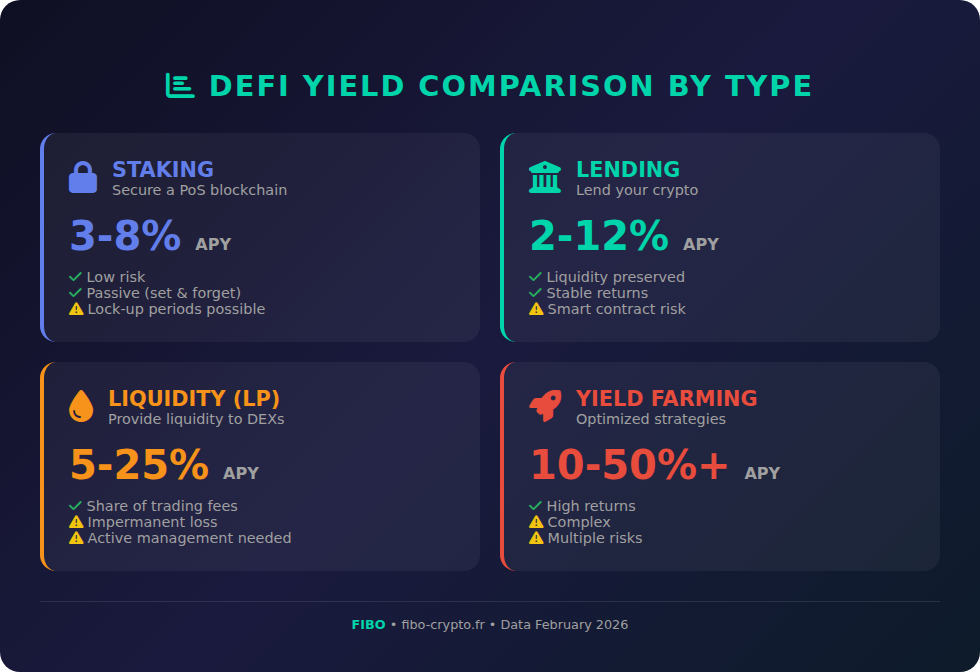
- 4 main sources: staking (3-8% APY), lending/borrowing (2-12% APY), liquidity provision (5-25% APY), and optimized yield farming (10-50%+ APY)
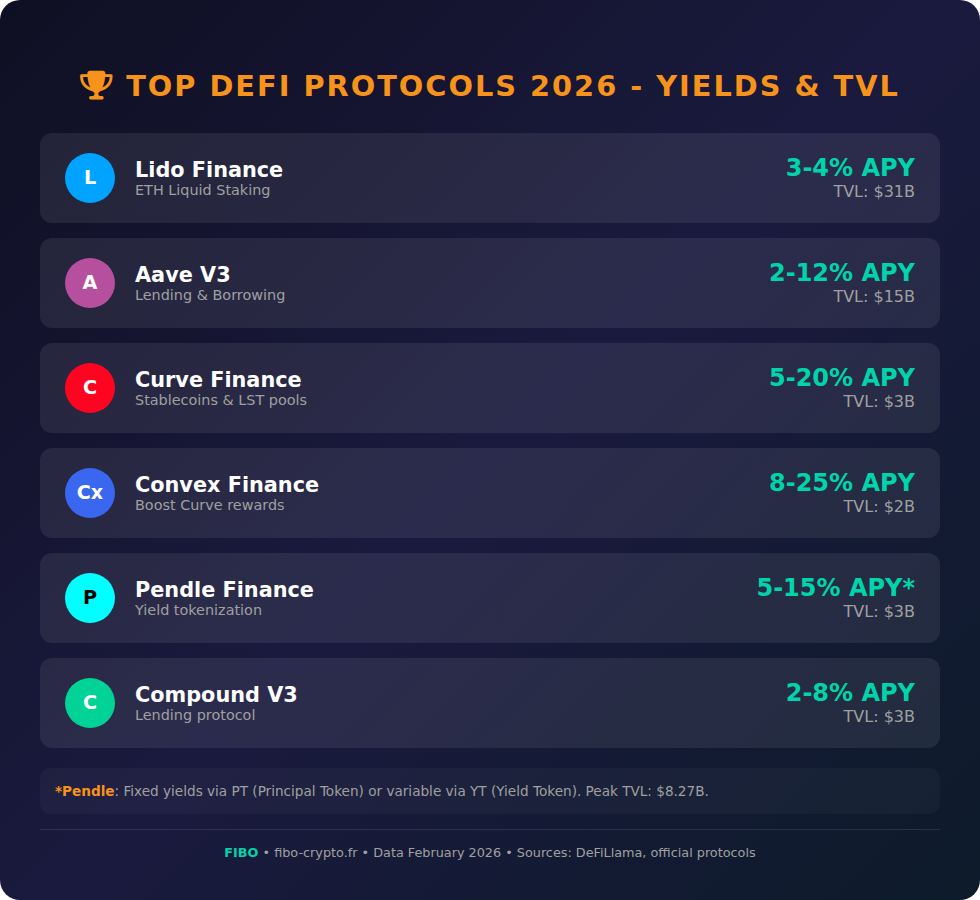
- Leading protocols: Lido dominates liquid staking ($31B TVL), Aave leads lending ($15B), Curve for stablecoins ($3B), and Pendle for yield tokenization ($3B)
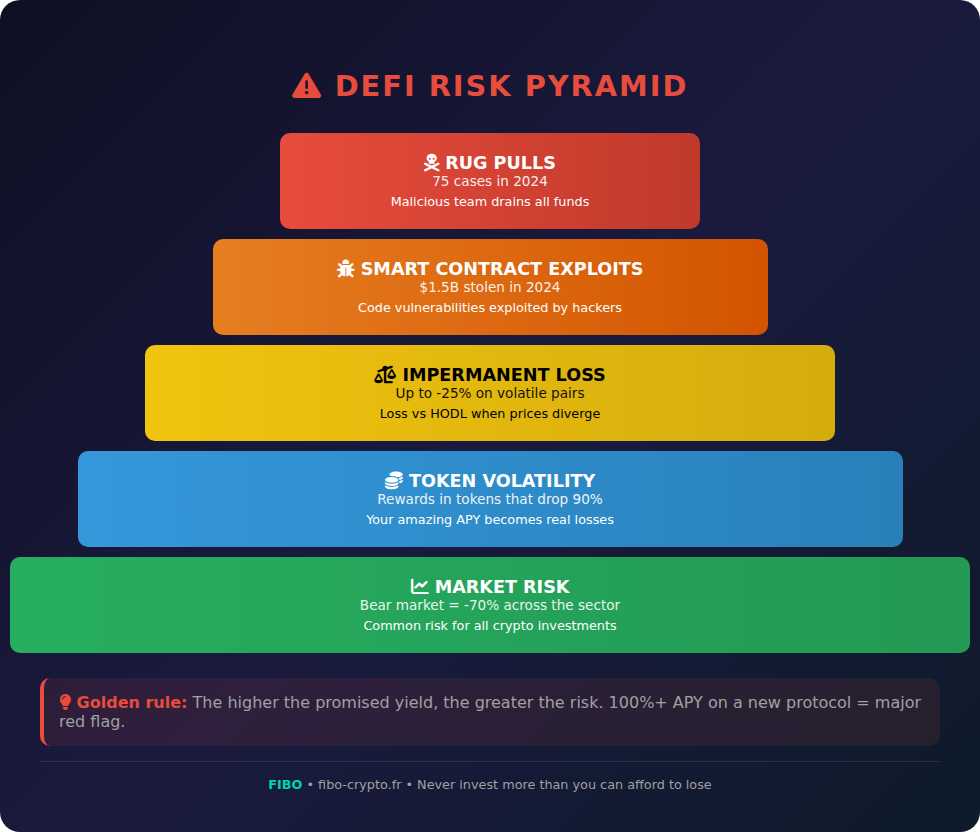
- Major risks: impermanent loss (up to -25% on volatile pairs), smart contract exploits ($1.5B stolen in 2024), and rug pulls (75 cases in 2024)
- 77% of DeFi yields now come from real protocol revenue (fees, interest) rather than inflationary token emissions
- Strategies by profile: conservative (stablecoins, 5-8% APY), moderate (ETH/stETH, 8-15% APY), aggressive (LP farming, 15-50% APY)
- Total DeFi TVL: $129 billion in January 2025 (+137% year-over-year), projected to reach $200 billion by end of 2025
DeFi yield represents one of the most attractive opportunities today for generating passive income with your cryptocurrencies. While traditional savings accounts struggle to exceed 3% annually, decentralized finance offers yields ranging from 5% to over 30% depending on the strategies employed. This comprehensive guide explains how to earn DeFi yield, compares the best protocols, and helps you build a strategy suited to your risk profile.
In 2024, the total value locked (TVL) in DeFi protocols surged 137% to reach $129 billion. This spectacular growth reflects the growing interest of both retail and institutional investors in these new yield sources. But beware: behind the promises of attractive returns lie risks that are crucial to understand before getting started.
What is DeFi Yield? Complete Definition
DeFi yield refers to the gains generated by depositing your cryptocurrencies in decentralized finance protocols. Unlike traditional investments managed by banks, these yields are created by smart contracts — autonomous programs executed on the blockchain.
Specifically, when you deposit your crypto in a DeFi protocol, it’s used in several ways:
- Lent to other users in exchange for interest payments (lending)
- Used to facilitate trades on decentralized platforms (liquidity provision)
- Staked to secure a blockchain and validate transactions (staking)
- Automatically reinvested across different protocols (yield farming)
The term “yield” encompasses several types of rewards: interest on loans, shares of transaction fees, protocol governance tokens, and sometimes promotional bonuses.
Why Are DeFi Yields Higher Than Traditional Investments?
Several factors explain the significant gap between DeFi yields (5-30% APY) and traditional bank investments (<3% APY):
- No intermediaries: no bank or fund manager taking fees
- 24/7 markets: capital works continuously, with no weekend closures
- Protocol competition: platforms offer attractive rewards to attract liquidity
- Risk premiums: users are compensated for DeFi-specific risks
- Constant innovation: new arbitrage and optimization opportunities emerge regularly
However, be careful: these higher yields come with proportionally higher risks that we’ll detail later.
The 4 Main Sources of DeFi Yield
Understanding the different yield sources is essential for building a coherent strategy. Each method has a distinct risk/reward profile.
1. Staking: Secure and Earn
Staking involves locking your tokens to participate in securing a blockchain using Proof-of-Stake (PoS) consensus. In exchange for this contribution, you receive rewards in the form of newly created tokens.
Typical yields:
- Ethereum (via Lido, Rocket Pool): 3-4% APY
- Solana: 6-8% APY
- Cosmos (ATOM): 15-20% APY
- Polkadot (DOT): 12-15% APY
Advantages: low complexity, limited loss risk, predictable income.
Disadvantages: unlock period (unstaking), moderate yields, exposure to staked token price.
Liquid Staking: The Best of Both Worlds
Liquid staking revolutionizes traditional staking. Protocols like Lido or Rocket Pool allow you to stake your ETH while receiving a derivative token (stETH, rETH) that can be used elsewhere in DeFi.
Example: you deposit 10 ETH on Lido and receive 10 stETH. Your ETH generates 3.5% APY from staking, AND you can use your stETH as collateral on Aave to borrow and invest further. This is the concept of compound yield.
2. Lending: Lend to Generate Interest
DeFi lending protocols like Aave, Compound, or Spark allow you to lend your crypto to other users. Borrowers pay interest that is redistributed to you.
Current yields (February 2026):
- USDC on Aave: 4-8% APY
- USDT on Compound: 3-6% APY
- ETH on Aave: 1-3% APY
- GHO (Aave stablecoin): 6-10% APY
Rates fluctuate based on supply and demand. During bull markets, borrowing demand surges and rates rise. Conversely, in bear markets, yields decrease.
Advantages: instant liquidity (withdrawal possible at any time), no impermanent loss, relatively stable income.
Disadvantages: variable yields, smart contract risk, dependence on borrowers.
3. Liquidity Provision (LP): Fuel the DEXs
Decentralized exchanges (DEXs) like Uniswap, Curve, or PancakeSwap operate thanks to liquidity providers (LPs). You deposit a pair of tokens (e.g., ETH/USDC) into a pool, and you receive a share of the transaction fees in return.
How it works:
- You deposit tokens in a 50/50 ratio (or other depending on the pool)
- You receive LP tokens representing your share of the pool
- For each swap using your pool, a portion of the fees (0.1% to 1%) goes to you
- Some protocols add rewards in governance tokens
Typical yields:
- Stablecoins (USDC/USDT) on Curve: 5-10% APY
- ETH/USDC on Uniswap V3: 10-25% APY
- Volatile pairs on PancakeSwap: 20-80% APY
⚠️ Beware of impermanent loss: if the prices of the two tokens diverge significantly, you can lose more than what the fees generate. This risk is detailed in the dedicated section.
4. Yield Farming: Advanced Optimization
Yield farming (or liquidity mining) pushes optimization to its maximum. It involves moving your capital between different protocols to maximize yields, often by stacking multiple income sources.
Typical yield farming strategy:
- Deposit ETH on Lido → receive stETH (+ 3.5% APY staking)
- Deposit stETH on Curve in the stETH/ETH pool → LP tokens (+ 5% APY fees)
- Stake LP tokens on Convex → CRV + CVX rewards (+ 8% APY)
- Total yield: ~16% APY
Experienced yield farmers achieve 20-50% APY by combining multiple protocols. But this complexity significantly increases risks.
Comparison of the Best DeFi Protocols for Generating Yield
Here’s a detailed analysis of the most reliable and performant protocols for earning DeFi yield.
Lido Finance: The King of Liquid Staking
TVL: $31 billion | Founded: 2020 | Blockchain: Ethereum, Polygon, Solana
Lido dominates the liquid staking market with over 30% of all staked ETH. The protocol allows you to stake your ETH and receive stETH in return, a token that automatically appreciates with staking rewards.
Current yield: 3.2-3.8% APY on ETH
Advantages:
- Instant liquidity (stETH trades easily)
- No minimum deposit (vs 32 ETH to stake yourself)
- stETH usable as collateral on Aave, Compound, etc.
- 15+ security audits
Disadvantages:
- 10% commission on rewards
- Risk of stETH “depeg” vs ETH in crisis situations
- Relative centralization (Lido controls 30% of ETH staking)
Aave V3: The DeFi Lending Reference
TVL: $15 billion | Founded: 2017 | Blockchains: 10+ (Ethereum, Arbitrum, Polygon, Base…)
Aave is the most widely used lending protocol in the world. It allows you to lend your crypto to earn interest, or borrow against collateral.
Current yields:
- USDC: 4-8% APY
- USDT: 3-6% APY
- DAI: 5-9% APY (via integrated DSR)
- GHO (native stablecoin): 6-10% APY
- wstETH: 0.5-2% APY
Advanced features:
- E-Mode: optimized borrowing between correlated assets (ETH/stETH)
- Isolation Mode: risk limitation on new tokens
- Flash Loans: instant loans without collateral (1 block)
- Credit Delegation: delegate your borrowing capacity
Curve Finance: The Stablecoin Expert
TVL: $3 billion | Founded: 2020 | Specialty: low slippage swaps
Curve uses an optimized mathematical formula for exchanges between similar assets (stablecoins, ETH/stETH). This efficiency generates significant volumes and therefore fees for liquidity providers.
Popular pools and yields:
- 3pool (USDC/USDT/DAI): 3-8% APY
- stETH/ETH: 5-12% APY
- Tricrypto (USDT/WBTC/WETH): 8-20% APY
- crvUSD pools: 10-25% APY
The veCRV system: by locking your CRV tokens, you get veCRV which boosts your rewards up to 2.5x and gives you the right to vote on emission distribution.
Convex Finance: The Curve Multiplier
TVL: $2 billion | Role: optimize Curve yields
Convex simplifies and amplifies Curve yields. Rather than locking your CRV yourself for 4 years, you deposit your Curve LP tokens on Convex which manages the boost collectively.
Advantages:
- Automatic boost without locking CRV
- Rewards in CRV + CVX
- Auto-compounding possible via certain vaults
- 50-100% higher yields than direct deposit on Curve
Pendle Finance: Tokenize the Yield
Peak TVL: $8.27 billion | Innovation: separate principal and yield
Pendle revolutionizes the yield approach by allowing you to tokenize future yield. A stETH deposit is separated into two tokens:
- PT (Principal Token): represents the capital, trades at a discount → guaranteed fixed yield
- YT (Yield Token): represents future yield → speculation on rates
Use cases:
- Buy PTs to lock in a yield (e.g., 8% guaranteed over 6 months)
- Buy YTs to bet on rising rates
- Provide PT/YT liquidity for double yield
In 2025, Pendle enabled locking in 8% yields on LSTs that were only generating 3.5% variable.
Compound V3: Lending Simplicity
TVL: $3 billion | Founded: 2018 | Focus: simplicity and security
Compound pioneered DeFi lending. V3 simplifies the experience with a model where each market (USDC, ETH) operates independently.
Current yields:
- USDC: 3-7% APY
- WETH (collateral only): 0% but allows borrowing
Step-by-Step Guide: Start Generating DeFi Yield
Here’s the recommended method for getting started with DeFi yield, from simplest to most advanced.
Step 1: Prepare Your Wallet and Funds
Prerequisites:
- A non-custodial wallet (MetaMask, Rabby, or Ledger hardware wallet)
- Cryptocurrencies (ETH for gas fees + assets to invest)
- Understand the basics: what is a transaction, an approval, gas
Recommended minimum budget:
- On Ethereum mainnet: $1,000+ (high gas fees)
- On Arbitrum/Base: $100+ (minimal gas fees)
- On Polygon: $50+ (near-zero gas fees)
Step 2: Choose Your First Strategy (Beginner)
To start, prioritize simplicity and security:
Option A – Liquid Staking (simplest)
- Go to stake.lido.fi
- Connect your wallet
- Deposit your ETH → receive stETH
- That’s it! Your stETH appreciates automatically (~3.5%/year)
Option B – Lending on Aave (variable yields)
- Go to app.aave.com
- Select the blockchain (Ethereum, Arbitrum, Base…)
- Click “Supply” on the chosen asset (USDC, ETH…)
- Approve and confirm the deposit
- Your interest accumulates in real-time
Step 3: Optimize with Curve + Convex (Intermediate)
Once comfortable with the basics, you can combine multiple protocols:
- Convert some of your ETH to stETH via Lido
- Go to curve.fi
- Deposit in the stETH/ETH pool
- Retrieve your LP tokens (curve-stETH)
- Go to convexfinance.com
- Stake your Curve LP tokens
- Harvest your CRV + CVX rewards regularly
Estimated yield: 8-15% APY (ETH staking + LP fees + token rewards)
Step 4: Advanced Strategies (Expert)
Advanced strategies typically involve:
- Leverage loops: deposit collateral, borrow, redeposit (watch out for liquidations)
- Yield aggregators: use Yearn, Beefy, or optimized vaults
- Pendle strategies: buy PTs to lock in high yields
- Cross-chain farming: exploit yield differences between blockchains
⚠️ These strategies require a deep understanding of the risks and active monitoring.
DeFi Yield Risks: What You Need to Know
No yield is free. Here are the major risks to understand before investing in DeFi.
1. Impermanent Loss Explained
Impermanent loss is the main risk of liquidity provision. It occurs when the prices of tokens in your pool diverge.
How it works:
Imagine you deposit 1 ETH + 2000 USDC in a 50/50 pool when 1 ETH = $2,000.
If ETH rises to $4,000:
- The pool rebalances via arbitrage
- You end up with less ETH and more USDC
- Your position is worth less than if you had simply HODLed your tokens
Loss table by price divergence:
| Price Change | Impermanent Loss |
|---|---|
| ±25% | -0.6% |
| ±50% | -2.0% |
| ±100% (2x) | -5.7% |
| ±200% (3x) | -13.4% |
| ±400% (5x) | -25.5% |
How to minimize impermanent loss:
- Favor correlated token pools (ETH/stETH, USDC/USDT)
- Use concentrated liquidity (Uniswap V3) with tight ranges
- Ensure fees cover potential losses
- Choose pools with additional token rewards
2. Smart Contract Risk
In 2024, $1.5 billion was stolen via smart contract exploits. Even audited protocols are not immune.
Common exploit types:
- Flash loan attacks
- Reentrancy bugs
- Oracle manipulation
- Logic errors in code
How to protect yourself:
- Only deposit on protocols with multiple audits (Consensys, Trail of Bits, OpenZeppelin)
- Favor protocols with TVL > $500M and history > 2 years
- Check for an active bug bounty (Immunefi)
- Diversify across multiple protocols
- Never put more than 10-20% of your capital on a single protocol
3. Rug Pulls: The DeFi Scam
A rug pull occurs when a project’s team suddenly withdraws all liquidity, leaving investors with worthless tokens.
75 documented rug pulls in 2024.
Red flags:
- 🚩 Anonymous team with no verifiable history
- 🚩 APYs above 100% on new protocols
- 🚩 No audit or audit by unknown firm
- 🚩 Unverified contracts or suspicious “owner only” functions
- 🚩 Aggressive marketing with unrealistic promises
- 🚩 Liquidity unlockable by the team
Golden rule: if it’s too good to be true, it probably is.
4. Reward Volatility
Many DeFi yields are paid in native protocol tokens (CRV, CVX, AAVE…). These tokens can lose 80-90% of their value in a bear market, wiping out your gains.
Solution: regularly convert your rewards to stablecoins or assets you want to keep.
DeFi Yield Strategies by Risk Profile
Your strategy should match your risk tolerance and objectives. Here are three typical profiles.

Conservative Profile: Preserve Capital (5-8% APY)
Objective: earn a yield above inflation with minimal risk.
Recommended allocation:
- 70%: Stablecoins on Aave/Compound (USDC, DAI)
- 20%: Stablecoin pool on Curve (3pool)
- 10%: sDAI (stablecoin with built-in yield via Spark)
Expected yield: 5-8% APY
Main risks: stablecoin depeg, smart contract exploit (very rare on these protocols)
Moderate Profile: Controlled Growth (8-15% APY)
Objective: combine ETH exposure with optimized yields.
Recommended allocation:
- 50%: stETH (Lido) → 3.5% APY base
- 30%: stETH/ETH pool on Curve+Convex → 8-12% APY
- 20%: Stablecoins on Aave → 5-8% APY
Expected yield: 8-15% APY
Main risks: ETH volatility, minor impermanent loss (highly correlated tokens)
Aggressive Profile: Maximize Yields (15-50%+ APY)
Objective: maximum yields with active management.
Recommended allocation:
- 40%: Concentrated liquidity on Uniswap V3 (major pairs)
- 30%: Pendle PT/YT strategies (lock in or speculate on rates)
- 20%: Multi-chain farming (Arbitrum, Base, Solana)
- 10%: New protocols (with strict due diligence)
Expected yield: 15-50%+ APY
Main risks: significant impermanent loss, active management required, increased exploit risk
⚠️ Important: never invest more than you can afford to lose, regardless of strategy.
DeFi Yield Taxation
In most jurisdictions, DeFi income is subject to taxation. Here’s what you need to know.
Applicable Tax Regime
Gains from yield farming, staking, and lending are generally considered as investment income or miscellaneous income depending on your jurisdiction.
Two taxation moments:
- Receiving rewards: tokens received are taxable at their value at the time of receipt
- Conversion to fiat: any capital gain when selling is also taxable
Tax rates: Vary by country. Consult a tax professional familiar with crypto assets in your jurisdiction.
Reporting Obligations
You must:
- Report your digital asset accounts held abroad (if required in your jurisdiction)
- Calculate your capital gains on disposals
- Keep a journal of all your transactions
Recommended tools: Koinly, CoinTracker, TokenTax for automated tax tracking.
Tools and Resources for Tracking Your DeFi Yields
Managing multiple DeFi positions requires appropriate tools.
Tracking Dashboards
- DeBank: consolidated view of all your multi-chain positions
- Zapper: tracking + one-click rebalancing
- Zerion: elegant interface for tracking your portfolio
Analytics and Research
- DeFiLlama: TVL, yields, and analytics for all protocols
- Aavescan: real-time data on Aave markets
- Curve.fi: APY and volumes for Curve pools
- Vaults.fyi: vault and yield comparator
Calculators
- APY.vision: real-time impermanent loss calculator
- CoinGecko APY Calculator: yield projections
- DeFi Rate: lending rate comparison
📚 Glossary
- APY (Annual Percentage Yield) : Annual yield taking compound interest into account. A 10% APY means that with automatic reinvestment of gains, you get a 10% return over one year.
- APR (Annual Percentage Rate) : Simple annual interest rate, without considering compounding. APY is always greater than or equal to APR.
- TVL (Total Value Locked) : Total value of assets deposited in a DeFi protocol. Key indicator of a protocol’s size and the trust it receives.
- Impermanent Loss : Loss suffered by a liquidity provider when prices of tokens in a pool diverge. The loss is “impermanent” as long as funds remain in the pool and prices can return to their initial level.
- Liquidity Provider (LP) : User who deposits tokens in a liquidity pool on a DEX in exchange for rewards in the form of trading fees and/or tokens.
- Yield Farming : Strategy of moving assets between different DeFi protocols to maximize yields, often by combining multiple income sources.
- Liquid Staking : Staking method where you receive a derivative token (stETH, rETH) representing your staked tokens, usable elsewhere in DeFi.
- Smart Contract : Autonomous program executed on a blockchain. In DeFi, smart contracts automatically manage deposits, loans, swaps, and reward distributions.
- DEX (Decentralized Exchange) : Decentralized exchange platform operating via smart contracts, without a centralized intermediary. Examples: Uniswap, Curve, PancakeSwap.
- AMM (Automated Market Maker) : Mechanism that enables swaps on a DEX using mathematical formulas rather than a traditional order book.
- Rug Pull : Scam where a project’s creators suddenly withdraw all liquidity, leaving investors with worthless tokens.
- Vault : Smart contract that automates yield farming strategies, managing deposits, harvests, and reinvestments for users.
- Governance Token : Token granting the right to vote on protocol decisions (updates, parameters, fund distribution). Examples: AAVE, CRV, UNI.
- Collateral : Asset deposited as guarantee to borrow other tokens. In DeFi, collateral is typically over-collateralized (value greater than the loan).
- Slippage : Difference between expected transaction price and actual executed price. High liquidity pools have lower slippage.
Frequently Asked Questions
What is the best DeFi yield for a beginner in 2026?
For a beginner, liquid staking on Lido is the best starting point. You simply deposit your ETH and receive stETH that automatically generates 3-4% APY. No active management is required, risk is moderate, and your stETH remains liquid. Once comfortable, you can explore lending on Aave (4-8% on USDC) or stablecoin pools on Curve (5-10%). Absolutely avoid protocols promising more than 50% APY until you fully understand the risks.
How do I avoid impermanent loss in DeFi?
To minimize impermanent loss: 1) Favor correlated token pools (ETH/stETH, USDC/USDT) where prices move together. 2) On Uniswap V3, use tight ranges on stable pairs. 3) Calculate if fees + rewards offset potential IL before depositing. 4) Monitor your positions with tools like APY.vision. 5) For volatile pairs, only allocate a small portion of your capital. IL is only realized at withdrawal: if prices return to their initial level, the loss disappears.
Are DeFi yields taxable?
Yes, DeFi gains are taxable in most jurisdictions. Rewards received (staking tokens, lending interest, LP fees) are typically taxable at their value at the time of receipt. When converting to fiat, any capital gains are also taxed. Tax regimes vary by country—consult a tax professional familiar with crypto assets. Tools like Koinly or CoinTracker can help automate tracking.
What minimum capital is needed to start yield farming?
Minimum capital depends on the blockchain: on Ethereum mainnet, plan for at least $1,000-2,000 as gas fees can reach $20-100 per transaction. On Arbitrum or Base (Layer 2), $100-200 is sufficient with fees of just a few cents. On Polygon, you can test with $50. For effective diversification across 3-5 protocols, $2,000-5,000 is ideal. Start small, understand the mechanics, then gradually increase.
What are the safest DeFi protocols for generating yield?
The safest protocols are those with the longest track record, highest TVL, and most audits: Lido ($31B TVL, 15+ audits, 4 years existence), Aave ($15B TVL, pioneer since 2017), Compound ($3B TVL, proven model), Curve ($3B TVL, stablecoin specialist), and MakerDAO (DAI creator, $8B TVL). These protocols have survived multiple market cycles and hacks without major loss of user funds. Always favor TVL > $1B and history > 2 years.
How does yield farming with Pendle work?
Pendle allows you to tokenize future yield of an asset. When you deposit a yield-bearing token (stETH, GLP…), Pendle splits it into two: the PT (Principal Token) which represents your capital and trades at a discount (guaranteed fixed yield), and the YT (Yield Token) which represents future yield (speculation on rates). You can buy PTs to lock in a high yield (e.g., 8% guaranteed over 6 months vs 3.5% variable), or YTs to bet on rising APYs. It’s a powerful tool for advanced strategies.
What's the difference between staking and yield farming?
Staking involves locking your tokens to secure a Proof-of-Stake blockchain and receive fixed rewards (3-15% APY depending on the network). It’s simple, passive, with moderate risk. Yield farming is an active strategy of optimizing yields by combining multiple DeFi protocols: staking + lending + liquidity provision + token rewards. Yields are higher (10-50%+) but so are risks and complexity. Staking suits beginners; yield farming is for experienced users.
Are 100% APY DeFi yields real or scams?
100%+ APYs can be temporarily real but are rarely sustainable. They occur during protocol launches (low TVL = high yields) or via massive governance token emissions. However, these yields drop quickly when liquidity flows in, and reward tokens often lose 80-90% of their value. A 100% APY paid in a token that loses 90% = net loss. Real scams promise fixed impossible guaranteed yields. Rule: any APY > 50% on a new protocol should trigger thorough due diligence before investing.
📰 Sources
This article is based on the following sources:
- DeFiLlama
- Aave Documentation
- Lido Finance
- Curve Finance Analytics
- CoinTelegraph – Yield Farming Explained
- DefiLlama Yields
- Immunefi Bug Bounties
- Dune Analytics
Comment citer cet article : Fibo Crypto. (2026). DeFi Yield: Complete Guide to Generating Crypto Passive Income (2026). Consulté le 24 February 2026 sur https://fibo-crypto.fr/en/blog/defi-yield-guide