Crypto Scam: The 12 Types of Fraud to Know and How to Protect Yourself (2026)
📋 Key Takeaways (TL;DR)
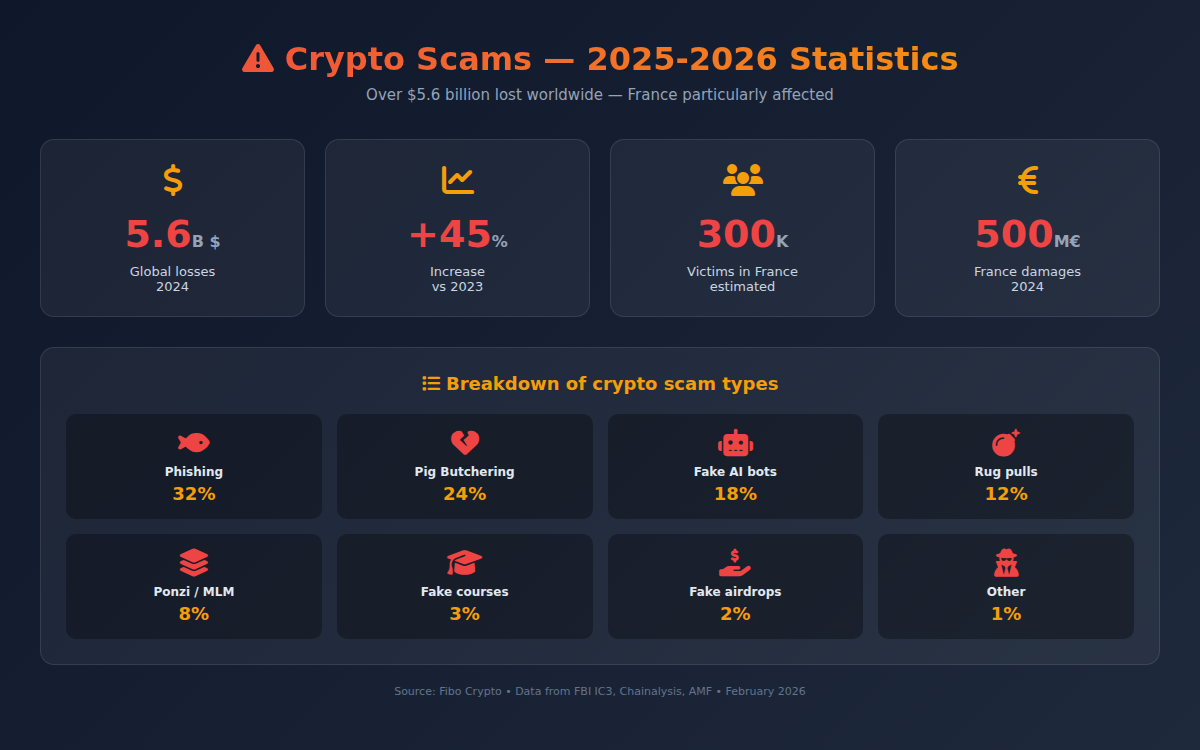
- Scale of the problem: over $5.6 billion lost to crypto scams in 2024 (+45% vs 2023), around €500 million in France alone
- 12 types of scams: phishing, pig butchering, fake AI bots, rug pulls, Ponzi/MLM, fake courses, fake airdrops, support scams, influencer impersonation, pump & dump, NFT scams, ransomware
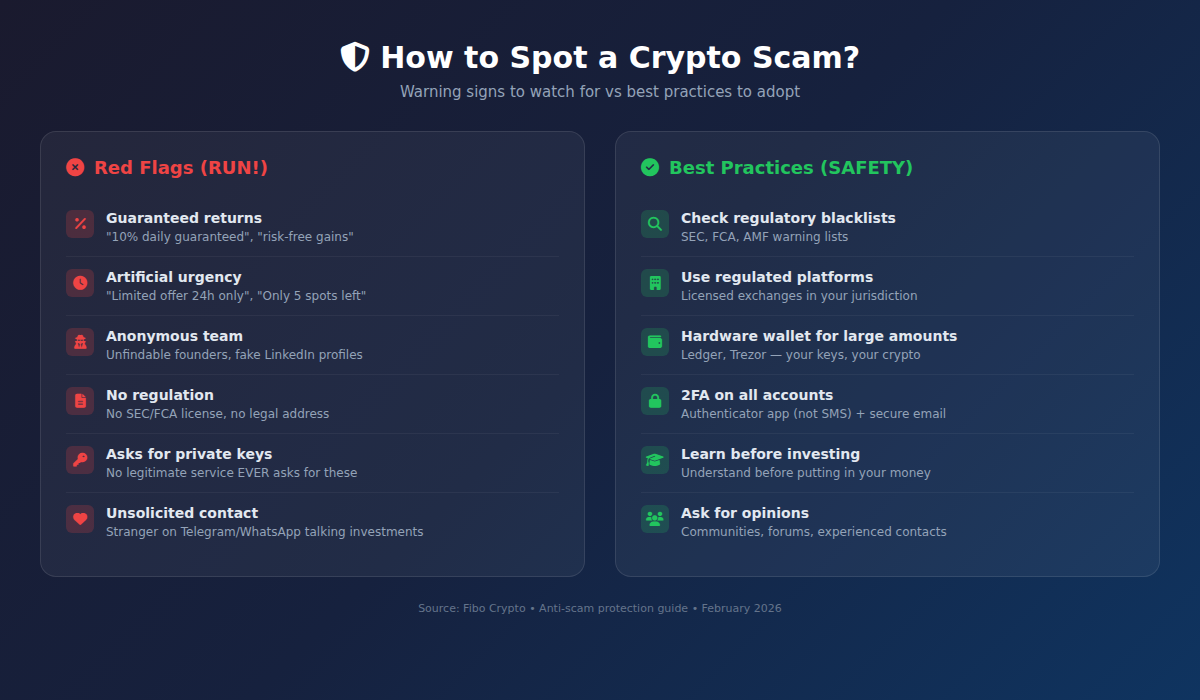
- Warning signs: guaranteed returns, artificial urgency, anonymous team, requests for private keys, unsolicited contact
- How to verify: check regulatory blacklists (SEC, FCA, AMF), search “[name] + scam” online
- Safe platforms: use regulated exchanges licensed in your jurisdiction
- If scammed: report to authorities (FBI IC3, Action Fraud UK, local police), file a complaint with all evidence
- Golden rule: if it sounds too good to be true, it’s a scam — guaranteed gains don’t exist in crypto
A crypto scam is a fraud designed to steal cryptocurrency or money from victims by exploiting lack of knowledge, greed, or psychological manipulation. In 2024, global losses from crypto scams exceeded $5.6 billion according to the FBI — a record high.
This comprehensive guide covers the 12 most common types of scams in 2025-2026, the warning signs to spot, and concrete measures to protect your investments. Whether you’re a beginner or experienced investor, knowing these traps is your best protection.
The 12 Most Common Crypto Scams in 2026
1. Phishing — 32% of scams
Phishing is the most widespread crypto scam. Its principle: tricking you into revealing your login credentials, passwords, or private keys by impersonating a legitimate platform (Binance, Coinbase, MetaMask, Ledger).
Common techniques:
- Emails mimicking the official design of a platform
- Fake websites with deceptive URLs (binance-support.com, metamask-connect.io)
- Urgent messages: “Your account will be suspended in 24 hours!”
- Fake tech support on Telegram or Discord
How to protect yourself:
- Check the URL in the address bar (https:// + official domain)
- Never click on links in emails — type the address manually
- Enable two-factor authentication (2FA) with an app (not SMS)
- Be suspicious of any message asking for sensitive information
2. Pig Butchering — 24% of scams
Pig butchering is a particularly insidious romance scam. A fraudster builds a relationship of trust over weeks or months before proposing a “crypto investment.”
How it works:
- First contact: a stranger reaches out on Telegram, WhatsApp, Instagram, or a dating app
- Grooming: daily conversations, building an emotional or romantic connection
- Proposal: “I’m making great returns with this platform, I can help you”
- Escalation: fake gains displayed, pressure to invest more and more
- Butchering: disappearance with all funds
Warning signs:
- Unsolicited contact who quickly mentions money
- Refuses video calls or in-person meetings
- Unknown or unregulated investment platform
- “Gains” shown via screenshots (easily faked)
3. Fake Trading Bots and AI Platforms — 18% of scams
The AI hype has spawned a new generation of scams. Platforms promise automatic returns through “revolutionary algorithms” or “ultra-performant AI bots.”
Typical promises:
- “Earn 10% daily on autopilot”
- “Our AI predicts the market with 99% accuracy”
- “No knowledge required, the robot does everything”
Reality: no bot can guarantee profits. Trading always involves risk. These platforms display fake gains to encourage more deposits — before vanishing.
4. Rug Pulls — 12% of scams
A rug pull occurs when creators of a crypto project suddenly abandon it and disappear with investors’ funds.
Two variants:
- Soft rug: team gradually sells their tokens, slow price collapse
- Hard rug: sudden liquidity removal, price drops to zero instantly
Very common with memecoins as they’re easy to create and promote. Always check: who holds the tokens? Is liquidity locked? Can the contract block sales?
5. Ponzi Schemes and MLM Crypto — 8% of scams
Ponzi schemes promise high fixed returns (5-10% monthly) funded by new entrants’ money. When recruitment slows, the system collapses.
Characteristics:
- Gains depend on referrals
- No real product or service
- “Too stable” returns (2% weekly with no fluctuation)
- Pyramid structure with multiple commission levels
Famous cases: BitConnect ($2.4 billion), OneCoin ($4 billion), PlusToken ($2 billion).
6. Fake Crypto Courses — 3% of scams
“Trainers” sell courses at premium prices ($1000-5000) promising to make you rich. In reality, the content is often basic, freely available elsewhere, or worse — a gateway to fraudulent investments.
Warning signs:
- Promises of quick wealth (“Become a millionaire in 30 days”)
- Trainer unfindable or with no verifiable experience
- Fake testimonials with generic photos
- Pressure to buy (“Discounted price today only”)
- Redirection to an obscure trading platform
7. Fake Airdrops and Giveaways
Scammers promise airdrops (free token distributions) or giveaways (“Send 0.1 ETH, receive 1 ETH”). These scams exploit the appeal of “free” money.
Common variants:
- Fake Elon Musk or celebrity Twitter/X accounts
- Sites asking you to connect your wallet to “claim” tokens
- Requests for “unlock fees” to receive an airdrop
Golden rule: a real airdrop never asks you to send money first.
8. Fake Tech Support Scams
Scammers impersonate MetaMask, Ledger, Coinbase or other platform support on social media. They respond to users having issues and request sensitive information.
Techniques:
- Monitoring hashtags and mentions of problems
- Quick response with an account mimicking official support
- Request to “sync” the wallet via a fake site
- Direct request for seed phrase “to resolve the issue”
Remember: no legitimate support will EVER ask for your recovery phrase.
9. Influencer Impersonation
Scammers create fake accounts mimicking well-known crypto influencers to promote scams. They use the same photos, similar names, and replicate communication styles.
Checks to make:
- Verification badge (blue checkmark)
- Follower count and account age
- Exact spelling of username
- Cross-reference with other official networks
10. Pump & Dump
A group buys a low-liquidity token massively, artificially pumps the price through aggressive marketing, then sells everything at the top — leaving late buyers with worthless tokens.
How to spot it:
- Sudden, intensive promotion of an unknown token
- Promises of “guaranteed x100”
- Telegram groups with trading “alerts”
- Volume exploding without fundamental reason
11. NFT Scams
The NFT market is rife with scams:
- Fake NFTs: copies of original works sold as authentic
- Wash trading: fictitious sales to artificially inflate price
- Collection rug pulls: team disappears after initial sale
- Malicious links: mint sites that drain your wallet
12. Ransomware
Malicious software encrypts your files and demands a ransom in Bitcoin or Monero to unlock them. In 2024, ransomware attacks increased by 62% according to Europol.
Prevention:
- Don’t open suspicious attachments
- Keep software updated
- Make regular offline backups
- Use up-to-date antivirus software
Famous Crypto Scams
Some of the largest crypto scams in history:
- BitConnect (2018): classic Ponzi scheme, $2.4 billion in losses worldwide
- OneCoin (2014-2017): fictitious “cryptocurrency,” $4 billion stolen globally
- PlusToken (2019): Chinese Ponzi targeting Asia, $2 billion in losses
- FTX (2022): exchange collapse and fund misappropriation, $8+ billion lost
- Celebrity impersonation scams: fake ads using Elon Musk, MrBeast, etc.
How to Verify if a Platform is Legitimate
1. Check Regulatory Blacklists
Financial regulators maintain lists of fraudulent sites:
- SEC (US): sec.gov/tcr
- FCA (UK): fca.org.uk/scamsmart
- AMF (France): protect-epargne.amf-france.org
- ASIC (Australia): moneysmart.gov.au
2. Verify Licensing
Legitimate platforms are registered with regulators. Check official registries for licensing status.
3. Search “[name] + scam”
A simple Google search often reveals victim testimonials or warnings.
4. Check Terms and Legal Information
A legitimate platform displays:
- Registered office address
- Registration number
- Clear terms and conditions
- Multiple contact methods (not just Telegram)
What to Do If You’re a Victim of a Crypto Scam
1. Act Quickly
- Immediately cease all contact with the scammer
- Don’t make any more payments (even if promised you’ll recover funds)
- Secure your other accounts (change passwords)
2. Report the Scam
- US: FBI IC3 (ic3.gov), FTC (reportfraud.ftc.gov)
- UK: Action Fraud (actionfraud.police.uk)
- EU: Local police + national financial regulator
- Crypto-specific: Report to the impersonated platform
3. File a Police Report
File a report with local police with all evidence:
- Screenshots of all exchanges
- Proof of transfers made
- Wallet addresses involved
- URL of the fraudulent site
4. Beware of “Recovery” Services
WARNING: scammers target scam victims promising to recover their funds for a fee. This is a double scam. No service can recover stolen cryptocurrencies.
The 10 Golden Rules to Avoid Crypto Scams
- If it sounds too good to be true, it’s a scam — guaranteed gains don’t exist
- Never share your recovery phrase (seed phrase) — NEVER, with anyone
- Verify before investing — regulatory blacklists, official registries, online searches
- Be wary of unsolicited contacts — especially if they talk about money
- Take your time — urgency is a manipulation technique
- Diversify and limit exposure — only invest what you can afford to lose
- Use a hardware wallet — for significant amounts
- Enable 2FA everywhere — with an authenticator app, not SMS
- Keep learning — understand what you’re investing in
- When in doubt, don’t act — ask for opinions first
📚 Glossary
- Crypto scam: Fraud designed to steal cryptocurrency or money by exploiting lack of knowledge, greed, or psychological manipulation.
- Phishing: Technique of impersonating a legitimate entity to steal sensitive information (credentials, passwords, private keys).
- Pig butchering: Romance scam where the fraudster builds trust over weeks before proposing a fake crypto investment.
- Rug pull: Sudden abandonment of a crypto project by its creators who disappear with investors’ funds.
- Ponzi scheme: Fraudulent system where returns for old investors are paid with new entrants’ money.
- Seed phrase: 12 or 24-word sequence that recovers access to a crypto wallet. Should NEVER be shared.
- 2FA: Two-factor authentication — additional security layer requiring a temporary code plus password.
- Airdrop: Free token distribution to a community. Real airdrops never ask you to send money first.
- KYC: Know Your Customer — identity verification required by regulated platforms.
- DYOR: Do Your Own Research — essential principle before any crypto investment.
Frequently Asked Questions
What is a crypto scam?
A crypto scam is a fraud designed to steal cryptocurrency or money by exploiting lack of knowledge, greed, or psychological manipulation. The most common forms are phishing, pig butchering, fake trading bots, and rug pulls.
How can I recognize a crypto scam?
Main warning signs are: abnormally high guaranteed returns, artificial urgency, anonymous team, requests for private keys or seed phrase, unsolicited contact on social media. If it sounds too good to be true, it’s a scam.
How do I verify if a crypto platform is legitimate?
Check regulatory blacklists (SEC, FCA, AMF), verify licensing on official registries, search “[name] + scam” on Google, and verify legal information (address, registration number).
What should I do if I’m a victim of a crypto scam?
Cease all contact with the scammer, stop all payments, report to FBI IC3 (US), Action Fraud (UK), or local police, and file a report with all evidence. Beware of fake “recovery” services — they’re double scams.
Can I recover money lost to a crypto scam?
Unfortunately, crypto transactions are irreversible and it’s very difficult to recover stolen funds. Be suspicious of services promising to recover your money for a fee — these are usually additional scams.
What is pig butchering?
Pig butchering is a romance scam where a fraudster builds a relationship of trust (friendly or romantic) over weeks or months, then proposes an “amazing crypto investment.” The victim is encouraged to invest more and more before the scammer disappears with everything.
What is a rug pull?
A rug pull occurs when crypto project creators suddenly abandon it and disappear with funds. Very common with memecoins, it can be “soft” (gradual selling) or “hard” (sudden liquidity removal).
Can platform support ask for my seed phrase?
NEVER. No legitimate support will ever ask for your recovery phrase (seed phrase). If anyone asks for it, it’s 100% a scam. Your seed phrase gives complete access to your funds.
Do guaranteed returns exist in crypto?
No. Any promise of guaranteed returns in crypto is a scam. Trading and investing always involve risks. Platforms promising “10% daily” or “risk-free gains” are fraudulent.
How do I report a crypto scam?
Report to FBI IC3 (ic3.gov) in the US, Action Fraud (actionfraud.police.uk) in the UK, or your local police and financial regulator. File a report with all evidence including screenshots, transaction proofs, and wallet addresses.
📰 Sources
This article is based on the following sources:
- FBI IC3 — Internet Crime Report 2024
- FCA — ScamSmart Warning List
- Chainalysis — Crypto Crime Report 2025
- Europol — IOCTA 2024
- SEC — Tips, Complaints and Referrals
How to cite this article: Fibo Crypto. (2026). Crypto Scam: Complete Guide to Recognizing and Avoiding Fraud. Retrieved February 9, 2026 from https://fibo-crypto.fr/en/blog/crypto-scam-complete-guide
The simplest way to buy, swap and manage your crypto
Join the first users and get priority access. No seed phrase, fees 3.5x lower, built-in DeFi yield.
Get early access →