Crypto Kidnapping in France: Complete Timeline of 30+ Cases, Causes and Protection (2025-2026)
📋 Key Takeaways (TL;DR)
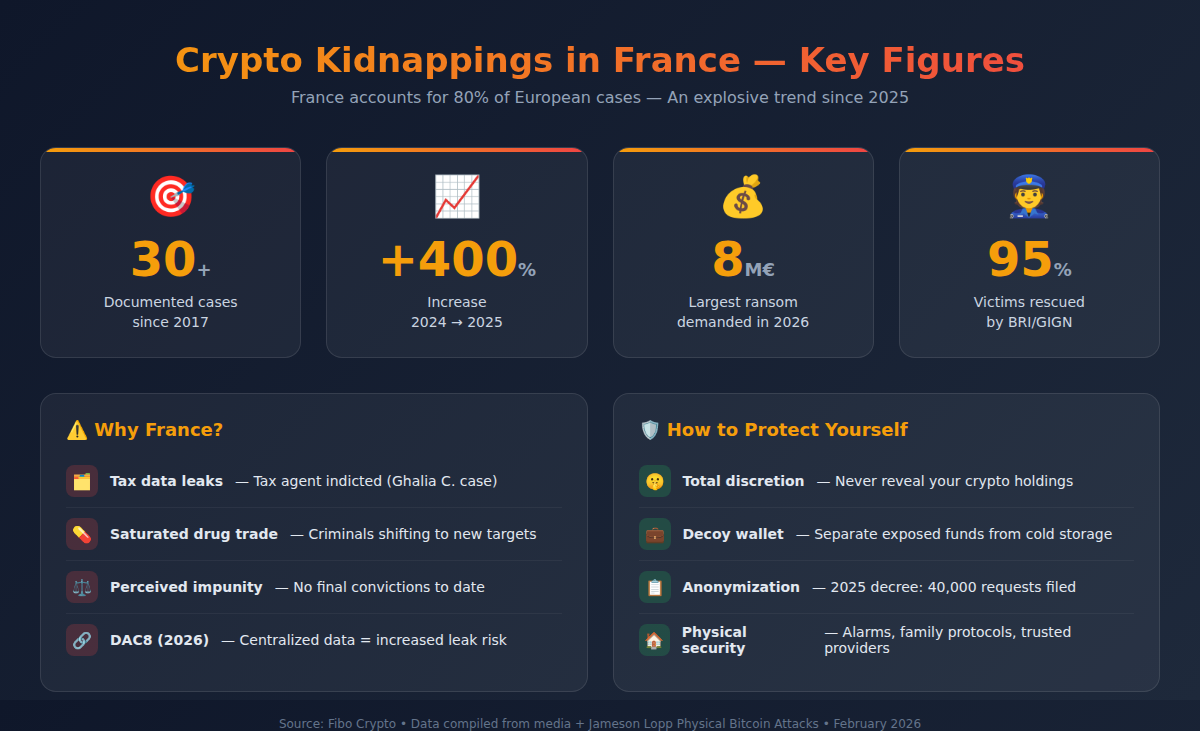
- Unprecedented surge: over 30 crypto kidnappings and assaults documented in France since 2017, including 20+ in 2025 alone and around ten already in 2026
- France = global epicenter: the country accounts for approximately 80% of European cases, far ahead of the UK or the Netherlands
- Landmark case: David Balland (Ledger co-founder), kidnapped and mutilated with his wife in January 2025 — ransom partially paid then frozen by Tether
- Identified causes: tax data leaks (Ghalia C. case), saturated drug trade, perceived judicial impunity, DAC8 directive
- Victim profile: crypto entrepreneurs, traders, but also their relatives (elderly parents, spouses, children) used as leverage
- Government response: August 2025 decree allowing address anonymization — 40,000 requests filed within months
- Blockchain paradox: crypto ransoms are fully traceable, making these crimes « a false good idea » according to experts
- Law enforcement effectiveness: BRI and GIGN rescue ~95% of victims — never pay without coordinating with authorities
A crypto kidnapping is a physical attack aimed at extorting cryptocurrency from a victim through force, detention, or torture. Since 2025, France has become the global epicenter of this emerging criminal phenomenon, with over 30 documented cases — a figure that places the country at the top of affected nations.
This comprehensive guide analyzes each known case, explains why France is particularly targeted, and details the protective measures recommended by security experts. Whether you’re an individual investor, crypto entrepreneur, or industry professional, understanding this threat is now essential.
Complete Timeline: All Crypto Kidnappings in France (2017-2026)
Here is an exhaustive list of documented kidnappings, hostage situations, and violent assaults related to cryptocurrencies in France. This timeline is regularly updated with new cases.
2026: The Dramatic Acceleration (10+ cases in 6 weeks)
The year 2026 began with an alarming intensification of attacks. In just six weeks, authorities recorded nearly ten new assaults:
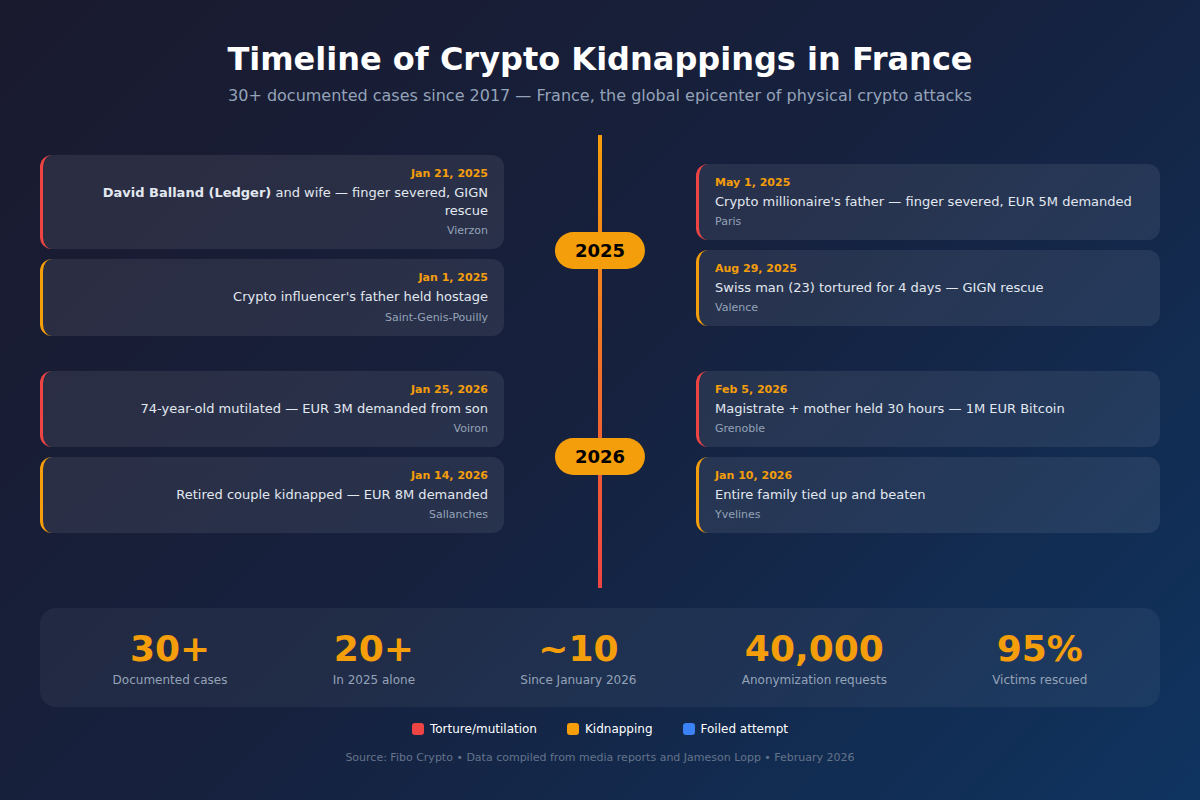
- February 5, 2026 — Saint-Martin-le-Vinoux (Isère): a 35-year-old magistrate and her 66-year-old mother kidnapped from their home, held for 30 hours in a garage. The target was the husband, CEO of a crypto company. EUR 1 million ransom demanded in Bitcoin. Victims found tied up and injured. 6 suspects arrested.
- January 25, 2026 — Voiron (Isère): a 74-year-old man kidnapped and mutilated (hand) to extort EUR 3 million from his son, suspected of working in blockchain. BRI freed the victim and arrested 3 suspects.
- January 24, 2026 — Bry-sur-Marne: 4 masked individuals armed with crowbars attempted to break into a crypto portfolio manager’s home. Attempt failed.
- January 19, 2026 — Paris: attempted kidnapping of a couple working in crypto thwarted thanks to a caretaker’s alert.
- January 14, 2026 — Sallanches (Haute-Savoie): retired couple kidnapped to demand EUR 8 million in cryptocurrency from their son.
- January 10, 2026 — Verneuil-sur-Seine (Yvelines): crypto investor and his entire family tied up and beaten at home.
- January 9, 2026 — Saint-Léger-sous-Cholet: 43-year-old man kidnapped for his crypto.
- January 8, 2026 — La Chapelle-Saint-Aubin: couple and their three children held hostage for 40 minutes.
- January 6, 2026 — Manosque: woman held captive by several masked individuals.
- January 4, 2026 — Dijon: man recognized in the street, chased and forced into a car by 3 young men accusing him of crypto scam.
2025: The Tipping Point (20+ cases)
2025 marks a major turning point with an explosion in the number of attacks:
- December 18, 2025 — La Rochelle: three attackers invaded a home, tied up the entire family and made several crypto transfers. Unconfirmed rumor of $10 million stolen.
- December 12, 2025 — Toulon: 17-year-old teenager briefly kidnapped to pressure his brother, a Dubai-based crypto trader. EUR 50,000 demanded. 3 minors arrested.
- December 1, 2025 — Val-d’Oise: the father (53) of a Dubai-based crypto entrepreneur kidnapped by 4 people in broad daylight.
- November 22, 2025 — Chalon-sur-Saône: 4th kidnapping attempt against the same crypto holder. 6 men arrested including 2 minors.
- October 1, 2025 — Val-de-Marne: woman and her two children threatened by 2 masked individuals to blackmail her husband, a crypto investor.
- September 26, 2025 — Rambouillet: 3 men and a woman scaled a property’s fence to kidnap a crypto entrepreneur. Attempt failed.
- August 29, 2025 — Valence: 23-year-old Swiss man kidnapped and tortured for 4 days. Freed by GIGN, 7 suspects arrested.
- August 26, 2025 — Paris/Saint-Germain-en-Laye: former crypto trader kidnapped and held captive. EUR 10,000 ransom demanded from his wife.
- August 5, 2025 — Paris: man working in crypto kidnapped and beaten, EUR 2 million in Bitcoin stolen. Attackers quickly captured.
- July 7, 2025 — Suresnes: woman attacked and beaten at home in front of her husband and children.
- June 17, 2025 — Maisons-Alfort: 23-year-old man held for several hours, EUR 5,000 ransom demanded. Link to a Ledger hardware wallet.
- June 13, 2025 — Juvisy-sur-Orge: 26-year-old trader kidnapped by 4 men on his way home. EUR 50,000 demanded, released after seeing the low balance on his wallet.
- May 26, 2025 — Nantes: police arrested 10 hooded men before they could act against a crypto entrepreneur.
- May 18, 2025 — Normandy: attempt thwarted through counter-surveillance. 5 people arrested. A GPS tracker had been placed on the victims’ car.
- May 13, 2025 — Paris: attempted kidnapping of Pierre Noizat’s daughter, CEO of a crypto exchange, in broad daylight. Repelled by passersby.
- May 1, 2025 — Paris: crypto millionaire’s father kidnapped in broad daylight. EUR 5 million ransom demanded, finger severed. Freed by police.
- January 24, 2025 — Troyes: crypto miner lured to a meeting then taken hostage. EUR 20,000 ransom demanded. 4 suspects arrested.
- January 21, 2025 — Vierzon: David Balland, Ledger co-founder, and his wife kidnapped and ransomed. Finger severed. Freed by GIGN. Ransom partially paid then frozen via Tether.
- January 1, 2025 — Saint-Genis-Pouilly: crypto influencer’s father held hostage on New Year’s Eve.
Earlier Cases (2017-2024)
- July 10, 2024 — Angers: 2 men invaded a home with knife and metal bar, demanded EUR 10,000.
- February 8, 2023 — Paris: 20-year-old crypto investor lured to a meeting by a woman, kidnapped by 3 men. EUR 40,000 demanded.
- January 26, 2022 — France: Owen Simonin (Hasheur) targeted by an armed individual at his home. The weapon was fake.
- August 18, 2021 — Plancher-Bas: Simon Arthuis, computer engineering student, drugged, tortured, and killed by 5 men for EUR 200,000 in cryptocurrency.
- October 2017 — Toulouse: 4 traders robbed at gunpoint.
Why Is France the Global Epicenter of Crypto Kidnappings?
France accounts for approximately 80% of European physical crypto-related assaults. Several converging factors explain this French singularity.
1. Compromised Tax Databases
The Ghalia C. case revealed a major flaw in French tax data security. This tax agent from Bobigny was indicted in June 2025 for transmitting confidential information to criminals: declared assets, personal addresses, family composition of crypto investors.
Analysis of her search history showed queries specifically targeting cryptocurrency holders. This case illustrates how a single insider can supply criminal networks with « turnkey » target lists.
2. Saturated Drug Trade
According to criminologist Jérôme Pierrat, the explosion of crypto kidnappings fits into a broader context of criminal reconversion. The cocaine market is saturated: the price per kilo dropped from EUR 27,000 to EUR 15,000 in just a few years, due to South American overproduction.
Gang-related murders have increased (+300% in ten years), making this activity deadly for newcomers. Facing this situation, young criminals are seeking new outlets: burglaries (+15% in 4 years), jewelry heists (gold at EUR 110,000/kg), and especially kidnappings — which had virtually disappeared since the Baron Empain affair (1978).
Cryptocurrencies changed the game: no need for physical contact to collect the ransom. A simple digital transfer is enough, eliminating the risk of arrest during the handover.
3. Perceived Judicial Impunity
Despite heavy theoretical penalties (20 years imprisonment for kidnapping, 30 years with torture), no final conviction has yet been pronounced for a crypto kidnapping in France.
In May 2025, 25 people had been indicted, including 18 placed in pre-trial detention. The profile is revealing: mostly very young men (16-23 years old), including 6 minors who will automatically receive reduced sentences.
This gap between stated severity and judicial reality fuels a sense of impunity. Proof: 6 attacks occurred in just 2 weeks in early January 2026.
4. DAC8: A Ticking Time Bomb
Since January 1, 2026, the European DAC8 directive requires crypto platforms to report client transactions to tax authorities: full identity, tax number, portfolio value as of December 31, transaction amounts.
This massive centralization of sensitive data creates unprecedented risk. In case of leak or hack, ultra-sensitive information would end up freely circulating — the best possible directory for criminals.
The Paradox: Crypto Ransoms Are Fully Traceable
« They want to collect crypto. Unfortunately, it’s a false good idea: everything is traceable, » reminds Sébastien Martin, president of the Web3 Security League.
Contrary to popular belief, the blockchain is a public, permanent, and immutable ledger. Every transaction is visible to everyone, forever. Law enforcement has blockchain forensics tools (Chainalysis, Elliptic) to trace funds and identify beneficiaries.
Concrete example: in the Ledger case, the ransom paid in USDT (stablecoin) was frozen by Tether within hours at the request of French authorities. The money was never recovered by the criminals.
This paradox doesn’t escape experts: criminals choose cryptocurrencies for their apparent anonymity, but end up facing a system more transparent than traditional bank transfers.
Protection Measures: Expert Recommendations
The August 2025 Decree: Address Anonymization
Facing the multiplication of attacks, the government published a decree allowing crypto asset holders to hide their personal address from public documents (company registries, Kbis, etc.).
Result: 40,000 anonymization requests filed within months. This measure limits address access through open sources, but doesn’t protect against internal database leaks.
The 10 Security Recommendations
- Never reveal your crypto holdings — not online, not to your circle, not on social media
- Separate your wallets — a « decoy wallet » with a modest amount (EUR 500-1000) readily accessible, the rest in secure cold storage
- Avoid wealth signals — discreet lifestyle, no « flexing, » modest car and home
- Secure your home — alarms, cameras, reinforced door, family protocols
- Use secure service providers — verify their client data protection practices
- Vary your addresses — don’t use the same one for deliveries, subscriptions, and official documents
- Monitor your digital footprint — OSINT audits (Perimeter Lab) to identify your vulnerabilities
- Train your family — relatives are preferred collateral targets
- Prepare a crisis plan — know who to contact, have a distress password
- Consider close protection — for significant assets (Lima Groupe, HEAT training)
In Case of Emergency: SEAL 911
If you’re a victim of actual crypto theft, SEAL 911 is a free emergency hotline, accessible 24/7 via Telegram (@seal_911_bot). This team of 40 blockchain security experts can coordinate initial actions: reporting, technical evidence collection, guidance to authorities.
SEAL 911 reports having already helped save over $75 million in crypto assets.
What to Do If You’re a Victim of a Crypto Kidnapping?
Law enforcement and experts recommend:
- Don’t pay immediately — elite units (BRI, GIGN) have an excellent resolution rate (~95% of victims freed)
- Alert authorities — call 17 or contact BRI directly through your local police station
- Don’t negotiate alone — criminals exploit family panic
- Document all exchanges — messages, calls, requested wallet addresses
- Cooperate with investigators — even trivial details can be useful
Recent interventions demonstrate the remarkable effectiveness of French specialized units. In nearly all cases, victims were freed and suspects arrested.
Outlook: Will the Phenomenon Worsen?
All warning lights are red for 2026:
- DAC8 active — increased centralization of sensitive data
- No exemplary convictions — persistent sense of impunity
- Expanded victim profile — relatives (parents, children) are now targeted
- Internationalization — cases are starting to appear in Belgium, Switzerland, Spain
Industry professionals are calling for strengthened criminal penalties, better personal data protection, and increased investor awareness — before the phenomenon becomes uncontrollable.
![How Does Blockchain Work? Complete Guide to Blockchain Technology [2026]](https://fibo-crypto.fr/wp-content/uploads/2026/02/how-blockchain-works-header-2026.webp)
📚 Glossary
- Crypto kidnapping: Physical assault aimed at extorting cryptocurrency from a victim through force, detention, or torture. Also called « wrench attack » or « $5 wrench attack. »
- Wrench attack: Expression referring to a physical attack (« $5 wrench attack ») to extort cryptocurrencies. References the idea that no digital security can withstand physical coercion.
- Cryptocurrency: Digital asset using cryptography to secure transactions, operating on a decentralized blockchain.
- Bitcoin: The first and most well-known cryptocurrency, created in 2009 by Satoshi Nakamoto.
- Blockchain: Distributed and immutable digital ledger that records all transactions transparently and tamper-proof.
- Ledger: French company and world leader in hardware wallets for securing cryptocurrencies offline.
- Stablecoin: Cryptocurrency whose value is pegged to a stable asset like the US dollar (USDT, USDC).
- Cold wallet: Cryptocurrency wallet not connected to the Internet, offering maximum security against hacks.
- OSINT: Open Source Intelligence — collecting and analyzing information from public sources to identify vulnerabilities.
- DAC8: European directive requiring automatic exchange of crypto transaction information between tax administrations.
Frequently Asked Questions
What is a crypto kidnapping?
A crypto kidnapping (or « wrench attack ») is a physical assault aimed at extorting cryptocurrency from a victim through force, detention, or torture. Criminals target crypto holders identified through data leaks or their public exposure.
Why are crypto kidnappings multiplying in France?
France accounts for ~80% of European cases due to several factors: tax data leaks (Ghalia C. case), saturated drug trade pushing criminals toward new targets, sense of impunity (no final convictions), and the DAC8 directive centralizing sensitive data.
How many crypto kidnappings have occurred in France?
Over 30 cases are documented since 2017, including 20+ in 2025 alone and around ten already in 2026. This figure is likely underestimated as many cases are not publicized.
Are Bitcoin ransoms really untraceable?
No, this is a myth. The blockchain records every transaction permanently and publicly. Law enforcement uses blockchain forensics tools (Chainalysis, Elliptic) to trace funds. In the Ledger case, the USDT ransom was frozen by Tether within hours.
How can you protect your cryptocurrency from physical attacks?
Key recommendations: never reveal your holdings, separate your wallets (a decoy with little funds, the rest in cold storage), adopt a discreet lifestyle, secure your home, choose service providers that protect client data, and train your family on risks.
What should you do if a relative is kidnapped for crypto ransom?
Immediately alert authorities (17 or BRI), don’t pay without police coordination, document all exchanges. French elite units (BRI, GIGN) have an excellent resolution rate (~95%) and free nearly all victims.
Does the anonymization decree really protect crypto investors?
The August 2025 decree allows hiding your address from public documents — 40,000 people requested it. It’s partial protection: it doesn’t prevent data leaks through crypto service providers or compromised tax databases.
What is the DAC8 directive?
DAC8 is a European directive effective January 1, 2026, requiring crypto platforms to report their clients’ transactions to tax authorities: full identity, portfolio values, transaction amounts. This centralization creates leak risks.
Who are the victims of crypto kidnappings?
Initially crypto entrepreneurs and traders, victims now include their relatives: elderly parents, spouses, children used as leverage. Criminals also target families of people working in blockchain even without holding crypto themselves.
How can you contact authorities in a crypto emergency?
In case of kidnapping: call 17 or contact BRI directly through your police station. After crypto theft: contact SEAL 911 via Telegram (@seal_911_bot) for immediate 24/7 technical assistance.
📰 Sources
This article is based on the following sources:
- Cryptoast — List of crypto kidnappings and assaults in France
- Franceinfo — Interview with Sébastien Martin, Web3 Security League
- Le Figaro — Grenoble magistrate kidnapping (February 2026)
- Jameson Lopp — Known Physical Bitcoin Attacks (global database)
- Jérôme Pierrat — Criminological analysis of the return of gangsterism
- Security Alliance — SEAL 911 Emergency Response
How to cite this article: Fibo Crypto. (2026). Crypto Kidnapping in France: Complete Timeline, Causes, and Protection. Retrieved February 9, 2026 from https://fibo-crypto.fr/en/blog/crypto-kidnapping-france-protection
The simplest way to buy, swap and manage your crypto
Available on iOS and Android. No seed phrase, fees shown upfront, built-in DeFi yield.