
Central Banks vs Crypto: Complete Guide to Understanding the Monetary Battle

📋 Key Takeaways (TL;DR)
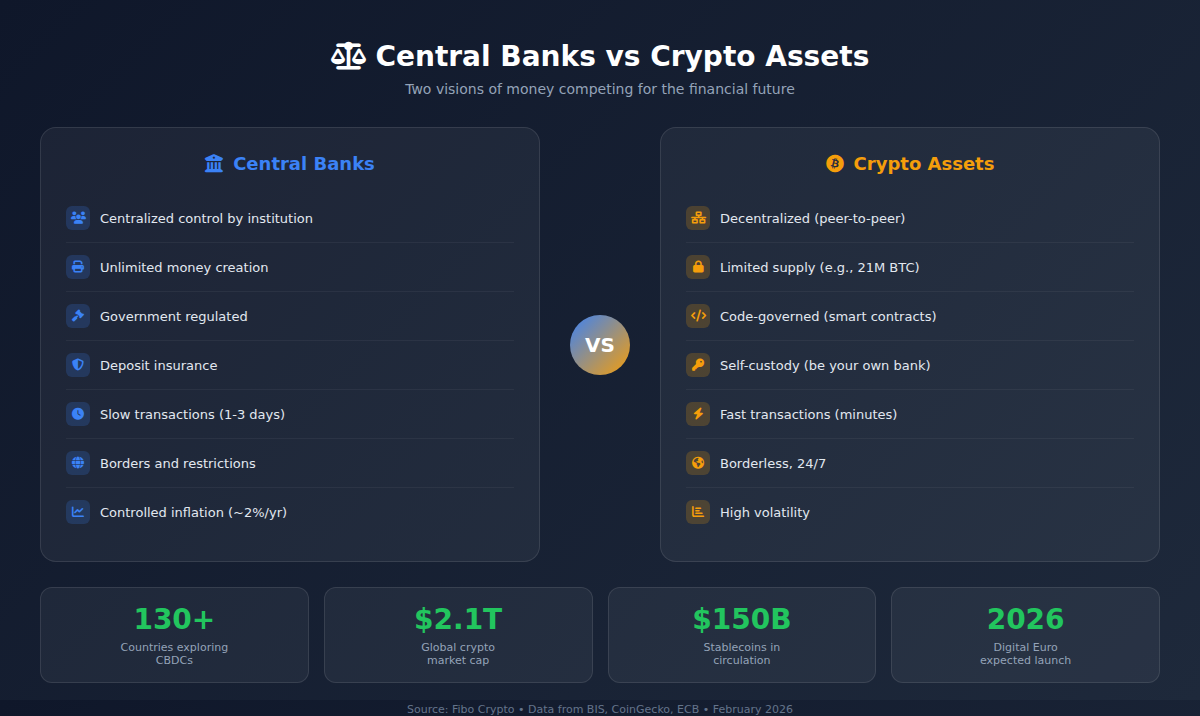
- Two opposing visions: central banks control money centrally, crypto offers a decentralized system without intermediaries
- Central bank power: money creation, interest rates, financial stability — but inflation and loss of trust as trade-offs
- The crypto threat: Bitcoin and stablecoins capture trust with transparency, speed, and programmed scarcity (21M BTC max)
- State response: 130+ countries exploring CBDCs, digital euro expected 2026-2027
- CBDC vs Bitcoin: CBDCs remain centralized and controllable, unlike decentralized crypto
- The future: likely coexistence of fiat, CBDCs, and crypto — diversification remains the best strategy
A central bank is the institution that controls monetary policy for a country or economic zone (ECB for euro, Fed for dollar). It creates money, sets interest rates, and ensures financial stability. Crypto assets offer a decentralized alternative, without intermediaries or state control.
The Role of Central Banks
- Money creation: they “print” money electronically to finance the economy
- Interest rates: they set borrowing costs for commercial banks
- Quantitative easing: massive asset purchases to inject liquidity
- Financial stability: bank supervision, lender of last resort
Crypto Assets: A Decentralized Alternative
- Limited supply: Bitcoin is capped at 21 million units
- Decentralization: no central bank, network managed by thousands of nodes
- Transparency: all transactions verifiable on blockchain
- Borderless: international transfers in minutes, 24/7

The State Response: CBDCs
Facing rising crypto, 130+ countries are exploring CBDCs:
- China (e-CNY): used by 260M+ people, most advanced
- Digital Euro: preparation phase, launch expected 2026-2027
- Digital Dollar: research phase, intense political debate in US
Note: CBDCs remain controlled by central banks. They offer digital speed but not the decentralization or censorship resistance of crypto.
📚 Glossary
- Central Bank: Institution controlling a country’s monetary policy (money creation, interest rates, financial stability).
- CBDC: Central Bank Digital Currency — digital money issued by a central bank (digital euro, digital yuan).
- Monetary Policy: Central bank actions to regulate money supply and interest rates.
- Quantitative Easing: Massive asset purchases by a central bank to inject liquidity into the economy.
- Decentralization: System without central authority, managed by a distributed network of participants.
Frequently Asked Questions
What is a central bank?
A central bank is the institution controlling monetary policy for a country. It creates money, sets interest rates, and ensures financial stability. Examples: ECB, Fed, Bank of England.
What is the difference between central banks and crypto?
Central banks are centralized and can create unlimited money. Cryptos like Bitcoin are decentralized, with limited supply (21M BTC) and function without intermediaries.
What is a CBDC?
A CBDC is digital money issued by a central bank. Unlike decentralized crypto, it remains state-controlled. Examples: digital yuan, digital euro.
Will the digital euro replace Bitcoin?
No, they are different. The digital euro is centralized and ECB-controlled. Bitcoin is decentralized and censorship-resistant. They will coexist.