How to Buy Solana (SOL) in France in 2026: Complete Guide

📋 En bref (TL;DR)
- Solana (SOL) ranks in the top 7 cryptocurrencies with a market cap of approximately $51 billion as of March 2026
- Several methods to buy: exchanges (Fibo, Binance, Coinbase), non-custodial wallets, or Solana ETFs
- Fibo offers the lowest fees: 0.25% swap commission, 3.5 times cheaper than MetaMask or Phantom (0.875%)
- Solana spot ETFs are approved in the United States since late 2025 (VanEck, 21Shares, Grayscale, Fidelity)
- Firedancer is live on mainnet: Jump Crypto’s new validator client now runs 20% of the network
- Staking yields between 5.9% and 7.5% APY natively, and up to 8.5% via liquid staking (Sanctum, Jito)
- 2026 taxation in France: flat tax of 31.4% on capital gains (a 1.4 percentage point increase from 2025)
- No minimum amount required to buy SOL — a few euros are enough to get started
Why Buy Solana in 2026?
Solana has established itself as one of the highest-performing blockchains on the market. In March 2026, SOL trades at around $89 with a market cap of $51 billion, making it the 7th largest cryptocurrency worldwide. But beyond price, it is the ecosystem that attracts investors.
An Ultra-Fast, Nearly Free Blockchain
Solana processes between 2,000 and 4,000 transactions per second under normal conditions, with peaks exceeding 100,000 TPS during stress tests. By comparison, Ethereum caps out at around 15 TPS without its scaling layers. Transaction fees on Solana remain below $0.01 — often around $0.001 — making the blockchain accessible to all types of investors.
2x cheaper fees. Up to 6% yield. No seed phrase. Fibo, the wallet you've been waiting for.
Get early access →Firedancer: An Ongoing Technical Revolution
The Firedancer validator client, developed by Jump Crypto over more than three years, has been live on the Solana mainnet since late 2025. As of March 2026, Firedancer runs over 20% of the network’s total stake (207 validators), having produced more than 50,000 blocks without any major incident. In controlled environments, Firedancer demonstrated a throughput capacity of one million transactions per second. The goal for 2026 is to reach 50% of the stake — a critical threshold for network resilience.
A Rapidly Expanding DeFi Ecosystem
DeFi on Solana reached $11.5 billion in TVL (Total Value Locked) by late 2025, with lending markets exceeding $3.6 billion. Liquid staking alone represents over $8 billion in TVL. Protocols such as Jupiter (DEX), Marinade Finance (liquid staking), and Kamino (lending) dominate the ecosystem and attract increasing institutional capital.
Solana Spot ETFs Are Approved
This is the major event of late 2025 — early 2026: the U.S. SEC approved the first Solana spot ETFs. VanEck (ticker VSOL), 21Shares (ticker TSOL), Bitwise, Grayscale, and Fidelity now offer listed products on American exchanges. VanEck even waived its management fees for the first billion dollars in assets between November 2025 and February 2026. This institutional approval validates Solana as a top-tier asset alongside Bitcoin and Ethereum.
Institutional Adoption Is Accelerating
Beyond ETFs, Visa has integrated USDC stablecoins on Solana for its settlements. PayPal launched PYUSD on the network. Shopify, Stripe, and Square are experimenting with Solana payments. This adoption by payment giants confirms the blockchain’s technical relevance for real-world use cases.
Prerequisites Before Buying Solana
Before you start buying SOL, you need to have a few things in order:
Required Documents and Accounts
Valid ID document — National ID card, passport, or residence permit. All regulated platforms require KYC (Know Your Customer) verification in compliance with European MiCA regulation and AMF requirements (France’s financial markets authority).
Bank account or debit/credit card — A current account or Visa/Mastercard is sufficient. Some platforms also accept instant SEPA transfers, which are generally free.
Email address and phone number — To create your account and enable two-factor authentication (2FA), which is essential for securing your holdings.
How Much Do You Need to Get Started?
There is no regulatory minimum amount for buying Solana. In practice, most platforms allow purchases starting from 1 euro. However, for the investment to make sense after fees, an initial purchase of 50 to 100 euros is a good starting point.
Risk Warning
Investing in cryptocurrencies carries the risk of capital loss. Solana has experienced drops of more than 90% in the past (such as between 2021 and 2022). Only invest what you can afford to lose and diversify your investments. This article does not constitute investment advice.
Method 1: Exchanges (Recommended for Beginners)
The simplest way to buy Solana in France is through an exchange. Here are the main options available.
Fibo — The Cheapest French Solution
Fibo is a non-custodial wallet developed by ADVIJU INVESTISSEMENT, a company registered as a PSAN (Digital Asset Service Provider) with the AMF (France’s financial markets authority). Its main advantage is a commission of only 0.25% on swaps — 3.5 times cheaper than MetaMask or Phantom (0.875%).
Strengths:
– Ultra-competitive commission: 0.25% per swap
– No recovery phrase to memorize (Privy technology)
– Simplified login via Gmail, email, or Apple
– Gas paid with the token being traded (no need to hold SOL to pay fees)
– French company, AMF-registered PSAN
– Solana network supported from launch
Weaknesses:
– Relatively new app (less track record than competitors)
– Number of available tokens still expanding
Binance — The Global Leader
Binance is the world’s largest exchange by volume. It offers SOL with trading fees starting at 0.1% and numerous trading pairs.
Strengths:
– Very high liquidity
– Competitive trading fees (0.1%)
– Large number of SOL pairs available
– Integrated Solana staking
Weaknesses:
– Complex interface for beginners
– Custodial platform (you don’t own your keys)
– Mixed regulatory history in France
Coinbase — The Go-To for Beginners
Coinbase is appreciated for its ease of use and intuitive interface. The platform is registered with the AMF to operate in France.
Strengths:
– Very simple interface
– AMF registration
– Insurance on held funds
– Responsive customer support
Weaknesses:
– Higher fees (up to 1.49% per transaction)
– Significant spreads on direct purchases
– Custodial platform
Bitpanda — The Austrian Alternative
Bitpanda, based in Vienna, holds a MiFID II license and operates as a regulated provider in Europe.
Strengths:
– Strong European license
– Fractional purchases available
– Clean interface
Weaknesses:
– 1.49% trading fees
– High spreads
– Fewer tokens available
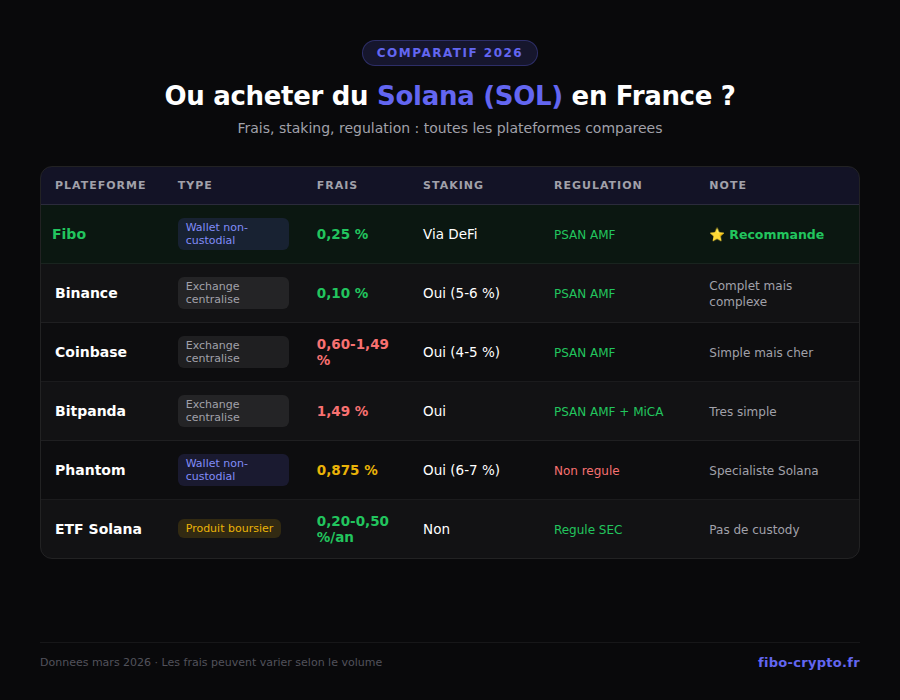
Fee Comparison Table
| Platform | Type | SOL Trading Fees | EUR Deposit | PSAN / AMF |
|---|---|---|---|---|
| Fibo | Non-custodial wallet | 0.25% | Bank transfer / Card | Yes (ADVIJU) |
| Binance | Custodial exchange | 0.10% | Free SEPA | Yes |
| Coinbase | Custodial exchange | 0.60 – 1.49% | SEPA / Card | Yes |
| Bitpanda | Custodial exchange | 1.49% | SEPA / Card | MiFID License |
| MetaMask | Non-custodial wallet | 0.875% | Via third party | No |
| Phantom | Non-custodial wallet | 0.875% | Via third party | No |
Method 2: Buying via a Non-Custodial Wallet
A non-custodial wallet (or self-hosted wallet) gives you complete control over your private keys. This is the fundamental principle of crypto: “not your keys, not your coins.”
How Does It Work?
With a non-custodial wallet, you hold the cryptographic keys that grant access to your SOL yourself. No intermediary can freeze, seize, or block your funds. In return, you alone are responsible for the security of your wallet.
Fibo Wallet: Simplified Self-Custody
Fibo reimagines the non-custodial wallet experience. Thanks to Privy technology, key management happens in the background — no 12 or 24-word recovery phrase to write down on paper. Recovery is handled through your social login (Gmail, Apple) combined with a biometric passkey. The result is an experience as simple as a traditional banking app, with the security of self-custody.
Additionally, Fibo lets you pay gas fees with the token you are trading. If you buy SOL with USDC, the fees are deducted directly in USDC — no need to hold SOL beforehand to cover network fees.
Phantom: Solana’s Legacy Wallet
Phantom is the most popular wallet in the Solana ecosystem with over 10 million users. It works as both a browser extension and a mobile app, and allows interaction with Solana’s entire DeFi ecosystem.
Strengths:
– The reference wallet for Solana
– Compatible with all Solana dApps
– Integrated staking
– Multi-chain (Solana, Ethereum, Polygon, Bitcoin)
Weaknesses:
– 0.875% commission on integrated swaps
– Mandatory recovery phrase (12 words)
– No PSAN registration
Other Solana-Compatible Wallets
Backpack — A wallet developed by the Mad Lads team, particularly popular for Solana NFTs. Modern interface with innovative xNFT features.
Solflare — A legacy Solana wallet focused on staking and DeFi. More technical interface, suited for advanced users.
Method 3: Solana ETFs
Since late 2025, it has been possible to invest in Solana through ETFs (Exchange-Traded Funds) listed on stock exchanges, without ever holding SOL directly.
What Is a Solana ETF?
A Solana ETF is an exchange-traded fund that tracks the price of SOL. You buy shares of the ETF through your regular broker (just like a stock), and the fund holds the corresponding SOL in reserve. This is the simplest way to gain exposure to Solana within a regulated, familiar framework.
Solana Spot ETFs Available in 2026
The U.S. SEC has approved several Solana spot ETFs:
VanEck Solana ETF (VSOL) — Among the first to launch, VanEck applied an aggressive strategy by waiving its management fees for the first billion dollars in assets between November 2025 and February 2026. The fund is listed on the Cboe BZX Exchange.
21Shares Core Solana ETF (TSOL) — Listed on the Cboe BZX Exchange, TSOL tracks the CME CF Solana-Dollar Reference Rate. 21Shares is a well-known European issuer of crypto ETPs.
Grayscale Solana Trust — Converted into a spot ETF, Grayscale’s legacy fund benefits from an already established investor base.
Fidelity, Bitwise, and others — Several other issuers have also launched their products, creating a competitive market that has already attracted hundreds of millions of dollars.
Availability in France
For French investors, access to U.S. Solana ETFs may be restricted due to PRIIPS regulation (the lack of a KID document in French blocks distribution to European retail investors). However, some brokers allow access through standard brokerage accounts (CTO — compte-titres ordinaire). Check with your broker (Degiro, Interactive Brokers, Trade Republic) for product availability.
European Solana ETPs (such as those from 21Shares and CoinShares) are also available on European exchanges and more easily accessible to French investors.
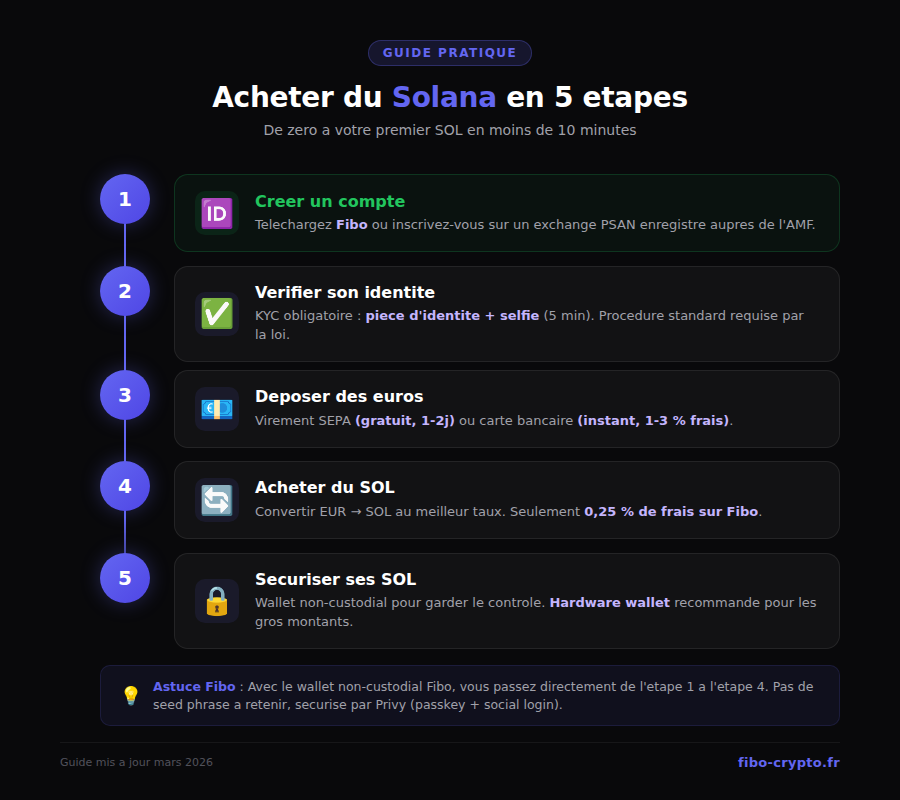
Step-by-Step Guide: Buying SOL on Fibo
Here is how to buy Solana on the Fibo app in just a few minutes.
Step 1: Download the Fibo App
Go to the App Store (iPhone) or Google Play Store (Android) and search for “Fibo Crypto.” Download and install the app for free.
Step 2: Create Your Account
Open the app and sign in with your email address, Gmail account, or Apple ID. Fibo uses Privy technology to automatically create your secure wallet — no recovery phrase to write down. A biometric passkey (Face ID, fingerprint) is set up to protect your account.
Step 3: Verify Your Identity
Complete KYC verification by providing a photo of your ID and a selfie. This step is mandatory under PSAN regulations (France’s Digital Asset Service Provider framework) and generally takes less than 5 minutes.
Step 4: Deposit Euros
Fund your account via SEPA bank transfer or debit/credit card. The funds are converted to a stablecoin (USDC) to facilitate on-chain trading. The minimum deposit is just a few euros.
Step 5: Buy Solana (SOL)
In the app, select SOL from the list of available cryptocurrencies. Enter the amount in euros you wish to invest. Fibo displays the conversion rate and fees (0.25% commission) with full transparency before confirmation. Confirm the transaction — your SOL appears instantly in your wallet.
Step 6: Secure and Track Your Investment
Your SOL is stored in your Fibo non-custodial wallet. You can track your portfolio performance directly in the app, send your SOL to another wallet, or use it in DeFi protocols.
Fees and Taxation in France
Understanding fees and taxation is essential before investing in Solana.
Fees to Expect
Platform fees — This is the main cost. On Fibo, the commission is 0.25% per swap. On Binance, expect 0.10%. On Coinbase, fees range from 0.60% to 1.49% depending on the amount and payment method.
Network fees (gas) — On Solana, transaction fees are negligible: roughly $0.001 per transaction. This is one of the blockchain’s major advantages over Ethereum (where fees can exceed several dollars). With Fibo, these fees are paid with the token being traded, simplifying the experience.
Deposit fees — SEPA transfers are generally free. Card deposits are charged between 1% and 3.5% depending on the platform. Prefer SEPA transfers to minimize fees.
Withdrawal fees — When withdrawing SOL to an external wallet, minimal network fees apply. Withdrawals in euros to a bank account are generally free or charged between 0 and 1 euro.
Cryptocurrency Taxation in France in 2026
Crypto taxation evolved in 2026 with an increase in the CSG (social security contribution) on capital income. Here is what you need to know:
The flat tax rises to 31.4% — Since January 1, 2026, the PFU (prelevement forfaitaire unique, France’s flat tax on capital gains) stands at 31.4% on crypto asset capital gains. This rate breaks down into 12.8% income tax and 18.6% social contributions (the CSG increased from 9.2% to 10.6%).
Progressive tax scale option — Taxpayers can opt for the progressive income tax scale if it is more advantageous. This option may be attractive for low-income taxpayers.
305-euro exemption threshold — If your total annual capital gains do not exceed 305 euros, you are exempt from tax.
Taxable event — Tax is only due when converting crypto to fiat currency (euros, dollars) or when paying for goods or services with crypto. Crypto-to-crypto exchanges (for example, SOL to USDC) are not taxable.
Reporting obligation — You must declare your accounts on foreign platforms (form 3916-bis) and your capital gains (form 2086) in your annual tax return.
Practical Example
You buy 1,000 euros worth of SOL in March 2026 on Fibo (fees: 2.50 euros). In December, your SOL is worth 1,500 euros and you sell everything for euros. Your capital gain is 497.50 euros. The 31.4% flat tax applies: 497.50 x 31.4% = 156.22 euros in tax. Your net gain after tax is 341.28 euros.
Solana Staking: Earning Passive Income
Staking is one of Solana’s most attractive features. It allows you to lock up your SOL to secure the network while earning rewards.
How Does Solana Staking Work?
Solana uses a consensus mechanism called Proof of Stake. Validators put SOL at stake to earn the right to validate transactions and produce blocks. By delegating your SOL to a validator, you contribute to network security and receive a share of the rewards.
Staking Yields in March 2026
Native staking — Yields range between 5.9% and 7.5% APY depending on the chosen validator. This is the simplest method: you delegate your SOL directly to a validator through a compatible wallet.
Liquid staking — Liquid staking lets you stake your SOL while retaining a liquid token (LST) that you can use in DeFi. The main protocols:
– Sanctum INF: up to 8.5% APY — the highest yield on the market
– Jito (jitoSOL): over $1.2 billion in locked value, with yield that includes MEV tips
– Marinade Finance (mSOL): Solana’s legacy liquid staking protocol, with automatic distribution across hundreds of validators
Advanced DeFi strategies — By combining liquid staking with lending, some strategies achieve 10 to 15% APY. Caution: these higher yields come with additional risks (smart contracts, liquidation).
Where to Stake Your SOL?
On non-custodial wallets like Fibo, Phantom, or Solflare, staking is integrated directly into the interface. On centralized platforms like Binance or Coinbase, staking is also available but with additional fees and without control of your keys.
Securing Your SOL: Best Practices
The security of your Solana depends above all on your personal practices. Here are the essential rules.
Choosing the Right Storage Type
Non-custodial wallet (recommended) — You hold your own keys. This is the most secure method for the long term. Fibo simplifies this experience by eliminating the need to manage a recovery phrase while leaving you in full control of your funds.
Hardware wallet (maximum security) — For significant amounts (several thousand euros), a hardware wallet like Ledger Nano S Plus or Ledger Stax provides an additional layer of security. Your private keys are stored in a secure chip isolated from the internet. Ledger is compatible with Solana.
Centralized platform (avoid for long-term storage) — Leaving your SOL on an exchange exposes you to risks of bankruptcy (recall FTX in 2022) or hacking. Only use for active trading.
The Golden Rules of Crypto Security
1. Enable 2FA everywhere — Two-factor authentication on all your accounts (platform, email, wallet). Prefer a 2FA app (Google Authenticator, Authy) over SMS, which is more vulnerable to SIM swapping.
2. Never share your recovery phrase — If you use a traditional wallet with a recovery phrase, never store it digitally (no photos, no text files). Write it down on paper and keep it in a secure location (safe, secure place). With Fibo, this concern disappears thanks to Privy technology.
3. Beware of phishing — Never click on links received by email or message asking you to connect your wallet. Always type website URLs directly into your browser. Scams imitating official sites are extremely common.
4. Diversify your storage points — Don’t put all your SOL in one place. Split between a daily wallet (Fibo or Phantom) and a hardware wallet (Ledger) for long-term reserves.
5. Update regularly — Keep your apps and operating systems up to date to benefit from the latest security patches.
Solana vs Ethereum: Which to Choose in 2026?
The comparison between Solana and Ethereum is one of the most debated topics in the crypto world. Here is an objective comparison table.
| Criteria | Solana (SOL) | Ethereum (ETH) |
|---|---|---|
| Speed | 2,000 – 4,000 TPS (1M with Firedancer) | ~15 TPS (L1), more with L2 |
| Transaction fees | ~$0.001 | $1 – $10 (L1), $0.01 – $0.10 (L2) |
| Finality | ~400 ms | ~12 minutes |
| Market cap | ~$51B (#7) | ~$250B (#2) |
| DeFi TVL | ~$11.5B | ~$50B (L1 + L2) |
| Staking APY | 5.9 – 7.5% | 3 – 4% |
| Spot ETF | Yes (2025) | Yes (2024) |
| Maturity | Launched in 2020 | Launched in 2015 |
| Architecture | Monolithic | Modular (L1 + L2) |
| Validator client | 2 clients (Agave + Firedancer) | 5+ clients |
| Network outages | Several historical outages (2022-2023) | No major outages |
When to Prefer Solana?
Solana excels for frequent, low-value transactions: DeFi trading, NFTs, payments, gaming. If you are looking for speed and minimal fees, Solana is a solid choice. The higher staking yield (5.9 – 7.5% vs 3 – 4% for Ethereum) is also an argument in its favor.
When to Prefer Ethereum?
Ethereum remains the reference for institutional DeFi and critical applications requiring proven reliability. Its Layer 2 ecosystem (Arbitrum, Optimism, Base) now offers fees comparable to Solana while benefiting from Ethereum’s security. Its diversity of validator clients (5+) makes it more resilient.
Our Recommendation
Rather than choosing between Solana and Ethereum, a diversification strategy is generally more relevant. Both blockchains serve complementary use cases, and the health of one does not necessarily harm the other. On Fibo, you can hold both SOL and ETH in the same wallet.
Our Opinion: Should You Buy Solana in 2026?
Arguments in Favor
A technically advanced ecosystem — With Firedancer live on mainnet and already 20% of the network’s stake, Solana has top-tier technical infrastructure. The theoretical capacity of one million TPS positions the blockchain to handle institutional volumes.
Institutional validation through ETFs — The SEC’s approval of spot ETFs is a strong signal. Institutional investment flows through ETFs create structural demand for SOL.
Strong fundamentals — Over $11 billion in DeFi TVL, an expanding payment ecosystem (Visa, PayPal, Shopify), and attractive staking yields (5.9 – 7.5%).
The lowest fees on the market — Near-zero transaction fees make Solana accessible to everyone, unlike Ethereum L1 where fees remain a barrier.
Risks to Consider
Historical volatility — SOL lost over 90% of its value during the 2022 bear market. As of March 2026, the price remains roughly 40% below its all-time high.
Relative centralization — Although the number of validators is growing, Solana remains more centralized than Ethereum. The hardware costs to run a validator are significant.
History of outages — The network experienced several total outages in 2022-2023. While the situation has improved, this risk has not entirely disappeared.
Growing competition — Ethereum’s Layer 2s (Base, Arbitrum) and other fast blockchains (Sui, Aptos) represent serious competition.
Conclusion: A High-Potential Asset with Accepted Risks
Solana is among the 3 essential blockchains in 2026, alongside Bitcoin and Ethereum. Its technical ecosystem (Firedancer), institutional validation (ETFs), and staking yields make it a credible investment for those willing to accept the volatility inherent to cryptocurrencies.
For a French investor in 2026, the most cost-effective method is to use a non-custodial wallet like Fibo to benefit from the lowest fees (0.25%) while retaining control of your keys — all within a framework regulated by the AMF (France’s financial markets authority).
Remember: always diversify your investments, only invest what you can afford to lose, and continuously educate yourself about the assets you invest in.
Glossary
📚 Glossary
- Solana : A Layer 1 blockchain launched in 2020 by Anatoly Yakovenko. Solana stands out for its processing speed (several thousand transactions per second) and near-zero fees. It uses a Proof of Stake consensus mechanism combined with a unique timestamping system called Proof of History.
- SOL : The native token of the Solana blockchain. SOL is used to pay transaction fees, participate in staking (network security), and ecosystem governance. It is divisible up to 9 decimal places (the smallest unit is called a lamport).
- Staking : The process of locking tokens (in this case SOL) to participate in securing a Proof of Stake blockchain. In return, the staker receives rewards in the form of additional tokens. On Solana, native staking yields between 5.9% and 7.5% APY in 2026.
- Validator : A network node that participates in validating transactions and producing blocks. On Solana, validators are selected proportionally to their stake (amount of delegated SOL). Over 1,900 validators operate on the network in 2026.
- TPS : Transactions Per Second. A measure of a blockchain’s processing capacity. Solana handles 2,000 to 4,000 TPS under normal conditions and targets 1 million TPS with Firedancer.
- DeFi : Decentralized Finance. A set of financial protocols running on blockchain without intermediaries: lending, borrowing, trading, staking. On Solana, DeFi represents over $11 billion in locked value.
- NFT : Non-Fungible Token. A unique digital asset recorded on a blockchain, representing a digital object (art, music, collectible). Solana is the second-largest blockchain for NFTs after Ethereum, thanks to its low fees.
- Wallet : A digital wallet for storing, sending, and receiving cryptocurrencies. There are two types: custodial (a platform holds your keys) and non-custodial (you hold your own keys). Fibo is a non-custodial wallet.
- PSAN : Prestataire de Services sur Actifs Numeriques (Digital Asset Service Provider). A mandatory registration issued by the AMF (Autorite des marches financiers, France’s financial markets authority) for any company offering cryptocurrency-related services in France. ADVIJU INVESTISSEMENT, the company behind Fibo, is PSAN-registered.
- Flat tax : Prelevement forfaitaire unique (PFU) — France’s flat tax applied to capital income. In 2026, the flat tax on crypto capital gains stands at 31.4% (12.8% income tax + 18.6% social contributions).
- Firedancer : A new validator client for Solana developed by Jump Crypto. Launched on mainnet in late 2025 after 3 years of development, it has demonstrated the capacity to process 1 million transactions per second in controlled conditions. As of March 2026, it runs over 20% of the network’s total stake.
- ETF : Exchange-Traded Fund. A financial product that replicates the performance of an underlying asset (in this case SOL) and trades on stock exchanges like a stock. Solana spot ETFs were approved by the U.S. SEC in late 2025.
- Liquid staking : A variant of staking where the user receives a liquid token (LST) in exchange for their staked SOL. This token can be used in DeFi protocols while continuing to generate staking rewards. Examples: jitoSOL, mSOL, INF.
- Gas : Network fees paid to execute a transaction on a blockchain. On Solana, gas fees are negligible (approximately $0.001). On Fibo, gas is paid with the token being traded, not with native SOL.
Frequently Asked Questions
How do I buy Solana (SOL) in France in 2026?
To buy Solana in France, you have three main options: use a non-custodial wallet like Fibo (only 0.25% in fees), go through an exchange like Binance or Coinbase, or invest via a Solana spot ETF. In all cases, you will need to verify your identity (KYC) and have a means of payment in euros (SEPA transfer or debit/credit card).
What is the minimum amount to buy Solana?
There is no regulatory minimum amount. Most platforms allow you to buy SOL starting from 1 euro. For an investment that makes sense after fees, we recommend starting with 50 to 100 euros. You can buy fractions of SOL — you do not need to buy a whole SOL.
What are the fees for buying Solana?
Fees vary by platform: Fibo charges 0.25% commission (the cheapest on the market), Binance charges 0.10% in trading fees, Coinbase between 0.60% and 1.49%, and MetaMask/Phantom charge 0.875%. Add deposit fees (free via SEPA, 1-3% by card) and Solana network fees (negligible, approximately $0.001).
Do I need to declare my Solana holdings for tax purposes in France?
Yes. In 2026, you must declare your crypto accounts on foreign platforms (form 3916-bis) and your capital gains upon selling for euros (form 2086). Capital gains are taxed at 31.4% (flat tax). Only annual capital gains below 305 euros are exempt. Crypto-to-crypto exchanges are not taxable.
Is Solana staking profitable?
Native Solana staking yields between 5.9% and 7.5% APY as of March 2026, which is significantly higher than Ethereum (3-4%). Liquid staking via protocols like Sanctum can reach 8.5%. Note: these yields are in SOL, so your actual return in euros also depends on SOL’s price movement.
Is Solana a good investment in 2026?
Solana has strong fundamentals: approved ETFs, Firedancer live on mainnet, a growing DeFi ecosystem, and adoption by Visa and PayPal. However, SOL remains a volatile asset that has previously lost 90% of its value. It is a high-potential but risky investment. Diversify and only invest what you can afford to lose.
How do I secure my SOL after purchasing?
Use a non-custodial wallet (Fibo, Phantom) to retain control of your keys. For large amounts, a Ledger hardware wallet offers maximum security. Always enable 2FA, never share your recovery phrase, and beware of phishing. With Fibo, security is simplified thanks to Privy technology (no recovery phrase required).
What is the difference between buying SOL on a platform and via an ETF?
On a platform or wallet, you directly hold SOL that you can stake, send, or use in DeFi. Via an ETF, you hold shares of a fund that holds the SOL for you — it is simpler, but you cannot stake or use your SOL. ETFs are suited for traditional investors who want exposure without managing a wallet.
Is Solana better than Ethereum?
Solana is faster (4,000 TPS vs 15 for Ethereum L1) and cheaper ($0.001 vs several dollars in fees). Ethereum is more mature, more decentralized, and has a larger DeFi ecosystem. The two blockchains are complementary. A diversification strategy including both assets is generally recommended.
Can I buy Solana with a debit/credit card in France?
Yes. Most platforms (Fibo, Binance, Coinbase) accept Visa and Mastercard to buy SOL directly. However, fees are higher than a SEPA transfer (1-3.5% for card vs free for SEPA). Card purchases are instant, while SEPA transfers take 1 to 2 business days.
📰 Sources
This article is based on the following sources:
- CoinGecko – Solana (SOL)
- Solana Foundation
- DefiLlama – Solana
- AMF – PSAN Registry
- Helius – Solana ETFs
- SEC – VanEck Solana ETF S-1
- StakePoint – Solana Staking Rates
- Waltio – Crypto Taxation 2026
- Solana Compass
- Cryptopolitan – Firedancer
Comment citer cet article : Fibo Crypto. (2026). How to Buy Solana (SOL) in France in 2026: Complete Guide. Consulté le 20 March 2026 sur https://fibo-crypto.fr/en/blog/buy-solana-france-guide-2026
The simplest way to buy, swap and manage your crypto
Join the first users and get priority access. No seed phrase, fees 3.5x lower, built-in DeFi yield.
Get early access →