How to Buy Ethereum (ETH) in France in 2026: Complete Guide

📋 En bref (TL;DR)
- Ethereum (ETH) is the world’s 2nd largest cryptocurrency by market cap, and a cornerstone of DeFi with over $60 billion in TVL
- Several methods to buy ETH in France: exchange platforms, non-custodial wallets, or spot Ethereum ETFs
- Fibo offers ETH purchases with only 0.25% swap fees — 3.5 times cheaper than MetaMask or Phantom
- 2026 tax update: the flat tax rises to 31.4% on crypto capital gains in France (up from 30% previously)
- ETH staking yields approximately 3.5 to 4% APY, and DeFi lending solutions like Aave offer up to 5.2%
- Spot Ethereum ETFs have been available since May 2024 (BlackRock ETHA, Fidelity FETH) for exposure without directly holding ETH
- Gas fees on Ethereum L1 range from $1 to $5 per transaction, but drop to $0.01–$0.05 on Layer 2s (Base, Arbitrum)
- Requirements: a valid ID, a European bank account, and a minimum of 10 to 50 EUR depending on the platform
Why Buy Ethereum in 2026?
Ethereum remains the cornerstone platform of the crypto ecosystem in 2026. With a price fluctuating between $2,000 and $2,500, a market cap that firmly makes it the number two behind Bitcoin, and a rapidly accelerating technical ecosystem, ETH continues to attract both retail and institutional investors.
The pillar of decentralized finance
Ethereum holds over $60 billion in TVL (Total Value Locked) across its decentralized finance protocols. Platforms like Aave, Uniswap, Lido, and MakerDAO run on Ethereum and process massive daily transaction volumes. No other blockchain offers such depth of liquidity or as mature a smart contract ecosystem.
2x cheaper fees. Up to 6% yield. No seed phrase. Fibo, the wallet you've been waiting for.
Get early access →Spot ETFs: an institutional turning point
Since May 2024, spot Ethereum ETFs have been available to investors. BlackRock (iShares Ethereum Trust, ticker ETHA) and Fidelity (Fidelity Ethereum Fund, ticker FETH) now offer regulated exposure to ETH. These financial products open the door to institutional capital and simplify access for traditional investors who prefer not to manage a wallet themselves.
Major technical upgrades
Ethereum continues its ambitious roadmap. After Dencun (March 2024), which slashed Layer 2 fees by 10x thanks to blobs, the Pectra upgrade (2025–2026) introduces native account abstraction and increases blob throughput. These improvements make Ethereum faster, cheaper, and more accessible.
A deflationary asset
Since the activation of EIP-1559 in August 2021, a portion of transaction fees is burned. Over 4 million ETH have been destroyed, creating deflationary pressure on supply. When the network is heavily used, more ETH is burned than created, making Ethereum a potentially deflationary asset in the long run.
A booming Layer 2 ecosystem
Base (Coinbase), Arbitrum, and Optimism now process millions of daily transactions with fees below $0.05. These networks inherit Ethereum’s security while providing speed and low costs. The L2 ecosystem reinforces ETH’s value proposition as the base asset of the network.
Prerequisites Before Buying Ethereum
Before buying your first ETH, make sure you meet these requirements:
Required documents:
- Valid ID: national identity card, passport, or residence permit. KYC (Know Your Customer) is mandatory on all regulated platforms in France
- European bank account: SEPA IBAN for bank transfers. Most platforms also accept debit/credit cards (higher fees)
- Proof of address: sometimes required depending on the platform (less than 3 months old)
Minimum amounts:
- Most platforms allow you to buy ETH starting from 10 to 50 EUR
- No need to buy a whole ETH: the cryptocurrency is divisible down to 18 decimal places (the smallest unit is called a wei)
Risk warning:
Investing in cryptocurrencies involves significant risks. The price of ETH can fluctuate sharply in both directions. Only invest money you can afford to lose and diversify your investments. Past performance is not indicative of future results.
Method 1: Exchange platforms (recommended for beginners)
Crypto exchange platforms remain the simplest and most popular method for buying Ethereum in France. Here are the main options available in 2026.
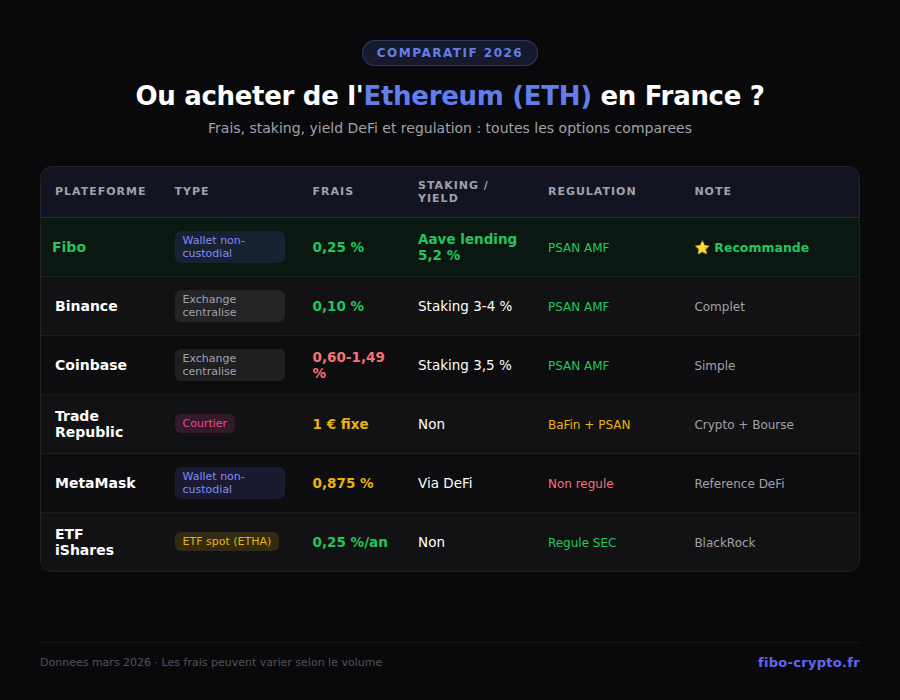
Comparison of major platforms
| Platform | Purchase fees | Minimum deposit | Regulation | Key strengths |
|---|---|---|---|---|
| Fibo | 0.25% | 10 EUR | PSAN (AMF) | Lowest fees, non-custodial wallet, integrated DeFi yield |
| Bitpanda | 1.49% | 1 EUR | PSAN (AMF) | Wide range of assets (crypto + stocks) |
| Binance | 0.10% | 15 EUR | PSAN (AMF) | Maximum liquidity, numerous trading pairs |
| Coinbase | 1.49% | 2 EUR | PSAN (AMF) | Intuitive interface, insurance |
| Trade Republic | 1 EUR flat | 1 EUR | BaFin / PSAN | Crypto + stocks + ETFs in a single app |
Why Fibo stands out
Fibo is a non-custodial wallet registered as a PSAN (Digital Asset Service Provider) with the AMF (French Financial Markets Authority). Unlike traditional exchange platforms that hold your crypto on their servers, Fibo gives you full control of your private keys while offering a streamlined user experience.
Key advantages of Fibo:
- 0.25% swap fees: that’s 3.5 times cheaper than MetaMask or Phantom (0.875%)
- No seed phrase to remember: key management is handled via Privy SDK, with recovery through social login (Gmail, Apple) and passkey
- Gas paid with the input token: no need to hold ETH to pay gas fees — the system uses the token you’re swapping directly
- Integrated DeFi yield: earn returns through Aave integration (approximately 5.2% APY on ETH)
- Multi-chain: Ethereum, Base, Arbitrum, Polygon from launch
Method 2: Non-custodial wallets
A non-custodial wallet gives you full control over your cryptocurrencies. You hold your own private keys, meaning no one else can access your funds.
Fibo Wallet
Fibo combines the advantages of a non-custodial wallet with the simplicity of a consumer-friendly app:
- Sign up in minutes via email or social login
- No 24-word seed phrase to write down on paper
- Buy ETH directly by card or bank transfer via Transak integration
- Swap between cryptos at 0.25% fees
- Direct access to DeFi lending via Aave
MetaMask
MetaMask is the legacy wallet of the Ethereum ecosystem. It works as a browser extension and mobile app:
- Open source and audited
- Compatible with all DeFi protocols
- Swap fees: 0.875%
- Requires managing a seed phrase (24 words)
- Gas fees must be paid in ETH
Note: with a non-custodial wallet, you are solely responsible for the security of your funds. If you lose access to your wallet without a recovery method, your crypto is permanently lost.
Method 3: Spot Ethereum ETFs
Since May 2024, you can gain exposure to Ethereum through spot ETFs listed on stock exchanges. This method is suitable for investors who want ETH price exposure without managing a wallet or private keys.
Major spot Ethereum ETFs
| ETF | Issuer | Ticker | Management fees |
|---|---|---|---|
| iShares Ethereum Trust | BlackRock | ETHA | 0.25% |
| Fidelity Ethereum Fund | Fidelity | FETH | 0.25% |
| Bitwise Ethereum ETF | Bitwise | ETHW | 0.20% |
| 21Shares Core Ethereum ETF | 21Shares | CETH | 0.21% |
Advantages and limitations of ETFs
Advantages:
- Purchase through a traditional broker (Trade Republic, Degiro, etc.)
- No wallet or private keys to manage
- Familiar regulatory framework
- Eligible for certain brokerage accounts
Limitations:
- No staking possible (you don’t hold the ETH)
- No access to DeFi
- Annual management fees (0.20 to 0.25%)
- Limited market hours (no 24/7 trading)
- No transferring ETH to a personal wallet
Step-by-step guide: Buying ETH on Fibo
Here’s how to buy Ethereum on Fibo in 5 simple steps:
Step 1: Create a Fibo account
Visit fibo-crypto.fr and download the app. Sign-up takes just a few minutes:
- Choose your login method: email, Google, or Apple
- Create your username
- Set up your security passkey (biometrics or PIN code)
Fibo automatically creates your non-custodial wallet in the background. No seed phrase to write down or private key to store manually.
Step 2: Verify your identity (KYC)
In compliance with French regulations, identity verification is required:
- Take a photo of your ID (front and back)
- Take a verification selfie
- Validation typically takes a few minutes
Step 3: Deposit euros
Several options to fund your account:
- SEPA bank transfer: free, within 1 to 2 business days
- Debit/credit card: instant, fees vary depending on the payment provider
Step 4: Buy ETH
- Select Ethereum (ETH) from the asset list
- Enter the amount in euros you wish to invest
- Choose the network: Ethereum L1, Base, Arbitrum, or Polygon
- Confirm the transaction
Tip: if you’re buying ETH to use DeFi or make frequent transactions, choose a Layer 2 like Base or Arbitrum. Fees there are 100 times lower than on Layer 1.
Step 5: Secure and grow your ETH
Once the purchase is complete, your ETH is in your Fibo wallet. You can:
- Hold it (HODL strategy)
- Put it into DeFi lending via Aave directly from Fibo to earn approximately 5.2% APY
- Send it to a hardware wallet for cold storage
Ethereum Fees and Taxation in 2026
Gas fees on Ethereum
Every transaction on Ethereum requires the payment of gas fees. These fees compensate the validators who secure the network and vary based on congestion:
| Network | Average fees per transaction | Confirmation time |
|---|---|---|
| Ethereum L1 | $1 to $5 | 12 seconds |
| Arbitrum | $0.01 to $0.05 | < 1 second |
| Base | $0.01 to $0.03 | < 1 second |
| Polygon | < $0.01 | 2 seconds |
On Fibo, gas fees are paid directly with the token you’re swapping. You don’t need to hold ETH specifically to cover gas, which significantly simplifies the user experience.
Platform fees
In addition to gas, each platform charges its own commission:
- Fibo: 0.25% per swap
- MetaMask: 0.875% per swap
- Phantom: 0.875% per swap
- Coinbase: 1.49% on purchases
- Binance: 0.10% spot
Crypto taxation in France in 2026
Since January 1, 2026, the taxation of crypto capital gains in France has been slightly modified:
- Flat tax at 31.4%: the exceptional contribution on high incomes brings the effective flat tax (a fixed-rate withholding tax known as PFU in France) to 31.4% for most taxpayers (up from 30% previously, comprising 12.8% income tax + 18.6% social contributions)
- Taxable event: capital gains are only taxable upon conversion to fiat currency (euro) or when purchasing goods/services. A crypto-to-crypto swap (e.g., ETH to BTC) is not a taxable event
- Mandatory reporting: any account held on a foreign platform must be declared using form 3916-bis
- Tax threshold: all capital gains realized during the year are aggregated. The calculation is based on net overall capital gains (gains minus losses)
Important: this information is provided for informational purposes only and does not constitute tax advice. Consult an accountant or tax attorney for your personal situation.
Ethereum Staking: Earn Yield on Your ETH
Staking allows you to participate in securing the Ethereum network while generating passive income. Since the transition to Proof of Stake (The Merge, September 2022), Ethereum operates entirely through validators who stake their ETH.
Solo staking: 32 ETH minimum
Solo staking requires:
- Holding at least 32 ETH (approximately $64,000 to $80,000 as of March 2026)
- Running a validator node 24/7
- Having dedicated hardware and a stable internet connection
- Yield: approximately 3.5 to 4% APY
This method is reserved for technically proficient users with significant capital.
Liquid staking: accessible to everyone
Liquid staking lets you stake any amount of ETH through a DeFi protocol and receive a substitute token (stETH, rETH) that can be used in other protocols:
- Lido (stETH): the largest liquid staking protocol (~30% of all staked ETH). Yield ~3.5% APY. No minimum
- Rocket Pool (rETH): more decentralized than Lido, with mini-pools for node operators. Yield ~3.3% APY
DeFi lending via Fibo: a simple alternative
Fibo directly integrates the Aave protocol, one of the global leaders in decentralized lending. By depositing your ETH into an Aave lending pool via Fibo, you can earn approximately 5.2% APY.
The advantage: everything is done from the Fibo interface, without having to navigate between different protocols or manage complex transactions. Lending yields fluctuate based on supply and demand but have historically remained higher than traditional staking.
Securing Your ETH: Best Practices
Security is a fundamental aspect of holding cryptocurrencies. Whether you’re storing 100 EUR or 100,000 EUR worth of ETH, apply these principles:
Security levels
Level 1: Application wallet (Fibo, MetaMask)
- Suitable for amounts used actively (DeFi, swaps, payments)
- Secured by biometrics, passkey, or password
- On Fibo: recovery via social login, no seed phrase to lose
Level 2: Hardware wallet (Ledger, Trezor)
- Recommended for large amounts stored long-term
- Private key stored offline on a physical device
- Protection against malware and phishing
- Requires managing a recovery seed phrase
Mistakes to avoid
- Never share your seed phrase or private key with anyone. No legitimate service will ever ask for it
- Beware of airdrops and offers that seem too good to be true: the majority are scams
- Always verify destination addresses before each transfer. A crypto transaction is irreversible
- Enable 2FA (two-factor authentication) on all platforms
- Watch out for unaudited smart contracts: only connect your wallet to reputable protocols
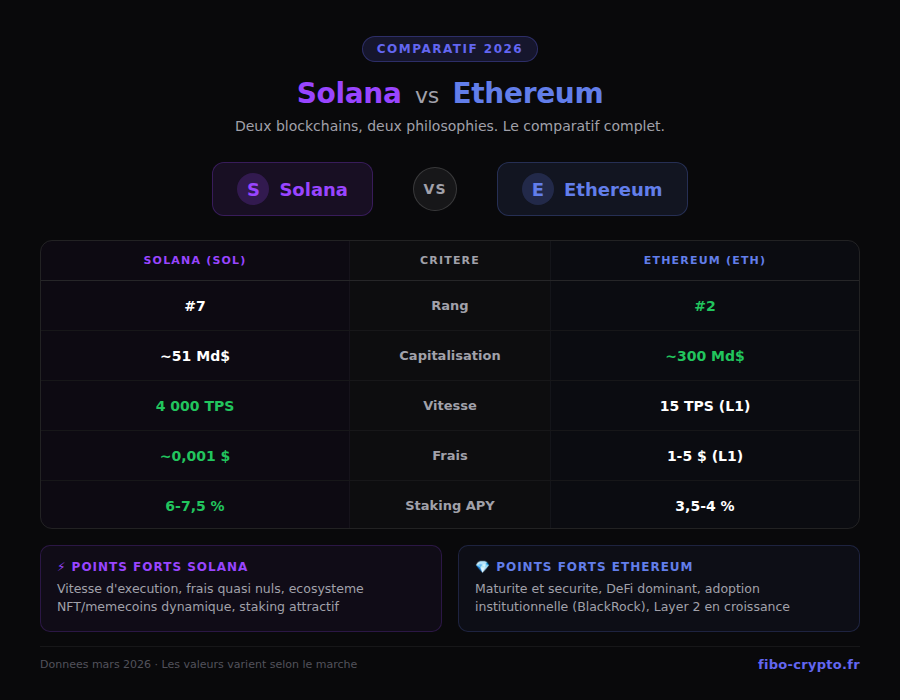
Ethereum vs Bitcoin: Two Different Investments
Ethereum and Bitcoin are the two largest cryptocurrencies, but their value propositions differ fundamentally:
| Criteria | Bitcoin (BTC) | Ethereum (ETH) |
|---|---|---|
| Primary function | Store of value (“digital gold”) | Smart contract platform |
| Maximum supply | 21 million BTC (fixed) | No fixed cap (deflationary via EIP-1559) |
| Consensus | Proof of Work (mining) | Proof of Stake (staking) |
| Native yield | None | 3.5–4% APY (staking) |
| Use cases | Savings, value transfer | DeFi, NFTs, dApps, Layer 2s |
| Volatility | High | Very high |
| Spot ETF | Yes (January 2024) | Yes (May 2024) |
In summary: Bitcoin appeals to investors seeking a store of value with a predictable monetary policy. Ethereum appeals to those who believe in the potential of decentralized finance and blockchain applications, with the added benefit of yield generation through staking and DeFi.
The two assets are complementary in a diversified portfolio. Many investors choose to allocate a share to each.
Our verdict: Should you buy Ethereum in 2026?
Ethereum remains a relevant investment in 2026, but it’s important to understand both its strengths and risks.
Arguments in favor
- Dominant position in DeFi: with over $60 billion in TVL and thousands of protocols, Ethereum is the reference infrastructure for decentralized finance
- Institutional adoption: spot ETFs, growing corporate interest, and Layer 2 development (Base by Coinbase, notably) confirm the network’s maturity
- Passive yield: between staking (3.5–4% APY) and DeFi lending (up to 5.2% via Aave), Ethereum offers income opportunities that Bitcoin does not natively provide
- Continuous technical evolution: the Dencun and Pectra upgrades regularly improve network performance
- Deflationary pressure: over 4 million ETH burned reduces the available supply
Risks to consider
- Increasing competition: Solana, Avalanche, and other alternative Layer 1s are capturing a growing market share
- Significant volatility: ETH can lose 30 to 50% of its value within weeks during market corrections
- Regulatory risks: the evolving European (MiCA) and French regulatory frameworks may impact the market
- Technical risks: smart contract bugs, security vulnerabilities in DeFi protocols
- Staking concentration: Lido represents approximately 30% of all staked ETH, raising decentralization concerns
Our recommendation
For a French investor looking to gain exposure to the crypto ecosystem beyond Bitcoin, Ethereum remains the strongest choice in 2026. Its ecosystem is the most developed, its liquidity is the deepest, and its use cases are the most diverse.
For beginners, we recommend buying ETH via Fibo: low fees (0.25%), simple interface, secure non-custodial wallet, and direct access to DeFi yields. If you prefer a traditional approach without managing a wallet, spot Ethereum ETFs (BlackRock ETHA, Fidelity FETH) are an excellent alternative.
Whichever method you choose, invest gradually (DCA — dollar-cost averaging), never invest more than you can afford to lose, and properly secure your assets.
📚 Glossary
- Ethereum (ETH) : Ethereum is a decentralized blockchain platform created by Vitalik Buterin in 2015. It enables the execution of smart contracts and decentralized applications (dApps). ETH is the network’s native cryptocurrency, used to pay transaction fees (gas) and participate in staking.
- Gas : Gas represents the transaction fees on the Ethereum network. Every operation (transfer, swap, smart contract interaction) consumes a certain amount of gas, paid in ETH. Fees vary depending on network congestion.
- Smart contract : A smart contract is a self-executing computer program stored on the blockchain. It automatically enforces the terms of an agreement when predefined conditions are met, without intermediaries.
- DeFi : Decentralized finance (DeFi) refers to the full range of financial services (lending, borrowing, trading, saving) operating on blockchain via smart contracts, without traditional banking intermediaries.
- Staking : Staking involves locking up cryptocurrencies to participate in transaction validation on a Proof of Stake network. In return, participants receive rewards in the form of new tokens.
- Layer 2 : A Layer 2 is a secondary network built on top of a main blockchain (Layer 1) to improve its scalability. On Ethereum, the main L2s are Arbitrum, Base, and Optimism, which offer fast and inexpensive transactions while inheriting Ethereum’s security.
- EIP : An Ethereum Improvement Proposal (EIP) is a technical enhancement proposal for the Ethereum protocol. The most notable EIPs include EIP-1559 (fee-burning mechanism) and EIP-4844 (proto-danksharding to reduce L2 fees).
- Validator : A validator is an Ethereum network node that participates in the Proof of Stake consensus. It verifies and proposes new blocks by staking a minimum of 32 ETH. In return, it receives rewards.
- Flat tax : The flat tax (known in France as the prelevement forfaitaire unique, or PFU) is the French tax regime applicable to capital gains on digital assets. In 2026, it stands at 31.4% (12.8% income tax + 18.6% social contributions).
- Non-custodial wallet : A non-custodial wallet is a digital wallet where the user retains full control of their private keys. Unlike centralized platforms, no third party can access the funds. Fibo and MetaMask are examples of non-custodial wallets.
- KYC : KYC (Know Your Customer) is the identity verification procedure imposed on financial platforms by regulations. It requires providing an ID document and sometimes proof of address.
- Proof of Stake : Proof of Stake (PoS) is a consensus mechanism where validators stake their cryptocurrencies to earn the right to validate transactions. Ethereum transitioned from Proof of Work to PoS in September 2022 (The Merge).
Frequently Asked Questions
What is the minimum amount to buy Ethereum?
Most platforms allow you to buy ETH starting from 10 to 50 EUR. On Fibo, the minimum deposit is 10 EUR. You don’t need to buy a whole ETH — the cryptocurrency is divisible into infinitely small fractions.
Is buying Ethereum legal in France?
Yes, buying and holding Ethereum is perfectly legal in France. Exchange platforms must be registered as a PSAN (Prestataire de Services sur Actifs Numeriques, i.e., Digital Asset Service Provider) with the AMF (French Financial Markets Authority). Capital gains are subject to the 31.4% flat tax in 2026.
What is the difference between buying ETH on a platform and through an ETF?
When you buy ETH on a platform or wallet, you actually own the cryptocurrency and can use it (DeFi, staking, transfers). An ETF gives you exposure to the ETH price without holding the asset: you cannot stake or use DeFi, but you benefit from a traditional regulatory framework.
How do you secure your Ethereum after purchase?
For modest amounts used regularly, an application wallet like Fibo is sufficient. For larger amounts stored long-term, a hardware wallet (Ledger, Trezor) offers superior security by keeping your private keys offline. In all cases, enable 2FA and never share your login credentials.
What are the fees for buying Ethereum?
Fees vary by method. On Fibo, swap fees are 0.25%. On Binance, expect 0.10% for spot trading. Platforms like Coinbase or Bitpanda charge around 1.49%. On top of that, Ethereum network gas fees apply ($1–$5 on L1, less than $0.05 on L2).
Can you earn interest on your Ethereum?
Yes, in several ways. Native staking yields approximately 3.5–4% APY. Liquid staking via Lido or Rocket Pool offers similar returns with greater flexibility. On Fibo, DeFi lending via Aave can generate approximately 5.2% APY on your ETH.
Should you buy ETH on Ethereum L1 or on a Layer 2?
If you plan to use your ETH actively (swaps, DeFi, frequent transfers), buy directly on a Layer 2 like Base or Arbitrum to benefit from gas fees that are 100 times lower. If you’re buying to hold long-term without making many transactions, Layer 1 works perfectly fine.
How do you report Ethereum gains on your taxes in France?
Capital gains realized when converting ETH to euros (or purchasing goods/services) must be reported. Use form 2086 for capital gains and form 3916-bis to declare accounts held on foreign platforms. The 31.4% flat tax applies to the net overall annual capital gain.
Is Ethereum a good investment in 2026?
Ethereum remains the second-largest cryptocurrency by market cap and the dominant platform for DeFi, smart contracts, and Layer 2s. Spot ETFs and technical upgrades (Pectra) strengthen its fundamentals. However, like any crypto investment, it carries significant volatility risks. Only invest what you can afford to lose.
📰 Sources
This article is based on the following sources:
- Ethereum Foundation
- DeFiLlama
- CoinGecko – Ethereum
- AMF – PSAN Registry
- Ultrasound.money
- BlackRock – iShares Ethereum Trust
- Service Public – Digital Asset Taxation
- Aave
- L2Beat
- Fibo Crypto
Comment citer cet article : Fibo Crypto. (2026). How to Buy Ethereum (ETH) in France in 2026: Complete Guide. Consulté le 20 March 2026 sur https://fibo-crypto.fr/en/blog/buy-ethereum-france-guide-2026
The simplest way to buy, swap and manage your crypto
Join the first users and get priority access. No seed phrase, fees 3.5x lower, built-in DeFi yield.
Get early access →