Understanding Blockchain: A Simple and Clear Guide

Introduction
You’ve heard about blockchain, but you don’t really know what it is? Don’t worry, you’re not alone. Blockchain intrigues as much as it confuses. Yet understanding this technology has become crucial in our rapidly evolving digital world.
Imagine a ledger, but instead of being in one location, it’s shared across thousands of computers. Every transaction is recorded transparently and immutably, making blockchain incredibly secure and reliable. This system isn’t limited to cryptocurrencies like Bitcoin. It finds applications across various sectors, from finance to supply chains.
However, blockchain is not without risks. Like any emerging technology, it comes with challenges, particularly regarding regulation and volatility. For example, cryptocurrency fluctuations can be as unpredictable as those seen during Bitcoin’s recent movements, which you can explore in our article on the crypto crash: Bitcoin falls below $86,000.
By the end of this article, you’ll be able to understand and explain blockchain to your friends and family, finally demystifying this concept. You’ll also discover how it could transform our digital future.
Simple Definition
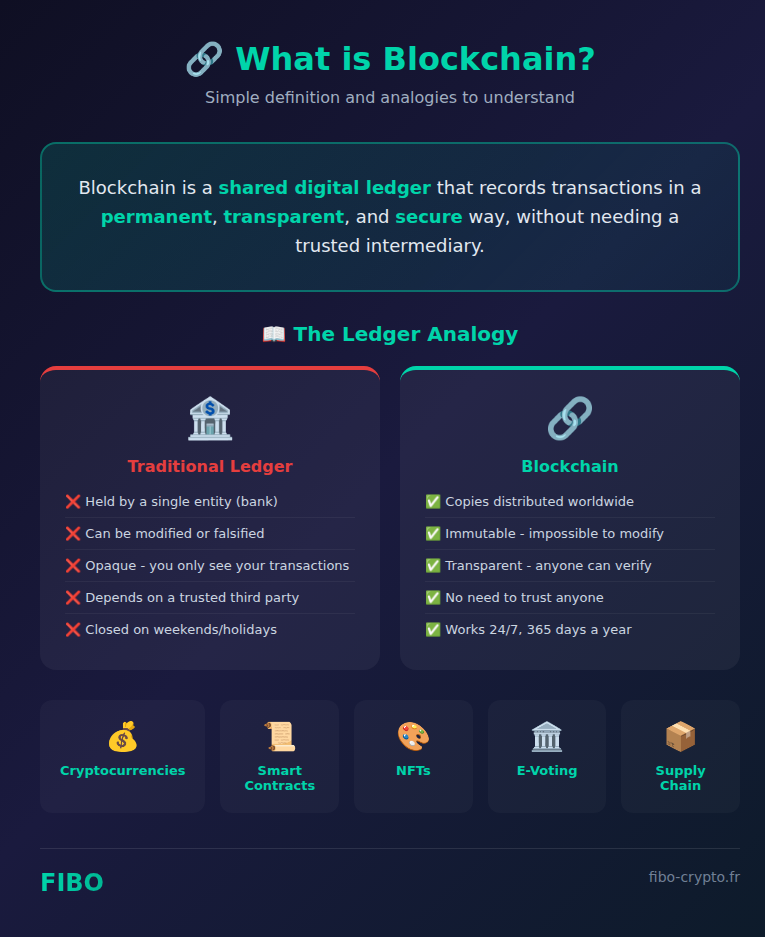
Blockchain is a technology that enables storing and securing information in a decentralized and transparent manner.
Imagine a large shared ledger where every transaction is recorded and verified by all participants. Each new transaction is like a new page added to this ledger, and once added, it can no longer be modified. This guarantees the security and transparency of the data.
How Does It Work in Practice?
To understand how blockchain works, let’s consider a concrete example. Suppose you want to send 50 euros to a friend via a blockchain application. Here’s how the process unfolds step by step:
- Transaction Initiation: You enter the transaction details into the application. This includes your address, your friend’s address, and the amount of 50 euros.
- Verification: The transaction is sent to a network of thousands of computers called « nodes. » These nodes verify that you actually have 50 euros to send.
- Adding to the Block: Once verified, the transaction is grouped with other transactions to form a « block. » This block contains several recent transactions.
- Validation: The network nodes must approve the block. They use a process called « proof of work » or « proof of stake » to ensure everything is correct.
- Adding to the Chain: Once validated, the block is added to the existing chain of blocks. Each block is linked to the previous one, forming a continuous chain.
- Confirmation: The transaction is now confirmed. Your friend receives the 50 euros, and the transaction is publicly visible on the blockchain.
This process ensures that the transaction is secure and transparent. It’s important to note that, contrary to popular belief, blockchain is not completely anonymous. Every transaction is recorded and traceable, although user identities are pseudonymous.
A diagram illustrating these steps could be useful for visualizing the transaction flow. [DIAGRAM: Blockchain Transaction Process]
Blockchain is not limited to cryptocurrencies. It’s used in various fields, such as logistics and healthcare, to ensure data traceability and security. To learn more about blockchain’s impact on commerce, check out our article on Square Bitcoin: 4 million American merchants can now accept BTC payments.
Concrete Example
Imagine a company that imports goods. Before implementing blockchain, it had to manage numerous paper documents to track its shipments. This included invoices, certificates of origin, and transport documents. This process was time-consuming and prone to human error.
With blockchain, this company was able to digitize and secure all this information. For example, according to a study by Maersk and IBM, using blockchain reduced administrative costs by an average of 20% in the supply chain. This represents considerable savings for a company that previously spent 1 million euros per year on document management. After implementation, it saves approximately 200,000 euros each year.
Document processing time was also reduced from several days to just a few hours. This allowed the company to deliver its goods faster, thereby increasing customer satisfaction. This gain in time and money demonstrates blockchain’s tangible impact in the logistics sector.
To learn more about concrete blockchain use cases in other sectors, check out our article on 10 banks uniting to launch a global stablecoin.
Advantages and Limitations
Blockchain offers many advantages, but it also has limitations. Understanding these aspects allows for informed decision-making.
| Advantages | Limitations |
|---|---|
| Increased Transparency: All operations are visible to all participants. | Energy Consumption: Mining can be energy-intensive, especially for Bitcoin. |
| Enhanced Security: Data is protected by cryptography. | Limited Scalability: Networks can be slow with a large number of operations. |
| Decentralization: No central control, reducing the risk of censorship. | Technical Complexity: Implementation can be difficult for beginners. |
Warning: Although blockchain is often perceived as anonymous, it is actually pseudonymous. Every operation is traceable, which has helped solve complex cases. To learn more, check out our article on the Upbit hack: South Korea accuses the Lazarus group.
For a complete overview of regulations, explore our article on India: the crypto giant revises its framework.
Key Takeaways
Blockchain is much more than just a tool for cryptocurrencies. It works like a large shared ledger where every record is secured and verified. Thanks to its decentralized nature, it offers increased transparency and enhanced security. However, it also presents challenges, particularly in terms of energy consumption and scalability.
To go further, explore how blockchain can transform other sectors like logistics or healthcare. A good starting point is to check out our glossary to better understand key terms. Don’t hesitate to deepen your knowledge and discover the potential impact of this technology on our daily lives.
By continuing your exploration, you’ll be able to explain blockchain to others, and even identify application opportunities in your own field. The key is to keep learning and stay curious about this evolving technology.
Frequently Asked Questions
- Is blockchain only used for cryptocurrencies?
No, blockchain has many applications beyond cryptocurrencies. It’s used in fields such as logistics, to track product journeys, or in healthcare to secure medical records.
- Is blockchain completely anonymous?
Not exactly. It’s more pseudonymous. Each user is identified by a public key, which doesn’t reveal their real identity. However, all transactions are visible on the network, which allows for some traceability.
- Is blockchain reserved for experts?
No, although it may seem complex, many tools simplify its use. For example, platforms like Ethereum allow creating decentralized applications without needing to understand all the technical details.
- What are blockchain’s challenges?
Blockchain faces challenges such as high energy consumption, particularly for mining-based blockchains like Bitcoin. Additionally, its limited scalability can cause problems when the number of users grows rapidly.
- How does blockchain improve security?
Each block is secured by cryptography and linked to the previous one, making any retroactive modification extremely difficult. This strengthens the security of stored data.
📚 Glossary
- Blockchain: A distributed digital ledger that records transactions across a network of computers in a secure and transparent manner.
- Block: A collection of transaction data that is cryptographically linked to previous blocks, forming a chain.
- Decentralization: The distribution of power and control across a network rather than a single central authority.
- Consensus: The mechanism by which network participants agree on the validity of transactions.
- Hash: A unique digital fingerprint generated from data using cryptographic algorithms.
Frequently Asked Questions
What is blockchain in simple terms?
Blockchain is a digital ledger shared across many computers. It records transactions transparently and securely, and cannot be altered after the fact.
How does blockchain work?
Transactions are grouped into blocks, verified by the network, then cryptographically linked to previous blocks – creating an immutable chain.
Why is blockchain important?
It enables trustless transactions without intermediaries. Useful for finance, supply chain, healthcare, and many other industries.
Is blockchain the same as Bitcoin?
No. Bitcoin is a cryptocurrency using blockchain. Blockchain is the underlying technology with many applications beyond crypto.
📰 Sources
This article is based on the following sources: