Real Estate Tokenization in 2026: Own a Building from $50, Is It Possible?
📋 En bref (TL;DR)
- The tokenized RWA market hit $35 billion by end of 2025, including $3-4 billion in real estate — a 536% increase in one year
- Own a piece of a building from $50: platforms like RealT (650+ properties, $138M) and Bricks (French-regulated, from EUR 10) make it possible
- Advertised yields of 9-11% on RealT vs 4.73% average for French REITs (SCPI) — but with significantly higher liquidity and regulatory risks
- BlackRock’s BUIDL exceeds $2.5 billion AUM and 12 European banks (BNP Paribas, ING, UniCredit) are building a euro stablecoin via Qivalis for H2 2026
- For 95% of European retail investors, traditional real estate funds remain superior in 2026 — but convergence between REITs and tokenization is likely by 2028-2030
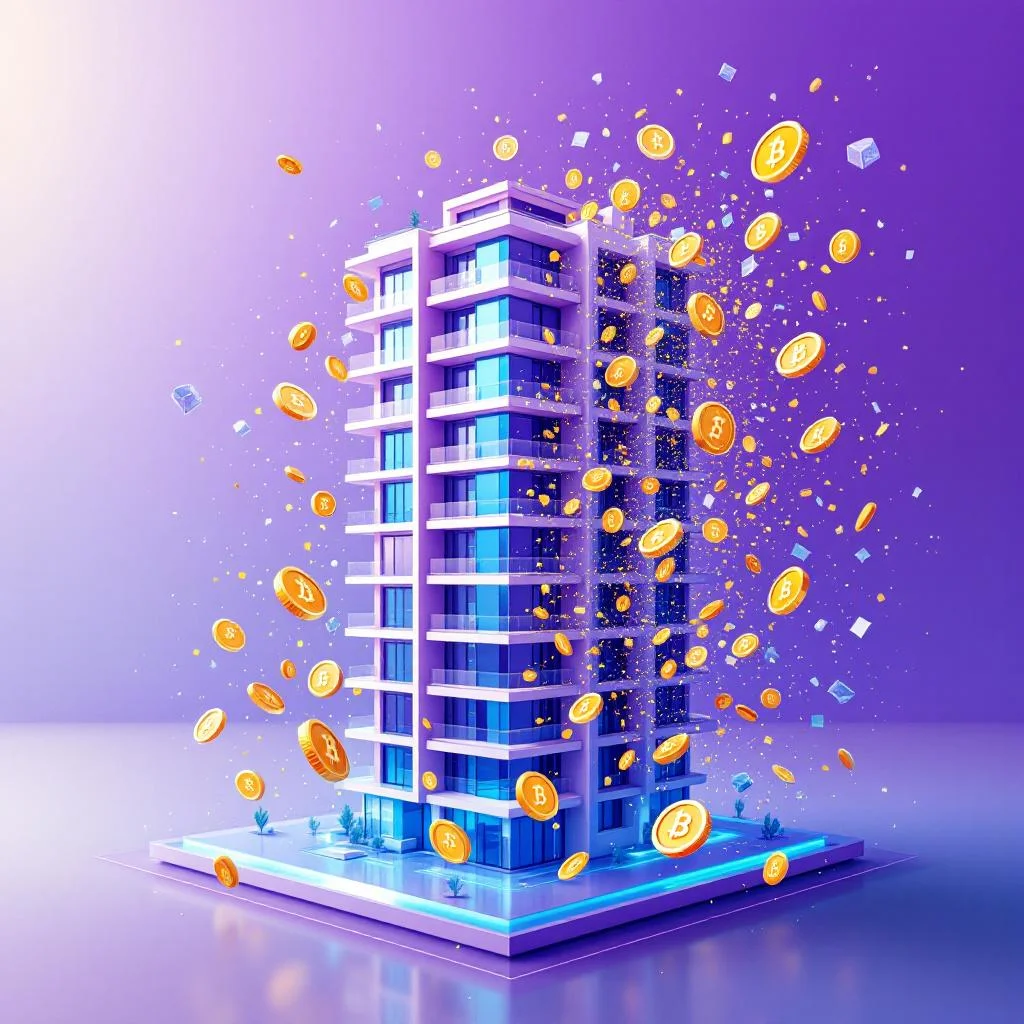
A Paris office building is worth EUR 5 million. You do not have EUR 5 million. Neither do I. But what if that building were split into 50,000 digital shares of EUR 100 each, recorded on a blockchain, and tradeable 24/7? That is exactly what real estate tokenization promises. And in 2026, that promise is beginning to materialize — with real opportunities and very real limitations.
How real estate tokenization actually works
The concept is straightforward. A property is held by a dedicated entity (SPV — Special Purpose Vehicle). Shares of that entity are converted into security tokens — digital tokens recorded on a blockchain. Each token represents a fractional ownership stake. A smart contract automatically handles rent distribution, shareholder voting, and share transfers.
Concrete example: a residential building in Detroit, valued at $100,000, is divided into 1,000 tokens of $100 each. You buy 5 tokens for $500. Every month, your share of the rental income lands directly in your crypto wallet, proportional to your 0.5% ownership. If the building appreciates, so do your tokens. You can resell them at any time on a dedicated marketplace — no notary, no three-month waiting period.
This is fundamentally different from traditional real estate crowdfunding. In crowdfunding, you lend money to a developer in exchange for interest. Here, you hold a real fraction of the property, with rights to rental income and capital appreciation.
The RWA market in 2026: numbers that demand attention
The market for tokenized Real World Assets (RWA) has exploded. By the end of 2025, total on-chain value reached approximately $35 billion, up from $5.5 billion at the start of 2025 — a sixfold increase in twelve months. Tokenized real estate alone accounts for $3-4 billion.
Projections are staggering. McKinsey estimates the total tokenized asset market at $2-4 trillion by 2030. BCG and Ripple project $9.4 trillion. Deloitte, more specifically, forecasts $4 trillion for tokenized real estate alone by 2035.
Financial giants are no longer watching from the sidelines. Larry Fink, BlackRock’s CEO, stated: “Every stock, every bond, every fund — every asset — can be tokenized.” His BUIDL fund, dedicated to tokenized U.S. Treasuries, has surpassed $2.5 billion in assets under management and represents 42% of the tokenized Treasuries market. It is even accepted as collateral on Binance.
In Europe, the Qivalis project brings together 12 major banks — BNP Paribas, ING, UniCredit, CaixaBank, BBVA, Danske Bank, DZ Bank, SEB, KBC, Raiffeisen, DekaBank, and Banca Sella — to create an institutional euro stablecoin. Launch is planned for H2 2026. In France, SG-FORGE (Societe Generale) has already issued tokenized green bonds on Ethereum and developed the EURCV stablecoin.
Where to invest: RealT, Bricks, and alternatives
RealT — the global leader
RealT is the reference platform for real estate tokenization. Founded in 2019, it has tokenized over 650 properties, primarily in the United States, for a total of $138 million. The minimum investment is $50. Advertised annual yields range from 9% to 11%, paid weekly in stablecoins (USDC or xDAI).
The process is transparent: each property has a detailed listing (address, photos, rental income, management fees, occupancy rate). Tokens are ERC-20 on the Gnosis Chain blockchain. Resale happens through RealT’s secondary market or on decentralized DeFi platforms.
Bricks — the French option
Bricks, registered as a PSAN (crypto asset service provider) in France, offers real estate tokenization starting from EUR 10. The model targets properties in France, which eliminates currency risk for European investors. However, volumes remain low and secondary market liquidity is limited. For a European saver, it is an accessible entry point, but market depth does not compare to RealT.
Traditional REITs vs tokenization: the honest comparison
In France, indirect real estate investment traditionally goes through SCPI (Societes Civiles de Placement Immobilier) — the French equivalent of REITs. The market exceeds EUR 80 billion. Here is a factual comparison:
Average yield: SCPI delivered 4.73% net of management fees in 2025. RealT advertises 9-11%, but caution is warranted — these yields include high-risk properties (Detroit, declining neighborhoods) and do not account for EUR/USD exchange risk or U.S. tax implications.
Entry ticket: EUR 172 to 1,000 for an SCPI, versus EUR 10 (Bricks) or $50 (RealT) for tokenization. Clear advantage for tokenization on accessibility.
Liquidity: SCPI shares are resold through the management company or on a secondary market, with a typical delay of 2 to 6 months. Real estate tokens are theoretically tradeable 24/7 — but in practice, order books are often thin. Selling $50,000 worth of RealT tokens at once could take weeks.
Regulation: SCPI are supervised by France’s AMF, with strict rules on diversification, transparency, and investor protection. Real estate tokenization operates within a far less mature framework. In July 2025, the AMF confirmed that security tokens are compatible with existing regulation (MiFID II for fund shares). But foreign platforms like RealT are not regulated by the AMF.
Taxation: standard real estate income tax for French SCPI. For foreign real estate tokens, double complexity — foreign-source income plus uncertain tax classification for security tokens.
Verdict for 2026: for 95% of European retail investors, traditional real estate funds remain the better option. Diversification is superior (dozens of properties per fund vs. one property per token), legal protection is stronger, and tax treatment is better established. Tokenization currently caters to crypto-native profiles willing to accept additional risks for potentially higher returns.
The risks nobody wants to talk about
The marketing pitch for real estate tokenization is compelling. Reality is more nuanced.
Liquidity risk: this is the number one problem. Tokenizing an illiquid asset does not magically make it liquid. A building in Detroit remains a building in Detroit, whether it is on a blockchain or not. If nobody wants to buy your tokens, you are stuck — just like with a physical property, but without the safety net of a local real estate agent.
Legal risk: what happens if the platform disappears? Do your tokens prove ownership before an American or European court? The answers vary by jurisdiction and remain largely untested in litigation.
Smart contract risk: the smart contracts managing rent distribution and governance can contain bugs. In DeFi, smart contract hacks have cost billions. Tokenized real estate is not immune.
Currency risk: for a European investor buying dollar-denominated tokens, EUR/USD fluctuations can wipe out the yield. A 10% yield in dollars becomes 5% if the dollar drops 5% against the euro.
The regulatory framework in 2026: MiCA, MiFID II, and national regulators
Regulation is advancing, slowly. In Europe, the framework is clarifying along two axes. MiCA (Markets in Crypto-Assets), effective since 2024, governs utility crypto-assets and stablecoins. But security tokens representing real estate fund shares fall under MiFID II (Markets in Financial Instruments Directive), an older and stricter framework.
France’s AMF position from July 2025 is encouraging: tokens representing real estate fund shares are compatible with existing French law. This opens the door to “tokenized REITs” — traditional real estate funds whose shares would be issued and traded on blockchain, combining the regulatory protection of REITs with the technical fluidity of tokenization.
This is likely the most probable scenario for 2027-2030: traditional real estate funds adopt tokenization as backend infrastructure (estimated 65% probability), rather than a revolution coming from crypto-native platforms.
2027-2030 scenario: the REIT-blockchain convergence
The most credible future is not “tokenization replaces REITs.” It is “REITs adopt blockchain.” Imagine: you buy REIT shares through your regular bank. Those shares are actually security tokens on a private or public blockchain. You can resell them instantly through a regulated secondary market. Rental income drops into your account automatically each month via a smart contract.
Several signals point toward this scenario. The Qivalis project from 12 European banks creates the necessary payment infrastructure (institutional euro stablecoin). The AMF’s position validates legal compatibility. And REIT management companies are actively seeking to reduce friction on the secondary market — a problem that blockchain solves natively.
SG-FORGE led the way with its tokenized green bonds on Ethereum. The move to real estate is a logical extension. If a major French REIT tokenizes its shares by 2028, that will be the real tipping point — not RealT’s 650 houses in Detroit.
Practical guide: where to start
If you want to get started with real estate tokenization in 2026, here is a realistic action plan:
1. Start with traditional REITs. If you have no real estate exposure yet, a diversified REIT remains the safest starting point. Average 4.73% yield, regulated framework, clear tax treatment.
2. Test with a small amount. Buy $100-500 worth of tokens on RealT or EUR 50-200 on Bricks. The goal is not the yield — it is understanding how it works: wallet creation, receiving rent in stablecoins, secondary market dynamics.
3. Do not exceed 5-10% of your real estate allocation. Tokenization remains experimental. Even if advertised yields are attractive, the risks of liquidity, regulation, and currency justify a cautious allocation.
4. Watch for tokenized REITs. When a major fund management company announces blockchain-based REIT shares, that will be the time to increase your exposure — with regulatory protection included.
Glossary
- RWA (Real World Assets): Real-world assets — real estate, bonds, commodities — represented as digital tokens on a blockchain. The tokenized RWA market reached $35 billion by end of 2025.
- Tokenization: The process of converting an asset (real estate, bond, stock) into digital tokens on a blockchain. Each token represents a fraction of the underlying asset and confers rights (income, voting, ownership).
- Smart contract: A self-executing computer program deployed on a blockchain. In real estate tokenization, it automatically manages rent distribution and governance rules, without intermediaries.
- SCPI (Societe Civile de Placement Immobilier): A French collective real estate investment vehicle regulated by the AMF, equivalent to a REIT. Investors buy shares and receive proportional rental income. The market exceeds EUR 80 billion in France.
- Stablecoin: A cryptocurrency pegged to a stable asset, usually the U.S. dollar or euro. Rental income from tokenized real estate is often paid in stablecoins (USDC, xDAI).
- Security token: A digital token representing a financial security (stock, bond, fund share). Unlike utility crypto-assets, security tokens are subject to existing financial regulations (MiFID II in Europe).
Frequently Asked Questions
Can you really buy a piece of a building for $50?
Yes. Platforms like RealT (from $50) and Bricks (from EUR 10) allow you to buy fractions of real estate properties as tokens. Each token represents a share of the company that owns the property, entitling you to proportional rental income. In practice, very small amounts generate negligible returns and mainly serve to test how the system works.
Is real estate tokenization legal in Europe?
France’s AMF confirmed in July 2025 that security tokens are compatible with existing regulation. Tokens representing real estate fund shares fall under MiFID II. However, foreign platforms like RealT are not regulated by the AMF. In Europe more broadly, MiCA covers utility tokens and stablecoins, while security tokens fall under existing financial regulation.
REITs or tokenization: which to choose in 2026?
For the vast majority of retail investors, traditional REITs remain superior in 2026: average 4.73% yield, diversification across dozens of properties, regulated framework, clear tax treatment. Tokenization is currently suited to crypto-native profiles willing to accept additional risks (liquidity, regulation, currency) for potentially higher returns (9-11% advertised on RealT).
What are the main risks of real estate tokenization?
The four major risks are: 1) liquidity — order books are often thin and selling large amounts quickly is difficult; 2) legal — proof of ownership via tokens has not yet been tested in litigation; 3) smart contracts — risk of bugs or hacks; 4) currency — for dollar-denominated tokens, EUR/USD fluctuations can wipe out the yield.
What is the Qivalis project and why does it matter?
Qivalis is a consortium of 12 major European banks (including BNP Paribas, ING, and UniCredit) developing an institutional euro stablecoin, with a planned launch in H2 2026. This project is crucial because it creates the payment infrastructure needed for real estate tokenization to work at scale in Europe, with regulated actors.
Sources
This article draws on the following sources:
- McKinsey — Tokenization: A digital-asset deja vu – Tokenized asset market projections ($2-4T by 2030).
- BCG & Ripple — Relevance of On-Chain Asset Tokenization – Tokenized RWA market estimate at $9.4T by 2030.
- RealT – Leading real estate tokenization platform (650+ properties, $138M tokenized).
- BlackRock — BUIDL Fund – Tokenized U.S. Treasuries fund (~$2.5B AUM).
- AMF — Security tokens position paper – Compatibility of security tokens with French law (July 2025).
- Deloitte — Tokenized Real Estate – Forecast of $4T for tokenized real estate by 2035.
How to cite this article: Fibo Crypto. (2026). Real Estate Tokenization in 2026: Own a Building from $50 — The Promise, the Reality, and the REIT Comparison. Retrieved March 17, 2026, from https://fibo-crypto.fr/en/blog/real-estate-tokenization-2026-rwa-reit-comparison