How Many Bitcoins Are There? Total Supply, Mining & Scarcity Explained

📋 En bref (TL;DR)
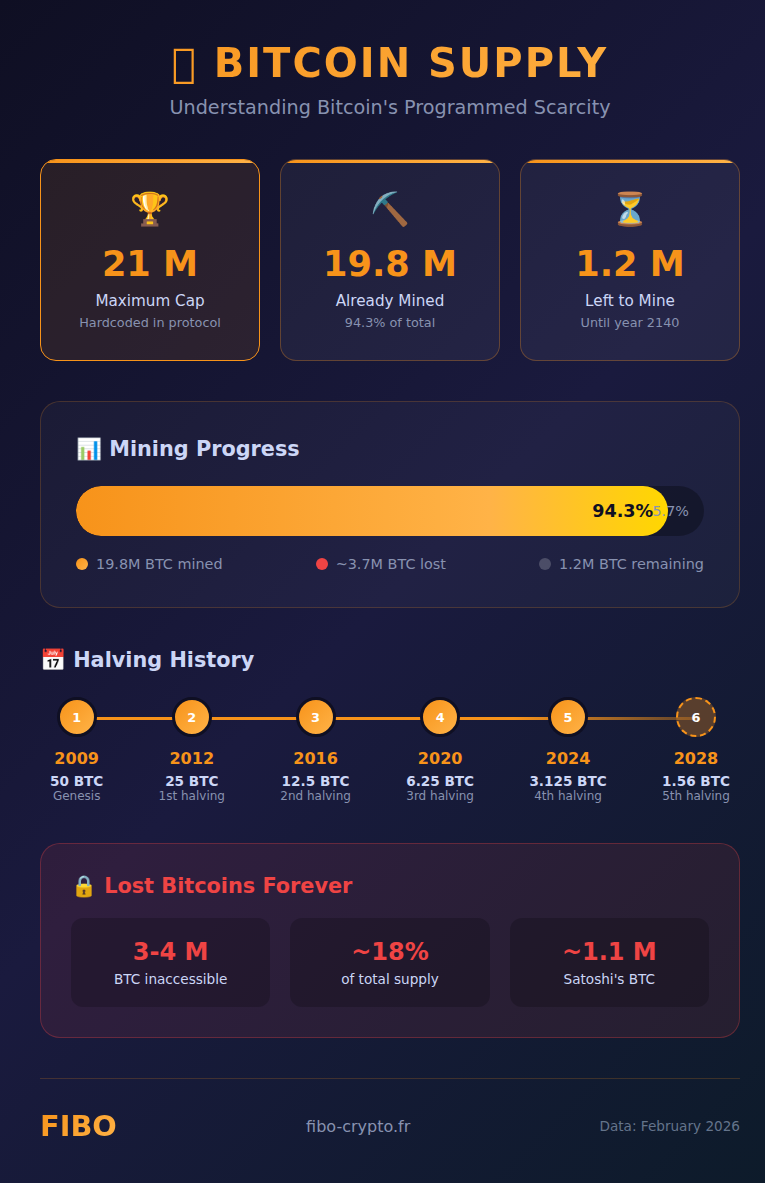
- Hard cap: 21 million bitcoins maximum, hardcoded into the protocol since 2009
- Already mined: ~19.8 million BTC in circulation (94.3% of total) as of February 2026
- Remaining to mine: ~1.2 million BTC will be gradually mined until 2140
- Halving: mining rewards are cut in half every 210,000 blocks (~4 years)
- Lost bitcoins: between 3-4 million BTC are permanently inaccessible (lost keys, forgotten wallets)
- Programmed scarcity: unlike fiat currencies, Bitcoin’s supply is fixed and predictable
- After 2140: no new bitcoins will be created, the network will run solely on transaction fees
21 million. Not one more, not one less. This is the maximum number of bitcoins that will ever exist. This limit, hardcoded by Satoshi Nakamoto in 2009, makes Bitcoin the scarcest asset in modern economic history. But how many bitcoins have already been created? How many are left to mine? And why does this scarcity matter so much?
Why Is Bitcoin Limited to 21 Million?
The 21 million limit is no accident. It was deliberately chosen by Satoshi Nakamoto to create a form of deflationary money, the opposite of fiat currencies that central banks can print at will.
2x cheaper fees. Up to 6% yield. No seed phrase. Fibo, the wallet you've been waiting for.
Join the waitlist →Scarcity Hardcoded in the Protocol
This limit is defined in Bitcoin’s source code and can only be changed with consensus from the entire network—technically possible but practically impossible. Here’s why:
- Decentralized governance: thousands of nodes worldwide must accept any protocol modification
- Aligned incentives: increasing supply would dilute existing bitcoins’ value—no holder has interest in voting for it
- Near-impossible consensus: even minor change proposals generate passionate debates in the community
The Theory Behind 21 Million
Several theories explain this specific choice:
- M1 correspondence: 21 million BTC × 100 million satoshis = 2.1 quadrillion units, close to the global M1 money supply in 2009
- Optimal divisibility: allows representing values from micro-payments to entire fortunes
- Mathematical simplicity: natural result of the reward formula (50 BTC × 210,000 blocks × 6 halvings ≈ 21M)
How Are New Bitcoins Created?
Unlike traditional currencies printed by central banks, new bitcoins are “mined” through a computational process called Proof of Work.
Mining: The Only Source of Creation
Mining is the only way to create new bitcoins. Here’s how it works:
- Transaction validation: miners collect pending transactions from the network
- Cryptographic puzzle-solving: they use computing power to find a valid hash
- Block addition: the first to find the solution adds a new block to the blockchain
- Reward: the winning miner receives newly created bitcoins + transaction fees
This process repeats roughly every 10 minutes, creating a constant but decreasing flow of new bitcoins.

The Halving: The Mechanism That Slows Creation
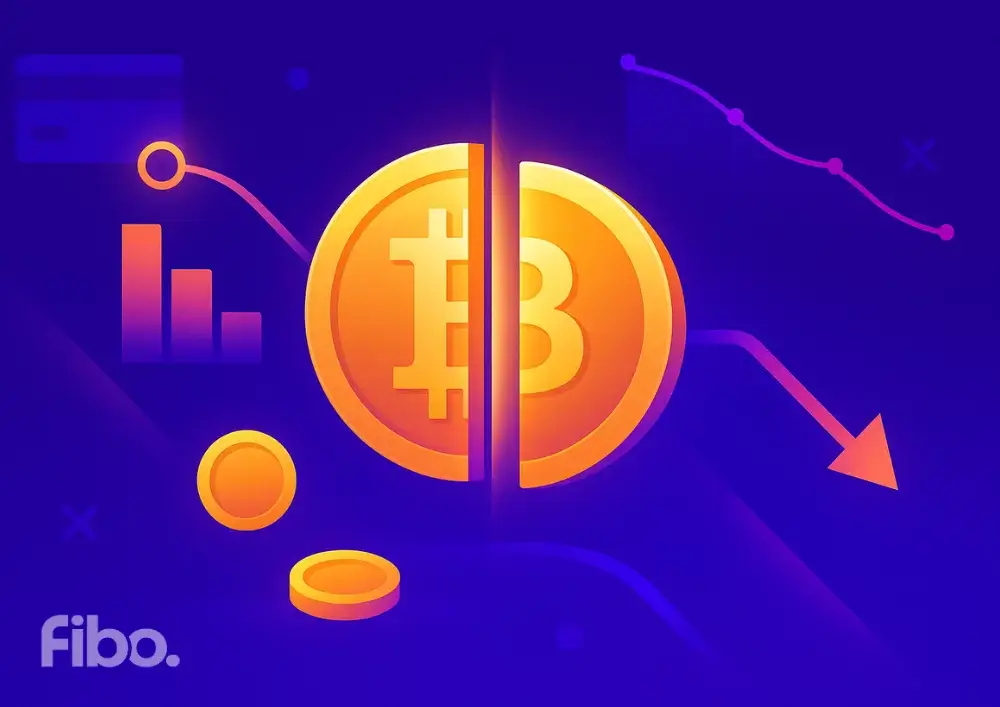
The halving is the key event that regulates new bitcoin issuance. Every 210,000 blocks (approximately 4 years), the mining reward is automatically cut in half.
Halving History
| Year | Block Reward | Total Supply Reached | % of Maximum |
|---|---|---|---|
| 2009 (Genesis) | 50 BTC | 0 | 0% |
| 2012 (1st halving) | 25 BTC | 10.5 M | 50% |
| 2016 (2nd halving) | 12.5 BTC | 15.75 M | 75% |
| 2020 (3rd halving) | 6.25 BTC | 18.375 M | 87.5% |
| 2024 (4th halving) | 3.125 BTC | 19.6875 M | 93.75% |
| 2028 (expected) | 1.5625 BTC | 20.34 M | 96.875% |
| ~2140 | 0 BTC | 21 M | 100% |
Economic Impact of the Halving
Each halving cuts in half the flow of new bitcoins entering the market. Historically, this has had significant consequences:
- Supply shock: fewer BTC available for sale (miners sell to cover costs)
- Upward pressure: if demand stays stable or increases, price tends to rise
- Market cycles: previous halvings preceded major rallies (not guaranteed for future)
How Many Bitcoins Are Left to Mine?
As of February 2026, approximately 19.8 million bitcoins have been mined, representing 94.3% of the total supply. That leaves about 1.2 million BTC yet to be created.
Increasingly Slow Creation
Important caveat: these 1.2 million bitcoins won’t be mined quickly. Due to the halving, their creation will span over 100 years:
- 2024-2028: ~656,250 BTC created
- 2028-2032: ~328,125 BTC created
- 2032-2036: ~164,062 BTC created
- And so on, until the last satoshi around 2140
What Happens After 2140?
Once all 21 million bitcoins are mined, no new BTC will ever be created. But the network will continue operating:
- Miners will be compensated solely through transaction fees
- Network security will depend on these fees being attractive enough
- Some economists predict natural fee increases with growing adoption
Lost Bitcoins: Even Greater Scarcity
Not all created bitcoins are actually in circulation. It’s estimated that 3-4 million BTC are lost forever, representing 15-20% of total supply.
How Can a Bitcoin Be “Lost”?
- Private key forgotten or destroyed: without the private key, funds are inaccessible
- Wallet deleted without backup: no seed phrase = unrecoverable funds
- Owner’s death: without passing on access, bitcoins remain locked
- Sent to invalid address: “burned” bitcoins are permanently removed from circulation
Famous Cases of Lost Bitcoins
- James Howells: 8,000 BTC on a hard drive thrown in a Welsh landfill (~$800M in 2026)
- Stefan Thomas: 7,002 BTC on an IronKey whose password he forgot (2 attempts remaining)
- Satoshi Nakamoto: ~1.1 million BTC never moved since 2009-2010, considered “dormant”
- Mt. Gox: 850,000 BTC stolen in 2014, partially recovered but many lost
These permanent losses reinforce Bitcoin’s scarcity. The “effective” supply (actually usable) is therefore well below the 19.8 million officially in circulation.

Bitcoin Supply vs Other Assets: Comparison
To understand Bitcoin’s uniqueness, let’s compare its supply to other assets:
Bitcoin vs Gold
- Gold: unknown supply (new discoveries possible), ~2% annual inflation from mining
- Bitcoin: exactly known supply (21M), decreasing and predictable inflation
Bitcoin vs Fiat Currencies
- Dollar/Euro: unlimited supply, increased at will by central banks (quantitative easing)
- Bitcoin: fixed supply, no authority can create new BTC
Bitcoin vs Other Cryptocurrencies
- Ethereum: no supply limit (though net issuance can be negative since The Merge)
- Dogecoin: unlimited supply, ~5 billion new DOGE per year
- Bitcoin: strict deflationary model with absolute cap
The Impact of Scarcity on Value
Bitcoin’s programmed scarcity is one of the main arguments for those who consider it a digital “store of value.”
The Stock-to-Flow Model
This model, popularized by analyst PlanB, measures scarcity by dividing existing stock by annual production. The higher the ratio, the scarcer the asset:
- Gold: ratio ~62 (very scarce)
- Bitcoin post-2024: ratio ~120 (scarcer than gold)
- Silver: ratio ~22
Important Caveats
Scarcity alone doesn’t guarantee value. For Bitcoin to maintain its value, it requires:
- Sustained demand (adoption, institutional investment)
- Functional infrastructure (miners, developers, exchanges)
- Protocol trust (security, censorship resistance)
How to Verify the Current Supply?
One of Bitcoin’s advantages is its total transparency. Anyone can verify the supply in real-time:
- Blockchain explorers: Blockchair, Blockchain.com
- Personal node: by running your own Bitcoin node, you independently verify the supply
- Public APIs: many services provide this data in real-time
This verifiability is fundamentally different from traditional currencies, where the actual money supply is often opaque.
📚 Glossary
- Satoshi Nakamoto : Pseudonym of Bitcoin’s anonymous creator, who published the whitepaper in 2008 and launched the network in 2009. Identity remains unknown.
- Satoshi (sat) : Smallest unit of Bitcoin, equal to 0.00000001 BTC. Named in honor of the creator.
- Halving : Scheduled event that cuts mining rewards in half every 210,000 blocks (~4 years), gradually reducing new BTC issuance.
- Mining : Process of validating transactions and creating new bitcoins by solving complex cryptographic problems.
- Proof of Work (PoW) : Consensus mechanism used by Bitcoin where miners prove computational work to validate blocks.
- Blockchain : Distributed, immutable ledger recording all Bitcoin transactions since the genesis block in 2009.
- Hash : Unique digital fingerprint generated by a cryptographic function, used to secure blockchain blocks.
- Node : Computer participating in the Bitcoin network by validating and relaying transactions, and maintaining a blockchain copy.
- Private Key : Secret code that allows controlling and spending bitcoins associated with an address. Must never be shared.
- Seed Phrase : Series of 12-24 words allowing recovery of a Bitcoin wallet. Constitutes the ultimate backup of your funds.
- Supply : Total quantity of bitcoins in circulation. Maximum supply is capped at 21 million BTC.
- Deflationary : Describes a currency whose supply decreases or remains fixed over time, unlike inflationary currencies.
Frequently Asked Questions
Why exactly 21 million bitcoins and not another number?
The 21 million figure results from the reward formula chosen by Satoshi Nakamoto: 50 BTC initially per block, halved every 210,000 blocks. This geometric progression converges to 21 million. The choice also means 21M × 100M satoshis = 2.1 quadrillion units, providing sufficient divisibility for micro-transactions while roughly corresponding to the global money supply at the time.
Can the 21 million bitcoin limit be changed?
Technically, yes—the code is open source. Practically, it’s nearly impossible. Such a change would require consensus from the majority of network nodes. Since increasing supply would dilute existing bitcoins’ value, no rational holder would vote for it. Any attempt would likely create a fork (network split), and the chain with the original supply would retain legitimacy and value.
How many bitcoins are actually available on the market?
Of the ~19.8 million BTC mined, an estimated 3-4 million are permanently lost (lost keys, forgotten wallets). About 1.1 million likely belong to Satoshi and have never moved. Many are held long-term (“hodlers”). The liquid supply actually available on exchanges is estimated at only 2-3 million BTC, which amplifies price movements during demand changes.
What happens when all 21 million are reached?
Around 2140, the last satoshi will be mined and no new bitcoin will ever be created. The network will continue operating: miners will be compensated solely through transaction fees paid by users. For the network to remain secure, these fees must be high enough to cover miners’ costs. Growing adoption and BTC value should naturally increase these fees.
Does the halving always have a positive impact on price?
Historically, the 2012, 2016, and 2020 halvings were followed by significant price increases in the following 12-18 months. However, correlation isn’t causation. Each halving reduces new supply, but price impact also depends on demand, macroeconomic context, and market sentiment. The 2024 halving occurred in a different context (Bitcoin ETFs approved), making historical comparisons more complex.
How can I verify Bitcoin's supply myself?
You can use free blockchain explorers like Blockchair, Blockchain.com, or Mempool.space that display real-time supply. For completely independent verification, you can run your own Bitcoin node (using Bitcoin Core, for example), which calculates supply from all transactions since 2009. This is one of Bitcoin’s major advantages: its verifiable transparency.
Will Satoshi Nakamoto's bitcoins ever be spent?
Nobody knows. The ~1.1 million BTC attributed to Satoshi have never moved since 2009-2010. Three hypotheses: (1) Satoshi lost the keys, (2) Satoshi died without passing on access, (3) Satoshi deliberately chooses not to touch these funds to preserve the project’s credibility. If these bitcoins ever moved, it would create a major media event and potentially significant market volatility.
📰 Sources
This article is based on the following sources:
- Bitcoin Whitepaper
- Bitcoin Core GitHub
- Chainalysis Lost Bitcoin Report
- Cambridge Bitcoin Electricity Consumption Index
- Glassnode Insights
- Stock-to-Flow Model by PlanB
Comment citer cet article : Fibo Crypto. (2026). How Many Bitcoins Are There? Total Supply, Mining & Scarcity Explained. Consulté le 21 March 2026 sur https://fibo-crypto.fr/en/blog/how-many-bitcoins-total-supply
The simplest way to buy, swap and manage your crypto
Join the first users and get priority access. No seed phrase, fees 3.5x lower, built-in DeFi yield.
Join the waitlist →