
Netherlands Bans Polymarket for Illegal Gambling Services
📋 En bref (TL;DR)
- Official ban: The Netherlands ordered Polymarket to cease operations under penalty of €420,000 per week in fines
- Maximum penalty: Fines can reach €840,000, with additional sanctions based on revenue
- Immediate action: Polymarket blocked Dutch users as of February 20, 2026
- Volume at stake: Dutch users reportedly wagered over €27 million on the platform
- European wave: Portugal, France, Belgium, Italy, and Hungary have also implemented restrictions
- Democratic concern: Bets on Dutch elections triggered the investigation
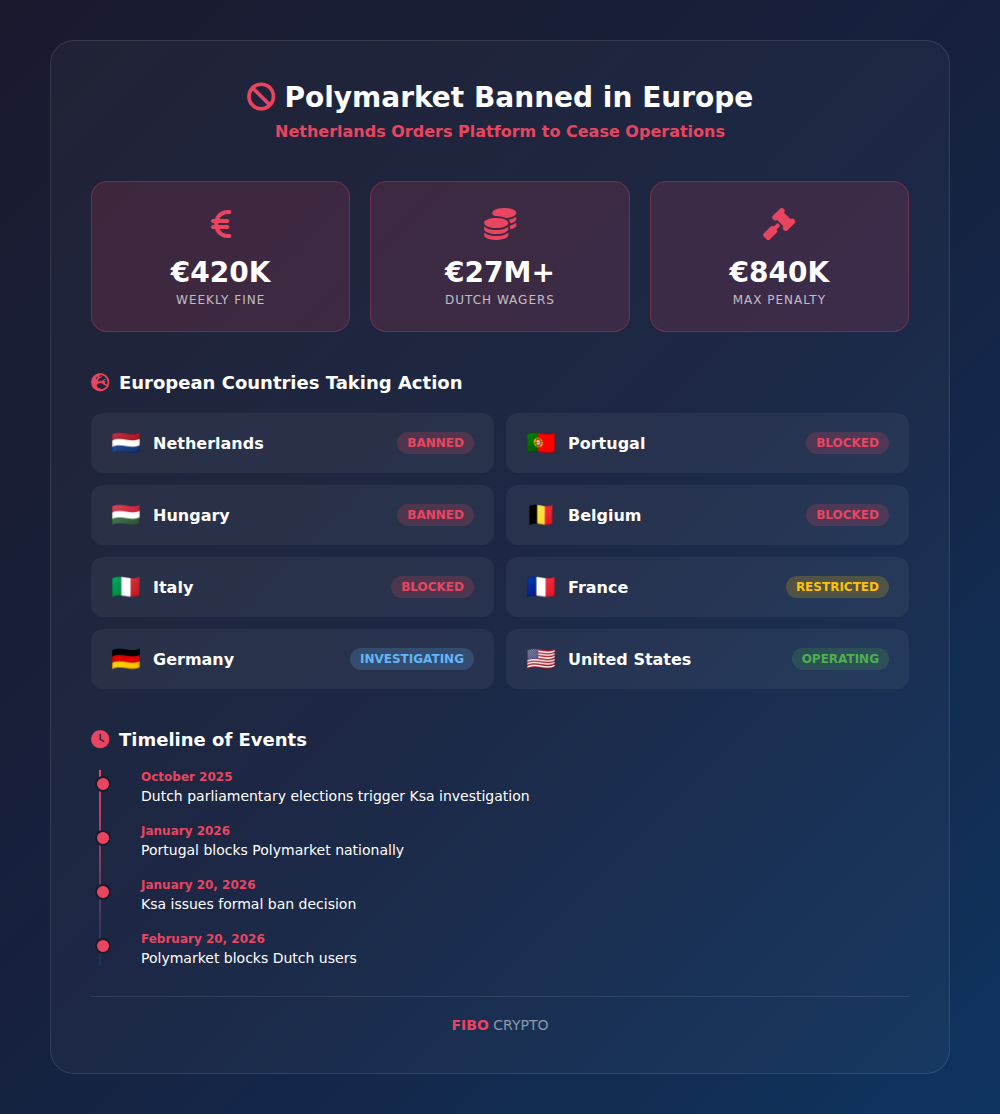
The Dutch gambling authority, the Kansspelautoriteit (Ksa), has dealt a major blow to the crypto prediction market space. In a decision issued on January 20, 2026, and enforced this week, it ordered Polymarket to immediately cease operations in the Netherlands or face severe financial penalties.
This decision is part of a wave of European restrictions that raises questions about the future of these innovative platforms on the continent. For European crypto investors, it raises fundamental questions about the boundary between financial innovation and regulated gambling.
Polymarket: What Exactly Is It?
Polymarket is a decentralized prediction market platform, founded in 2020 and based in Manhattan. It allows users to bet on the outcome of future events: elections, economic decisions, sports events, weather, or even quirky questions like « Will Jesus Christ return before the end of the year? »
Technically, Polymarket operates on the blockchain Polygon, a layer 2 scaling solution for Ethereum, and uses USDC (a dollar-pegged stablecoin) for transactions. This crypto infrastructure enables fast and transparent settlements without traditional banking intermediaries.
The platform experienced explosive growth, particularly around the 2024 US elections, where trading volumes exceeded $13.5 billion monthly according to a Dune/Keyrock report from November 2025. This success attracted regulatory attention worldwide.
The Kansspelautoriteit Decision: The Details
An Investigation Triggered by Election Betting
The Dutch authority opened its investigation after discovering that Polymarket allowed Dutch residents to bet on the October 2025 parliamentary elections. For regulators, these bets on the democratic process represent a major « societal risk » that could potentially influence the elections themselves.
In its decision, Ella Seijsener, director of licensing and supervision at the Ksa, stated unequivocally: « These types of companies offer bets that are not permitted under any circumstances in our market, not even by license holders. »
Evidence Gathered by Regulators
The Ksa demonstrated that Polymarket deliberately targeted the Dutch market. The investigation established that:
- The platform was accessible from Dutch IP addresses
- Euro payments via Dutch banks were accepted
- Customer support in Dutch was available
- The Netherlands was not excluded in the terms of service
Investigators even managed to create an account, deposit €10 via Mastercard from a Dutch bank, and place bets on political markets—damning proof that the platform operated without a license on Dutch territory.
Financial Penalties
The decision provides for a fine of €420,000 per week of non-compliance, capped at €840,000. However, the Ksa specified that additional sanctions, calculated on revenue, could be added later. Faced with this pressure, Polymarket chose to block Dutch users as of February 20, 2026.
Prediction Market or Gambling: The Legal Debate
Polymarket’s Position
Polymarket and its competitor Kalshi have always rejected the « gambling » classification. Shayne Coplan, founder of Polymarket, maintains that his platform constitutes « financial infrastructure, » comparable to derivatives markets. Tarek Mansour, CEO of Kalshi, goes further, stating: « If we are gambling, then you’re calling all financial markets gambling. »
The central argument is that users exchange « event contracts » with each other, not against a bookmaker. The price of these contracts reflects the aggregation of market information and expectations—a mechanism similar to traditional financial markets.
The Regulators’ Position
The Ksa dismissed these arguments. In its decision, it considers that « payments depend on uncertain events beyond participants’ control, » which corresponds to the legal definition of gambling under Article 1(1)(a) of the Dutch Gaming Act.
Jan Scheele, board member of the Blockchain Netherlands Foundation, explains this position: « Authorities generally focus on what a product enables users to do, rather than how it’s labeled. If users can wager money on uncertain events and receive a financial return if they’re correct, that looks like a bet. »
Europe Closes Its Doors: A Domino Effect
The Netherlands is not an isolated case. Europe is becoming the most restrictive region in the world for crypto prediction markets:
- Portugal: National block of Polymarket in January 2026, following massive betting on the presidential election (one trader reportedly won $44,000 from a $910 stake)
- France: Restrictions on betting features since 2024
- Belgium and Italy: Platform access blocked
- Hungary: Formal ban for illegal gambling activity
- Germany: Investigation by the GGL (gaming authority) ongoing
This European regulatory convergence contrasts with the United States, where Polymarket and Kalshi have forged partnerships with major media outlets (CNBC, CNN, ESPN) and where the debate remains open, despite ongoing legal proceedings.
Impact for European Crypto Investors
Increasingly Restricted Access
For European residents interested in prediction markets, legal options are shrinking. VPNs technically allow bypassing blocks, but expose users to legal risks, and platforms are strengthening their geographic controls.
The USDC Stablecoin at the Heart of the Model
Polymarket recently announced a strategic partnership with Circle, the issuer of USDC, to strengthen its settlement infrastructure. This partnership underscores the importance of stablecoins in the prediction market ecosystem, but also their exposure to future regulations.
A Question of Regulatory Philosophy
Jan Scheele summarizes the tension well: « The Netherlands has a reputation for enforcing relatively strict regulatory compliance standards, including in emerging sectors like crypto. This reflects a regulatory culture that prioritizes consumer protection and systemic integrity rather than a permissive approach that favors innovation. »
This « protection first » philosophy is gradually extending across the European Union, in the wake of the MiCA regulation on crypto-assets.
Key Takeaways for the Future
The ban on Polymarket in the Netherlands marks a turning point in the regulation of crypto prediction markets in Europe. Several lessons emerge:
- Legal classification prevails: Regardless of how a platform defines itself, regulators make the final call
- Election betting is a red line: The democratic argument weighs heavily in decisions
- Europe is hardening its stance: A trend likely to continue
- Blockchain innovation isn’t enough: Technology doesn’t exempt platforms from regulatory obligations
For European crypto investors, this case serves as a reminder of the importance of favoring regulated platforms that comply with local legislation. Financial innovation needs a clear legal framework to thrive sustainably.
📚 Glossary
- Prediction Market: A platform allowing bets on the outcome of future events (elections, economics, sports). Contract prices reflect the market’s estimated probability.
- Blockchain: Distributed ledger technology that records transactions transparently and immutably, without a central authority.
- USDC: A stablecoin issued by Circle, pegged 1:1 to the US dollar. Used as the transaction currency on Polymarket.
- Stablecoin: A cryptocurrency whose value is pegged to a stable asset (dollar, euro, gold) to minimize volatility.
- Polygon: A layer 2 blockchain built on Ethereum, offering fast and low-cost transactions.
- Kansspelautoriteit (Ksa): Dutch gambling regulatory authority, equivalent to the UK Gambling Commission or France’s ANJ.
Frequently Asked Questions
Why did the Netherlands ban Polymarket?
The Kansspelautoriteit considers that Polymarket offers illegal gambling services without a license. Bets on Dutch elections particularly alerted regulators to democratic risks.
Is Polymarket legal in France?
Polymarket has restricted its betting features for French users since 2024. Betting is not accessible, but viewing markets remains possible.
What’s the difference between a prediction market and a betting site?
Polymarket argues that its users exchange contracts with each other (like in financial markets), while betting sites pit players against a bookmaker. European regulators reject this distinction.
Can you use a VPN to access Polymarket from Europe?
Technically possible, but legally risky. Platforms are strengthening their controls and users expose themselves to sanctions if local regulators pursue action.
Which other European countries have banned Polymarket?
Portugal, Belgium, Italy, and Hungary have blocked or banned Polymarket. France has restricted betting features. Germany is conducting an investigation.
📰 Sources
This article is based on the following sources:
- Kansspelautoriteit – Official statement from the Dutch gambling authority (February 2026)
- Decrypt – Netherlands Bans Polymarket Over ‘Illegal Gambling Services’ (February 21, 2026)
- NL Times – Dutch regulators block access to U.S. betting site (February 20, 2026)
- BeInCrypto – Another European Country Bans Polymarket (February 21, 2026)
How to cite this article: Fibo Crypto. (2026). Netherlands Bans Polymarket for Illegal Gambling Services. Retrieved February 21, 2026 from https://fibo-crypto.fr/en/blog/netherlands-bans-polymarket-illegal-gambling