Victor Gillibert: “Bitcoin Is Digital Scarcity” – Origine Podcast Interview
📋 Key Takeaways (TL;DR)
- Victor Gillibert: Co-founder of Fibo, ESCP graduate, ex-private equity, in crypto since 2016
- Fibo: Turnkey crypto investment platform, registered with France’s AMF regulator
- Mission: Democratize crypto investing without being an expert — portfolios tailored to risk profiles
- Long-term approach: No speculation, no day trading — building crypto wealth over time
- The money laundering myth: 2% of global money supply is used for laundering, only 1% on Bitcoin (everything is traceable)
- Vision: Become the hub between traditional finance and blockchain — individuals, businesses, wealth advisors
- Core belief: Bitcoin = programmed digital scarcity (21M max) vs infinite central bank money printing
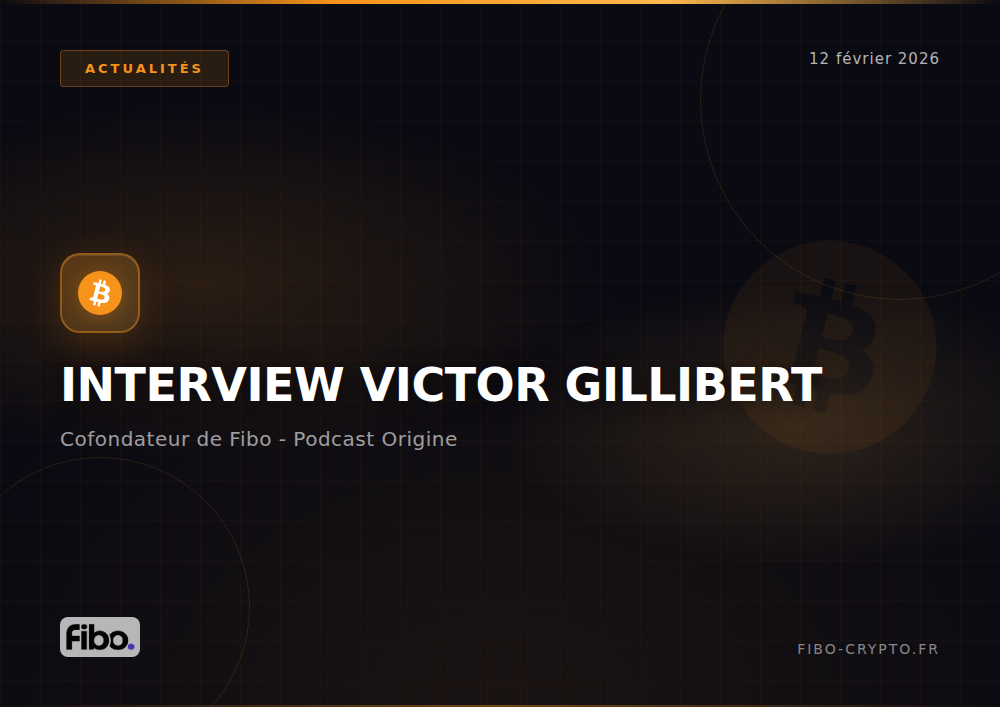
Watch the full interview with Victor Gillibert, co-founder of Fibo, on the Origine podcast. In this conversation, he discusses his background, the creation of Fibo, and his vision for crypto investing.
Who is Victor Gillibert?
Victor Gillibert is the co-founder of Fibo, a cryptocurrency investment platform registered as a DASP (Digital Asset Service Provider) with France’s Financial Markets Authority (AMF).
His background:
- Graduate of ESCP (business school)
- Experience in private equity (investment funds)
- In crypto since 2016
- Trained as a blockchain developer to master the technical fundamentals
He co-founded Fibo with his brother, with whom he shared a passion for computing and cryptocurrencies from the early days.
“I’ve been in finance for a long time, I’ve been in crypto for a long time too. I don’t react to market swings because I have long-term convictions.”
Fibo: Simplified Crypto Investing
The initial observation
Fibo was born from a simple observation: many people want to invest in crypto but don’t. According to studies, 50% of people who haven’t invested in cryptocurrencies plan to do so — their main reason for not taking the plunge? Lack of knowledge.
“People around me kept telling me: ‘Victor, I’m fed up, I always sell at the bottom, buy at the top, I make so many mistakes.’ The worst things in crypto are investing in projects you don’t understand because someone said it would 100x, overreacting to market swings, and investing money you can’t afford to lose.”
How does it work?
The Fibo client experience is designed to be turnkey:
- Risk profile questionnaire: Like life insurance, clients answer questions to determine their risk level
- Tailored portfolio: Based on the profile, Fibo recommends a more or less risky portfolio (tokenized government bonds, Bitcoin, innovative projects)
- Recurring investment: Option to invest from €50/month automatically
- Delegated management: Fibo handles everything — buying, secure custody, rebalancing
What sets Fibo apart: it’s not just Bitcoin. Portfolios include tokenized government bonds on the blockchain, which helps limit volatility while maintaining crypto ecosystem exposure.
The Uphill Battle: Starting a Crypto Business in France
DASP registration
Starting a crypto company in France is an uphill battle. Victor recalls:
“To create the company, you need to deposit share capital in a bank. We spent a month talking to six different banks, getting rejection after rejection. Nobody would even let us deposit our share capital. And yet, I had a serious profile, a stable pitch.”
The solution? Go through a notary or accountant to deposit the share capital.
Then comes DASP registration with the AMF — a process that takes an average of 8 months. During that time, zero revenue, only legal expenses.
Despite everything, benefits
Victor acknowledges that this regulation has its advantages:
- Requirement to implement professional processes (KYC, anti-money laundering)
- Learning best security practices for asset custody
- A mark of credibility that reassures clients
The Money Laundering Myth
One of the most common arguments against Bitcoin: “It’s for money laundering.” Victor debunks this myth with numbers:
“About 2% of the global money supply is used for money laundering. On the Bitcoin network, the latest studies show it’s 1%. So the Bitcoin network is used twice less for laundering than euros and dollars.”
Why? Because everything is traceable on the blockchain:
- Transparent history since the first block in 2009
- Impossible to use “dirty” bitcoins without getting caught
- On-chain analysis tools used even by notaries for real estate transactions
“If I wanted to launder money, I would never use the Bitcoin network. Everything is traceable, transparent. It’s more anonymous to steal a briefcase of cash than to steal bitcoins.”
The Philosophy: Long Term vs Speculation
The day trading mistake
Before Fibo, Victor and his brother had created a trading bot. The result?
“We made 3x in two weeks, and the next week you’re down 80%. It’s exhausting for your nerves, and it’s pointless. We couldn’t build a company on something so volatile.”
Hence the pivot to a wealth-building approach: building the least volatile portfolios possible in crypto, aiming for the long term.
The emotional coach role
A large part of Fibo’s work involves calming clients’ emotions:
“Whenever there are volatile days, I get on calls with clients to explain. When the market drops, I tell them to calm down. When the market rises, it’s the same. Don’t overreact. If you buy an apartment in a nice neighborhood, you don’t sell it just because interest rates moved.”
Bitcoin: The Core Conviction
The money creation problem
Victor explains how he fell into crypto in 2016, alongside his economics courses at ESCP:
“I started understanding money creation. We used to use gold, then paper backed by gold, then we said: we don’t need gold, let’s just print. So you can create money infinitely. And I thought: doesn’t that cause problems?”
Numbers that make you think:
- Post-Covid inflation of 7-8%/year
- 50% of countries with inflation around 10%/year
- 10% inflation = you lose half your wealth in 5 years
- Even at 4% (ECB target), you lose half in 20 years
Bitcoin: digital scarcity
Against this infinite money creation, Bitcoin offers a mathematical alternative:
“With Bitcoin, you learn that mathematically there will never be more than 21 million. All the code is transparent. I know that today, roughly every 10 minutes, 3.125 BTC are created. In 2028, it will be 1.6. You have a digital scarcity object that didn’t exist before.”
Fibo’s Ambitions
B2B: Treasury management
Fibo is also expanding to businesses:
- Treasury placement on the blockchain
- Returns around 5-6% (vs 2-3% in traditional banking)
- Instant liquidity (no lock-up for 6 months or 2 years)
Wealth Advisors
Another development axis: supporting wealth advisors so they can offer crypto products to their clients. The challenge? Simplification.
“A wealth advisor told me: ‘I can’t see myself explaining blockchain to my clients, it’s too complicated.’ I replied: ‘Do you feel comfortable talking about Amazon stock? Do you know how the TCP/IP protocol works? No. So you don’t need to know all the technicalities to discuss a topic.'”
The long-term vision
Fibo’s ultimate ambition:
“We want to be the hub between the traditional financial system and blockchain. The connection so people can buy bonds on the blockchain, tokenized real estate, through us. They would have their IBAN at Fibo, make a transfer, and everything would be as seamless as transferring from one bank to another.”
📚 Glossary
- DASP: Digital Asset Service Provider — mandatory regulatory status in France to conduct crypto activities, issued by the AMF.
- AMF: Autorité des Marchés Financiers — France’s financial markets regulator.
- Tokenization: Process of representing a real asset (real estate, bonds, stocks) as a digital token on a blockchain.
- KYC: Know Your Customer — mandatory identity verification procedure for financial services.
- DeFi: Decentralized Finance — ecosystem of financial services operating on blockchain without intermediaries.
- Halving: Division by two of Bitcoin miner rewards, approximately every 4 years, reducing new BTC issuance.
- Wealth Advisor: Professional who helps individuals with their investments.
- OTC: Over-The-Counter — peer-to-peer transactions outside traditional exchange platforms.
Frequently Asked Questions
What is Fibo and how does it work?
Fibo is a French crypto investment platform, registered as a DASP with the AMF. It offers pre-built asset portfolios tailored to each client’s risk profile. Clients answer a questionnaire, receive a suitable portfolio, and can invest from €50/month. Fibo handles everything: buying, secure custody, and rebalancing.
Is Fibo a regulated platform?
Yes, Fibo is registered as a DASP (Digital Asset Service Provider) with France’s Financial Markets Authority (AMF). This registration guarantees professional security processes, compliant identity verification, and anti-money laundering measures.
Is Bitcoin really used for money laundering?
Studies show that only 1% of Bitcoin transactions are used for laundering, compared to 2% for the global money supply (euros, dollars). Bitcoin is actually used less for laundering because everything is traceable on the blockchain since 2009. On-chain analysis tools can track every transaction.
What’s the difference between Fibo and exchanges like Binance?
Unlike exchanges that let you choose your cryptos, Fibo manages everything for you. You don’t need to know the projects: Fibo builds diversified portfolios suited to your risk profile, including less volatile assets like tokenized government bonds. It’s a wealth-building approach, not speculative.
Does Fibo offer services to businesses?
Yes, Fibo offers treasury management for businesses. Returns are around 5-6% (vs 2-3% in traditional banking), with instant liquidity — no lock-up for months. Fibo also supports wealth advisors to offer crypto products to their clients.
📰 Sources
This article is based on the following sources:
How to cite this article: Fibo Crypto. (2026). Victor Gillibert: “Bitcoin Is Digital Scarcity” – Origine Podcast Interview. Retrieved February 12, 2026 from https://fibo-crypto.fr/en/blog/interview-victor-gillibert-fibo-podcast-origine