SegWit vs Taproot: Understanding Bitcoin Upgrades (2026 Beginner Guide)
📋 En bref (TL;DR)
- SegWit and Taproot are two major Bitcoin protocol upgrades, activated in 2017 and 2021 respectively.
- SegWit fixes the transaction malleability bug and reduces transaction size by 40-50%, lowering fees.
- Taproot improves privacy by making all transactions look identical from the outside, even complex ones.
- Addresses are distinguished by prefix: 1… (Legacy), 3… (SegWit), bc1q… (Native SegWit), bc1p… (Taproot).
- These upgrades are complementary: SegWit optimizes efficiency, Taproot adds privacy and smart contracts.
- The Lightning Network wouldn’t have been possible without SegWit, which fixed a critical protocol bug.
- For users, these upgrades mean lower fees, faster transactions, and better privacy protection.
SegWit vs Taproot: you’ve probably heard these terms if you’re interested in Bitcoin. But what do they really mean? Why does Bitcoin need upgrades, and how have these two developments transformed the world’s first cryptocurrency?
In this comprehensive guide, we’ll explain what SegWit and Taproot are, why they were created, and how they concretely impact your daily Bitcoin usage. Whether you’re a beginner or an experienced user, you’ll finally understand the differences between these two fundamental technologies.
Why Does Bitcoin Need Upgrades?
Imagine a national highway built in the 1960s. At the time, it was perfectly sized for automobile traffic. But 60 years later, with the explosion in the number of vehicles, that same road is constantly congested. It needs to be widened, traffic lights optimized, maybe even bypass roads created.
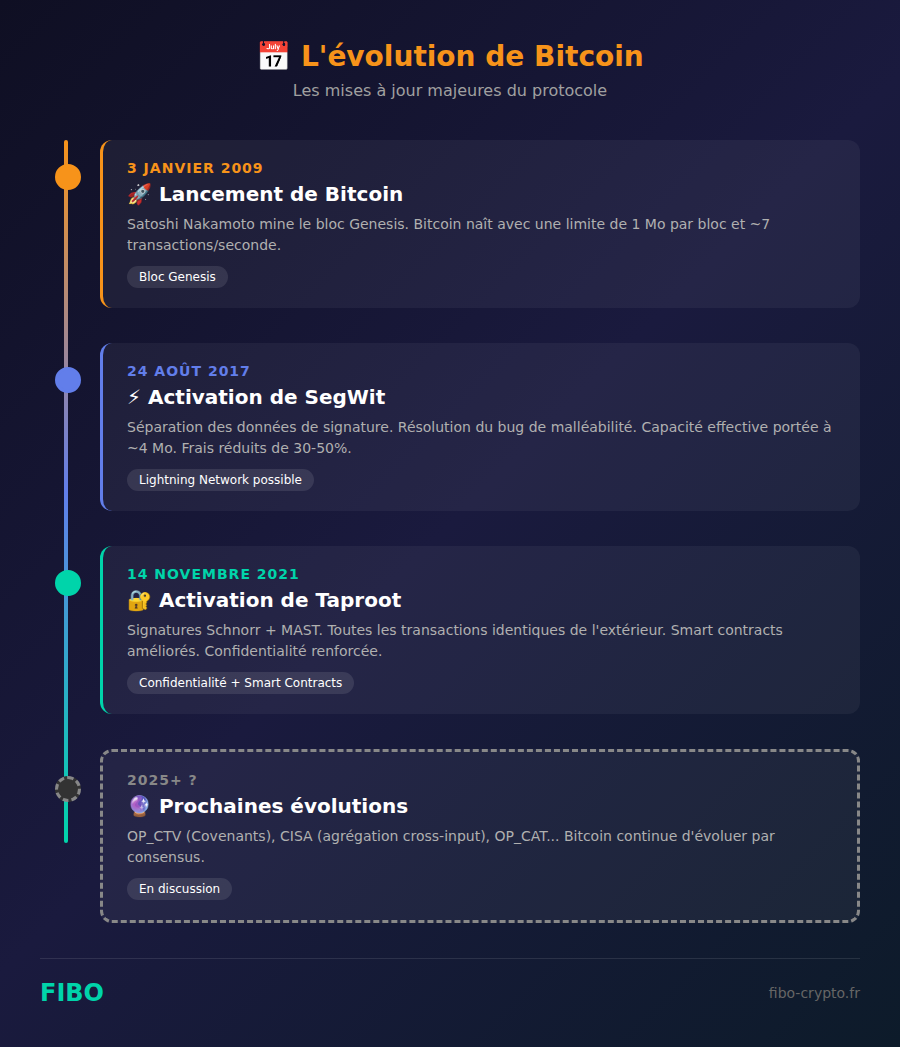
Bitcoin works the same way. When Satoshi Nakamoto launched it in 2009, the network was designed for modest use. Today, millions of people worldwide use Bitcoin, and the “traffic” on the network has exploded.
Bitcoin’s Scalability Problem
Bitcoin was designed with strict limits: a 1 MB block size and a new block approximately every 10 minutes. These constraints ensure network decentralization and security, but they also limit its capacity to about 7 transactions per second.
For comparison, Visa processes about 65,000 transactions per second. You see the problem?
When Bitcoin gained popularity, the consequences were immediate:
- Explosive transaction fees: during peak usage, fees sometimes exceeded $50 per transaction
- Extended confirmation times: hours, even days of waiting
- Degraded user experience: impossible to use Bitcoin for small daily purchases
The Bitcoin network had to evolve, but without sacrificing its fundamental principles: decentralization, security, and censorship resistance.
How Bitcoin Evolves: Soft Forks vs Hard Forks
Unlike traditional software, Bitcoin can’t simply be “updated.” The network is decentralized—there’s no central company that decides and imposes changes. Any modification must be adopted by consensus.
There are two types of updates:
Hard fork: a modification incompatible with older versions. Users must update their software, otherwise they end up on a different chain. This is how Bitcoin Cash was created in 2017: one group wanted to increase block size, others refused, creating two separate networks.
Soft fork: a backward-compatible modification. Older software versions continue to work, even if they don’t benefit from new features. SegWit and Taproot are both soft forks—a more cautious approach that preserves network unity.
What is SegWit?
SegWit (Segregated Witness) is a Bitcoin protocol upgrade activated on August 24, 2017. It’s probably the most important technical modification in Bitcoin’s history, and it solved a critical problem that had been blocking network development for years.
The Transaction Malleability Problem
Before SegWit, Bitcoin suffered from a bug called “transaction malleability.” To understand this problem, let’s use a simple analogy.
Imagine you’re sending a letter by mail. The letter (content) and envelope (delivery information) form a whole. Now imagine a malicious postal worker could modify the information on the envelope without touching the letter’s content. The recipient would receive the letter, but with a different tracking number.
On Bitcoin, this was exactly what happened. A transaction’s unique identifier (its “hash” or TXID) could be modified by a third party before confirmation, without changing the transaction’s actual content. Result:
- Wallets had trouble correctly tracking transactions
- Exchanges were vulnerable to fraud (a user could claim they never received their bitcoins)
- The Lightning Network was impossible to build—because it relies on stable transaction identifiers
The SegWit Solution: Separating Content from Envelope
SegWit solves this problem by separating signature data (the “witness”) from the rest of the transaction. These signatures, representing about 65% of a transaction’s size, are now stored in a separate area.
To continue our postal analogy: it’s as if we separated the sender’s signature (proof of authenticity) from the letter’s content. The signature still exists and remains verifiable, but it’s no longer part of the transaction identifier calculation.
Result: the transaction identifier becomes immutable. No more malleability possible.
SegWit’s Concrete Benefits
Beyond fixing the malleability bug, SegWit brought considerable improvements:
1. Effective Block Capacity Increase
Rather than directly increasing block size (which would have created a hard fork), SegWit introduced a new measurement system: “weight units.” Signature data, moved to the witness area, “weighs” 4 times less.
Practically, a Bitcoin block can now contain the equivalent of 4 MB of data (instead of 1 MB), while technically respecting the historical limit. It’s clever: more transactions per block, without a hard fork.
2. Transaction Fee Reduction of 30-50%
SegWit transactions take up less space, so they cost less. Savings are significant, especially for frequent users and exchange platforms processing thousands of transactions daily.
3. Lightning Network Activation
This is perhaps the most important benefit. By fixing transaction malleability, SegWit made possible the development of the Lightning Network, a “layer 2” enabling instant and nearly free Bitcoin transactions.
Without SegWit, no Lightning. And without Lightning, Bitcoin would struggle to serve as currency for everyday purchases.
4. Better Error Detection
SegWit addresses (Native SegWit) use a new format called Bech32, entirely lowercase. This format includes better typo detection, reducing the risk of losing funds due to input errors.
What is Taproot?
Taproot is the next major Bitcoin upgrade, activated on November 14, 2021 at block 709,632. If SegWit solved efficiency problems, Taproot tackles two other challenges: privacy and smart contracts.
This upgrade was proposed by developer Gregory Maxwell in 2018, then underwent three years of discussions, testing, and improvements before activation. Over 90% of miners signaled their support, demonstrating rare consensus in the Bitcoin ecosystem.
Bitcoin’s Privacy Problem
Contrary to popular belief, Bitcoin is not anonymous. It’s pseudonymous. Every transaction is publicly visible on the blockchain, and different transaction types have distinct “fingerprints.”
For example, before Taproot, one could easily identify:
- Simple transactions (one sender, one recipient)
- Multi-signature transactions (multiple people must sign)
- Time-locked transactions (locked until a certain date)
- Complex smart contracts
This information is valuable for blockchain analysis companies, governments, and potentially criminals looking for interesting targets.
The Analogy: Making All Transactions Look Identical
Imagine a parking lot where some cars are regular sedans, others are armored limousines with escorts. An observer could easily deduce which ones transport VIPs.
Now imagine all cars look exactly like the same white sedans, regardless of their true nature. That’s what Taproot does: all transactions look the same on the blockchain, whether it’s a simple payment or a complex contract involving multiple parties.
Taproot’s Three Technical Pillars
Taproot isn’t a single modification, but a set of three BIPs (Bitcoin Improvement Proposals):
1. BIP 340 — Schnorr Signatures
Schnorr signatures replace the old ECDSA algorithm. Their main advantage: signature aggregation. Multiple signatures can be combined into one, which:
- Reduces multi-signature transaction size
- Decreases fees proportionally
- Makes it impossible to distinguish a multi-sig transaction from a simple one
Concrete example: a company using a 3-of-5 wallet (three out of five executives must approve) no longer publishes three visible signatures, but just one. From the outside, it’s indistinguishable from a regular payment.
2. BIP 341 — MAST (Merkelized Abstract Syntax Trees)
MAST allows creating smart contracts with multiple possible spending conditions, while only revealing the condition actually used.
Imagine a Bitcoin will with three scenarios:
- Scenario A: the primary heir receives the funds
- Scenario B: after 1 year without activity, funds go to a secondary heir
- Scenario C: after 5 years, funds go to a charity
Before Taproot, all three conditions would have been publicly visible. With MAST, only the scenario that occurs is revealed. The others remain secret.
3. BIP 342 — Tapscript
Tapscript is a new scripting language accompanying Taproot. It makes Bitcoin more flexible and prepares the ground for future improvements, without requiring new major soft forks.
Taproot’s Concrete Benefits
1. Improved Privacy
All Taproot transactions look the same. Whether you’re sending €10 to a friend or executing a complex insurance contract, it’s indistinguishable. This uniformity strengthens Bitcoin’s fungibility: each bitcoin truly becomes equal to all others.
2. More Efficient Complex Transactions
Multi-signature transactions and smart contracts become up to 30% smaller, thus cheaper. This is particularly beneficial for:
- Corporate wallets (multi-sig)
- Escrow services
- Atomic swaps
- Payment channels (Lightning Network)
3. Bitcoin Smart Contracts
Bitcoin isn’t Ethereum and never will be. But Taproot opens the way for more sophisticated contracts while remaining simple and secure. Applications like DLCs (Discrete Log Contracts) now enable creating decentralized financial contracts on Bitcoin.
SegWit vs Taproot: The Complete Comparison
Now that you understand what SegWit and Taproot are, let’s compare them side by side.
SegWit vs Taproot Comparison Table
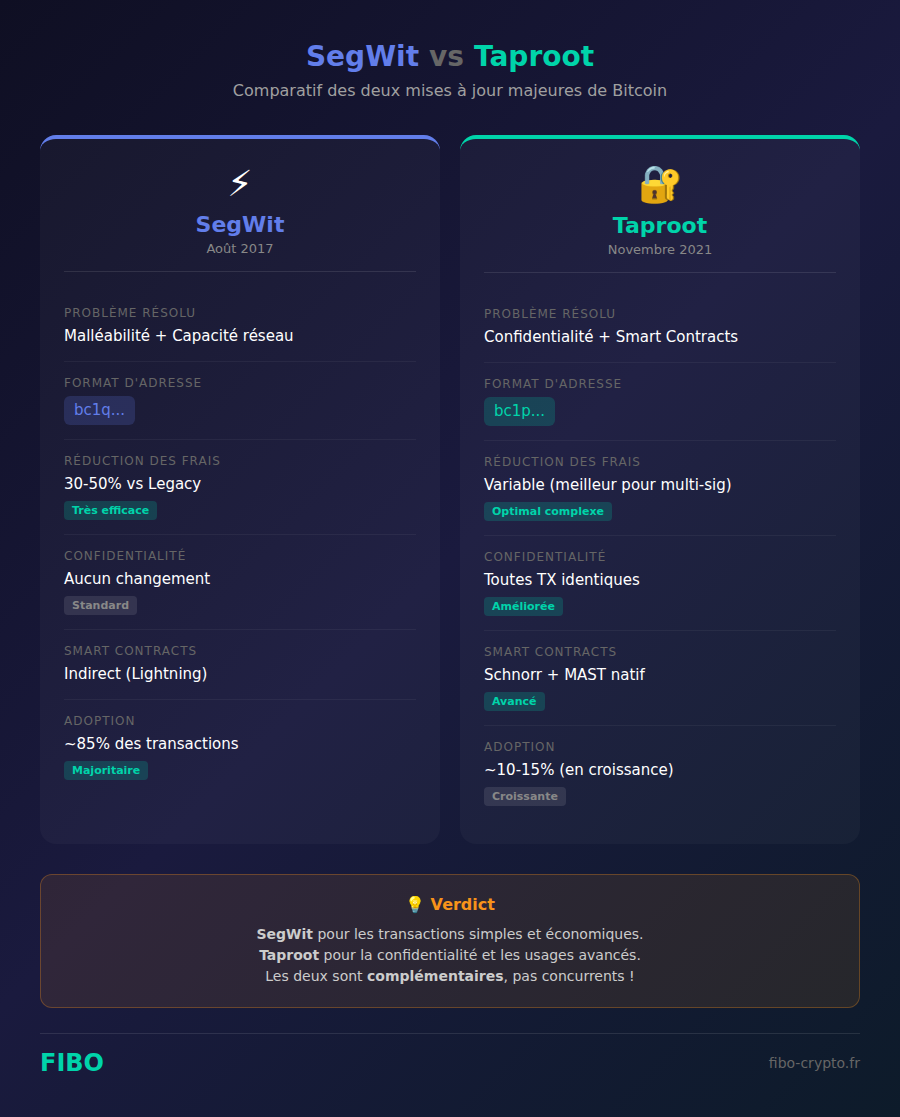
Activation Date:
- SegWit: August 24, 2017
- Taproot: November 14, 2021
Main Problem Solved:
- SegWit: Transaction malleability + network capacity
- Taproot: Privacy + advanced smart contracts
Address Format:
- SegWit: Starts with “bc1q” (Bech32)
- Taproot: Starts with “bc1p” (Bech32m)
Fee Reduction:
- SegWit: 30-50% compared to Legacy addresses
- Taproot: Variable — more efficient for complex transactions
Privacy Impact:
- SegWit: No direct impact
- Taproot: Significant improvement (all transactions identical)
Smart Contract Support:
- SegWit: Indirect (enables Lightning Network)
- Taproot: Direct (MAST, Schnorr, Tapscript)
Current Adoption:
- SegWit: ~85% of transactions
- Taproot: ~10-15% of transactions (growing)
Complementary, Not Competitors
A frequent question: should you choose between SegWit and Taproot? The answer is no.
These two upgrades are complementary. SegWit laid the foundations by solving structural protocol problems and increasing capacity. Taproot then built on these foundations to add privacy and advanced features.
Moreover, Taproot requires SegWit to function. Taproot addresses (bc1p…) are an evolution of Native SegWit addresses (bc1q…). You can’t have Taproot without SegWit.
Think of it like a house: SegWit is the solid foundation and structure. Taproot is the thermal insulation, smart windows, and home automation. Both are necessary for a modern, efficient house.
Concrete Impact for Users
All this tech is great, but what does it actually change for you?
Transaction Fees
If you’re using a Legacy address (starting with “1”), you’re paying the highest fees. By switching to Native SegWit (bc1q), you immediately save 30 to 50% on your fees.
With Taproot (bc1p), savings depend on transaction type:
- Simple transaction: fees similar to Native SegWit, sometimes slightly higher
- Multi-signature transaction: up to 30% additional savings
- Complex smart contract: very significant savings
Recommendation: for the average user making simple transactions, Native SegWit remains the best choice. For advanced users or businesses, Taproot becomes interesting.
Transaction Speed
SegWit and Taproot don’t directly accelerate confirmation speed (blocks are still generated every ~10 minutes). But by allowing more transactions per block, they reduce congestion.
Result: during high activity periods, your transactions are more likely to be included quickly without having to overpay fees.
Privacy
If protecting your privacy matters to you, Taproot is clearly superior. Your transactions blend into the crowd, making them harder to analyze.
That said, Taproot isn’t a complete privacy solution like Monero or Zcash. Your address remains visible, amounts too. But the “type” of transaction (simple, multi-sig, smart contract) is no longer identifiable.
How to Know What Address Type You’re Using?
It’s simple: look at your receiving address prefix.
- Starts with “1” → Legacy (P2PKH) — oldest, most expensive
- Starts with “3” → SegWit compatible (P2SH-SegWit) — intermediate
- Starts with “bc1q” → Native SegWit (P2WPKH) — optimal for most uses
- Starts with “bc1p” → Taproot (P2TR) — most advanced
How to Use SegWit and Taproot?
Good news: using SegWit and Taproot requires no technical knowledge. Just choose the right wallet and address type.
Bitcoin Address Types in Detail
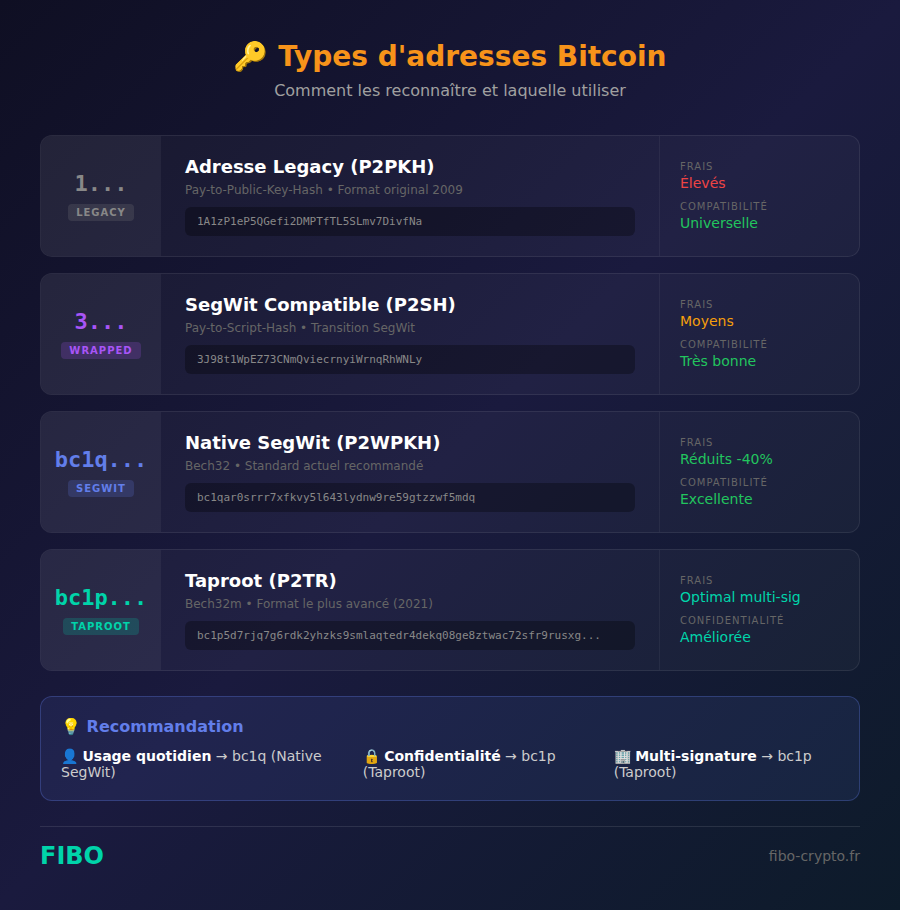
1. Legacy Addresses (P2PKH)
Format: starts with “1” (e.g.: 1A1zP1eP5QGefi2DMPTfTL5SLmv7DivfNa)
This is Bitcoin’s original format, used since 2009. It works everywhere but costs the most in fees. If your wallet generates this address type, it’s time to migrate.
2. SegWit Compatible Addresses (P2SH-SegWit)
Format: starts with “3” (e.g.: 3J98t1WpEZ73CNmQviecrnyiWrnqRhWNLy)
A transitional format wrapping a SegWit address in Legacy format. Compatible with all wallets but doesn’t offer SegWit’s maximum savings.
3. Native SegWit Addresses (P2WPKH)
Format: starts with “bc1q” (e.g.: bc1qar0srrr7xfkvy5l643lydnw9re59gtzzwf5mdq)
The current standard for most users. 30-50% reduced fees, better error detection, compatible with the vast majority of services.
4. Taproot Addresses (P2TR)
Format: starts with “bc1p” (e.g.: bc1p5d7rjq7g6rdk2yhzks9smlaqtedr4dekq08ge8ztwac72sfr9rusxg3297)
The most recent and advanced format. Improved privacy, smart contract support, but still limited adoption on some platforms.
SegWit and Taproot Compatible Wallets
Most modern wallets support at minimum Native SegWit. Here are the main options:
Mobile Wallets:
- BlueWallet (iOS/Android) — Supports Native SegWit and Taproot
- Muun (iOS/Android) — Taproot by default + integrated Lightning
- Phoenix (iOS/Android) — Lightning-first with Taproot support
- Trust Wallet (iOS/Android) — Native SegWit and Taproot
Desktop Wallets:
- Sparrow Wallet — Reference for advanced users, full Taproot
- Electrum — Complete SegWit and Taproot support
- Specter — Ideal for multi-sig with Taproot
Hardware Wallets:
- Ledger Nano S+/X — Native SegWit default, Taproot supported
- Trezor Model T/One — Full SegWit and Taproot support
- Coldcard — Security reference, complete Taproot
- BitBox02 — Native SegWit and Taproot
How to Migrate to a More Modern Address?
If you’re still using a Legacy address, here’s how to migrate:
- Create a new wallet (or new address) selecting Native SegWit or Taproot format
- Send your bitcoins from your old address to the new one
- Wait for confirmation and verify funds have arrived
- Update your references: inform your contacts, platforms, etc. of your new address
⚠️ Note: this migration involves an on-chain transaction with fees. Wait for low congestion periods to minimize costs.
Bitcoin’s Future: After Taproot?
Bitcoin continues to evolve. After SegWit and Taproot, several improvements are being discussed in the community.
Potential Future Improvements
OP_CTV (CheckTemplateVerify)
This proposal would enable creating “covenants” — conditions restricting how bitcoins can be spent. Use case: Bitcoin vaults where funds can only be withdrawn after a cooling-off period, protecting against theft.
OP_CAT
A proposal enabling data concatenation in Bitcoin scripts. Combined with other opcodes, it would open the way to more expressive smart contracts while staying true to Bitcoin’s philosophy.
Cross-Input Signature Aggregation (CISA)
An extension of Schnorr signatures allowing aggregation of signatures from multiple inputs into one. Potential fee savings of 20-30% for transactions with multiple inputs.
Lightning Network and Layer 2s
SegWit enabled the Lightning Network. Taproot improved it. But these technologies’ true potential is yet to come.
The Lightning Network already enables:
- Instant transactions (milliseconds instead of minutes)
- Near-zero fees (fractions of a cent)
- Theoretically unlimited scalability
With Taproot, Lightning channels become indistinguishable from regular transactions, improving network privacy. New features like PTLCs (Point Time-Locked Contracts) are gradually replacing HTLCs, offering even more privacy.
Other layer 2 solutions are also emerging: Ark, RGB Protocol, Fedimint… All building on the foundations laid by SegWit and Taproot.
📚 Glossary
- SegWit (Segregated Witness) : 2017 Bitcoin upgrade separating signature data from the rest of the transaction, solving malleability and increasing network capacity.
- Taproot : 2021 Bitcoin upgrade improving privacy and enabling more efficient smart contracts through Schnorr signatures and MAST.
- Soft fork : Backward-compatible protocol upgrade. Older software versions continue working. No chain split.
- Hard fork : Incompatible upgrade requiring all users to migrate, otherwise creating two separate chains.
- Transaction malleability : Bug allowing modification of a transaction’s identifier before confirmation, without changing its content.
- Schnorr Signatures : New signature scheme used by Taproot, enabling aggregation of multiple signatures into one.
- MAST (Merkelized Abstract Syntax Trees) : Technique revealing only the spending conditions actually used in a smart contract.
- Tapscript : New scripting language introduced with Taproot to support Schnorr signatures and future improvements.
- Lightning Network : Layer 2 solution enabling instant, near-free Bitcoin transactions via payment channels.
- Bech32 / Bech32m : Encoding formats for SegWit (bc1q) and Taproot (bc1p) addresses, with better error detection.
- Legacy (P2PKH) : Original Bitcoin address format starting with “1”, oldest and most expensive in fees.
- Native SegWit (P2WPKH) : Modern address format starting with “bc1q”, offering the best fees for simple transactions.
- Multi-signature (multi-sig) : Wallet type requiring multiple signatures to authorize a transaction (e.g.: 2-of-3).
- Fungibility : Property of a currency where each unit is interchangeable and equal to others. Taproot improves Bitcoin’s fungibility.
- BIP (Bitcoin Improvement Proposal) : Document describing a proposed improvement to the Bitcoin protocol, submitted to the community for discussion.
Frequently Asked Questions
What's the main difference between SegWit and Taproot?
SegWit (2017) solves the transaction malleability problem and increases network capacity by separating signature data. Taproot (2021) improves privacy by making all transactions look identical from the outside, and enables more efficient smart contracts through Schnorr signatures. These two upgrades are complementary: Taproot builds on SegWit’s foundations.
Should I use a SegWit or Taproot address?
For most users, a Native SegWit address (starting with bc1q) is the best choice: it’s widely supported and offers 30-50% reduced fees. Taproot addresses (bc1p) are recommended if you value privacy or use complex transactions like multi-sig. Check that your exchange supports your address type before switching.
How can I recognize my Bitcoin address type?
Look at your address prefix: “1” = Legacy (old, expensive), “3” = SegWit compatible (intermediate), “bc1q” = Native SegWit (recommended for most), “bc1p” = Taproot (most advanced). If your address starts with “1” or “3”, you should consider migrating to bc1q or bc1p to save on fees.
Do SegWit and Taproot reduce transaction fees?
Yes. SegWit reduces fees by 30-50% compared to Legacy addresses by taking up less block space. Taproot offers similar savings for simple transactions but becomes even more advantageous for complex transactions (multi-signatures, smart contracts) thanks to Schnorr signature aggregation.
Do all wallets support Taproot?
No, but most modern wallets now support it. Wallets like BlueWallet, Sparrow, Electrum, Ledger, and Trezor fully support Taproot. Some exchanges took longer to adopt it, but compatibility is constantly improving. Always check before sending funds to a Taproot address.
Does Taproot make Bitcoin truly anonymous?
No, Taproot doesn’t offer complete anonymity. Bitcoin remains pseudonymous: addresses and amounts are visible on the blockchain. What Taproot improves is the indistinguishability of transaction types: a simple transaction, multi-sig, or smart contract all look the same. This complicates blockchain analysis but doesn’t make transactions invisible.
Why does the Lightning Network need SegWit?
The Lightning Network relies on payment channels where transactions are pre-signed but not immediately broadcast. Before SegWit, the malleability bug allowed modifying a transaction’s identifier, which broke these chains of interdependent transactions. By fixing this bug, SegWit made the Lightning Network technically possible.
How do I migrate my bitcoins to a SegWit or Taproot address?
Create a new address in your desired format (bc1q or bc1p) in your wallet, then send your bitcoins from your old address to the new one. This operation generates transaction fees, so wait for low network congestion. Once the transaction is confirmed, your bitcoins benefit from the new format’s advantages.
Conclusion
SegWit and Taproot represent two crucial stages in Bitcoin’s evolution. SegWit solved fundamental technical problems and enabled the Lightning Network’s emergence. Taproot added a privacy layer and opened the way to smart contracts on Bitcoin.
For everyday users, the recommendation is simple:
- Migrate to Native SegWit (bc1q) if you’re still using Legacy addresses
- Consider Taproot (bc1p) if privacy matters to you or if you use multi-sig configurations
- Use modern wallets that support these formats
These upgrades demonstrate that Bitcoin isn’t static. The protocol continues to evolve carefully, by consensus, to address scalability, privacy, and utility challenges—while preserving what makes it strong: decentralization and security.
📰 Sources
This article is based on the following sources:
- BIP 141 – Segregated Witness
- BIP 340, 341, 342 – Taproot
- Bitcoin.org – Developer Documentation
- River Learn – SegWit Guide
- Bitcoin Optech – Taproot Series
- Blockstream Research – Schnorr Signatures
Comment citer cet article : Fibo Crypto. (2026). SegWit vs Taproot: Understanding Bitcoin Upgrades (2026 Beginner Guide). Consulté le 4 March 2026 sur https://fibo-crypto.fr/en/blog/segwit-vs-taproot-bitcoin-guide-en