Most Promising Crypto 2026: Top 10 Best Cryptocurrencies to Buy

📋 En bref (TL;DR)
- Bitcoin remains the safest cryptocurrency with approved spot ETFs and a market dominance above 55%.
- Ethereum dominates DeFi with 75% of total TVL and over 3,000 decentralized applications.
- Solana, the fastest blockchain, targets 1 million TPS through the Firedancer upgrade.
- XRP benefits from regulatory clarity following the resolution of its lawsuit with the SEC.
- Aave offers approximately 5% APY in DeFi lending, generating passive yield on your stablecoins (yield varies with market conditions; not guaranteed and not contractual).
- Emerging cryptos (SUI, Hyperliquid) are driving new trends in gaming and perpetual DEXs.
- Diversifying across 5 to 10 projects remains the best approach to reduce risk.
- DCA (Dollar-Cost Averaging) remains the most reliable and proven investment strategy.
- The MiCA regulation strengthens protection for European investors since January 2025.
- A non-custodial wallet is essential to maintain full control of your digital assets.
What Makes a Cryptocurrency Promising in 2026? Selection Criteria
A promising cryptocurrency in 2026 combines proven technology, growing adoption, solid fundamentals (tokenomics, team, partnerships), and an upcoming catalyst — whether it’s an ETF, a major upgrade, or institutional adoption. With over 15,000 cryptocurrencies on the market, identifying those with real potential requires a rigorous methodology.
The market environment in March 2026 is particularly favorable. The post-halving bull cycle from 2024 is reaching maturity. Spot ETFs for Bitcoin and Ethereum have opened the doors of crypto to institutional investors, with billions of dollars in inflows. In Europe, the MiCA regulation finally provides a clear regulatory framework that reassures both retail investors and professional funds.
To select the most promising cryptocurrencies, we applied five fundamental criteria. Each project in our Top 10 was evaluated across these dimensions.
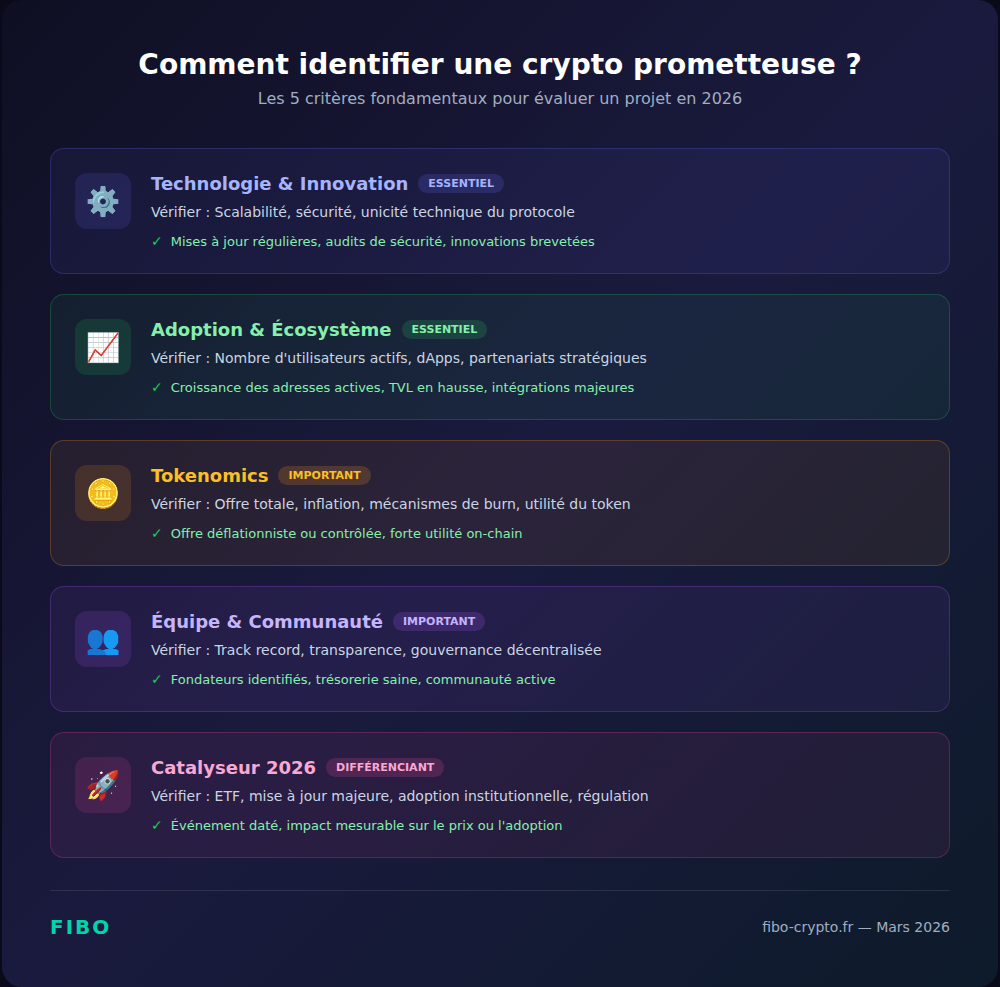
One important final point: none of these criteria is sufficient on its own. Revolutionary technology without adoption is just a research project. Massive adoption without solid tokenomics creates a worthless token. It’s the combination of all five factors that separates a promising investment from reckless speculation.
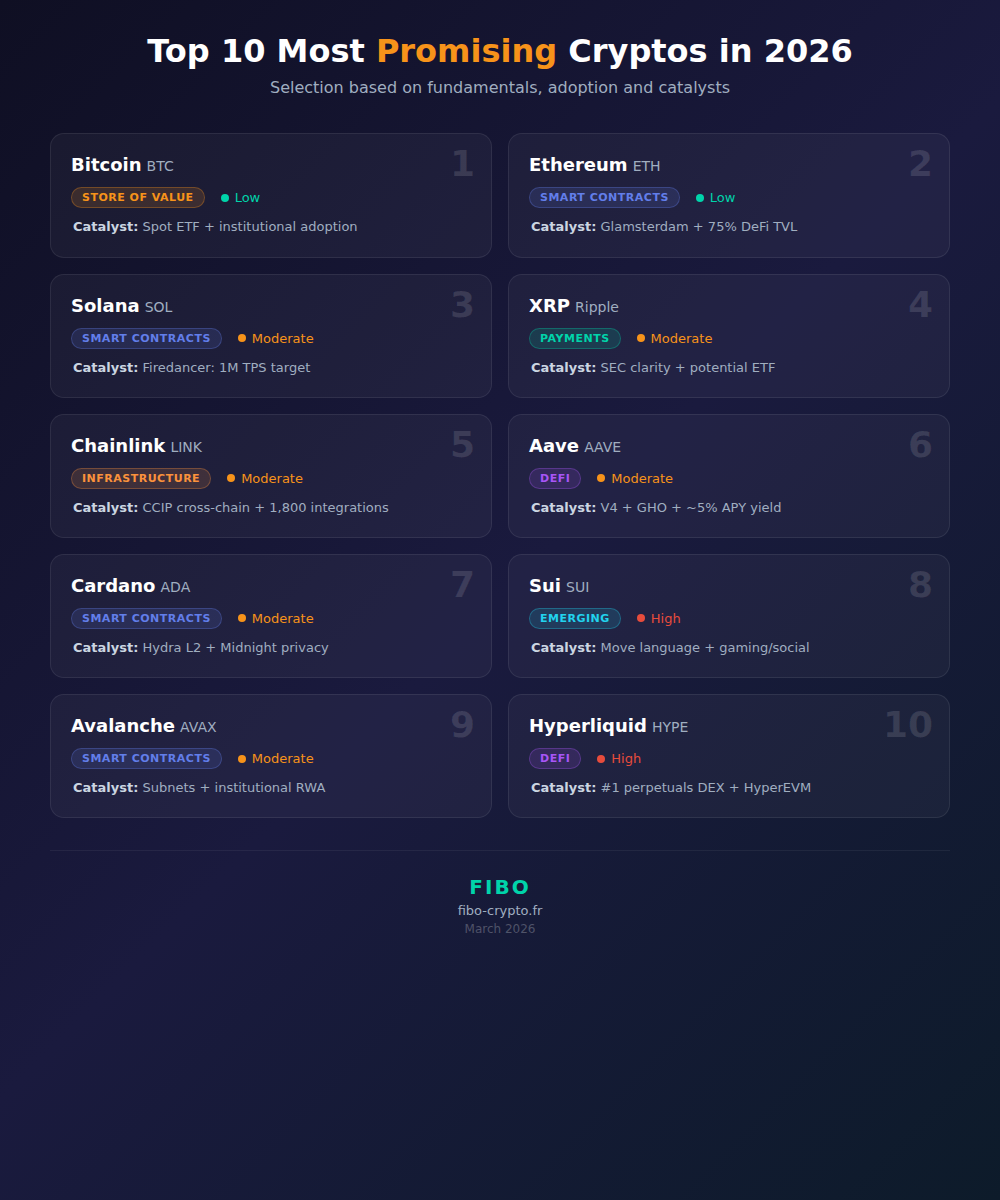
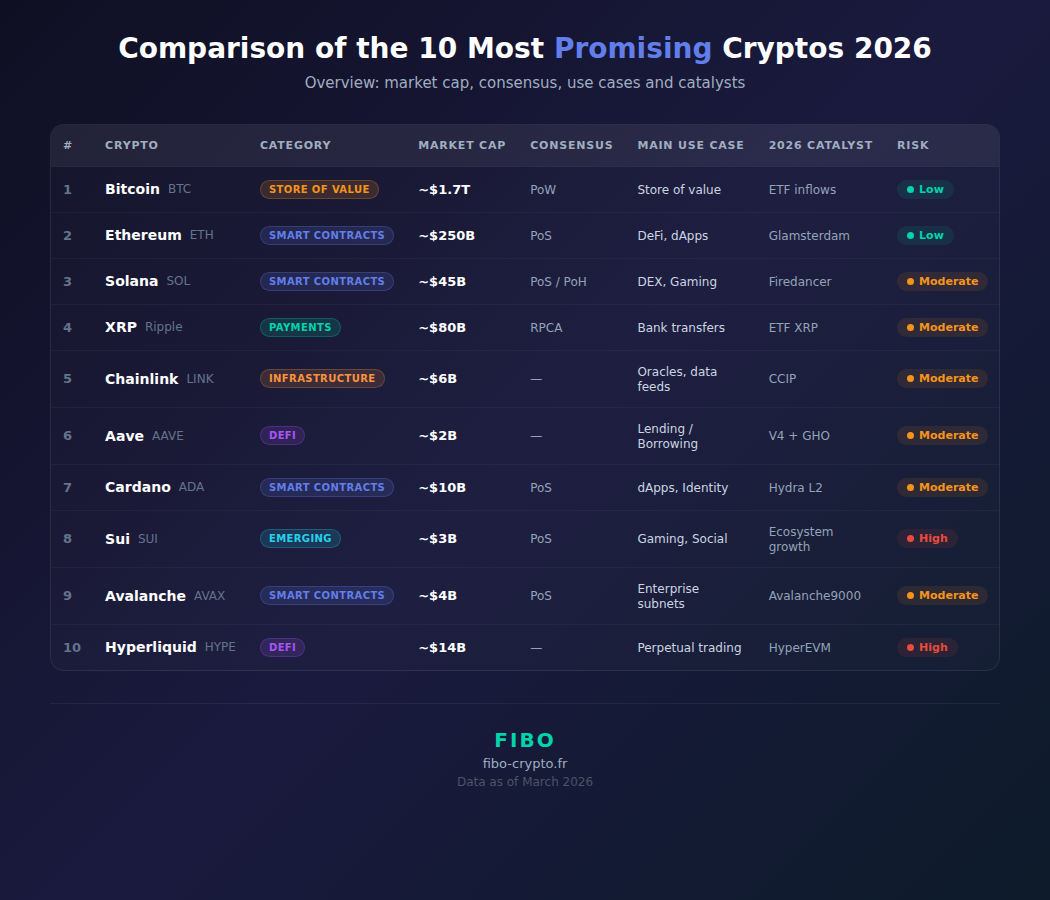
The 10 Most Promising Cryptocurrencies in 2026
Our selection of the 10 most promising cryptocurrencies in 2026 is based on an in-depth analysis of fundamentals, adoption, and upcoming catalysts for each project. We’ve included projects at different maturity levels — from battle-tested blue chips like Bitcoin and Ethereum, to high-potential emerging projects like SUI and Hyperliquid.
Each cryptocurrency is presented with its key statistics, growth drivers, and risks. Because investing with knowledge also means understanding what could go wrong.

1. Bitcoin (BTC) — The Safe Haven of the Crypto Market
Bitcoin remains the safest and most established cryptocurrency on the market in 2026, with a market cap representing over 55% of the entire crypto market. The first decentralized digital asset, created in 2009 by Satoshi Nakamoto, it reached a decisive milestone with the approval of spot ETFs in the United States.
Market cap: #1 globally | Dominance: ~55% | Spot ETF: approved (January 2024) | Cycle: post-halving 2024
2026 is shaping up to be a turning point for Bitcoin. The spot ETFs, launched in January 2024, continue to attract massive inflows — tens of billions of dollars in cumulative assets under management. BlackRock, Fidelity, and other asset management giants now offer Bitcoin as a standalone asset class to their institutional clients. MicroStrategy alone holds over 200,000 BTC in its corporate treasury.
The April 2024 halving reduced miner rewards from 6.25 to 3.125 BTC per block. Historically, the 12 to 18 months following a halving are the most bullish in the cycle. Several investment bank analysts — including Standard Chartered — project Bitcoin between $100,000 and $200,000 by the end of 2026.
Institutional adoption is no longer limited to tech companies. Sovereign wealth funds and pension funds are beginning to allocate a modest share of their portfolios to BTC, validating its status as “digital gold.” The Bitcoin network processes over 300,000 transactions per day with security that has never been compromised in 17 years of existence.
Risks: Volatility remains significant, with 20-30% corrections common even during bull cycles. The increased correlation with U.S. stock indices (S&P 500, Nasdaq) exposes Bitcoin to macroeconomic shocks and Federal Reserve interest rate decisions.

2. Ethereum (ETH) — The Undisputed King of Smart Contracts
Ethereum remains the most widely used smart contract platform in the world in 2026, concentrating approximately 75% of the total value locked (TVL) in DeFi. With over 3,000 active decentralized applications, its ecosystem is unmatched.
Market cap: #2 globally | DeFi TVL: ~75% of total | dApps: 3,000+ | Spot ETF: approved (2024)
Ethereum’s roadmap continues to materialize in 2026. The Glamsterdam upgrade, planned for this year, delivers significant improvements to network scalability and efficiency. But it’s the explosion of Layer 2 solutions — Base (Coinbase), Arbitrum, Optimism — that is truly transforming the user experience. These second-layer solutions enable transactions for just a few cents while inheriting Ethereum’s security.
The spot Ethereum ETF, approved in 2024, is gradually attracting institutional investors. The staking mechanism provides a native yield of approximately 3.5% to 4% APY, making it a productive asset — a compelling argument against traditional bonds.
The Ethereum ecosystem dominates in virtually every category: DeFi (Aave, Uniswap, Lido), NFTs (OpenSea, Blur), infrastructure (Chainlink, The Graph), and real-world asset tokenization (RWA). The developer community is the largest in the sector, with thousands of active contributors.
Risks: Gas fees on the mainnet remain high during periods of heavy demand, pushing users toward L2s or competing chains like Solana. Competition is intensifying in the smart contract space, though Ethereum’s dominant position appears difficult to overtake in the short term.

3. Solana (SOL) — The Ultra-Fast Blockchain Challenging Ethereum
Solana has established itself in 2026 as the fastest blockchain on the market, processing over 65,000 transactions per second with near-zero fees, and it’s targeting one million TPS through Firedancer. Its ecosystem has exploded, particularly in DEXs and gaming.
Current TPS: 65,000 | Firedancer target: 1M TPS | Average fees: <$0.01 | DEX volume: all-time highs
The major catalyst for Solana in 2026 is Firedancer, a new validator client developed by Jump Crypto. This upgrade aims to multiply the network’s performance tenfold, reaching 1 million transactions per second. If this target is achieved, Solana would have more throughput capacity than Visa and Mastercard combined.
The Solana ecosystem has matured significantly. Trading volumes on Solana DEXs (Jupiter, Raydium, Orca) regularly rival those on Ethereum. On-chain gaming has found fertile ground thanks to the speed and minimal fees. Projects like Star Atlas and Aurory are attracting hundreds of thousands of players. Integration with consumer-friendly wallets like Phantom has democratized access.
Solana has also capitalized on the memecoin and community token trend through the pump.fun platform, generating massive trading volume. Beyond the hype, this demonstrates the network’s ability to handle extreme demand spikes.
Risks: The network experienced several total outages between 2022 and 2023, though stability has improved significantly since then. Validator concentration remains a concern for decentralization purists.

4. XRP (Ripple) — The Cryptocurrency for International Payments
XRP enters a new era in 2026 following the resolution of its lengthy lawsuit with the SEC, finally providing the regulatory clarity that opens the door to massive institutional adoption in cross-border payments. With over 300 banking partnerships, Ripple is one of the most connected crypto projects to traditional finance.
Market cap: Top 5 | Banking partnerships: 300+ | SEC resolution: finalized | RLUSD: stablecoin launched
The end of the SEC vs. Ripple lawsuit has removed the primary obstacle to XRP adoption. Speculation around a spot XRP ETF is growing, with several asset managers having filed applications. If approved, it could follow the trajectory of the Bitcoin and Ethereum ETFs and attract billions of dollars.
Ripple has launched RLUSD, its own dollar-backed stablecoin, strengthening the XRP Ledger ecosystem. Ripple’s On-Demand Liquidity (ODL) payment network is used by financial institutions in over 55 countries for international transfers — a market estimated at $150 trillion per year.
The XRP Ledger offers transactions in 3 to 5 seconds with negligible fees (fractions of a cent). This technical performance, combined with Ripple’s regulatory compliance, makes it a serious contender to become the standard for institutional cross-border payments.
Risks: The heavy reliance on Ripple Labs — a centralized company — contrasts with the ideal of decentralization. Competition from Swift GPI (the traditional interbank network undergoing modernization) and stablecoins (USDC, USDT) for international payments is real.

5. Chainlink (LINK) — The Invisible Infrastructure Powering DeFi
Chainlink is the most widely used decentralized oracle network in the world, providing the essential off-chain data that DeFi needs to function, with over 1,800 integrations to its name. Without Chainlink, most DeFi protocols simply couldn’t operate.
Integrations: 1,800+ | Oracle position: #1 globally | CCIP: cross-chain protocol live | Staking: launched
Chainlink is often described as the “invisible infrastructure” of DeFi. Every time a protocol needs the price of Bitcoin, the EUR/USD exchange rate, weather data, or any other external data feed, it goes through an oracle. Chainlink holds a near-monopolistic position in this critical segment.
The major catalyst for 2026 is CCIP (Cross-Chain Interoperability Protocol), a protocol that enables blockchains to communicate with each other securely. CCIP is particularly attractive to financial institutions looking to tokenize real-world assets (bonds, real estate, equities) and transfer them across different blockchains. Swift, the global interbank network, has tested CCIP in its blockchain experiments.
The launch of LINK staking introduced a yield mechanism for token holders, improving tokenomics. Chainlink continues to innovate with Chainlink Functions, which allow smart contracts to execute arbitrary code and interact with any web API.
Risks: The main risk is the “token velocity problem” — the LINK token primarily serves to pay for oracle services, which can limit price appreciation. Competition from alternative oracles like Pyth (fast, DeFi-oriented) and API3 is growing, though Chainlink’s market share remains dominant.

6. Aave (AAVE) — The Undisputed Leader in Decentralized Lending
Aave is the #1 decentralized lending protocol in the world, enabling users to lend and borrow cryptocurrencies without intermediaries, with a yield of approximately 5% APY on stablecoins (yield varies with market conditions; not guaranteed and not contractual). The protocol manages billions of dollars in TVL across multiple blockchains.
Lending position: #1 DeFi | TVL: billions $ | GHO stablecoin: live | V4: planned 2026 | Stablecoin APY: ~5% (yield varies with market conditions; not guaranteed and not contractual)
How Aave works is straightforward: lenders deposit their crypto into liquidity pools and earn interest. Borrowers provide collateral and borrow other assets. Everything is automated by audited smart contracts, with no human intermediary. The yield of roughly 5% APY on stablecoins outperforms most traditional savings accounts.
Aave V4, expected in 2026, represents a major protocol overhaul. It introduces a “unified liquidity layer” that optimizes capital efficiency, more dynamic interest rates, and improved cross-chain integration. The GHO stablecoin, native to Aave, continues its expansion as a decentralized alternative to USDC and USDT.
Institutional adoption of DeFi increasingly runs through Aave. The Aave Arc protocol, designed for institutions with built-in KYC features, allows investment funds and corporations to participate in DeFi lending within a regulated framework. It’s a strong signal that DeFi and traditional finance are converging.
Risks: Smart contract risks, even on a protocol as thoroughly audited as Aave, always exist. An exploit or vulnerability could lead to significant losses. Increasing DeFi regulation in both Europe and the United States could also impose constraints that limit certain features.

7. Cardano (ADA) — The Scientific Approach to Blockchain
Cardano stands out in 2026 for its unique scientific approach — every upgrade is validated through peer-reviewed academic publications — and is finally accelerating development with Hydra and its AI partnership with SingularityNET. The community’s patience is beginning to pay off.
Approach: peer-reviewed | Scaling: Hydra Layer 2 | AI partnership: SingularityNET | Africa projects: Ethiopia, Tanzania
The primary catalyst for 2026 is Hydra, Cardano’s Layer 2 solution. Hydra creates parallel processing “heads” (channels) that theoretically increase network capacity to millions of transactions per second. Progressive deployment is underway, and early results are promising for payment and microtransaction use cases.
The other trump card is Midnight, a privacy-focused sidechain targeting businesses and institutions that need private blockchain transactions. The strategic partnership with SingularityNET (an AI project founded by Ben Goertzel) positions Cardano at the intersection of blockchain and artificial intelligence — a major trend for 2026.
Projects in Africa continue to progress. The partnership with Ethiopia’s Ministry of Education for the certification of 5 million students on the Cardano blockchain is one of the largest real-world deployments in the sector. Similar initiatives in Tanzania and Kenya are expanding the network’s footprint.
Risks: The main criticism of Cardano remains its slow development pace. The academic approach, while guaranteeing rigor, slows time-to-market compared to more agile competitors like Solana. The dApp ecosystem remains limited compared to Ethereum or Solana.

8. Sui (SUI) — The New Blockchain Shaking Up the Industry
SUI is the next-generation blockchain impressing with its technical performance — sub-500 millisecond finality and an object-oriented Move language — attracting a gaming and social ecosystem that’s exploding in growth. Launched in 2023, it has risen to become one of the most closely watched projects on the market.
Language: Move | Finality: <500ms | Architecture: object-oriented | Ecosystem: gaming & social
What sets SUI apart from most blockchains is its object-oriented architecture. Unlike the account-based model (Ethereum) or UTXO model (Bitcoin), SUI treats every digital asset as an independent object. This enables massive parallel transaction processing without the usual bottlenecks.
The Move programming language, originally developed by Meta (Facebook) for the Libra/Diem project, offers superior security guarantees. The smart contract bugs that have cost billions on Ethereum are structurally harder to produce in Move. This is a significant advantage for attracting institutional developers.
The SUI ecosystem is exploding in 2026. DeepBook, the native DEX, is seeing growing volumes. Walrus, a decentralized storage protocol, offers an alternative to IPFS and Arweave. On-chain games and decentralized social apps are finding in SUI the performance needed to deliver a user experience close to Web2.
Risks: SUI remains a young project with a limited track record. The controversy around the token vesting schedule — a significant portion of the supply is still locked and will be gradually released — creates potential selling pressure. Competition with Aptos (which also uses Move) and Solana is fierce.

9. Avalanche (AVAX) — Subnets at the Service of Institutions
Avalanche is positioning itself in 2026 as the go-to blockchain for financial institutions, thanks to its subnet architecture that enables custom blockchains with sub-second finality. JP Morgan, Citibank, and other major institutions have tested the technology.
Architecture: Subnets | Finality: <1 second | Institutional tests: JP Morgan Onyx | Upgrade: Avalanche9000
The subnet concept is Avalanche’s ace in the hole. A subnet is essentially a custom blockchain that operates within the Avalanche network, with its own validation rules, fee policy, and privacy level. For financial institutions, it’s ideal: they get blockchain technology while meeting their regulatory requirements (KYC, compliance, privacy).
The Avalanche9000 upgrade, being deployed progressively, significantly reduces the cost of launching a subnet and improves interoperability between different sub-chains. Real-world asset tokenization (RWA) — real estate, bonds, investment funds — is the use case attracting the most institutional interest in Avalanche.
JP Morgan used the Onyx platform on Avalanche for asset tokenization tests. BlackRock, Securitize, and other major players are actively exploring Avalanche subnets for their tokenization projects. It’s a strong signal that TradFi is taking the technology seriously.
Risks: Avalanche’s TVL has declined in relative terms compared to the competition, particularly against Ethereum’s Layer 2s (Base, Arbitrum) which are capturing a growing share of DeFi activity. The challenge will be converting institutional pilot projects into large-scale adoption.

10. Hyperliquid (HYPE) — The DEX That’s Making Centralized Exchanges Nervous
Hyperliquid is the largest decentralized perpetual futures exchange by volume in 2026, with a fully on-chain order book and performance that rivals Binance — all without KYC. It’s the project that best embodies the promise of high-performance decentralized finance.
Position: #1 DEX perpetuals by volume | Order book: 100% on-chain | HyperEVM: expanding ecosystem | Latency: ~200ms
What sets Hyperliquid apart is its fully on-chain order book. Unlike most DEXs that use AMM (Automated Market Maker) models, Hyperliquid replicates the experience of a centralized exchange — with limit orders, stop-losses, and the full suite of professional trading tools — but in a completely decentralized manner.
HyperEVM, the Ethereum-compatible virtual machine launched on Hyperliquid, creates an entire ecosystem around the DEX. Lending protocols, stablecoins, and yield farming projects are deploying on HyperEVM, transforming Hyperliquid from a simple DEX into a complete DeFi platform. Trading volumes on Hyperliquid regularly exceed several billion dollars per day.
The no-KYC model attracts traders worldwide who value privacy and the absence of intermediaries. The massive HYPE token airdrop in late 2024 created a large and engaged community.
Risks: Hyperliquid is a very recent project, which implies higher technical risk. Security incidents have already affected the platform, a reminder that DeFi protocols remain vulnerable. Increasing DEX regulation, particularly in Europe with MiCA and in the U.S. with evolving SEC oversight, could impose restrictions on no-KYC platforms.
How to Choose a Promising Cryptocurrency: A Methodological Guide
To choose a promising cryptocurrency, analyze 5 fundamental criteria: technology (innovation, scalability), adoption (active users, partnerships), tokenomics (supply, inflation, utility), team (track record, transparency), and timing (upcoming catalyst). This analytical framework will help you avoid the traps of marketing hype and FOMO.
Analyzing project fundamentals
Always start with the whitepaper and technical documentation. A serious project clearly explains what problem it solves, how its technology works, and why a token is necessary. If the token has no clear utility within the ecosystem, that’s a red flag.
Check the founding team. Are the founders publicly identified? What’s their background? Have they previously launched successful projects? An anonymous project isn’t necessarily bad (Bitcoin itself has an anonymous creator), but it adds a risk factor. Also review the roadmap: have past milestones been met?
Security audits are essential, especially for DeFi protocols. Audits performed by reputable firms (CertiK, Trail of Bits, OpenZeppelin) reduce the risk of exploits. Verify that the code is open-source and that audits are published and recent.
Evaluating growth potential
Market capitalization gives an indication of growth potential. A project at $10 billion in market cap has a realistic 10x potential, while a project at $500 billion can hardly triple. But be careful: small caps also carry significantly more risk.
Adoption is the best leading indicator. Track on-chain metrics: daily active addresses, transaction volume, number of active developers on GitHub, TVL for DeFi protocols. Tools like DefiLlama, Token Terminal, and Dune Analytics provide this data for free.
Identify the catalyst. Every cryptocurrency in our Top 10 has at least one identified catalyst for 2026: ETF, technical upgrade, major partnership, regulatory change. A project without a visible catalyst is an investment that depends solely on market sentiment — that’s speculation, not investing.
Understanding the risks
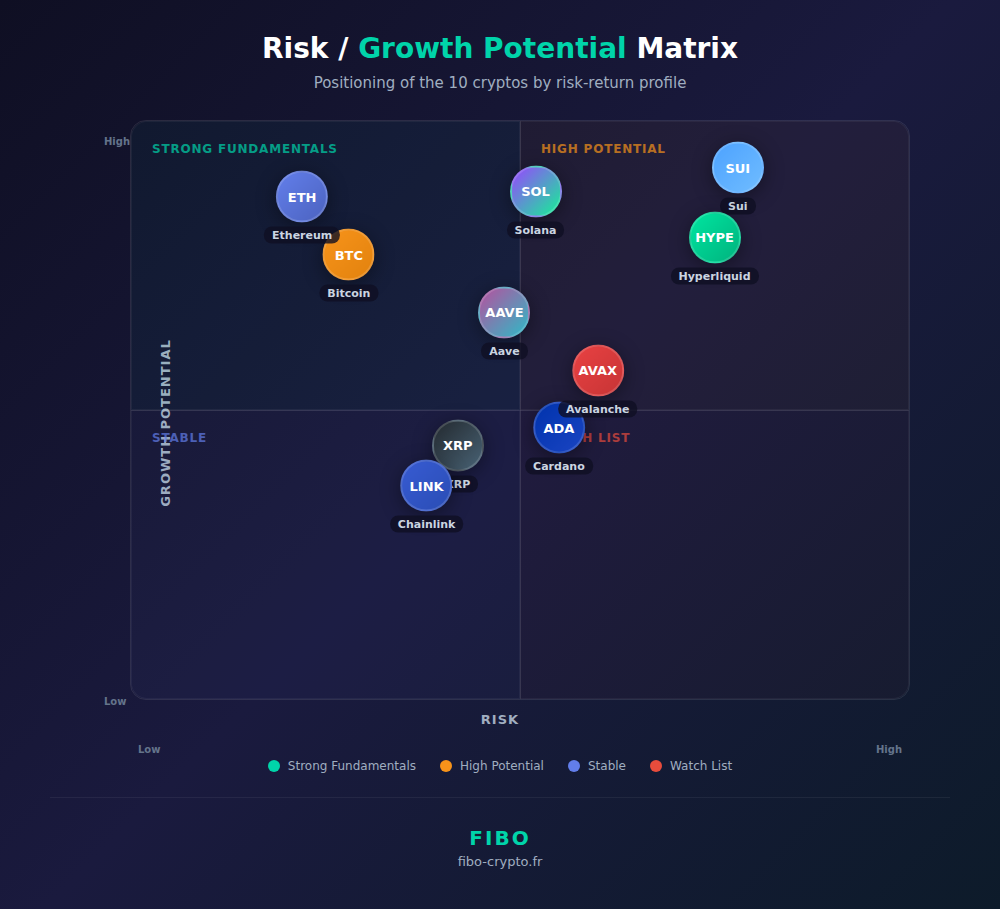
Every crypto investment carries specific risks. Technical risks (bugs, hacks, outages), regulatory risks (bans, restrictions), market risks (volatility, correlation), and project risks (team, execution, competition) must be evaluated individually.
| Evaluation criterion | Free tools | What to check |
|---|---|---|
| Market cap & price | CoinMarketCap, CoinGecko | Market cap, 24h volume, price history |
| On-chain activity | Dune Analytics, Etherscan | Active addresses, daily transactions, gas usage |
| DeFi & TVL | DefiLlama | Total TVL, breakdown by protocol, trend |
| Development | GitHub, Electric Capital | Recent commits, developer count, update frequency |
| Security | CertiK, DeFi Safety | Published audits, security score, past incidents |
| Community sentiment | LunarCrush, X/Twitter | Social engagement, signal-to-noise ratio |
Always ask yourself: “What happens if I’m wrong?” If the answer is “I lose money I can’t afford to lose,” reduce your exposure. Never invest more than 5 to 15% of your total net worth in cryptocurrencies.
Crypto Investment Strategies for 2026
The most effective strategy for investing in crypto in 2026 is DCA (Dollar-Cost Averaging) — investing a fixed amount at regular intervals — combined with diversification across 5 to 10 projects and a maximum allocation of 5 to 15% of your net worth. This approach eliminates the stress of market timing and reduces the impact of volatility.
DCA: investing without timing the market
DCA involves investing a fixed amount — for example $100 per month — on a regular basis, regardless of the market price. When prices are low, you buy more units. When they’re high, you buy fewer. Over time, you achieve a smoothed average purchase price without needing to predict market movements.
The historical data is clear: DCA into Bitcoin since 2017 has delivered an annualized return above 50%, despite the bear markets of 2018 and 2022. Even investors who started at the worst possible time (the 2017 or 2021 peaks) are well in profit thanks to DCA.
Automate your DCA through an exchange or a dedicated app. Set an amount you can invest each month without affecting your essential budget (rent, food, emergency savings). Don’t modify your plan based on market emotions.
Diversified portfolio: the ideal allocation
A balanced crypto portfolio in 2026 could follow this allocation:
| Category | Allocation | Examples | Role |
|---|---|---|---|
| Blue chips | 50% | Bitcoin, Ethereum | Stability, long-term performance |
| Established large caps | 30% | Solana, XRP, Chainlink, Avalanche | Growth, sector diversification |
| Emerging projects | 20% | SUI, Hyperliquid, Aave | Outperformance potential, innovation |
This 50/30/20 allocation balances security and growth potential. Blue chips (BTC, ETH) form the stable foundation. Established large caps provide exposure to growing sectors (payments, infrastructure, scaling). Emerging projects carry the potential for asymmetric returns — but also the most risk.
Rebalance your portfolio quarterly. If an asset has outperformed and now represents 40% of your portfolio when your target was 20%, sell a portion to return to your initial allocation. This mechanism forces you to “sell high and buy low” in a disciplined way.
Generating passive yield with DeFi
DeFi allows you to put your cryptocurrencies to work instead of leaving them idle in a wallet. Staking Ethereum offers approximately 3.5 to 4% APY. Lending on Aave generates around 5% APY on stablecoins (yield varies with market conditions; not guaranteed and not contractual). Staking Solana yields approximately 6 to 7% APY.
These yields are attractive but carry specific risks: smart contract risk (bugs or exploits), liquidation risk (for borrowing), and impermanent loss risk (for liquidity provision). For a beginner, native staking (ETH, SOL) or stablecoin lending on a battle-tested protocol like Aave are the safest options.
A non-custodial wallet with built-in DeFi access greatly simplifies the process. Rather than manually navigating between different protocols, you can lend your stablecoins on Aave directly from your wallet in just a few clicks.

The 7 Fatal Mistakes When Investing in Crypto
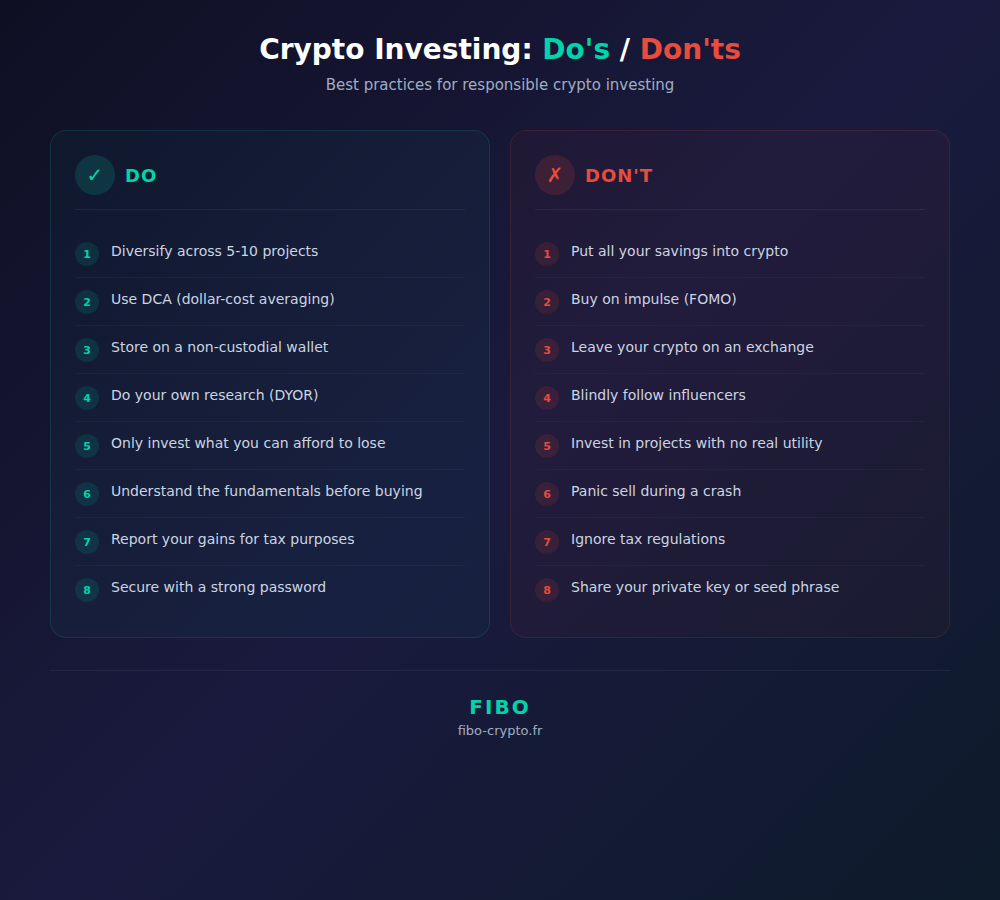
The most common mistakes when investing in crypto are: investing more than you can afford to lose, failing to diversify, giving in to FOMO, ignoring wallet security, not doing your own research (DYOR), panic selling, and neglecting taxes. Avoiding these classic pitfalls can literally save your capital.
- Investing more than you can afford to lose. Rule number one. The crypto market can drop 50% in a few weeks. If that money is essential for your daily life, the stress will push you to sell at the worst possible time. Limit your crypto exposure to 5-15% of your total net worth, after building an emergency fund covering 3 to 6 months of expenses.
- Failing to diversify. Putting all your capital into a single cryptocurrency, even Bitcoin, is risky. In 2022, projects that seemed solid (Terra/LUNA, FTT) lost 99% of their value. A portfolio spread across 5 to 10 projects in different categories absorbs shocks better.
- Giving in to FOMO (Fear Of Missing Out). Buying a cryptocurrency because it’s already up 500% is a recipe for disaster. The best opportunities are found when nobody’s talking about it, not when everyone is. If your neighbor is recommending a crypto to you, it’s probably already too late.
- Ignoring wallet security. Leaving your crypto on a centralized exchange means trusting a third party. The FTX and Celsius collapses were painful reminders of this lesson. Use a non-custodial wallet to maintain control of your private keys. “Not your keys, not your coins” isn’t a slogan — it’s reality.
- Not doing your own research (DYOR). Crypto “influencers” often have financial incentives to promote certain projects. Never rely on a single source of information. Read the whitepaper, check on-chain metrics, review security audits. This research is your best insurance policy.
- Panic selling. Corrections of 20-30% are normal in crypto, even during a bull market. Panic selling locks in a loss that might have been temporary. If your investment thesis hasn’t changed (the project’s fundamentals are still solid), a price drop is a buying opportunity, not a sell signal.
- Neglecting taxes. In the U.S., crypto gains are subject to capital gains tax — short-term rates (up to 37%) for assets held under a year, and long-term rates (0-20%) for longer holds. In the EU, tax treatment varies by country but most nations tax crypto profits. Every crypto-to-crypto swap and every conversion to fiat is a taxable event in many jurisdictions. Keep a record of all your transactions from the start. Tools like CoinTracker, Koinly, or CoinTracking simplify reporting.
Crypto Trends 2026: What’s Going to Change Everything
Four major trends are reshaping the crypto market in 2026: institutionalization through ETFs, MiCA regulation in Europe, the convergence of artificial intelligence and blockchain, and the democratization of DeFi. Understanding these structural forces is essential for positioning your portfolio.
Crypto ETFs are transforming the market
Spot Bitcoin and Ethereum ETFs have fundamentally changed market dynamics. They provide a regulated bridge between traditional finance and crypto, allowing investors who would never have opened an exchange account to gain Bitcoin exposure through their regular brokerage account.
Cumulative inflows into Bitcoin ETFs are measured in tens of billions of dollars. The price impact is structural: institutional demand is constant and growing, while the supply of new BTC decreases after each halving. Other crypto ETFs are under review — XRP, Solana — which could further expand the addressable market.
MiCA: European regulation as a competitive advantage
The MiCA regulation (Markets in Crypto-Assets), fully in force since early 2025, is the world’s first comprehensive regulation of crypto assets. It imposes clear rules on token issuers, exchanges, and crypto service providers in Europe.
For European investors, it’s a competitive advantage. MiCA requires stablecoin reserve transparency, client fund protection rules, and governance requirements for service providers. Across the Atlantic, the U.S. regulatory landscape continues to evolve, with the SEC and CFTC refining their approaches to crypto oversight. This global push toward clearer regulation benefits the entire market by reducing uncertainty and attracting institutional capital.
Artificial intelligence and blockchain
The convergence of AI and blockchain is the most prominent trend of 2026. Projects like SingularityNET (a Cardano partner), Fetch.ai, and Bittensor are building decentralized AI infrastructure. The idea: use blockchain to create open, transparent, and censorship-resistant AI marketplaces.
Practical applications are emerging: autonomous AI agents capable of trading on DEXs, AI-powered oracles for more accurate data, decentralized content generation, and automatic optimization of DeFi strategies. SUI and Avalanche are particularly active in this space, attracting developers at the intersection of both technologies.
DeFi is becoming accessible to everyone
DeFi has long suffered from a complex user interface, reserved for experts who could navigate MetaMask, Etherscan, and various protocols. In 2026, that barrier is falling. Next-generation non-custodial wallets directly integrate DeFi protocol access — staking, lending, swaps — in just a few clicks, without handling 24-word seed phrases.
Key recovery technology through social login (Gmail, Apple) or passkeys eliminates the primary barrier to adoption: the fear of losing your private keys. The result is a user experience close to traditional banking apps, but with the benefits of decentralization — full control of your assets, DeFi yields, and transparency.
Conclusion: Which Crypto Should You Invest In for 2026?
The crypto market in 2026 offers unprecedented opportunities, driven by institutional ETFs, clarified regulation, and increasingly mature technology. Our Top 10 covers the entire spectrum — from the security of Bitcoin to the innovation of SUI and Hyperliquid.
The key is to invest with a method: diversify across 5 to 10 projects, use DCA to smooth out your entry price, never risk more than you can afford to lose, and always do your own research. DeFi, particularly through battle-tested protocols like Aave, allows you to generate passive yield on your assets.
One final crucial point: the security of your assets starts with your choice of wallet. A non-custodial wallet gives you full control of your private keys — it’s the foundation of the financial sovereignty that crypto promises. Choosing a reliable wallet that’s simple to use and has built-in DeFi access is the first step for any serious investor in 2026.
📚 Glossary
- Bitcoin (BTC): The first and largest cryptocurrency by market cap. Created in 2009 by Satoshi Nakamoto, it functions as a decentralized digital store of value with a maximum supply capped at 21 million units.
- Ethereum (ETH): The second-largest cryptocurrency and leading smart contract platform. Launched in 2015 by Vitalik Buterin, it hosts the majority of decentralized applications (DeFi, NFTs, DAOs).
- Blockchain: A distributed and immutable digital ledger that records transactions chronologically and transparently. Each block contains a set of transactions validated by the network.
- DeFi (Decentralized Finance): A set of financial services (lending, borrowing, trading, insurance) operating on blockchain without banking intermediaries, via automated smart contracts.
- Smart Contract: A self-executing computer program deployed on a blockchain. It automatically executes the terms of an agreement when predefined conditions are met, without human intervention.
- Token: A digital asset created on an existing blockchain (unlike a native cryptocurrency such as BTC or ETH). Tokens can represent value, voting rights, service access, or a real-world asset.
- Wallet: An application or device that stores the private keys used to access your cryptocurrencies. A non-custodial wallet gives full control to the user, unlike a custodial wallet managed by a third party.
- Staking: A mechanism that involves locking up your cryptocurrencies to participate in transaction validation on a Proof-of-Stake blockchain, in exchange for rewards (yield).
- DCA (Dollar-Cost Averaging): An investment strategy that involves investing a fixed amount at regular intervals, regardless of market price, to smooth out your average purchase price over time.
- TVL (Total Value Locked): The total value of assets deposited in a DeFi protocol. It’s the primary metric for measuring adoption and user trust in a protocol.
- Oracle: A service that provides real-world data (prices, weather, sports results) to smart contracts on the blockchain. Chainlink is the most widely used oracle network.
- Layer 2 (L2): A scalability solution built on top of a main blockchain (Layer 1) to increase transaction speed and reduce fees. Examples: Base, Arbitrum, Optimism on Ethereum.
- DEX (Decentralized Exchange): A cryptocurrency exchange platform that operates without a centralized intermediary, directly via smart contracts. Users maintain control of their funds.
- Market Cap (Market Capitalization): The total value of a cryptocurrency, calculated by multiplying the unit price by the number of tokens in circulation. It’s the primary indicator of a project’s size.
- Halving: A programmed event that halves Bitcoin miner rewards approximately every 4 years. It reduces BTC supply inflation and has historically preceded bullish phases.
- MiCA (Markets in Crypto-Assets): The European regulation that harmonizes crypto regulation across Europe since 2025. It establishes licensing requirements, consumer protection rules, and stablecoin reserve transparency standards for crypto service providers.
- Tokenomics: A token’s economic model: total supply, emission rate, burn mechanisms (destruction), distribution between team/investors/community, and token utility within the ecosystem.
- ETF (Exchange-Traded Fund): An exchange-traded fund that tracks the performance of an underlying asset. Spot Bitcoin and Ethereum ETFs allow investing in crypto through a standard brokerage account without directly holding the asset.
- FOMO (Fear Of Missing Out): The fear of missing an investment opportunity. A psychological bias that drives people to buy an asset after a sharp rise, often at the worst time. It’s one of the most common mistakes in crypto.
- APY (Annual Percentage Yield): The annual return on an investment including compound interest. In DeFi, APY indicates the expected return for staking, lending, or liquidity provision.
Frequently Asked Questions
What is the most promising cryptocurrency in 2026?
Bitcoin (BTC) remains the most promising crypto in 2026 thanks to approved spot ETFs, a market dominance above 55%, and the post-halving 2024 effect. Ethereum (ETH) comes second with 75% of DeFi TVL and the Glamsterdam upgrade. For higher growth potential with more risk, Solana (SOL) is targeting 1 million TPS with Firedancer. The choice depends on your risk profile: BTC for safety, ETH for the ecosystem, SOL for performance.
Which crypto will explode in 2026?
The cryptos with the strongest upside potential in 2026 are those combining solid fundamentals with an imminent catalyst. Solana (SOL) with Firedancer, XRP with a potential spot ETF, and SUI with its exploding gaming ecosystem are among the top candidates. Aave (AAVE) could also surprise with V4 and institutional DeFi adoption. Caution: no prediction is guaranteed, and high-potential projects also carry more risk.
Which crypto should I buy with $100?
With $100, prioritize diversification across 2-3 established cryptos rather than a single project. An effective split would be: $50 in Bitcoin (BTC) for stability, $30 in Ethereum (ETH) for the DeFi ecosystem, and $20 in Solana (SOL) or an emerging project. Use a non-custodial wallet to maintain control of your assets. $100 is an excellent amount to start a monthly DCA and learn market mechanics without major financial risk.
Is now a good time to invest in crypto in 2026?
The March 2026 context is favorable: the post-halving Bitcoin 2024 cycle is historically bullish over 12-18 months, spot ETFs are attracting massive institutional inflows, the MiCA regulation provides a secure framework in Europe, and DeFi adoption is accelerating. However, the best time to invest is always when you’re ready financially and emotionally. DCA eliminates the timing question by smoothing your entry price over time.
What is the best cryptocurrency for beginners?
Bitcoin (BTC) is the best cryptocurrency for beginners in 2026. It’s the oldest (17 years with no security breach), the most liquid, the best documented, and the least volatile among major cryptocurrencies. Spot ETFs make it accessible through a standard brokerage account. Ethereum (ETH) is the second choice, offering exposure to the largest DeFi ecosystem. Start by understanding these two projects before exploring alternatives.
How much should I invest in crypto to start?
Invest an amount you’re prepared to lose entirely without impacting your daily life. Financial advisors recommend limiting crypto exposure to 5-15% of your total net worth. Practically, $50 to $200 per month via DCA is a good starting point. Before investing in crypto, make sure you have an emergency fund covering 3 to 6 months of expenses and no high-interest debt. Consistency matters more than the amount.
What are the risks of investing in cryptocurrency?
The main risks are: extreme volatility (20-50% corrections possible even in a bull market), total loss risk on smaller projects (Luna/FTX in 2022), hacking risk on exchanges or DeFi protocols, regulatory risk, and losing access to your private keys. To minimize these risks: diversify across 5-10 projects, use DCA, store on a non-custodial wallet, and never invest more than 5-15% of your net worth.
How can you tell if a cryptocurrency is reliable?
Check 5 criteria: 1) Is the team identified with a verifiable track record? 2) Is the code open-source and audited by reputable firms (CertiK, Trail of Bits)? 3) Are the tokenomics transparent? 4) Is on-chain activity real (verifiable on DefiLlama, Dune Analytics)? 5) Does the project deliver on its promises (roadmap met)? A project that checks all 5 boxes is considered reliable. Beware of projects promising unrealistic returns.
Should I invest in Bitcoin or Ethereum in 2026?
The two are complementary. Bitcoin is a pure store of value with ETFs and the halving effect — it’s the safest choice. Ethereum additionally offers native yield via staking (~3.5-4% APY) and exposure to the largest DeFi ecosystem. A 60% BTC / 40% ETH allocation is a solid starting point. If you had to pick just one, Bitcoin remains the most prudent choice for a beginner investor.
How do you secure your cryptocurrency?
To secure your crypto: 1) Use a non-custodial wallet to maintain control of your private keys. 2) Enable two-factor authentication (2FA) on all your accounts. 3) Never store your crypto on a centralized exchange long-term (risk of collapse like FTX). 4) For large amounts, use a hardware wallet (Ledger, Trezor). 5) Back up your seed phrase on a physical medium, never as a screenshot. Next-generation wallets with passkey recovery offer a good balance of security and simplicity.
📰 Sources
This article is based on the following sources:
- CoinMarketCap — Real-time market cap, volume, and market dominance data for cryptocurrencies.
- CoinGecko — Market cap, trading volumes, and development metrics for cryptocurrencies.
- DefiLlama — TVL (Total Value Locked) and DeFi data across all blockchains and protocols.
- Standard Chartered — Global Research — Bitcoin price forecasts and digital asset market analysis.
- 21Shares — State of Crypto — Market Outlook 2026 and institutional crypto market analysis.
- SEC.gov — Spot Bitcoin ETF approval (January 2024) and Ethereum ETF, regulatory filings.
- European Commission — MiCA Regulation — European regulatory framework for crypto-asset markets.
- Ethereum.org — Roadmap — Official Ethereum roadmap including Glamsterdam and upcoming upgrades.
- Solana Foundation — Firedancer — Technical documentation for the Firedancer validator client developed by Jump Crypto.
- Aave — V4 Documentation — Official documentation for the Aave lending protocol, including V4 specifications.
How to cite this article: Fibo Crypto. (2026). Most Promising Crypto 2026: Top 10 Best Cryptocurrencies to Buy. Retrieved from https://fibo-crypto.fr/en/blog/most-promising-cryptocurrencies-2026-investment-guide
The simplest way to buy, swap and manage your crypto
Available on iOS and Android. No seed phrase, fees shown upfront, built-in DeFi yield.