Liquidity Pools Explained: How DeFi Pools Work in 2025
📋 En bref (TL;DR)
- Liquidity pools are smart contracts holding token pairs that enable decentralized trading without order books
- Automated Market Makers (AMMs) use mathematical formulas like x × y = k to determine prices automatically
- Liquidity providers (LPs) deposit tokens and earn 0.05% to 1% fees on every swap
- Impermanent loss occurs when token prices diverge—a 2x price change means ~5.7% loss vs holding
- Top DEXs include Uniswap ($5B+ TVL), Curve (stablecoins), and PancakeSwap (BSC)
- LP tokens represent your pool share and can be staked for additional yield farming rewards
- Risk management is crucial: choose stablecoin pairs or correlated assets to minimize losses
Liquidity pools are the backbone of decentralized finance (DeFi), enabling billions of dollars in daily trading without traditional intermediaries. Unlike centralized exchanges that rely on order books and market makers, DeFi protocols use smart contracts to create decentralized pools where anyone can provide liquidity and earn passive income. Understanding how these pools work is essential for anyone looking to participate in the DeFi ecosystem—whether as a trader seeking the best rates or an investor earning yield on idle assets.
In this comprehensive guide, we’ll explore everything you need to know about liquidity pools: how Automated Market Makers (AMMs) work, the mathematics behind price determination, strategies to maximize returns while minimizing impermanent loss, and a comparison of the top DEX platforms in 2025.
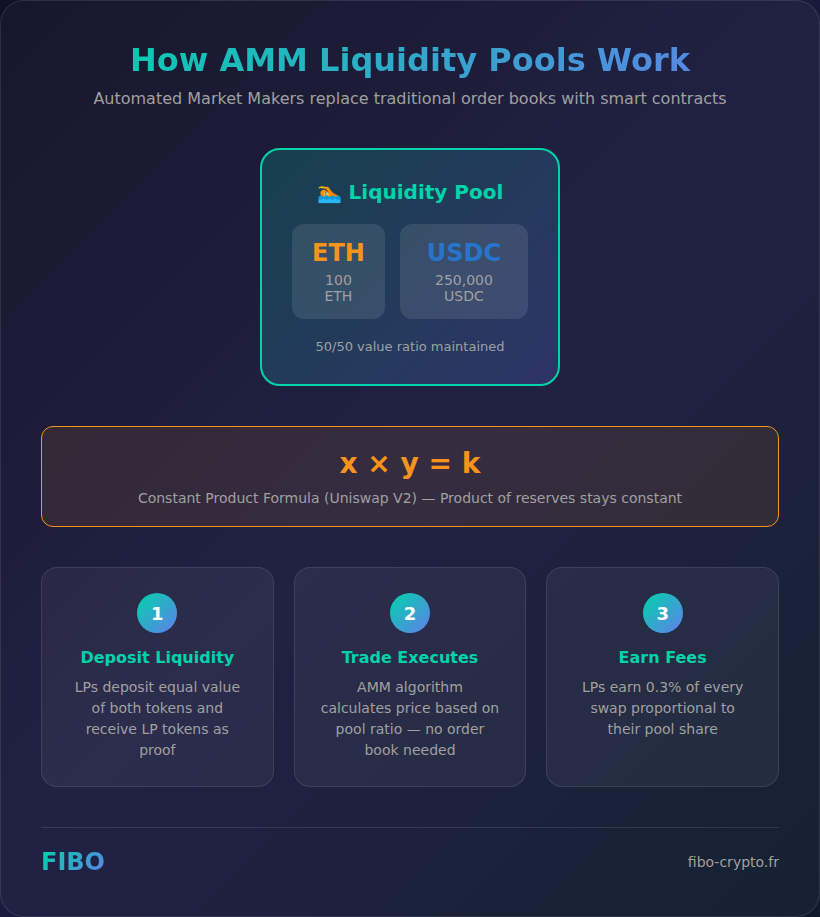
What Is a Liquidity Pool in DeFi?
A liquidity pool is a collection of cryptocurrency tokens locked in a smart contract that facilitates decentralized trading, lending, and other DeFi activities. Instead of matching buyers and sellers through an order book (like Coinbase or Binance), liquidity pools use algorithms to enable instant swaps between any two tokens in the pool.
The concept was pioneered by Bancor in 2017 and popularized by Uniswap in 2018, fundamentally changing how decentralized exchanges operate. Today, liquidity pools power over $50 billion in Total Value Locked (TVL) across DeFi protocols, processing millions of transactions daily.
Key Components of a Liquidity Pool
Every liquidity pool consists of three essential elements:
- Token pairs: Two cryptocurrencies deposited in equal value (e.g., ETH/USDC, BTC/ETH)
- Smart contract: Self-executing code that manages deposits, withdrawals, and swaps
- Liquidity providers (LPs): Users who deposit tokens and earn fees from trades
When you deposit $1,000 worth of ETH and $1,000 worth of USDC into a Uniswap pool, you receive LP tokens representing your proportional share of the pool. These tokens can be redeemed at any time for your underlying assets plus accumulated fees.
How Do Automated Market Makers (AMMs) Work?
Automated Market Makers are the algorithms that power liquidity pools, replacing traditional order books with mathematical formulas. The most common AMM model uses the constant product formula:
x × y = k
Where x represents the quantity of Token A, y represents the quantity of Token B, and k is a constant that must remain unchanged after every trade. This elegant formula ensures that:
- Prices adjust automatically based on supply and demand
- Larger trades cause more price impact (slippage)
- The pool can never be fully depleted of either token
Real-World Example: ETH/USDC Swap
Imagine a pool containing 100 ETH and 250,000 USDC (k = 25,000,000). A trader wants to buy 10 ETH:
- Before trade: 100 ETH × 250,000 USDC = 25,000,000 (k)
- After removing 10 ETH: 90 ETH remaining
- New USDC balance: 25,000,000 ÷ 90 = 277,778 USDC required
- Trader pays: 277,778 – 250,000 = 27,778 USDC for 10 ETH
The effective price of $2,778 per ETH is higher than the initial spot price ($2,500) due to slippage. Larger pools have deeper liquidity and lower slippage, making them more attractive for traders.
Types of AMM Models
Different protocols have developed specialized AMM formulas for specific use cases:
- Constant Product (Uniswap V2): x × y = k — general purpose, works for all token pairs
- Constant Sum: x + y = k — zero slippage but depletes easily (rarely used alone)
- StableSwap (Curve): Hybrid formula optimized for stablecoin pairs with minimal slippage
- Concentrated Liquidity (Uniswap V3): LPs choose price ranges, improving capital efficiency 4000x
How to Provide Liquidity: Step-by-Step Guide
Becoming a liquidity provider is straightforward but requires understanding the process and risks involved. Here’s how to add liquidity to a pool like Uniswap:
Step 1: Connect Your Wallet
Visit the DEX interface (e.g., app.uniswap.org) and connect a Web3 wallet like MetaMask, Coinbase Wallet, or WalletConnect. Ensure you have ETH for gas fees plus the tokens you want to deposit.
Step 2: Select a Pool
Navigate to the “Pool” or “Liquidity” section and choose which token pair to provide liquidity for. Consider:
- Trading volume: Higher volume = more fees earned
- TVL: Larger pools are more stable
- Fee tier: Uniswap V3 offers 0.01%, 0.05%, 0.3%, and 1% tiers
- Token volatility: Affects impermanent loss risk
Step 3: Deposit Equal Values
Most AMMs require you to deposit equal dollar values of both tokens. If ETH is $2,500, depositing 1 ETH means you also need 2,500 USDC. The protocol calculates the exact amounts automatically.
Step 4: Receive LP Tokens
After confirming the transaction, you receive LP tokens representing your pool share. These tokens:
- Can be redeemed for underlying assets + fees anytime
- Are transferable (you can sell your position)
- Can be staked in yield farms for additional rewards
Liquidity Pool Returns: How Much Can You Earn?
Returns from liquidity provision come from two primary sources:
1. Trading Fees
Every swap through the pool generates fees paid by traders, typically 0.3% per trade on Uniswap V2. These fees are distributed proportionally to all LPs based on their pool share.
Example calculation:
- Pool TVL: $10 million
- Your deposit: $10,000 (0.1% share)
- Daily trading volume: $5 million
- Daily fees: $5M × 0.3% = $15,000
- Your daily earnings: $15,000 × 0.1% = $15/day
- Annualized APR: ~55% (assuming consistent volume)
2. Liquidity Mining Rewards
Many protocols offer additional token incentives to attract liquidity. These yield farming rewards can significantly boost returns:
- SushiSwap: SUSHI token rewards for LP stakers
- Curve: CRV tokens + boosted rewards with veCRV
- PancakeSwap: CAKE tokens for BSC liquidity providers
Combined APYs can range from 5-100%+ depending on the pool, though higher yields typically come with higher risks.
Impermanent Loss Explained: The Hidden Risk
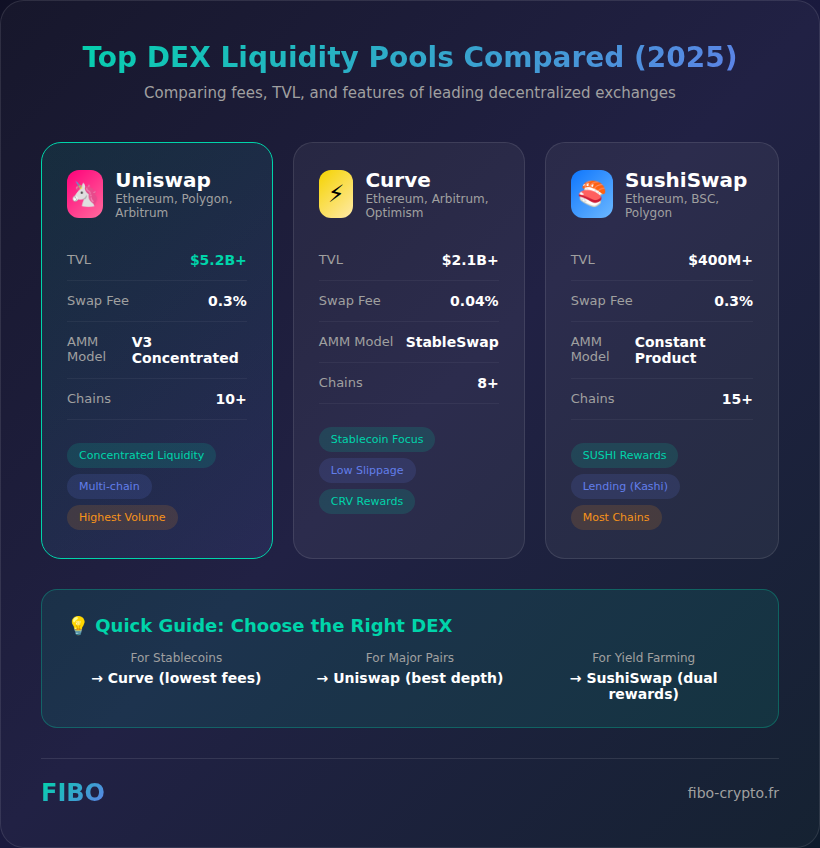
Impermanent loss (IL) is the most significant risk for liquidity providers. It occurs when the price ratio of tokens in your pool changes compared to when you deposited. The greater the price divergence, the larger the loss.
Why Does Impermanent Loss Happen?
When prices change, arbitrageurs rebalance the pool to match external market prices. This rebalancing reduces your holdings of the appreciating asset and increases holdings of the depreciating one—the opposite of what you’d want as an investor.
Impermanent Loss Calculator
Here’s how much IL you face based on price changes:
- 1.25x price change (25%): 0.6% loss
- 1.50x price change (50%): 2.0% loss
- 2x price change (100%): 5.7% loss
- 3x price change (200%): 13.4% loss
- 5x price change (400%): 25.5% loss
These losses are “impermanent” because they only become permanent when you withdraw. If prices return to their original ratio, the loss disappears.
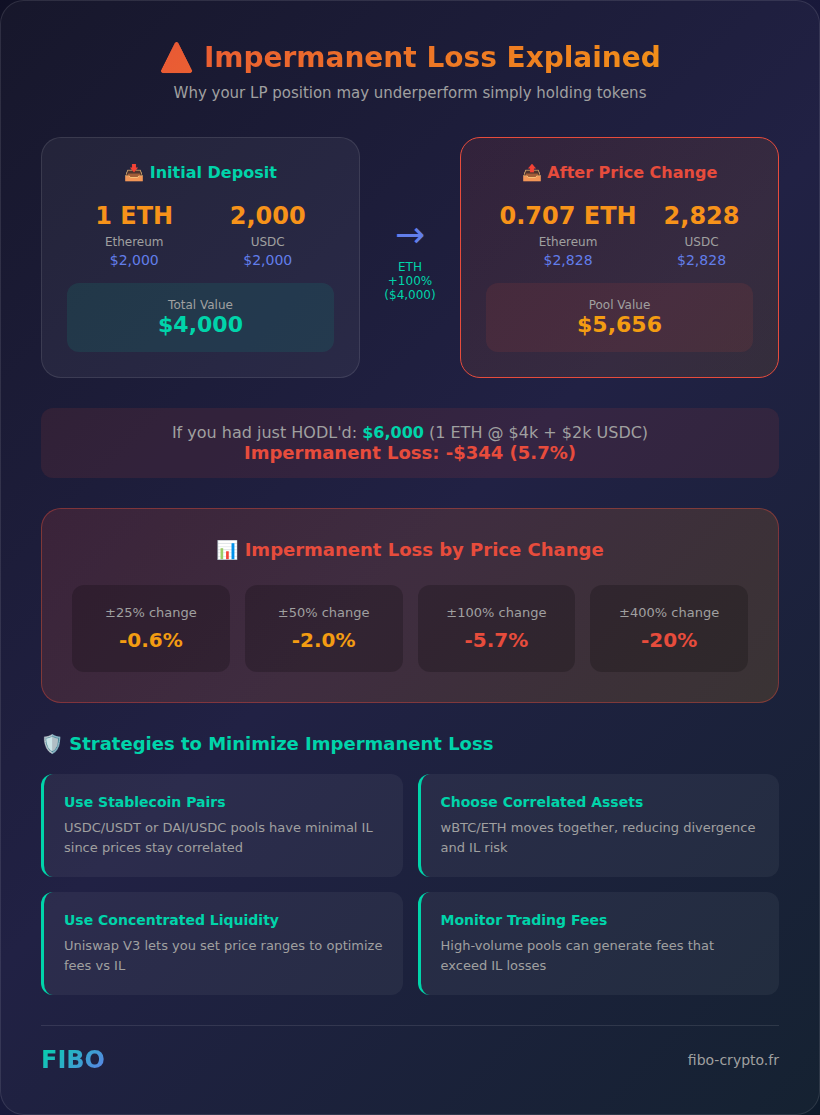
Strategies to Minimize Impermanent Loss
- Choose stablecoin pairs: USDC/USDT or DAI/USDC have near-zero IL
- Use correlated assets: wBTC/ETH or stETH/ETH move together
- Provide liquidity during low volatility: Sideways markets reduce IL
- Select high-fee pools: 1% fee tiers can offset IL faster
- Use concentrated liquidity wisely: Uniswap V3 amplifies both fees AND IL
Top DEX Platforms for Liquidity Providers in 2025
Choosing the right platform depends on your goals, risk tolerance, and preferred blockchain:
Uniswap — Best for Ethereum & Multi-Chain
Total Value Locked: $5+ billion
Supported chains: Ethereum, Polygon, Arbitrum, Optimism, Base, BSC
Fee tiers: 0.01%, 0.05%, 0.3%, 1%
Uniswap V3’s concentrated liquidity allows LPs to earn up to 4000x more fees by focusing liquidity in specific price ranges. The tradeoff is higher complexity and amplified impermanent loss if prices move outside your range.
Curve Finance — Best for Stablecoins
Total Value Locked: $2+ billion
Specialty: Stablecoin and pegged asset swaps
Fees: 0.04% (extremely low)
Curve’s StableSwap algorithm minimizes slippage for similarly-priced assets, making it the go-to platform for stablecoin LPs. The CRV token and veCRV governance system offers additional yield opportunities.
PancakeSwap — Best for Binance Smart Chain
Total Value Locked: $1.5+ billion
Supported chains: BSC, Ethereum, Aptos
Fee: 0.25%
PancakeSwap dominates the BSC ecosystem with lower gas fees than Ethereum-based DEXs. CAKE token staking and “Syrup Pools” provide additional yield opportunities.
Balancer — Best for Multi-Token Pools
Unique feature: Pools can contain up to 8 different tokens in custom ratios (not just 50/50). This creates self-rebalancing index fund-like portfolios that earn trading fees.
Advanced Strategies: Maximizing Liquidity Pool Returns
1. Liquidity Mining (Yield Farming)
After receiving LP tokens, you can stake them in protocol-specific “farms” to earn additional rewards. This compounds your returns but adds smart contract risk from additional protocols.
2. Concentrated Liquidity Optimization
On Uniswap V3, setting tighter price ranges increases fee earnings but requires active management. Tools like Arrakis, Gamma, and Gelato Network automate position management.
3. Liquidity Pool Aggregators
Platforms like Yearn Finance and Beefy Finance automatically move your liquidity to the highest-yielding opportunities, handling compounding and optimization for you.
4. Arbitrage-Resistant Pools
New AMM designs like Maverick and Trader Joe V2 use dynamic fee models that increase during high volatility, protecting LPs from arbitrage losses.
Security Risks and How to Protect Yourself
Beyond impermanent loss, liquidity providers face several security risks:
Smart Contract Vulnerabilities
Bugs in protocol code can lead to fund losses. Mitigation strategies:
- Use only audited protocols (check DeFi Safety and Certik reports)
- Start with smaller amounts on newer platforms
- Avoid protocols offering unsustainably high APYs
Rug Pulls and Malicious Tokens
Scammers create fake tokens that can drain your wallet. Protection measures:
- Verify contract addresses on official sources
- Check token liquidity depth before trading
- Use token scanners like Token Sniffer or RugDoc
Oracle Manipulation
Price oracles can be exploited to drain pools. Choose protocols using robust oracles like Chainlink or TWAP (Time-Weighted Average Price).
Liquidity Pools vs. Traditional Finance
How do DeFi liquidity pools compare to traditional market making?
| Aspect | DeFi Liquidity Pools | Traditional Market Making |
|---|---|---|
| Access | Open to anyone | Institutional only |
| Minimum Capital | $10+ | $1M+ |
| Custody | Self-custodial (your keys) | Custodian-held |
| Hours | 24/7/365 | Market hours only |
| Transparency | Fully on-chain | Opaque |
Future of Liquidity Pools: What’s Next?
The liquidity pool landscape continues evolving rapidly:
- Intent-based trading: Protocols like CoW Swap batch orders to reduce MEV extraction
- Hooks and customization: Uniswap V4 allows custom logic in pools
- Cross-chain liquidity: Bridges enabling seamless multi-chain LP positions
- Real-world assets (RWAs): Tokenized stocks and bonds entering DeFi pools
- AI-managed positions: Automated strategies optimizing concentrated liquidity
📚 Glossary
- Liquidity Pool : A smart contract containing tokens that enables decentralized trading without order books.
- AMM (Automated Market Maker) : An algorithm that determines token prices using mathematical formulas instead of order matching.
- Liquidity Provider (LP) : A user who deposits tokens into a pool and earns fees from trades.
- LP Token : A receipt token representing your share of a liquidity pool, redeemable for underlying assets.
- Impermanent Loss : The reduction in value experienced by LPs when token prices diverge from their deposit ratio.
- TVL (Total Value Locked) : The total dollar value of assets deposited in a DeFi protocol.
- Slippage : The price difference between expected and executed trade prices, caused by limited liquidity.
- Constant Product Formula : The x × y = k equation used by Uniswap-style AMMs to maintain liquidity.
- Concentrated Liquidity : Uniswap V3 feature allowing LPs to focus capital within specific price ranges.
- Yield Farming : Staking LP tokens in additional protocols to earn bonus rewards.
- DEX (Decentralized Exchange) : A peer-to-peer trading platform without central authority.
- Gas Fees : Transaction costs paid to blockchain validators for processing operations.
- Smart Contract : Self-executing code that automatically enforces agreement terms on blockchain.
- Arbitrage : Profiting from price differences across markets, which keeps pool prices aligned.
Frequently Asked Questions
What is a liquidity pool and how does it work?
A liquidity pool is a collection of cryptocurrency tokens locked in a smart contract that enables decentralized trading. Instead of matching buyers with sellers through an order book, pools use Automated Market Maker (AMM) algorithms to facilitate instant swaps. When you trade, you swap against the pool’s reserves, and prices adjust automatically based on supply and demand. Liquidity providers deposit token pairs (like ETH and USDC) and earn a share of trading fees—typically 0.3% per swap—proportional to their contribution.
How much can you earn from liquidity pools?
Earnings vary significantly based on trading volume, pool size, and your share. In high-volume pools like ETH/USDC on Uniswap, APRs can range from 5-30% from trading fees alone. Adding liquidity mining rewards (yield farming) can boost total APY to 20-100%+. However, these returns must be weighed against impermanent loss risk. A realistic expectation for major stablecoin pairs is 3-10% APY with minimal IL, while volatile pairs may offer higher nominal returns but greater risk.
What is impermanent loss and how can I avoid it?
Impermanent loss occurs when the price ratio of tokens in your pool changes. If you deposit ETH/USDC and ETH doubles in price, arbitrageurs will rebalance the pool, leaving you with less ETH than you started with. A 2x price change results in approximately 5.7% loss compared to simply holding. To minimize IL: (1) choose stablecoin pairs like USDC/USDT, (2) select correlated assets like wBTC/ETH, (3) provide liquidity during low-volatility periods, and (4) ensure trading fees outpace potential IL.
What are the best liquidity pools for beginners?
Beginners should start with stablecoin pools (USDC/USDT, DAI/USDC) on established platforms like Curve or Uniswap, which have minimal impermanent loss risk. Blue-chip pairs like ETH/USDC on Uniswap are also relatively safe with good volume. Avoid new tokens, extremely high APY pools (often unsustainable), and pools on unaudited protocols. Start with a small amount to understand the process before committing significant capital.
How do LP tokens work and what can I do with them?
LP tokens are receipts that prove your ownership stake in a liquidity pool. When you deposit 1% of a pool’s liquidity, you receive LP tokens representing that 1% share. These tokens can be: (1) redeemed anytime for your underlying assets plus accumulated fees, (2) transferred or sold to others, (3) staked in yield farms for additional token rewards, or (4) used as collateral on some lending platforms. LP tokens automatically appreciate as trading fees accumulate in the pool.
Is providing liquidity safe? What are the risks?
Liquidity provision carries several risks: (1) Impermanent loss from price divergence, (2) Smart contract bugs or exploits—always use audited protocols, (3) Rug pulls with malicious tokens that drain your wallet, (4) Oracle manipulation attacks on some platforms, and (5) Gas fees eating into profits on Ethereum mainnet. Risk mitigation includes: diversifying across pools, starting small, using established platforms, and never depositing more than you can afford to lose.
What's the difference between Uniswap V2 and V3?
Uniswap V2 uses a simple constant product formula where liquidity is spread across all prices from 0 to infinity. V3 introduced concentrated liquidity, allowing LPs to focus their capital within specific price ranges. This can improve capital efficiency up to 4000x—earning more fees with the same capital. However, V3 requires active management: if prices move outside your range, you stop earning fees and face amplified impermanent loss. V2 is simpler and more passive; V3 rewards active management.
Can I lose all my money in a liquidity pool?
While unlikely in established pools, total loss is possible through: (1) Smart contract exploits draining pool funds, (2) One token becoming worthless (e.g., algorithmic stablecoin depegging), or (3) Rug pulls with malicious tokens. In normal market conditions with audited protocols, you won’t lose everything—impermanent loss is typically capped at 25% even with 5x price changes. However, combining IL with a token’s price crash can result in severe losses. Always verify contracts, use reputable platforms, and diversify.
📰 Sources
This article is based on the following sources:
- Uniswap V3 Whitepaper
- Bancor Impermanent Loss Calculator
- DeFi Llama
- Curve Finance Documentation
- Chainlink DeFi Research
- Ethereum.org DeFi Guide
Comment citer cet article : Fibo Crypto. (2026). Liquidity Pools Explained: How DeFi Pools Work in 2025. Consulté le 12 March 2026 sur https://fibo-crypto.fr/en/blog/liquidity-pools-defi