Savings and Investments: Why Include Cryptocurrencies in Your Portfolio

📋 En bref (TL;DR)
- Emergency fund first : Build a safety net of 3-6 months’ salary in a savings account before any investment
- The impossible triptych : No investment can offer high returns, total security AND perfect liquidity — trade-offs are always required
- Wealth pyramid : Crypto assets sit at the top (1-10% max), after securing the foundations
- Markowitz diversification : Modern Portfolio Theory demonstrates the value of including uncorrelated assets like crypto
- 3 Fibo categories : Stable (low risk), Essential (Bitcoin, Ethereum) and Opportunities (high risk/reward)
- DCA recommended : Regular investing smooths volatility and reduces market timing stress
- Regulated platform : Choosing a DASP registered with AMF like Fibo ensures security and regulatory compliance
Savings and investment are topics often overlooked by many. Between lack of knowledge, misconceptions, and apparent complexity, many people give up on optimizing their financial wealth. Yet understanding the basics allows you to take control of your economic future.
In this comprehensive guide, we’ll clarify essential concepts — wealth, savings, investment — and explain why cryptocurrencies deserve a place in a diversified wealth strategy.
Understanding Savings: The Foundation of Your Financial Security
Wealth, Savings, and Investment: The Definitions
Wealth represents all your assets and holdings: real estate, savings, investments, and anything with monetary value.
Savings refers to the portion of your income set aside each month, rather than spent immediately. It divides into two categories:
- Emergency savings: a safety net immediately available for unexpected situations (savings accounts). Recommended target: 3-6 months’ salary.
- Investment savings: more profitable long-term investments, with some risk and sometimes reduced liquidity.
The Impossible Triptych of Finance
Before investing, it’s crucial to understand a fundamental rule: no financial product can simultaneously offer high returns, total security, and perfect liquidity. This is the “impossible triptych.”
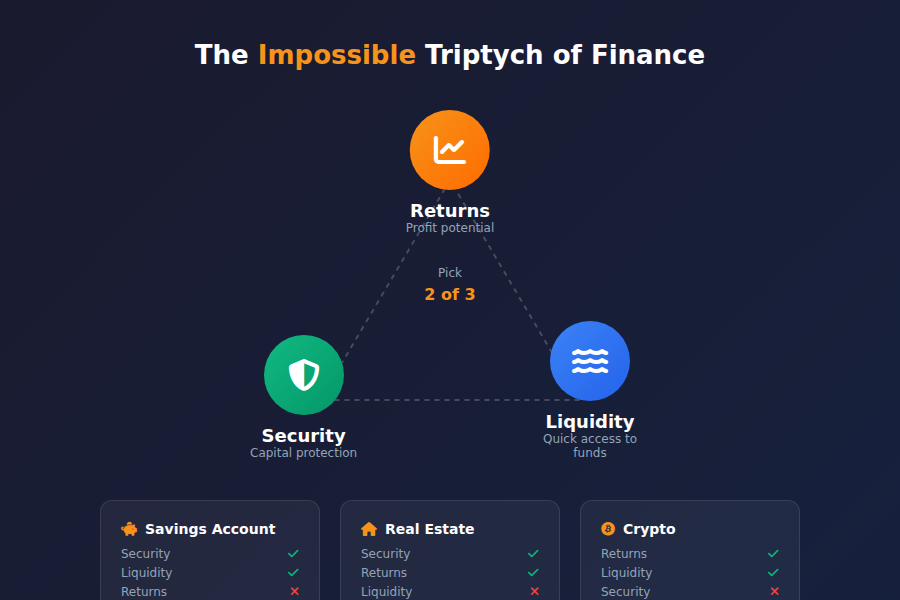
A savings account offers security and liquidity, but low returns. Real estate offers security and returns, but limited liquidity. Cryptocurrencies offer returns and liquidity, but with capital loss risk.
Beware of anyone promising all three at once — it’s probably a scam.

The Savings and Investment Pyramid
A sound wealth strategy is built like a pyramid, from bottom to top:
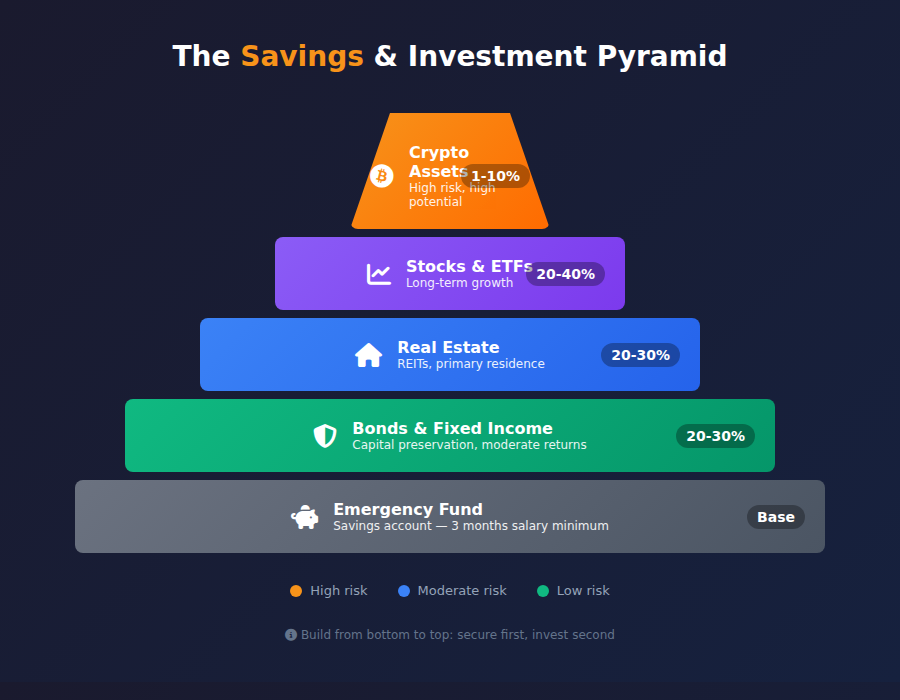
- Base: Emergency fund — Savings accounts. 3-6 months’ salary, immediately available.
- Level 2: Bonds & Fixed income — Capital preservation, moderate returns (2-4%).
- Level 3: Real estate — Primary residence, REITs. Stability and rental income.
- Level 4: Stocks and ETFs — Long-term growth, moderate volatility.
- Summit: Crypto assets — High potential, high risk. Maximum 1-10% of wealth.
Golden rule: only move to the next level when the lower level is secured. Never invest in crypto with money you might need.
Why Include Cryptocurrencies in Your Portfolio?
Diversification According to Markowitz
The phrase “don’t put all your eggs in one basket” isn’t just a popular saying — it’s a fundamental principle of modern finance, formalized by economist Harry Markowitz with Modern Portfolio Theory.
This theory demonstrates that by combining assets whose prices move differently (uncorrelated assets), you can reduce overall risk while maintaining return potential. Cryptocurrencies, whose behavior differs from traditional stocks and bonds, constitute a relevant diversification building block.
The Return Potential of Digital Assets
Blockchain technologies and their applications are developing across many sectors: finance, logistics, legal services, healthcare… This innovation attracts investors and capital.
Bitcoin, with its supply limited to 21 million units, is the best-performing asset since its creation in 2009. Some see it as “digital gold” capable of protecting against monetary inflation.
It’s unwise to invest exclusively in Bitcoin, but it would be even more regrettable not to hold any at all.

The 3 Fibo Categories: Matching Risk to Your Profile
Fibo has developed a unique segmentation of the digital asset market into three categories, allowing you to adapt your risk exposure:
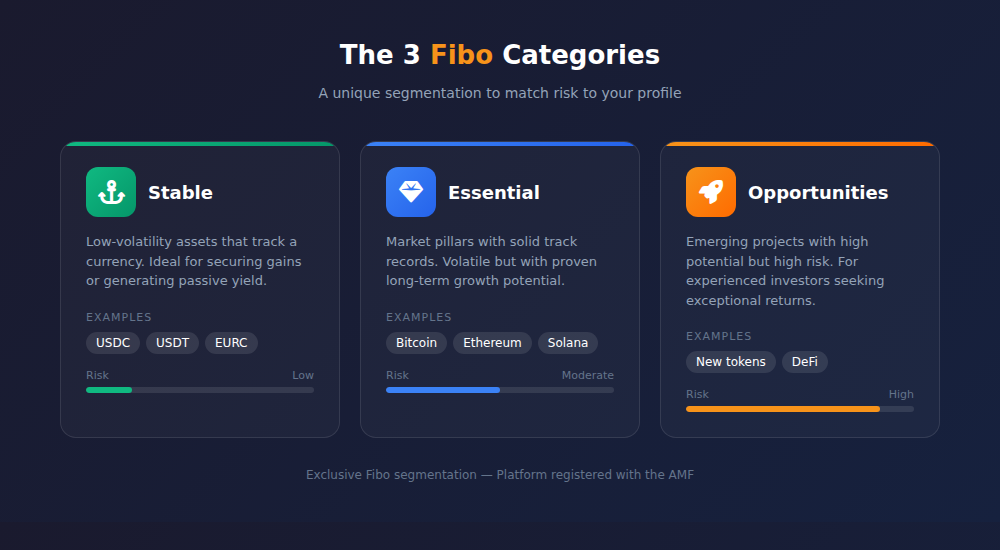
1. Stable Assets (low risk)
Stablecoins (USDC, USDT, EURC) track the price of a currency like the dollar or euro. They reduce portfolio volatility while potentially generating yield through lending protocols.
2. Essential Assets (moderate risk)
Bitcoin and Ethereum are the pillars of the crypto market, with solid track records and growing institutional adoption. Volatile but with demonstrated long-term growth potential.
3. Opportunity Assets (high risk)
Emerging projects, new tokens, DeFi protocols… These assets offer exceptional return potential but with significant loss risk. Reserved for experienced investors.

Defining Your Investor Profile
Your investment choices should be personalized according to several criteria:
- Your age: The younger you are, the longer your investment horizon, allowing you to accept more volatility. A young profile could devote 5-15% of their wealth to crypto, while a conservative profile would limit it to 1-5%.
- Your financial situation: Stable income allows better investment planning and regular investing (DCA method).
- Your goals: Home purchase in 5 years? Retirement in 30 years? Different horizons call for different strategies.
The DCA Method: Investing Serenely
DCA (Dollar Cost Averaging) involves investing a fixed amount at regular intervals, regardless of market price. This approach:
- Smooths out average purchase cost
- Eliminates stress about the “right time” to invest
- Transforms investing into a regular habit
With Fibo, you can schedule automatic purchases to implement your DCA strategy effortlessly.
Addressing Common Concerns
“Crypto is too volatile”
That’s true — but it’s precisely this volatility that generates return potential. Stablecoins help reduce this volatility while staying in the ecosystem. And over the long term, volatile investments are generally more rewarding.
Tip: if your investments keep you up at night, reduce the amounts. Your mental health comes first.
“Crypto platforms aren’t reliable (cf. FTX)”
Fibo is a French company, registered as a DASP (Digital Asset Service Provider) with the AMF. We use Fireblocks’ MPC technology, the global leader in crypto security.
“I don’t know anything about it and it scares me”
That’s normal! At Fibo, we’ve designed a simple and educational experience: clear explanations, ergonomic mobile app, personalized support. You don’t need to be an expert to get started.
📚 Glossary
- Wealth : All of a person’s assets and holdings, including real estate, savings, investments, and anything with monetary value.
- Cryptocurrencies : Digital currencies using cryptography to secure transactions, operating in a decentralized manner on a blockchain.
- Bitcoin : The first and most important cryptocurrency, created in 2009 by Satoshi Nakamoto, with a supply limited to 21 million units.
- Stablecoins : Cryptocurrencies whose value is pegged to a stable asset (dollar, euro), maintaining a 1-to-1 parity with their underlying asset.
- Blockchain : Distributed ledger technology that records transactions in a transparent, secure, and immutable manner.
- DCA (Dollar Cost Averaging) : Strategy of regularly investing a fixed amount regardless of market price, to smooth out purchase cost.
- Diversification : Investment strategy of spreading capital across different assets to reduce overall portfolio risk.
- Volatility : Measure of the amplitude of an asset’s price variations. The more volatile an asset, the more its prices fluctuate.
- DASP : Digital Asset Service Provider (PSAN in French), regulatory status granted by the AMF in France for crypto platforms.
- AMF : Autorité des Marchés Financiers (French Financial Markets Authority), the French regulator overseeing financial markets.
Frequently Asked Questions
What portion of my savings should I invest in cryptocurrencies?
It depends on your investor profile. First build an emergency fund (3-6 months’ salary), then allocate a portion of your investment savings to crypto. A young, dynamic profile may devote 5-15%, while a conservative profile would limit it to 1-5%.
Is DCA the best strategy for investing in crypto?
DCA (Dollar Cost Averaging) is one of the simplest and most effective strategies for beginners. By regularly investing a fixed amount, you smooth out purchase price and reduce volatility impact. This disciplined approach is recommended by most experts for long-term investing.
Do stablecoins really reduce portfolio volatility?
Yes, stablecoins track the price of a stable currency like the dollar or euro. By integrating them into your crypto portfolio, you reduce exposure to extreme price swings while potentially generating yield through decentralized lending protocols.
Is Fibo a secure crypto platform?
Fibo is registered as a DASP with the AMF, ensuring compliance with French regulatory standards. The platform uses Fireblocks’ MPC technology, the global leader, to secure user assets.
What’s the difference between emergency savings and investment savings?
Emergency savings are immediately available and secure (savings accounts), intended for unexpected situations. Investment savings aim for higher returns over the long term, with risk-taking and sometimes reduced liquidity. Cryptocurrencies fall into this second category.
📰 Sources
This article is based on the following sources:
- AMF France – Official guide on crypto-asset investment
- Investopedia – Modern Portfolio Theory (Markowitz)
- BlackRock – Crypto assets in portfolio allocation
How to cite this article: Fibo Crypto. (2026). Savings and Investments: Why Include Cryptocurrencies in Your Portfolio. Retrieved from https://fibo-crypto.fr/en/blog/savings-investments-the-case-for-crypto