NFT: Complete Guide to Understanding Non-Fungible Tokens (2026)
📋 En bref (TL;DR)
- Definition: An NFT (Non-Fungible Token) is a unique, tamper-proof digital certificate of ownership stored on a blockchain
- How it works: Each NFT has a unique identifier (token ID) generated by a smart contract, with traceable metadata
- Technical standards: ERC-721 (unique NFT) and ERC-1155 (semi-fungible) on Ethereum, SPL on Solana
- Main uses: Digital art, PFP collections, gaming, music, virtual real estate, ticketing, certification
- Market: $24.7 billion volume in 2022, major correction in 2023-2024, selective recovery in 2025-2026
- Risks: Extreme volatility (-90% common), sophisticated scams, limited liquidity, often misunderstood ownership rights
- Future: Real-world asset tokenization (RWA), digital identity, mainstream integration without the “NFT” label
NFTs have revolutionized our understanding of digital ownership. By proving the authenticity and uniqueness of a digital file, these tokens have opened new economic models for artists, creators, and brands. But between multi-million dollar sales and spectacular crashes, the NFT market remains challenging to navigate. This comprehensive guide explains everything you need to know about non-fungible tokens in 2026.
What is an NFT? Simple Definition
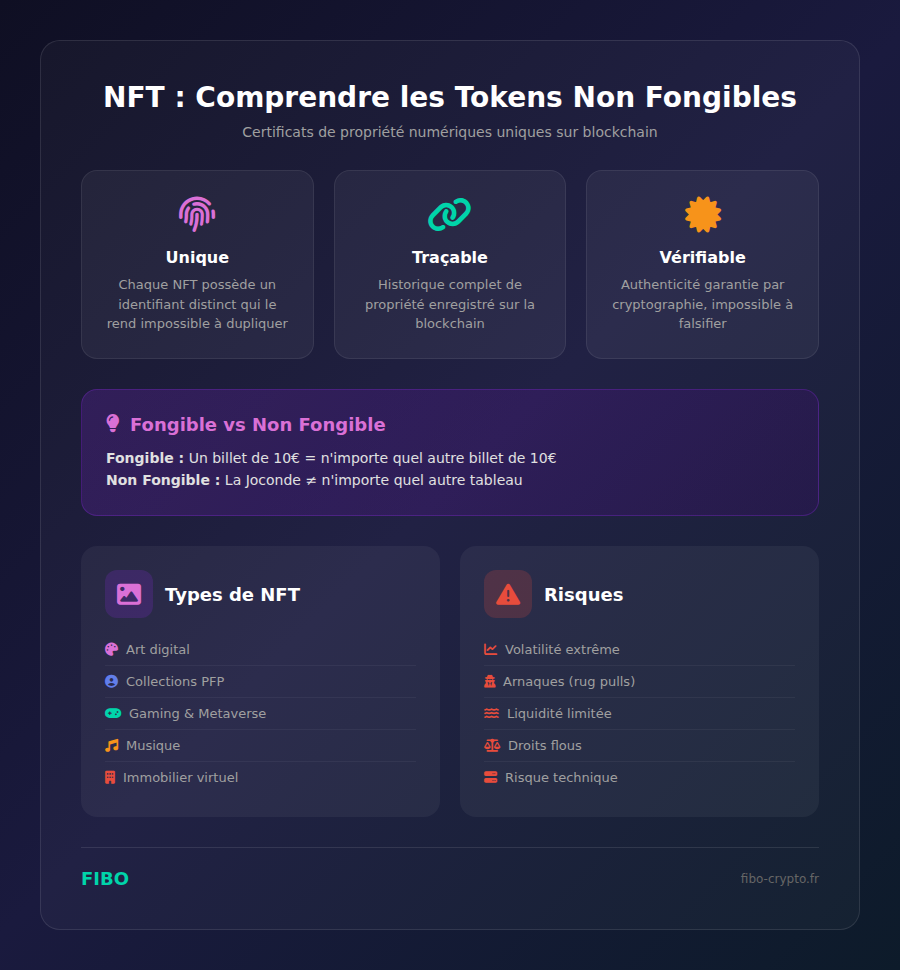
An NFT (Non-Fungible Token) is a unique digital certificate of ownership permanently stored on a blockchain. Unlike cryptocurrencies like Bitcoin where each unit is interchangeable, each NFT is distinct and cannot be exchanged identically for another.
Understanding Fungibility
Fungibility is a fundamental economic concept:
- Fungible asset: Interchangeable with another of the same nature and value. A $10 bill is worth exactly as much as any other $10 bill.
- Non-fungible asset: Unique and irreplaceable. The Mona Lisa cannot be exchanged for just any other painting — it’s one of a kind.
NFTs bring this concept of uniqueness to the digital world. Before their invention, copying a digital file was trivial, and the copy was indistinguishable from the original. NFTs now allow us to distinguish an “original” from its copies through a tamper-proof certificate of authenticity.
How Does an NFT Work Technically?
An NFT works through a smart contract deployed on a blockchain that generates a unique identifier (token ID), associated with metadata describing the represented asset.
Technical Components of an NFT
1. The Smart Contract
A smart contract is a self-executing computer program deployed on a blockchain. It defines all the rules of the NFT: creation (minting), transfer, burning, and potentially royalties paid to the creator on resales. On Ethereum, the most common standards are:
- ERC-721: Each token is unique (1 NFT = 1 identifier)
- ERC-1155: Allows semi-fungible tokens (multiple identical copies of the same NFT)
2. The Token ID
Each NFT has a unique numerical identifier within its smart contract. It’s like a serial number that distinguishes it from all other tokens issued by the same contract. The combination “contract address + token ID” absolutely identifies each NFT in the world.
3. Metadata
Metadata describes the NFT: name, description, attributes (for collections), and most importantly, the link to the associated file. They can be stored:
- On-chain: Directly on the blockchain (expensive but permanent)
- Off-chain decentralized: On IPFS or Arweave (recommended)
- Off-chain centralized: On a regular server (risky if the server shuts down)
4. The Associated File
Contrary to a widespread misconception, the NFT generally does NOT contain the image or file itself. It contains a link (URI) to that file. This is why storage choice is crucial: if the server hosting the image disappears, your NFT may point to… nothing.
Blockchains Supporting NFTs
Several blockchains allow creating and trading NFTs:
- Ethereum: The historical reference, but sometimes high gas fees
- Solana: Fast and inexpensive, popular for PFP collections
- Polygon: Ethereum Layer 2 solution, near-zero fees
- Tezos: Eco-friendly, favored by artists
- Bitcoin (Ordinals): NFTs directly inscribed on Bitcoin since 2023

Types of NFTs
NFTs come in several categories based on their use: digital art, PFP collections, gaming, music, virtual real estate, and utilities.
Digital Art
Digital artwork represents the most publicized use of NFTs. In March 2021, artist Beeple sold a composite piece for $69.3 million at Christie’s, catapulting NFTs into global headlines. Platforms like SuperRare, Foundation, and Art Blocks allow artists to sell directly to collectors without intermediaries.
PFP Collections (Profile Picture)
“Profile picture” collections have created a genuine cultural phenomenon. CryptoPunks (2017), Bored Ape Yacht Club (2021), Azuki, Pudgy Penguins… Owning an NFT from these collections grants access to exclusive communities and serves as a social signal in the crypto ecosystem.
Gaming and Metaverse
NFTs are revolutionizing gaming by allowing players to truly own their virtual items. Weapons, skins, land, characters… everything can be tokenized and resold. Games like Axie Infinity, Gods Unchained, Illuvium, or The Sandbox use this technology.
Music and Entertainment
Artists use NFTs to sell their music directly to fans, with automatic royalties on resales. Platforms like Sound.xyz even allow fans to own “shares” of songs and receive a fraction of streaming revenue.
Virtual Real Estate
Land in virtual worlds (Decentraland, The Sandbox, Otherside) is sold as NFTs. In 2021-2022, some parcels traded for several million dollars. Brands like Adidas, Gucci, and Warner Music have purchased virtual land.
Utilities and Certifications
Beyond collectibles, NFTs serve as:
- Event tickets: Anti-counterfeit, controlled resale
- Certificates of authenticity: Luxury goods, art, wine
- POAPs: Proof of attendance at events
- Exclusive access: Private content, gated communities
- Diplomas and certifications: Several universities are experimenting
Why Do NFTs Have Value?
An NFT’s value rests on four pillars: verifiable scarcity, traceable provenance, potential utility, and community or speculative dimensions.
Verifiable Scarcity
Thanks to the blockchain, a collection’s supply is publicly verifiable and immutable. If a collection is limited to 10,000 pieces, that number cannot be changed. This programmed scarcity creates value for collectors.
Traceable Provenance
An NFT’s complete history — creation, successive sales, owners — is permanently recorded on the blockchain. It’s impossible to falsify an artwork’s origin or falsely claim an NFT belonged to a celebrity.
Utility
Some NFTs provide access to concrete benefits: exclusive events, private content, governance votes, airdrops, passive income. This “utility” beyond mere possession can justify value.
Speculation and Community
As with traditional art, much of the value is subjective and social. Belonging to a prestigious community, the social status conferred, and speculation on future appreciation motivate many buyers.
How to Buy Your First NFT
To buy an NFT, you need a compatible wallet, cryptocurrencies, and access to a marketplace.
Step 1: Create a Wallet
Install a non-custodial wallet:
- MetaMask: For Ethereum, Polygon, Arbitrum
- Phantom: For Solana
- Rainbow: Elegant MetaMask alternative
Carefully save your seed phrase (12-24 words). It’s the only way to recover your funds if you lose access.
Step 2: Buy Crypto
Purchase ETH or SOL on a regulated exchange (Coinbase, Kraken, Binance) then transfer to your wallet. Budget slightly more than the NFT price to cover transaction fees.
Step 3: Connect Your Wallet to a Marketplace
Main marketplaces:
- OpenSea: The largest, multi-chain
- Blur: Trader-focused, aggregator
- Magic Eden: Leading platform on Solana
- Foundation: Curated art, invitation only
- Rarible: Community-driven, multi-chain
Step 4: Explore and Buy
Browse collections, check statistics (volume, floor price, holder count), and buy via “Buy Now” or make an offer. On Ethereum, watch out for gas fees which can be significant during congestion.
NFT Risks to Know
Key risks include: extreme volatility, sophisticated scams, limited liquidity, and confusion about ownership rights.
Price Volatility
The NFT market is extremely volatile. Popular collections have lost 90% or more of their value within months. Floor prices can collapse overnight if hype fades. Only invest what you can afford to lose entirely.
Scams
The sector is unfortunately rife with scams:
- Rug pulls: Creators disappear with funds after the sale
- Phishing: Fake sites mimicking official marketplaces
- Fake collections: Copies of popular projects with similar names
- Wallet drainers: Malicious smart contracts that empty your wallet
- Wash trading: Artificially inflated volumes through transactions between linked wallets
Limited Liquidity
Unlike cryptocurrencies, NFTs don’t sell instantly. An NFT can remain unsold for months if demand evaporates. Never consider an NFT a “liquid” investment.
Ownership Rights Confusion
Owning an NFT generally does NOT mean owning copyright to the work. You own the token (certificate of ownership), not necessarily the right to reproduce, modify, or commercialize the image. Some projects like Bored Ape Yacht Club explicitly grant commercial rights, but that’s the exception.
Technical Risks
If the server hosting the image disappears and storage isn’t decentralized, your NFT may point to a dead link. Always check where metadata is stored (IPFS or Arweave = safer).
The Future of NFTs: Beyond the Hype
The future of NFTs is moving toward utility use cases: real-world asset tokenization (RWA), digital identity, and seamless integration into the traditional economy.
Real-World Asset Tokenization (RWA)
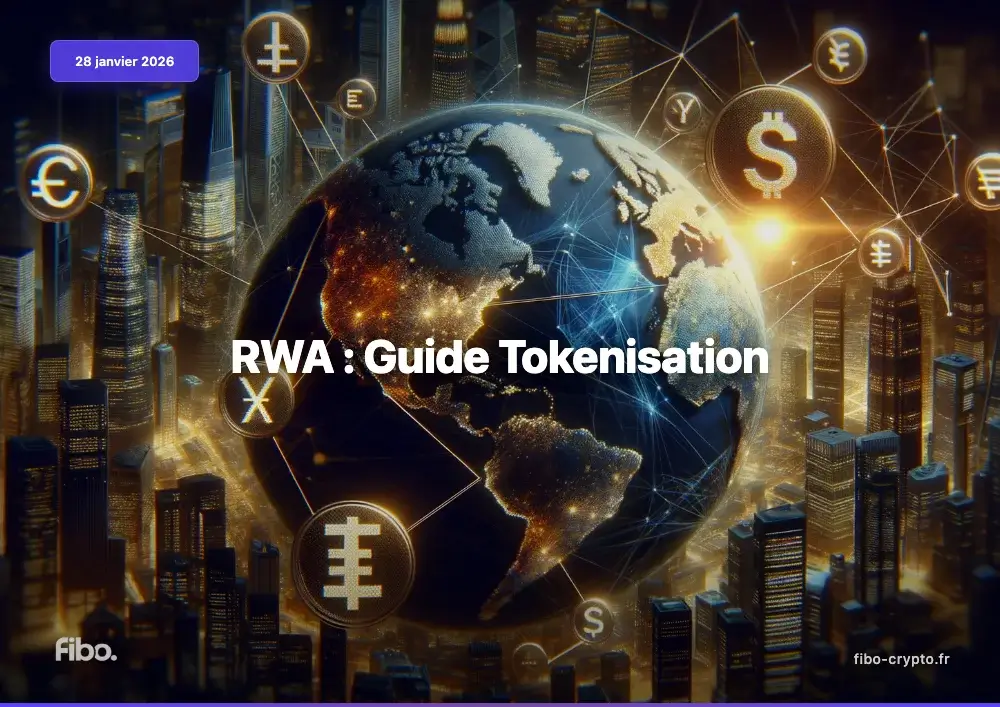
NFTs can represent physical assets on the blockchain: fractional real estate, physical artworks, luxury watches, investment fund shares. This RWA tokenization is attracting traditional financial institutions.
Digital Identity
NFTs can serve as tamper-proof diplomas, professional certificates, or identity proofs. Estonia is already experimenting with official blockchain documents.
Invisible Mainstream Integration
Brands like Nike (.SWOOSH), Starbucks (Odyssey), Reddit (Collectible Avatars), and Instagram have integrated NFTs into their products — often without using the term “NFT” to avoid negative preconceptions. This “invisible” adoption may be the real revolution.
📚 Glossary
- NFT (Non-Fungible Token): A unique digital token representing ownership of a digital or physical asset, permanently recorded on a blockchain.
- Blockchain: A distributed, immutable digital ledger that records transactions chronologically and transparently.
- Smart contract: A self-executing computer program deployed on a blockchain, defining NFT rules (creation, transfer, royalties).
- ERC-721: Technical standard on Ethereum defining how to create unique NFTs. Each token has a distinct identifier.
- Floor price: The lowest-priced NFT available for sale in a collection. A key indicator of collection value.
- Mint: The action of creating an NFT for the first time on the blockchain. The first owner “mints” the token.
- Gas: Transaction fees paid to validators to execute operations on a blockchain like Ethereum.
- IPFS: InterPlanetary File System, a decentralized storage network used to host NFT-associated files permanently.
- PFP (Profile Picture): Category of NFTs designed to be used as profile pictures on social networks.
- Royalties: Percentage of sale price automatically paid to the original creator on each NFT resale.
- Rug pull: Scam where project creators abandon development and disappear with funds after the initial sale.
- Wallet: Digital wallet (software or hardware) for storing, sending, and receiving NFTs and cryptocurrencies.
- Whitelist: List of wallet addresses authorized to purchase an NFT early, often at a reduced or guaranteed price.
- Metadata: Information describing an NFT (name, description, attributes, file link). Can be on-chain or off-chain.
Frequently Asked Questions
What is an NFT in simple terms?
An NFT is a unique digital certificate of ownership stored on a blockchain. It proves you are the authentic owner of a digital asset (image, video, music) or physical asset. Unlike cryptocurrency, each NFT is unique and non-interchangeable.
Can you copy an NFT since it’s a digital image?
Yes, you can copy the image associated with an NFT, just as you can photograph the Mona Lisa. However, the copy is not the NFT. The value lies in the certificate of authenticity recorded on the blockchain, proving you own the original recognized by the creator.
How much does it cost to create an NFT?
Costs vary by blockchain. On Ethereum, gas fees can range from $5 to $100+ depending on congestion. On Solana or Polygon, fees are typically under $1. Some platforms offer “lazy minting” where fees are only paid upon the first sale.
Are NFTs a good investment?
NFTs are extremely risky as investments. The vast majority lose 90%+ of their value. Only a tiny minority of collections maintain long-term value. Only invest what you can afford to lose entirely and favor projects with real utility.
How do I spot an NFT scam?
Watch out for guaranteed profit promises, anonymous teams, unrealistic roadmaps, and pressure to buy quickly. Always verify official links on the project website, check creator history, and never click links received via direct message.
Do I own copyright when I buy an NFT?
Generally no. By default, you own the token (certificate of ownership), not the copyright to the work. Some projects like Bored Ape Yacht Club explicitly grant commercial rights, but that’s the exception. Always read the terms before buying.
📰 Sources
This article is based on the following sources:
- Ethereum.org – Non-fungible tokens (NFTs) – Official Ethereum documentation
- EIP-721: Non-Fungible Token Standard – Official technical specification
- Dune Analytics – NFT Market Overview – Updated on-chain data
- NFTGo Analytics – NFT collection statistics and rankings
- Chainalysis – NFT Market Report – NFT market analysis
How to cite this article: Fibo Crypto. (2026). NFT: Complete Guide to Understanding Non-Fungible Tokens. Retrieved from https://fibo-crypto.fr/en/blog/nft-complete-guide