Bitcoin: The Silent Redistribution of Early Coins
📋 En bref (TL;DR)
- Historic redistribution: OG holders (2009-2012 miners) are methodically liquidating their positions, with 470,000 BTC reactivated in 2024-2025
- Not a bear market: fundamentals have never been stronger (spot ETFs, record hashrate, growing institutional adoption)
- Unprecedented decoupling: Bitcoin/Nasdaq correlation drops to 0.46, its lowest in 5 years, signaling an independent dynamic
- Market maturation: ownership fragmentation reduces volatility (corrections dropping from -83% to -50%) and strengthens resilience
- Outlook: consolidation phase estimated at 6-18 months before full absorption and bullish resumption
Why Is Bitcoin Stalling While Markets Are at All-Time Highs?
For several months, Bitcoin has been going through a phase that puzzles investors: while traditional markets (S&P 500, Nasdaq) reach historic highs, BTC remains stuck in a frustrating price range. For many investors, this consolidation phase looks like market exhaustion.
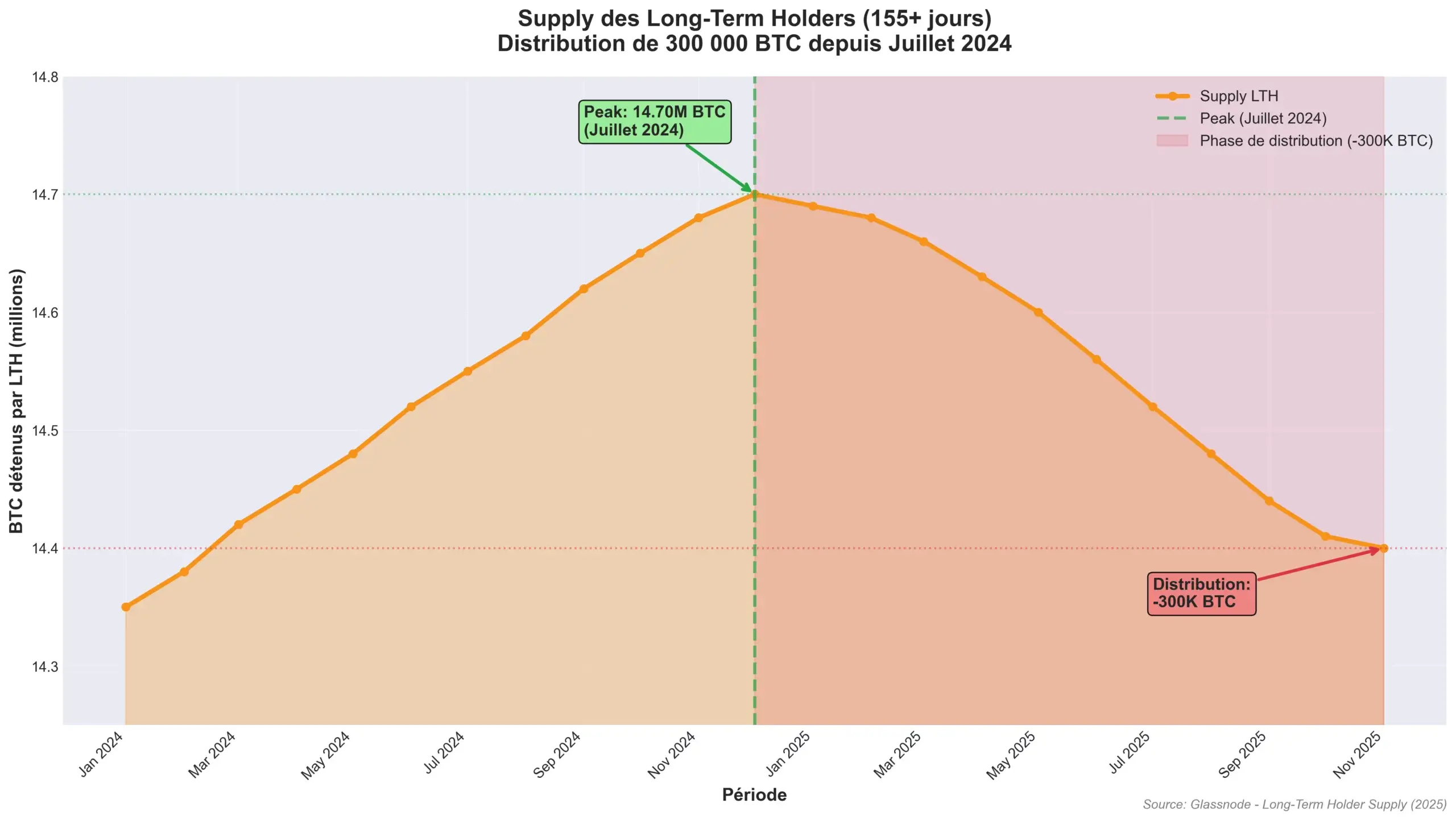
In reality, Bitcoin’s stagnation conceals a much deeper transformation: a silent redistribution of supply, where the earliest holders — the famous “OG holders” — are methodically liquidating a portion of their positions in favor of a new generation of investors, both retail and institutional.
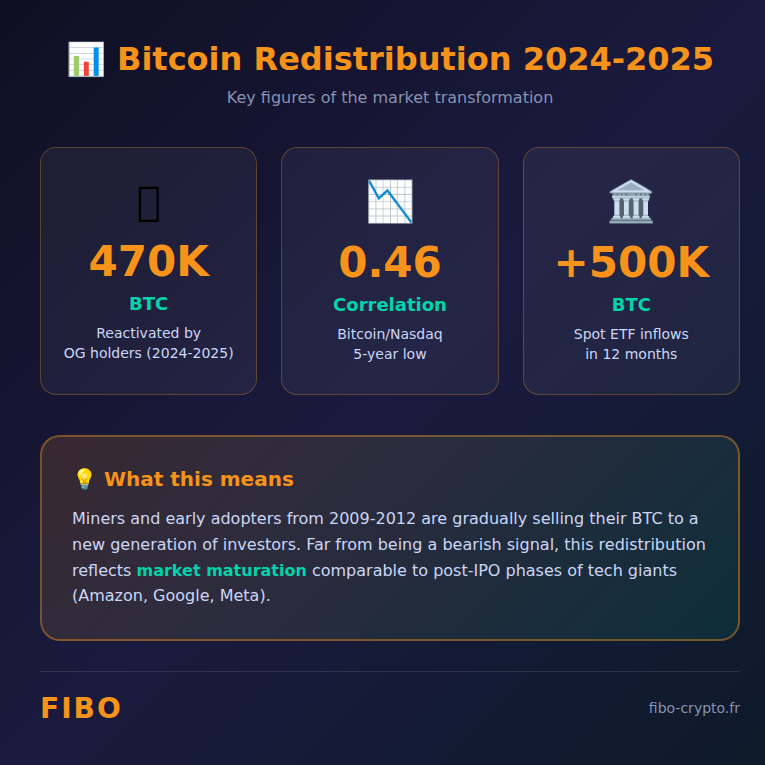
This phase resembles the post-IPO periods of major tech stocks: Amazon, Google, and Meta all experienced long and frustrating consolidation phases, during which pioneers gradually sold… before the market surged to new highs.
The Paradox: Bitcoin’s Price Stalls Despite a Favorable Context
The Bitcoin market today presents an apparent contradiction. On one hand, fundamentals have never been stronger: approval of spot ETFs, growing institutional adoption, hashrate (the total computing power deployed by miners to secure the network) at record levels, no major regulatory crisis. On the other hand, the price remains trapped in an interminable consolidation that erodes investor morale.
Historically, Bitcoin tended to amplify movements in risk assets: when the Nasdaq rose, Bitcoin rose even more. The 2023–2025 cycle is different: consolidation periods are longer, and Bitcoin increasingly follows its own logic, driven by its internal supply and demand cycle rather than equity markets alone.
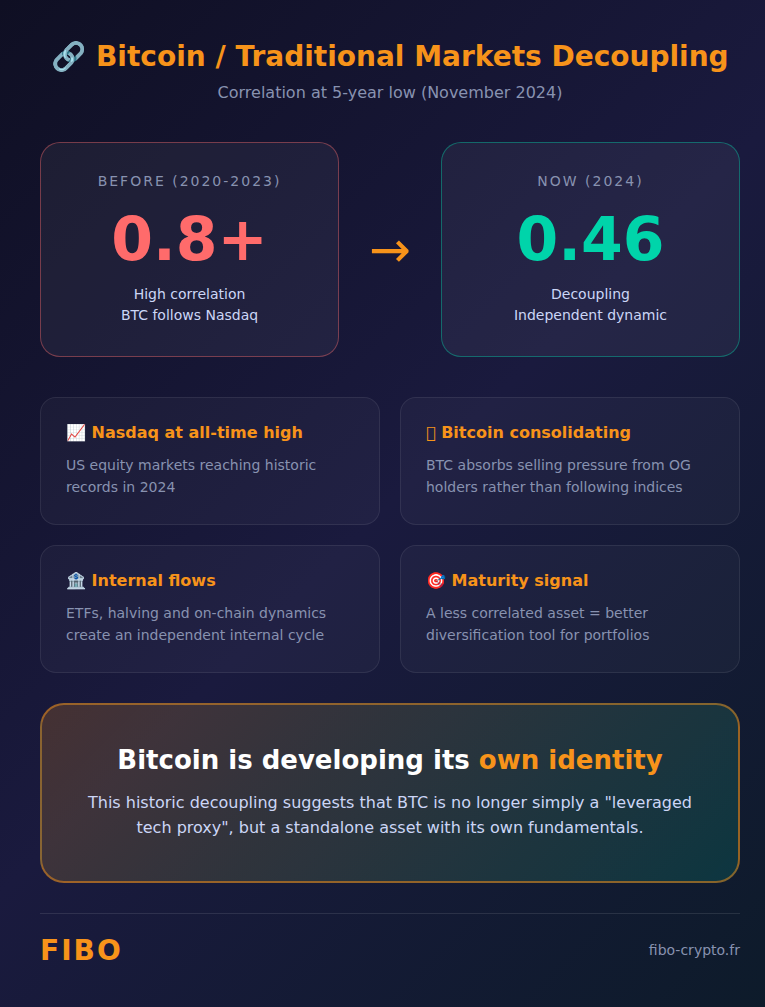
This situation isn’t new in the history of innovative assets. It recalls the post-IPO periods of Amazon, Google, or Facebook, where early investors gradually liquidate their positions while the broader market rises. The result? Frustrating consolidation, depressed sentiment, but laying the groundwork for healthy asset redistribution.
OG Holder Distribution: The Blockchain Trail
On-chain data confirms this hypothesis irrefutably. Galaxy Digital recently revealed selling $9 billion worth of Bitcoin for a single client. This staggering figure is just the visible part of a larger phenomenon: dormant addresses from the early miner era (2009-2012) are awakening and redistributing their holdings.
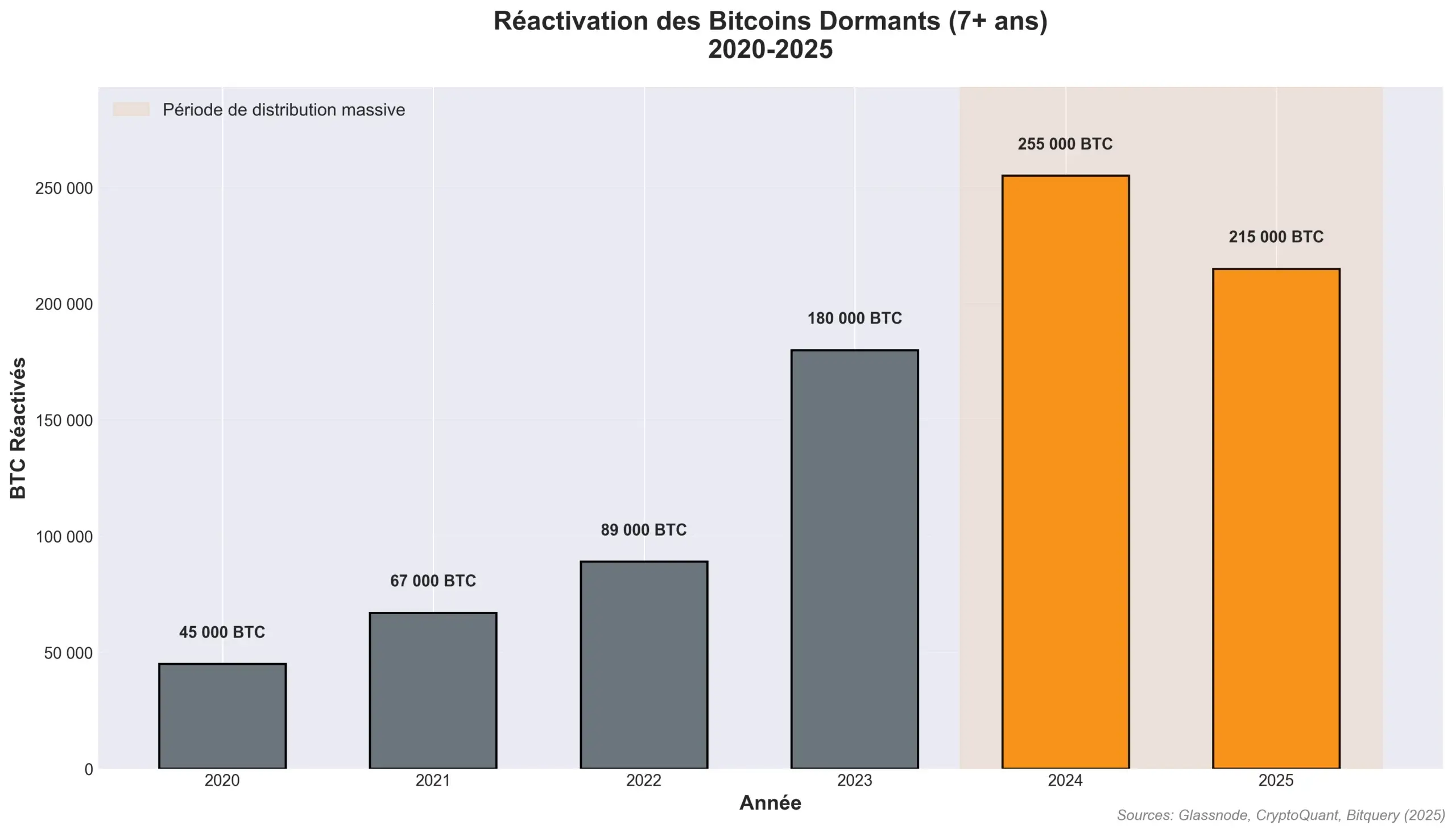
These “OG holders” — those who mined or bought Bitcoin at $1, $10, or $100 — are now realizing generational gains. For the first time in Bitcoin’s history, market liquidity allows massive exits without causing a collapse. Unlike previous cycles (2015, 2019), the market has the depth needed to absorb this selling pressure without panicking.
Why This Isn’t a Bear Market
Several indicators distinguish this phase from a true bear market:
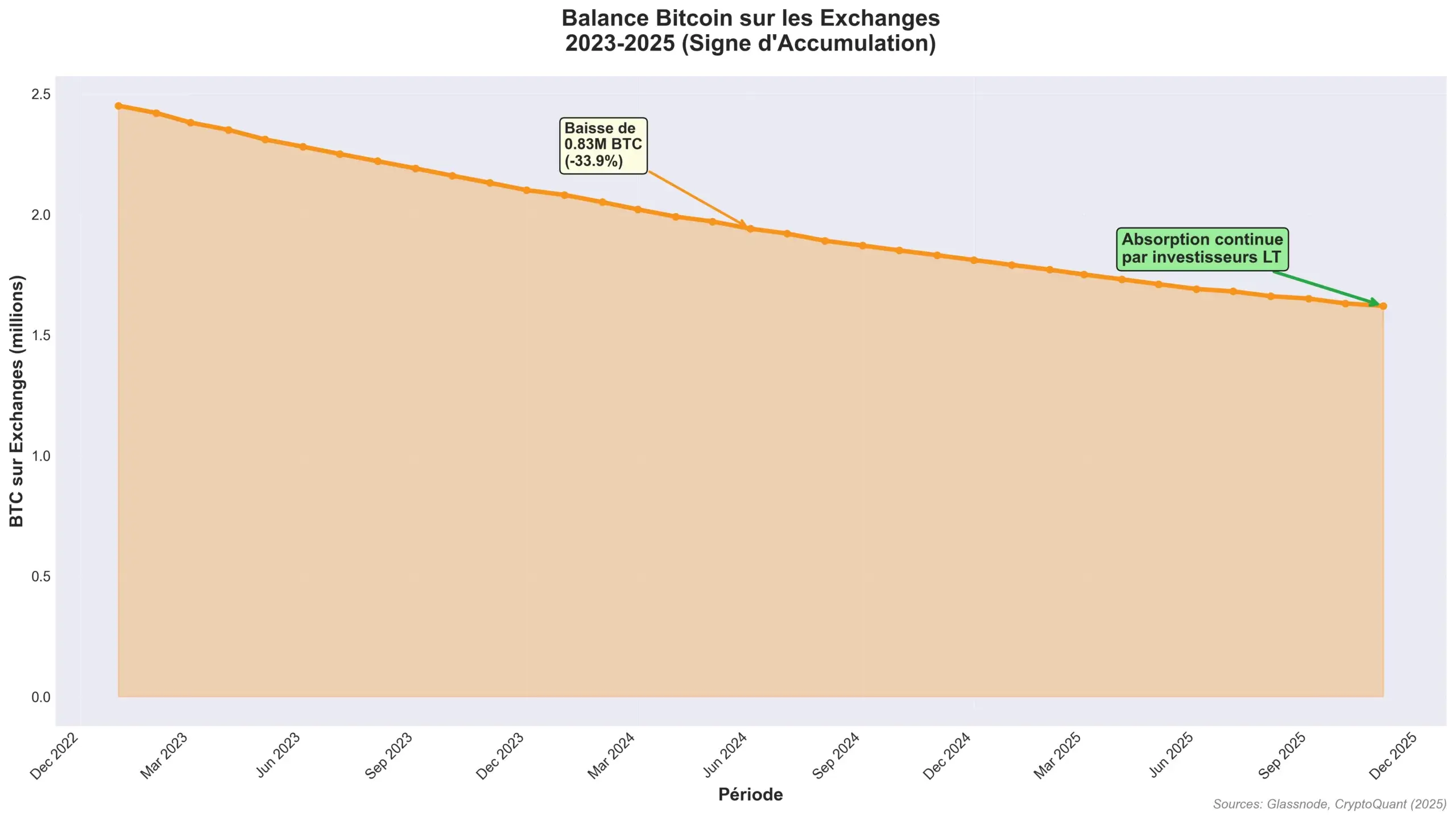
1. Continuous supply absorption: Buyers continue to step in on dips, preventing new lows from being established.
2. Relative price stability: Despite selling pressure, Bitcoin maintains a stable range, indicating solid underlying demand.
3. Intact fundamentals: The Bitcoin network has never been more secure, with record hashrate and growing institutional adoption via ETFs.
4. Negative sentiment without terror: The community is frustrated, not terrified. This is a crucial distinction: frustration reflects disappointed expectations, not an existential questioning of Bitcoin.
From Concentration to Fragmentation: A Necessary Maturation
A concentrated market, where a few whales hold a disproportionate share of supply, is inherently unstable. These players can manipulate prices, create extreme volatility, and discourage institutional adoption.
Conversely, a fragmented market — where millions of investors hold more modest positions — is structurally more stable. Price variations are absorbed by a broad base, reducing volatility and creating an environment conducive to mass adoption.
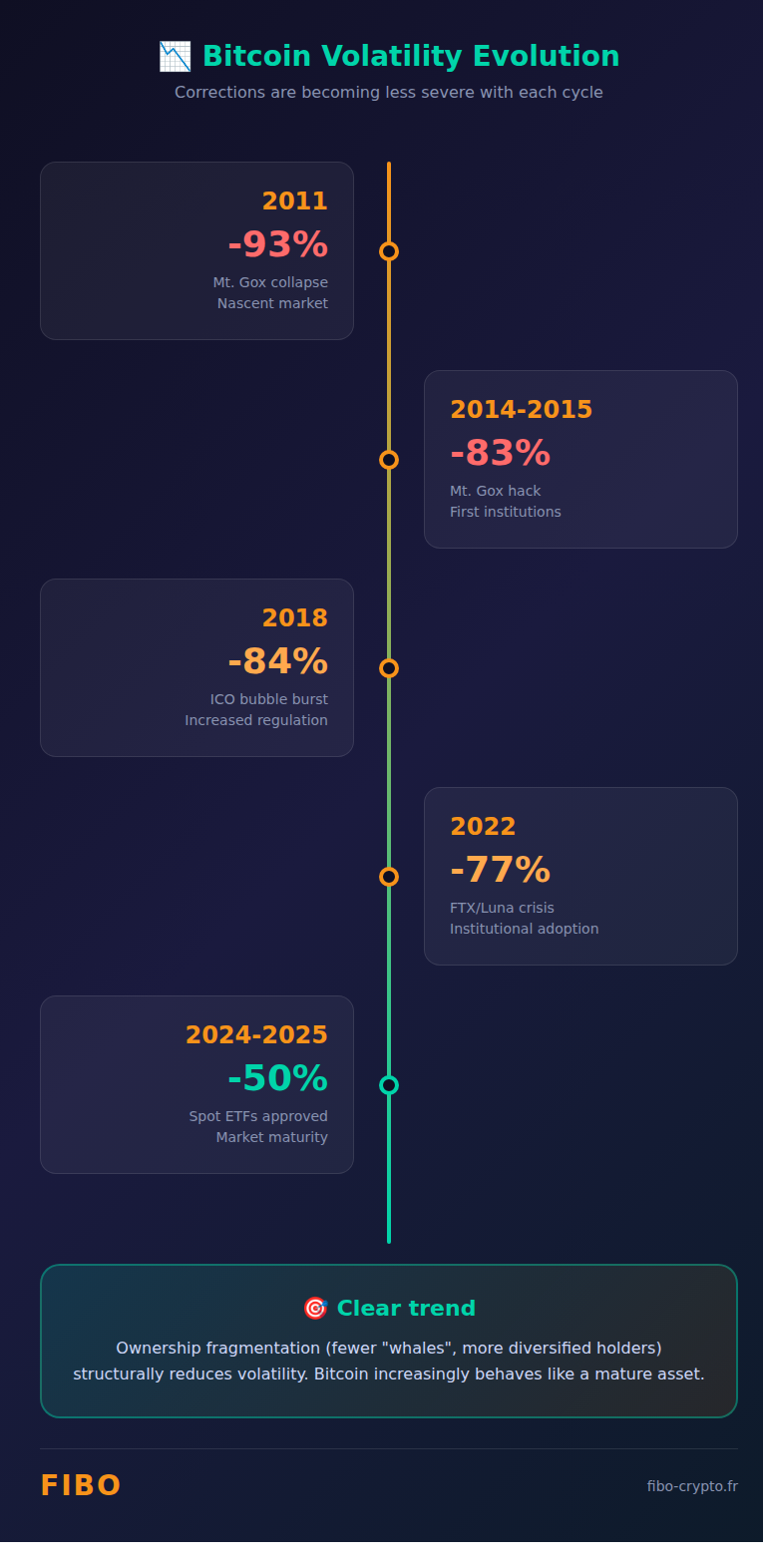
The current phase is precisely this transition: from concentrated speculative to decentralized monetary. For early holders, it’s the opportunity to realize historic gains. For the market, it’s a redistribution that strengthens long-term resilience.
Timeline and Outlook
This “silent IPO” won’t resolve overnight. Analyses suggest a consolidation of 6 to 18 months before OG holder supply is fully absorbed.
- Decreasing volatility: Massive corrections (80% in 2018) become moderate (50%, then 30%).
- Correlation return: Bitcoin begins following risk markets again once distribution is complete.
- Sentiment improvement: Frustration gives way to optimism as price breaks out of its range.
Lessons from Technological History
Bitcoin isn’t the first innovative asset to go through this phase. The internet, PCs, mobile, cloud: all these innovation cycles followed a similar pattern. Massive initial risk attracts early adopters, who realize enormous gains. Then comes distribution, where these pioneers liquidate their positions, causing frustrating consolidation. Finally, massive institutional adoption propels the asset toward a new growth phase.
Bitcoin is following exactly this trajectory. Volatility was the price of its birth. Stability will be the proof of its maturity.
Conclusion: A Bullish Transition Disguised as Stagnation
This phase may seem boring for short-term traders. Yet it is fundamentally bullish for Bitcoin’s future. OG holder redistribution is transforming Bitcoin from a concentrated speculative asset into a decentralized monetary asset, held by millions of investors worldwide.
This transition isn’t a weakness: it’s maturation. Bitcoin isn’t stagnating, it’s consolidating. It isn’t declining, it’s redistributing. And when this phase is complete, the market will have a solid, fragmented, and resilient foundation to begin the next growth cycle.
As Visser Labs writes: “Bitcoin’s volatility was the price of its birth. Its stability will be the proof of its adulthood.”
📚 Glossary
- Bitcoin : First decentralized cryptocurrency, created in 2009 by Satoshi Nakamoto. Operates on a peer-to-peer network secured by Proof of Work.
- ETF : Exchange-Traded Fund. Bitcoin spot ETFs allow investing in Bitcoin through a regulated financial product.
- Hashrate : Total computing power deployed by miners to secure the Bitcoin network. A high hashrate indicates a more secure network.
- On-chain : Data directly from the blockchain, allowing analysis of transactions, fund movements, and investor behavior.
- OG Holders : “Original Gangster holders” – the very first Bitcoin holders, miners or buyers from the 2009-2012 era, who own BTC acquired at extremely low prices.
- Long-Term Holders : Addresses holding Bitcoin for more than 155 days. Key indicator of long-term investor conviction.
- Whales : Addresses holding very large amounts of Bitcoin (typically 1000+ BTC). Their movements can significantly influence the market.
- ATH : All-Time High, the highest price ever reached by an asset. For Bitcoin, each new cycle has historically produced a new ATH.
- Cold storage : Method of storing cryptocurrencies offline (secure USB drives, hardware wallets), offering maximum protection against hacking.
- HODL : Term derived from a typo of “hold,” now an acronym for “Hold On for Dear Life.” Strategy of holding cryptocurrencies for the long term.
- Consolidation : Market phase where price moves within a narrow range without a clear trend, often interpreted as a period of accumulation or distribution.
- DCA : Dollar Cost Averaging. Strategy of regularly investing a fixed amount, regardless of price, to smooth entry points.
Frequently Asked Questions
Is this a good time to buy Bitcoin?
It’s difficult to predict market movements. That’s why many investors use DCA (dollar-cost averaging): you regularly buy the same amount, regardless of price, which reduces the impact of fluctuations. This strategy is particularly relevant during consolidation phases.
What influences Bitcoin's price?
Bitcoin’s price is influenced by many factors: supply and demand, investor confidence, global adoption, macroeconomic news, regulations, and network technical developments. Bitcoin remains a volatile asset, so it’s essential not to invest money you can’t afford to lose.
Why are OG holders selling now?
Early Bitcoin holders (2009-2012 miners) have seen their investments multiply by millions. The current cycle offers, for the first time, sufficient liquidity to sell massive positions without crashing the market. It’s a unique opportunity to realize generational gains.
Is this consolidation a bearish sign?
No. Unlike a classic bear market, fundamentals remain solid (ETFs, record hashrate, institutional adoption). Selling pressure comes from OG holder redistribution, not loss of confidence. It’s a maturation phase, not decline.
How long will this consolidation phase last?
Analyses suggest a duration of 6 to 18 months for OG holder supply to be fully absorbed by new buyers (retail, institutional, ETFs). After this phase, the market should return to bullish dynamics.
📰 Sources
This article is based on the following sources:
Comment citer cet article : Fibo Crypto. (2026). Bitcoin: The Silent Redistribution of Early Coins. Consulté le 4 March 2026 sur https://fibo-crypto.fr/en/blog/bitcoin-silent-redistribution-early-coins