
Best Crypto News Sources: Complete Guide to Reliable Information 2025
📋 En bref (TL;DR)
- Cross-reference sources : Check at least 2-3 different media outlets (CoinDesk, The Block, Decrypt) before making any investment decision
- Reliable media : Prioritize established outlets with identifiable editorial teams and transparent ethical guidelines
- On-chain tools : Use Glassnode, DeFi Llama and Dune Analytics to verify data yourself instead of blindly trusting « experts »
- Systematic DYOR : « Do Your Own Research » isn’t just a slogan but a daily discipline to avoid scams
- Spot red flags : Guaranteed gains, artificial urgency, anonymous accounts, projects without whitepapers = run immediately
- Daily routine : 15-30 minutes of structured monitoring per day beats hours of chaotic Twitter scrolling
- Quality communities : Reddit (r/CryptoCurrency, r/Bitcoin), legitimate project Discords and reputable podcasts complement media perfectly
Getting informed correctly in crypto is the difference between winning and losing. In 2025, the cryptocurrency market generates a continuous flow of information: 24/7 news, viral tweets, technical analysis, Telegram rumors, self-proclaimed influencers… In this constant noise, how do you distinguish reliable sources from dream sellers? This complete guide lists all the resources to build an effective crypto monitoring system — professional media, on-chain analysis tools, educational YouTube channels, quality podcasts, and most importantly, techniques to detect fake news and shills.
Why getting properly informed is crucial in crypto
The crypto market is unique. Unlike traditional markets that close on weekends, crypto never sleeps. A Fed announcement at 8 PM can move Bitcoin by 10% in minutes. An Elon Musk tweet can create (or destroy) billions in market cap. In this volatile environment, information is your first line of defense.
Misinformation is costly
According to a Chainalysis study, crypto scams cost investors more than $12 billion in 2024. Most victims were trapped by false information: promises of unrealistic returns, fake partnership announcements, pump & dump schemes orchestrated on Telegram. The first protection? Knowing how to recognize a reliable source from a toxic one.
The informational advantage
In crypto, those who win are often those who know before others. Not necessarily insiders — simply investors who have built effective monitoring systems. Following the right sources allows you to anticipate market movements, understand emerging narratives, and make informed rather than emotional decisions.
Top English-language crypto media
Most crypto information first circulates in English. Here are the essential sources for complete monitoring:
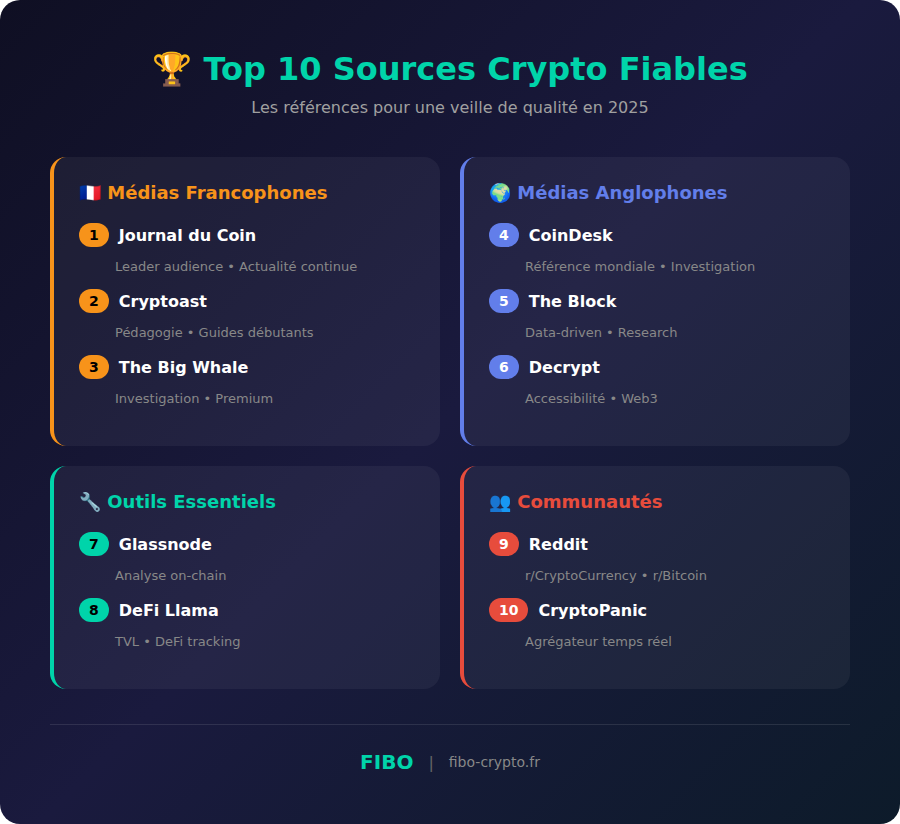
CoinDesk — The New York Times of crypto
Founded in 2013, CoinDesk is the global reference. Investigative journalism, institutional coverage, market indices (CoinDesk 20), podcasts, conferences (Consensus)… It’s the outlet that revealed the FTX scandal. Essential.
The Block — Data-driven research
The Block combines news and research. Their data dashboards (The Block Data) are used by professionals. In-depth articles, frequent exclusives, and a very analytical approach.
Decrypt — Accessibility
Decrypt excels at making things accessible. Their beginner guides are excellent, and their coverage includes NFTs, gaming, and Web3 culture. Less institutional than CoinDesk, more accessible.
Bitcoin Magazine — Unapologetic maximalism
Bitcoin Magazine, founded in 2012 (co-founded by Vitalik Buterin!), focuses exclusively on Bitcoin. If you’re a bitcoiner, it’s your bible. Technical analysis, philosophy, Lightning Network news.
Blockworks — Professional grade
Blockworks targets institutional investors and professionals. Webinars, quality podcasts (Empire, Lightspeed), and deep macro coverage.
Cointelegraph — Global coverage
Cointelegraph offers broad coverage with an accessible style. Available in multiple languages, it covers all aspects of the crypto ecosystem with helpful infographics.
Crypto Twitter/X: accounts to follow
Twitter (X) remains the beating heart of Crypto Twitter (CT). Information circulates there before the media. But beware: it’s also a nest of shills and scams. Here’s a selection of reliable accounts:
Serious analysts and traders
- @WClementeIII (Will Clemente) — Bitcoin on-chain analysis, Glassnode data commentary
- @cburniske (Chris Burniske) — Ex-ARK Invest, macro visions and market cycles
- @Cobie — Respected trader, humor and cutting insights
- @DylanLeClair_ — Bitcoin analyst, accessible on-chain data
- @RaoulGMI (Raoul Pal) — Global macro, ex-Goldman Sachs, institutional vision
- @nic__carter (Nic Carter) — Castle Island Ventures, Bitcoin research
Developers and builders
- @VitalikButerin — Ethereum co-founder, technical and philosophical reflections
- @muabortoothcager (Muneeb Ali) — Stacks, Bitcoin L2, development
- @hasufl (Hasu) — Research, MEV, protocol economics
- @0xMaki — DeFi builder, Sushi/Aura contributor
News aggregators
- @tier10k — Instant breaking news
- @WatcherGuru — Real-time updates (always verify!)
- @BitcoinMagazine — Bitcoin news
- @TheBlock__ — The Block’s Twitter account
Crypto YouTube: recommended channels
YouTube is ideal for visual learning. But beware of « TO THE MOON 🚀 » thumbnails — many creators are paid to promote questionable projects. Here are quality channels:
Educational channels
- Coin Bureau (2M+ subscribers) — Guy explains everything with clarity. Project reviews, technical analysis, guides. Very educational.
- Bankless — High-level DeFi/Ethereum interviews and discussions
- Real Vision Crypto — Raoul Pal, macro visions, institutional interviews
- Unchained (Laura Shin) — In-depth interviews, crypto journalism
- Whiteboard Crypto — Excellent explanatory animations for beginners
- Benjamin Cowen — Bitcoin technical analysis, data-driven
- Anthony Pompliano — Bitcoin and macro, accessible content
Crypto podcasts: learn while you commute
Podcasts allow you to dive deep into topics during your commute or gym sessions. Here are the must-listens:
Top podcasts
- Bankless — THE DeFi/Ethereum reference podcast. Ryan and David dissect the ecosystem with quality guests.
- Unchained (Laura Shin) — High-level journalistic interviews
- The Pomp Podcast (Anthony Pompliano) — Bitcoin and macro, varied guests
- What Bitcoin Did (Peter McCormack) — Bitcoin-focused interviews
- Empire (Blockworks) — For professionals, business visions
- Epicenter — Technical blockchain development
- The Defiant — DeFi focused, Camila Russo (ex-Bloomberg)
- Up Only — Crypto culture and market commentary
Crypto newsletters: essentials in your inbox
Newsletters structure information and avoid FOMO from infinite scrolling. Here are the best:
- Bankless — DeFi and Ethereum, investment strategies
- The Daily Gwei (Anthony Sassano) — Daily Ethereum news
- Week in Ethereum News — Technical weekly summary
- Milk Road — Accessible and humorous crypto news
- The Defiant — DeFi focus, by Camila Russo (ex-Bloomberg)
- Messari Crypto Theses — Annual deep-dive research report
On-chain and market analysis tools
Data doesn’t lie. These tools let you verify for yourself instead of blindly trusting « experts »:
Market aggregators
- CoinMarketCap — Prices, market cap, volumes. The classic.
- CoinGecko — More independent alternative (CMC is owned by Binance)
On-chain analysis
- Glassnode — THE reference. Bitcoin and Ethereum data, advanced metrics (MVRV, Puell Multiple, etc.). Limited free version but useful.
- Dune Analytics — Community dashboards on all blockchains. Raw data, SQL queries.
- Nansen — « Smart money » wallet tracking, institutional flows (paid)
- Arkham Intelligence — Entity and wallet tracking, on-chain investigations
DeFi analysis
- DeFi Llama — TVL by protocol and blockchain, yields, comparisons. Essential.
- Token Terminal — Protocol financial metrics (revenue, P/E ratios)
Fundamental research
- Messari — Project profiles, research reports, screenings
- CryptoPanic — Real-time news aggregator with sentiment
Forums and crypto communities
Communities can accelerate your learning — if you choose the right ones:
- r/CryptoCurrency (7M+ members) — News and general discussions
- r/Bitcoin — Bitcoin community, strict moderation
- r/Ethereum — Technical discussions and ETH news
- r/CryptoTechnology — Deep technical discussions
- r/DeFi — Decentralized finance focused
Discord
Every major project has its Discord. Prioritize official servers of projects you’re invested in. Beware of « alpha » groups promising easy gains.
Telegram
⚠️ High-risk zone. Many Telegram groups are scam and pump & dump nests. NEVER invest based on Telegram advice. Use it only for official project announcements.
How to detect fake news and shills
This is THE crucial skill. Here are techniques to separate signal from noise:
Immediate red flags
- Guaranteed gains — « 100x guaranteed », « 10%/day returns » = certain scam
- Artificial urgency — « Last chance », « Only 2 hours left » = manipulation
- Anonymous account — No name, no face, no track record = maximum distrust
- Too good to be true — If it seems unrealistic, it probably is
- Social pressure — « Everyone’s buying », « You’ll miss the train » = artificial FOMO
Verifying information
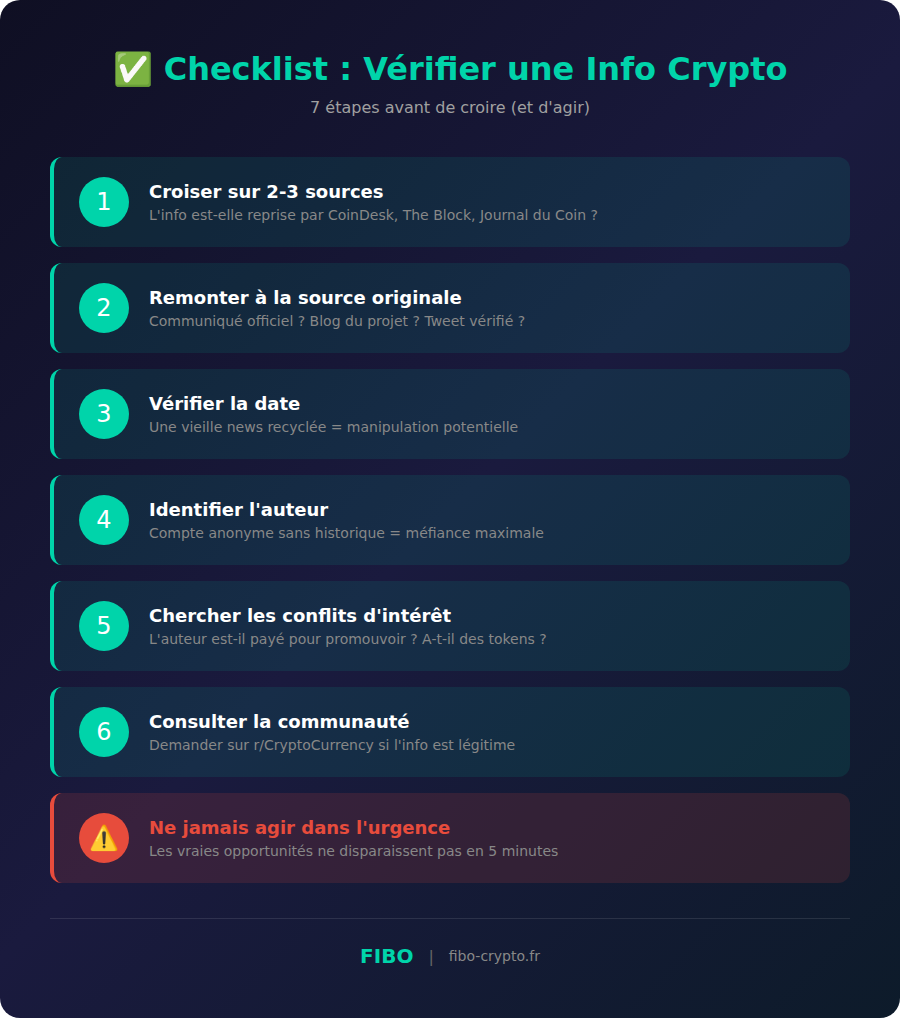
- Cross-reference sources — Is the info picked up by CoinDesk, The Block, Decrypt?
- Trace to the source — Official announcement? Project blog post? Verified founder tweet?
- Check dates — An old news story recycled to manipulate the market?
- Look for conflicts of interest — Is the author paid to promote? Do they hold tokens?
- Consult the community — Ask on r/CryptoCurrency if the info is legitimate
Identifying a shill
A shill is someone who secretly promotes a crypto project, often for payment. Distinctive signs:
- Recently created account with suspicious activity
- Only talks about ONE project, always positively
- Refuses to admit any project flaws
- Uses aggressive marketing techniques (rocket emojis, FOMO jargon)
- No verifiable track record
Building your daily information routine
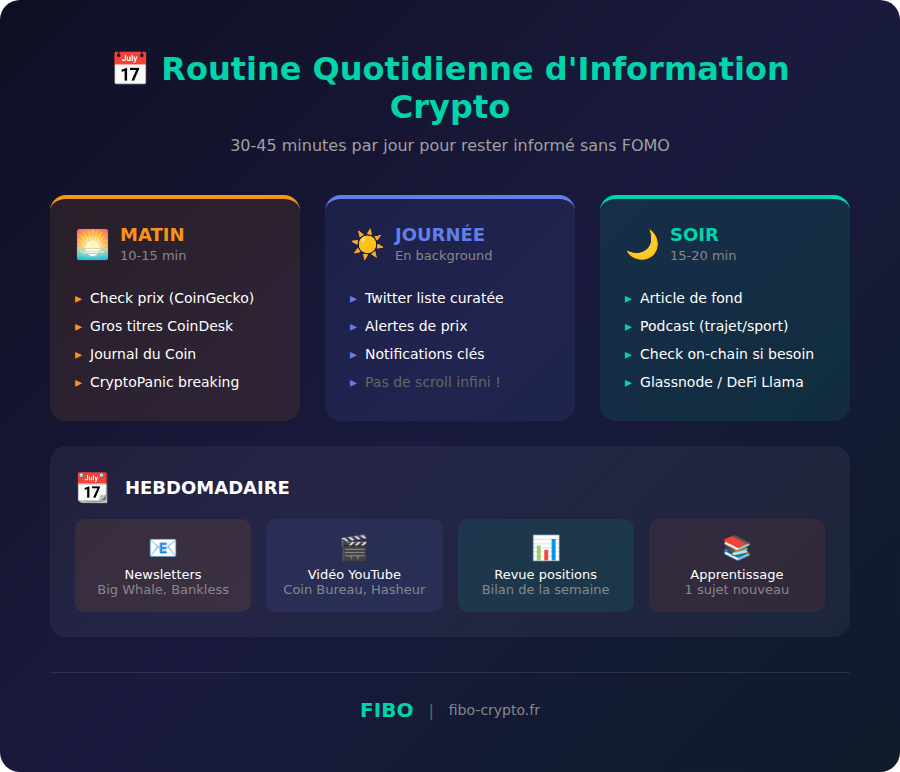
Effective monitoring is structured monitoring. Here’s an example daily routine:
Morning (10-15 min)
- Quick price check (CoinGecko or CMC)
- Scan headlines on CoinDesk and The Block
- Check CryptoPanic for overnight breaking news
Daytime (in background)
- Twitter with a curated list of reliable accounts (see previous section)
- Price alerts on your positions (CoinGecko or Blockfolio)
Evening (15-20 min)
- Deep read of a long-form article (The Block, Bankless)
- Listen to a podcast during dinner or workout
- Check on-chain data if significant market movement (Glassnode, DeFi Llama)
Weekly
- Newsletters (Bankless, Week in Ethereum, Milk Road)
- Educational YouTube video (Coin Bureau, Whiteboard Crypto)
- Review your positions and decisions from the week
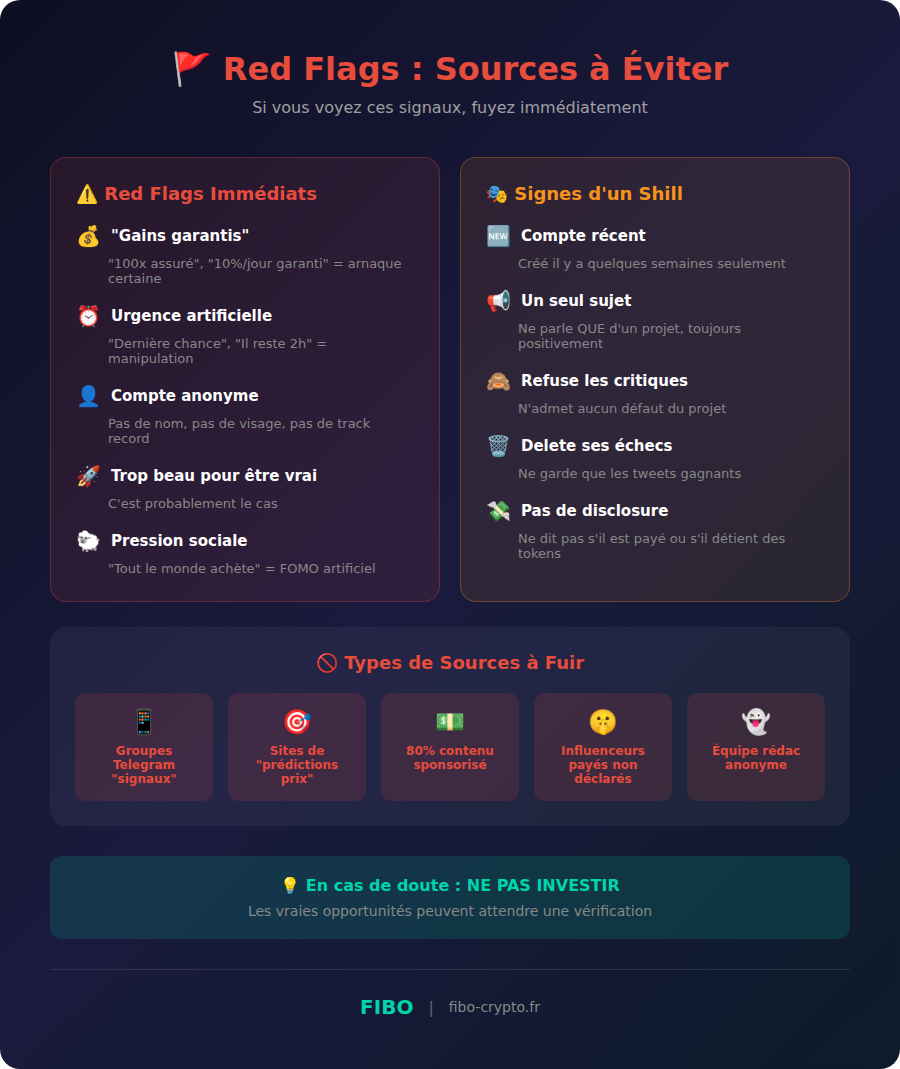
Sources to avoid: the red flags
Just as important as knowing where to go: knowing where NOT to go.
Types of sources to flee
- « Signal » Telegram groups — 95% are disguised pump & dumps
- Undisclosed paid influencers — Many are paid without saying so
- « Price prediction » sites — Often auto-generated, zero value
- Accounts that delete failed tweets — They only keep successes to appear infallible
- Media with too much « sponsored content » — If 80% of content is paid, editorial integrity is compromised
Signs a source is compromised
- No negative criticism of any project
- Disproportionate coverage of obscure projects
- No legal mentions or editorial policy
- Anonymous or fictitious editorial team
- Systematic gain promises
📚 Glossaire
- DYOR : « Do Your Own Research » — Fundamental principle urging every investor to do their own research before investing. Never rely solely on others’ advice.
- FUD : « Fear, Uncertainty, Doubt » — Deliberate spreading of fear and uncertainty to drive down a price. Common manipulation technique.
- Shill : Person who secretly promotes a crypto project, often for payment, without disclosing their conflict of interest.
- Alpha : Information or strategy that gives an advantage in the market. « Finding alpha » = discovering opportunities before others.
- Pump & Dump : Fraudulent scheme where a group buys a token, artificially raises its price (pump), then sells massively (dump) to latecomers.
- Rug pull : Scam where project developers disappear with investor funds after collecting liquidity.
- On-chain : Data directly from the blockchain, verifiable by all. On-chain analysis = study of blockchain transactions and addresses.
- TVL (Total Value Locked) : Total value of assets deposited in a DeFi protocol. Key indicator of adoption and trust.
- Whale : Holder of a very large amount of cryptocurrency, capable of influencing prices through their buys or sells.
- FOMO : « Fear Of Missing Out » — Fear of missing an opportunity, leading to impulsive and often bad decisions.
- Bearish / Bullish : Negative (bear = clawing down) or positive (bull = charging up) sentiment on an asset.
- Market cap : Market capitalization. Token price multiplied by circulating supply. Indicator of project size.
- Narrative : Dominant story explaining why a sector or token should gain value. Narratives change with market cycles.
- CT (Crypto Twitter) : Crypto community on Twitter/X. Fast but noisy information source.
- KOL : « Key Opinion Leader » — Influencer or opinion leader in the crypto space.
- Tokenomics : Token economics — distribution, emission, utility, incentive mechanisms. Crucial for evaluating a project.
Questions fréquentes
What are the best crypto news websites in 2025?
The top references are CoinDesk (global leader with investigative journalism), The Block (data-driven research and exclusives), Decrypt (accessibility and beginner guides), and Blockworks (professional-grade institutional coverage). These outlets have identifiable editorial teams, ethical guidelines, and balanced ecosystem coverage.
How do I verify if crypto information is reliable?
Apply the 3-source rule: credible info must be picked up by at least 2-3 recognized media outlets (CoinDesk, The Block, Decrypt). Always trace back to the original source (official announcement, verified project tweet). Check the info’s date and look for any conflicts of interest from the author. When in doubt, ask on r/CryptoCurrency.
Which crypto Twitter accounts should I follow in 2025?
For serious analysis: @WClementeIII (Bitcoin on-chain), @cburniske (macro), @RaoulGMI (institutional vision), @nic__carter (Bitcoin research). For builders: @VitalikButerin (Ethereum). For news: @tier10k, @BitcoinMagazine. Avoid anonymous accounts with gain promises.
What are the best crypto podcasts to learn from?
Bankless (DeFi/Ethereum reference), Unchained (Laura Shin, journalistic interviews), What Bitcoin Did (Bitcoin focus), Empire (Blockworks, professional grade). These podcasts have in-depth formats that perfectly complement daily news.
How do I spot a crypto scam or shill?
Immediate red flags: guaranteed gains, artificial urgency (« last chance »), anonymous accounts without track records, projects without whitepapers or identifiable teams, FOMO pressure (« everyone’s buying »). A shill only speaks positively about one project and refuses to admit any flaws. When in doubt, the rule is simple: don’t invest.
What's the best daily crypto information routine?
Morning (10 min): price check and headlines (CoinDesk, The Block). Daytime: Twitter with curated list + price alerts. Evening (15 min): long-form article + podcast. Weekly: newsletters (Bankless, Milk Road) + educational YouTube video. This structure avoids infinite scroll FOMO while staying informed.
Are crypto Telegram groups reliable?
Generally, no. The majority of « signal » or « alpha » Telegram groups are disguised pump & dump scams. Use Telegram only for official announcements from projects you’re already invested in, never for investment decisions.
What tools can I use to analyze the crypto market myself?
For prices: CoinGecko or CoinMarketCap. For on-chain analysis: Glassnode (Bitcoin/ETH), Dune Analytics (community dashboards). For DeFi: DeFi Llama (TVL and yields). For research: Messari (project profiles). These tools let you verify information yourself instead of blindly trusting others.
Do I need to pay for good crypto sources?
Not necessarily. Free versions of Glassnode, DeFi Llama, Messari, and free media (CoinDesk, Decrypt, The Block) are enough for 90% of investors. Paid subscriptions (The Block Research, Nansen, Messari Pro) are useful for professionals or very active investors who need advanced data or exclusives.
How can I avoid crypto fake news?
1) Systematically cross-reference on 2-3 reliable sources. 2) Check the date (recycled old news = manipulation). 3) Trace back to the original source. 4) Be wary of anonymous accounts and « experts » without track records. 5) Never act in urgency — real opportunities don’t disappear in 5 minutes.
📰 Sources
Cet article s'appuie sur les sources suivantes :
Comment citer cet article : Fibo Crypto. (2026). Best Crypto News Sources: Complete Guide to Reliable Information 2025. Consulté le 11 février 2026 sur https://fibo-crypto.fr/blog/best-crypto-news-sources