Understanding Solana: Complete Guide 2026
📋 En bref (TL;DR)
- Definition: Solana is a high-performance blockchain launched in 2020, capable of processing up to 65,000 transactions per second for near-zero fees
- How it works: Its key innovation, Proof of History (PoH), creates a cryptographic clock that speeds up consensus among validators
- Ecosystem: Over 2,100 active dApps, $7 billion in DeFi (Kamino, Raydium, Jupiter), and a thriving NFT market
- Performance: Finality in ~400 ms, average fees of $0.00025, and energy consumption 3,000 times lower than Bitcoin
- Risks: History of network outages (the most recent in February 2024), relative centralization of validators, and SOL token volatility
- Key takeaway: Classified as a “digital commodity” by the SEC in March 2026, Solana has established itself as the leading alternative to Ethereum for decentralized applications
What Is Solana?
Solana is a layer 1 blockchain designed for speed and low transaction costs. Launched in March 2020, it processes between 2,000 and 4,000 transactions per second under normal conditions, with peaks exceeding 65,000 TPS, for an average fee of $0.00025 per transaction. It is currently the fifth-largest cryptocurrency by market capitalization and one of the most active ecosystems in the industry.
The story of Solana begins in 2017, when Anatoly Yakovenko, an engineer who spent over a decade at Qualcomm working on high-performance telecommunications systems, published a whitepaper describing a new consensus mechanism: Proof of History. His observation was straightforward — existing blockchains waste considerable time reaching agreement on the order of transactions. By creating a cryptographic clock embedded in the blockchain, Yakovenko proposed eliminating this bottleneck.
He founded Solana Labs with Raj Gokal (a former executive at Omada Health) and Greg Fitzgerald (a colleague from Qualcomm), and the team launched a testnet in 2019, followed by the mainnet beta in March 2020. The name “Solana” is a nod to Solana Beach, a coastal town near San Diego, California, where the founding team spent its early years of development.
As of March 2026, Solana positions itself as the most credible alternative to Ethereum for decentralized applications. With SOL trading around $85, a market capitalization exceeding $60 billion, and a classification as a “digital commodity” by the U.S. SEC (announced on March 18, 2026), the project has reached a major institutional milestone. This classification places Solana in the same regulatory category as Bitcoin and Ethereum — a strong signal for institutional investors.
Here are Solana’s key figures as of March 2026:
- Launch year: 2020 (mainnet beta)
- Founder: Anatoly Yakovenko (ex-Qualcomm)
- Consensus: Proof of History + Proof of Stake
- TPS: 2,000-4,000 (normal), peaks at 65,000+
- Block time: ~400 milliseconds
- Average fees: $0.00025 per transaction
- SOL price: ~$85 (March 2026)
- Market cap: >$60 billion
- Circulating supply: ~464 million SOL
- Validators: ~1,500 active
- TVL DeFi: ~$7 billion
How Does Solana Work? Proof of History Explained
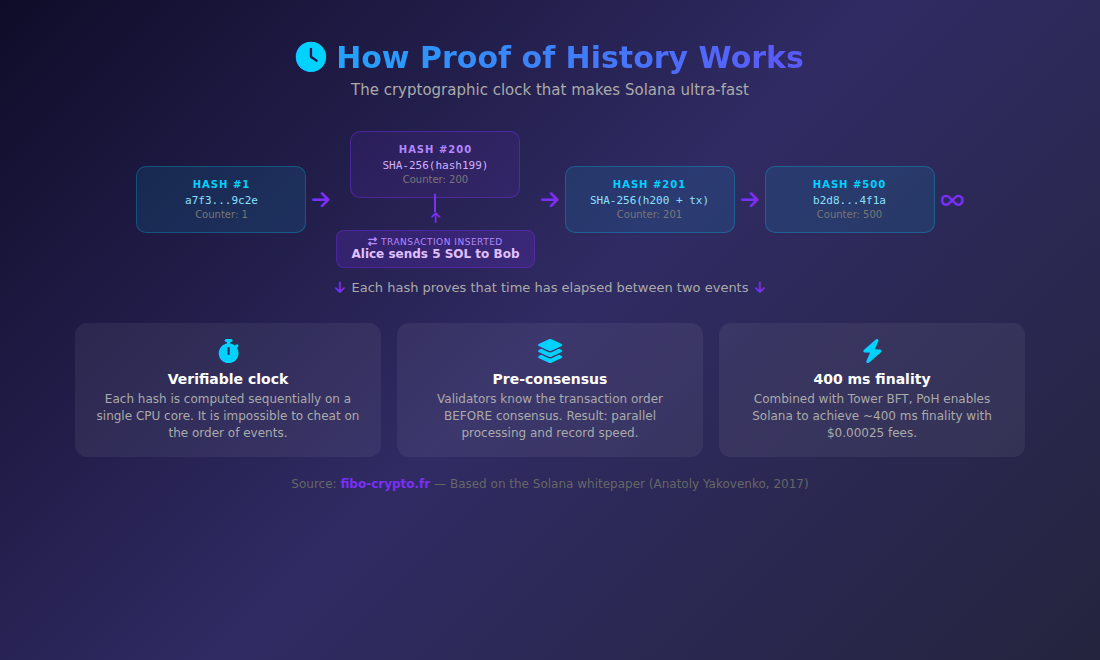
Proof of History (PoH) is Solana’s foundational innovation. It is a cryptographic clock that timestamps each transaction before validators even process it, eliminating the need to agree on the chronological order of events. This pre-synchronization enables Solana to achieve processing speeds that are impossible with traditional consensus mechanisms.
To understand PoH, you first need to understand the problem it solves. In traditional blockchains like Bitcoin or Ethereum, validators must communicate with one another to agree on the order of transactions. This consensus process is the main bottleneck limiting speed. On Bitcoin, it takes roughly 10 minutes to confirm a block. On Ethereum, roughly 12 seconds.
Proof of History solves this problem by creating a verifiable sequence of SHA-256 hashes, where each hash depends on the previous one. In practice, the system continuously computes:
hash(n) = SHA-256(hash(n-1))
Each hash serves as mathematical proof that time has elapsed between two events. When a transaction arrives, it is inserted into this sequence. Any validator can then verify the chronological order without needing to communicate with others — they simply recalculate the hashes. It is as if every transaction carried a tamper-proof timestamp.
The result is remarkable: validators no longer need to negotiate the order of transactions. They receive pre-ordered blocks and verify them in parallel. The block time drops to roughly 400 milliseconds, with near-instant finality.
But PoH is just one of eight technical innovations that power Solana. Here are the other seven:
Tower BFT: Optimized Consensus
Tower BFT is Solana’s optimized version of PBFT (Practical Byzantine Fault Tolerance). Thanks to PoH, validators do not need to exchange messages to agree on time — they use the PoH clock as a reference. This drastically reduces the amount of communication required between nodes and allows the network to function even if one-third of validators are faulty or malicious.
Gulf Stream: Mempool-Free Transaction Forwarding
In most blockchains, pending transactions are stored in a “mempool” — a shared waiting queue. This mempool is often a congestion bottleneck and a source of MEV (Maximal Extractable Value). Gulf Stream eliminates this problem by forwarding transactions directly to upcoming validators, even before they become the leader of the next block. The result: transactions are pre-processed and confirmation times decrease.
Sealevel: Parallel Smart Contract Execution
Sealevel is Solana’s parallel execution engine. Unlike Ethereum’s EVM, which executes smart contracts sequentially (one at a time), Sealevel identifies transactions that do not interact with the same accounts and executes them simultaneously across different CPU cores. It is like going from a single-lane road to a multi-lane highway — throughput increases proportionally to the number of available cores.
Pipeline: Streamlined Transaction Processing
Pipeline is Solana’s Transaction Processing Unit (TPU). Inspired by GPU architectures, it divides processing into four sequential stages that operate as a pipeline: data reception (at the kernel level), signature verification (at the GPU level), state update (Banking Stage), and writing to disk. While one stage processes the current batch, the previous stage is already processing the next batch.
Cloudbreak: Horizontally Scaled Database
Cloudbreak is Solana’s account database, designed for parallel reads and writes on SSDs. It uses memory-mapped files and an indexing system that enables simultaneous access to thousands of accounts without bottlenecks. This architecture is essential for Sealevel to execute transactions in parallel — the database must keep pace.
Turbine: Block Propagation
Turbine is Solana’s block propagation protocol, inspired by BitTorrent. Instead of sending a complete block to every validator, the leader splits the block into fragments (shreds) and distributes them to a subset of validators. Each validator then retransmits the fragments to another subset. This cascading distribution system enables blocks to be propagated to 1,500 validators far more quickly than traditional broadcasting.
Archivers: Distributed Storage
Archivers (formerly called Replicators) are nodes specialized in storing the blockchain’s history. They allow validators to focus on processing transactions without being weighed down by years of historical data. This distributed storage system draws on Proof of Replication to verify that data is correctly replicated.
These eight innovations work as an integrated whole. PoH provides the clock, Tower BFT secures the consensus, Gulf Stream eliminates the mempool, Sealevel parallelizes execution, Pipeline optimizes processing, Cloudbreak manages data, Turbine propagates blocks, and Archivers store the history. It is this complete architecture that enables Solana to achieve performance levels that competing blockchains struggle to match.
Solana vs Ethereum vs Bitcoin: Technical Comparison
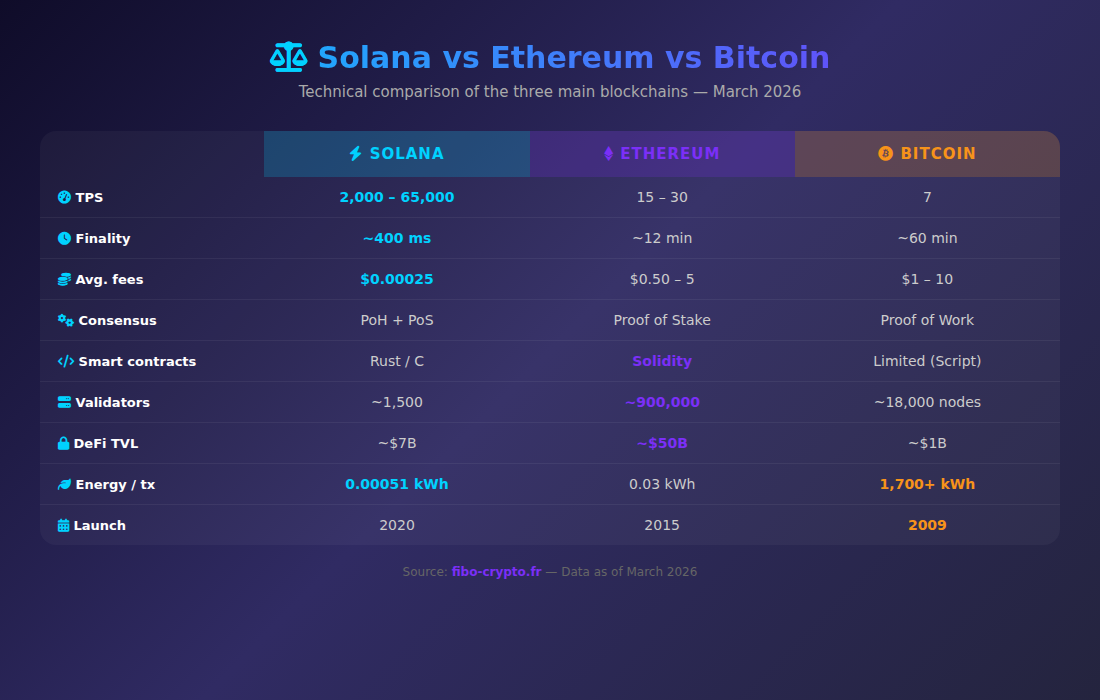
Solana, Ethereum, and Bitcoin serve different goals and make opposing technical trade-offs. Solana prioritizes speed and cost (400 ms finality, $0.00025 fees), Ethereum favors security and decentralization (900,000 validators), and Bitcoin emphasizes monetary robustness (battle-tested PoW consensus since 2009). Rather than rivals, they form a complementary ecosystem.
Here is a detailed comparison of the three major blockchains:
Transaction speed — Solana processes between 2,000 and 65,000 TPS with a 400 ms block time. Ethereum achieves 15 to 30 TPS with blocks every 12 seconds, although its layer 2 solutions (Arbitrum, Optimism, Base) significantly increase this throughput. Bitcoin is limited to 7 TPS with blocks every 10 minutes. The gap is substantial: a transaction that takes less than a second on Solana requires roughly 12 minutes of finality on Ethereum and an hour on Bitcoin.
Transaction fees — This is one of Solana’s most tangible advantages. Average fees of $0.00025 make microtransactions economically viable — something that is impossible on Ethereum mainnet ($0.50 to $5 per transaction) or Bitcoin ($1 to $10). Even Ethereum L2s, with fees of $0.01 to $0.10, remain 40 to 400 times more expensive than Solana.
Consensus mechanism — Bitcoin uses Proof of Work (PoW), where miners solve cryptographic puzzles by consuming energy. Ethereum transitioned to Proof of Stake (PoS) in September 2022 with “The Merge.” Solana combines PoS with Proof of History (PoH), its time-synchronization layer. Each consensus makes a different trade-off between security, speed, and energy consumption.
Decentralization — This is where Solana faces the most scrutiny. With roughly 1,500 validators, Solana is significantly less decentralized than Ethereum (~900,000 validators) or Bitcoin (~18,000 full nodes). However, context matters: Solana validators require powerful hardware (32 GB RAM minimum, NVMe SSD), which is a deliberate architectural choice favoring performance. Solana’s Nakamoto coefficient (the minimum number of validators needed to compromise the network) is approximately 20, compared to 2-3 for many smaller PoS blockchains.
Programming languages — Solana smart contracts (called “programs”) are written in Rust or C, compiled to BPF bytecode. This represents a higher barrier to entry than Ethereum’s Solidity, but Rust offers superior memory safety guarantees. Frameworks like Anchor simplify development on Solana and flatten this learning curve.
DeFi ecosystem — Ethereum dominates with roughly $50 billion in TVL, seven times more than Solana (~$7 billion). But Solana is growing rapidly, and its DeFi ecosystem is particularly dynamic when it comes to innovation (Jupiter, Kamino, Drift). Bitcoin, with roughly $1 billion in TVL via solutions like Stacks and Lightning Network, remains marginal in DeFi.
Energy consumption — Solana consumes roughly 0.00051 kWh per transaction, compared to 0.03 kWh for Ethereum (post-Merge) and over 1,700 kWh for Bitcoin. Solana is therefore approximately 60 times more efficient than Ethereum and over 3 million times more efficient than Bitcoin. The Solana Foundation regularly publishes audited environmental impact reports.
Do you need to choose between these three blockchains? Not necessarily. They serve different use cases. Bitcoin remains the benchmark as a store of value and monetary asset. Ethereum is the platform of choice for applications requiring maximum security and a mature ecosystem. Solana excels for applications requiring high throughput and low costs — trading, payments, gaming, mobile applications. Most experienced investors and developers use all three.
The Solana Ecosystem in 2026
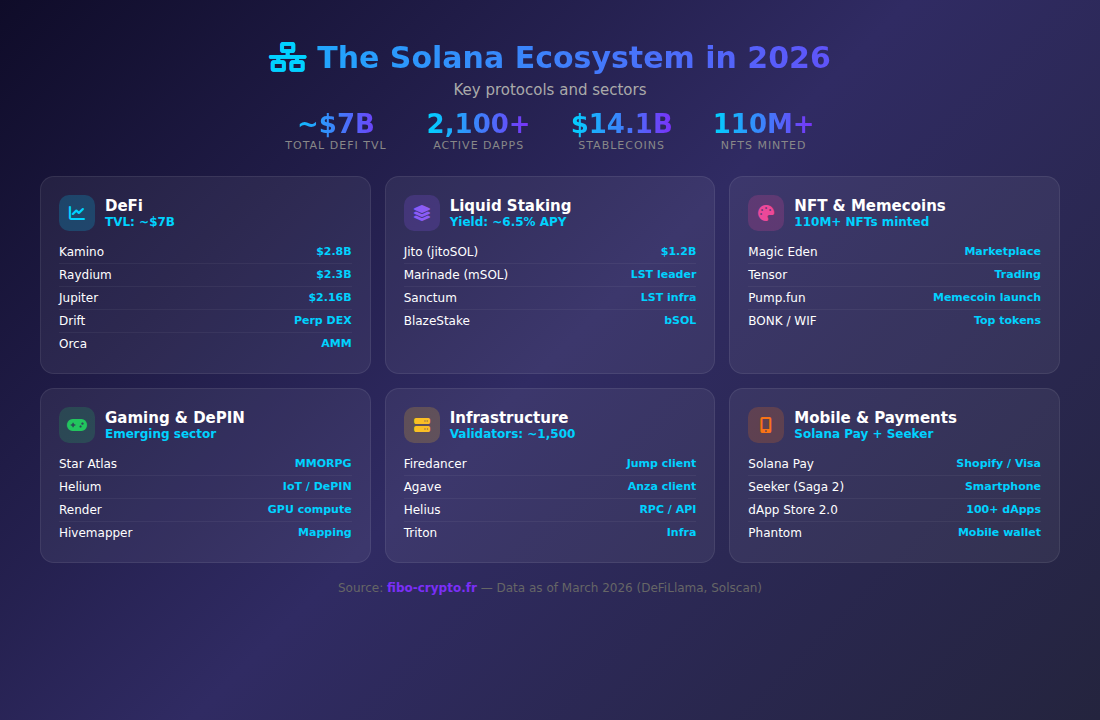
The Solana ecosystem includes over 2,100 active decentralized applications as of March 2026, with a DeFi TVL of $7 billion, a stablecoin market of $14.1 billion, and over 110 million minted NFTs. Kamino ($2.8 billion), Raydium ($2.3 billion), and Jupiter ($2.16 billion) dominate a maturing DeFi ecosystem.
DeFi: The Major Protocols
DeFi on Solana has seen spectacular growth, rising from less than $1 billion in TVL in early 2023 to over $7 billion by March 2026. Here are the protocols that define this ecosystem:
Kamino Finance (TVL: ~$2.8 billion) — The leader of Solana’s DeFi ecosystem. Kamino started as an automated concentrated liquidity manager before evolving into a full platform including lending, borrowing, and liquidity management. Its success is built on an intuitive interface and yield optimization strategies that simplify otherwise complex operations.
Raydium (TVL: ~$2.3 billion) — Solana’s leading decentralized exchange (DEX). Raydium combines an AMM (Automated Market Maker) model with an on-chain order book, offering deep liquidity and tight spreads. It serves as the underlying trading infrastructure for much of the Solana ecosystem and as the launchpad for many new tokens.
Jupiter (TVL: ~$2.16 billion) — Solana’s dominant liquidity aggregator, comparable to 1inch on Ethereum. Jupiter routes orders across all of Solana’s DEXs to secure the best price. The protocol launched Jupiter Lend in 2025, diversifying its offering beyond aggregation. With a polished interface and advanced features (limit orders, automatic DCA, perpetual futures), Jupiter is often the first entry point for users into Solana DeFi.
Jito (TVL: ~$1.2 billion) — Solana’s dominant liquid staking protocol. Jito offers JitoSOL, a liquid staking token that allows SOL holders to earn staking rewards (~6.5% APY) while retaining the liquidity of their tokens. Jito stands out through its MEV (Maximal Extractable Value) integration — MEV revenues are redistributed to stakers, increasing the total yield.
Drift Protocol — Solana’s leading derivatives trading platform (perpetual futures). Drift enables trading with up to 20x leverage across dozens of pairs. Its on-chain architecture provides the transparency and self-custody that are impossible on centralized exchanges.
Orca — An AMM DEX that stands out for its simplicity and concentrated liquidity pools (Whirlpools). Orca targets users who prioritize a smooth experience and a clean interface over the advanced features of Raydium.
The stablecoin market on Solana has reached $14.1 billion, an indicator of the ecosystem’s financial maturity. USDC is the dominant stablecoin, backed by a direct partnership between Circle and the Solana Foundation.
NFTs and Digital Culture
Solana has established itself as the second-largest blockchain for NFTs, behind Ethereum but well ahead of other competitors. Over 110 million NFTs have been minted on Solana, with 14 million wallets holding at least one NFT.
Magic Eden remains Solana’s number-one NFT marketplace, although it has expanded to Ethereum, Bitcoin, and Polygon. Tensor targets active traders with advanced tools (collection orders, real-time analytics). Metaplex provides the technical infrastructure (NFT standards, creation tools) used by the majority of projects.
Compressed NFT (cNFT) technology, launched in 2023, has reduced the cost of creating an NFT to less than $0.001, making mass use cases viable such as event tickets, loyalty programs, and digital certifications.
Memecoins: An Economy of Their Own
Solana’s memecoin ecosystem has become a major cultural and economic phenomenon. Pump.fun, the memecoin launch platform, generated over $100 million in revenue in 2025, facilitating the creation of tens of thousands of tokens. BONK (Solana’s “shiba” memecoin) and WIF (the “dog with a hat”) have become cultural touchstones within the crypto ecosystem.
While the memecoin phenomenon is often criticized — and rightly so — for its excessive speculation and risks to novice investors, it has also had unexpected positive effects: attracting millions of new users to Solana, stress-testing the network under extreme load, and generating significant revenue for validators through transaction fees.
Gaming, DePIN, and Emerging Applications
Gaming — Star Atlas is the most ambitious gaming project on Solana, a space MMO powered by Unreal Engine 5 with a fully on-chain economy. Other projects like Aurory and Genopets have built active communities.
DePIN (Decentralized Physical Infrastructure Networks) — Solana has become the go-to blockchain for DePIN projects. Helium (a decentralized IoT and 5G network) migrated to Solana in 2023, bringing over 900,000 hotspots. Render (distributed GPU rendering for film studios and AI) has also migrated to Solana. Hivemapper (collaborative mapping) rewards drivers who share dashcam images with HONEY tokens.
Mobile — The Solana Foundation has made a bold bet on mobile. Following the Saga Phone (2023), the Seeker (announced for 2025-2026) is an Android smartphone with a built-in crypto wallet and direct access to the dApp Store 2.0 — a decentralized app store free of the 30% commissions charged by Apple and Google. Solana Pay, the payment protocol, enables merchants to accept payments in SOL, USDC, and other tokens with near-instant finality and no credit card fees.
The SOL Token: Tokenomics and Staking
SOL is Solana’s native token, used to pay transaction fees, participate in staking, and govern the network. With a circulating supply of approximately 464 million SOL out of a total of 580 million, a current inflation rate of 5.07%, and a mechanism that burns 50% of fees, Solana’s tokenomics are evolving toward an increasingly deflationary model.
The Three Functions of SOL
Transaction fees — Every operation on the Solana blockchain requires a fraction of SOL as a fee. At an average of $0.00025, these fees are negligible for individual users, but they represent significant revenue at the scale of a network processing hundreds of millions of transactions per day.
Staking — SOL holders can delegate their tokens to validators to secure the network. In return, they receive staking rewards of approximately 6.5% APY. Staking is the network’s core security mechanism: the higher the staked value, the more costly it becomes to attack the blockchain.
Governance — SOL grants voting rights on network evolution proposals (SIMD — Solana Improvement Documents). Major decisions, such as the inflation model or protocol upgrades, are put to a vote among stakers.
Supply and Inflation Schedule
Unlike Bitcoin, which has a fixed maximum supply of 21 million BTC, Solana has no supply cap. The total supply currently stands at approximately 580 million SOL, of which 464 million are in circulation. The difference primarily consists of tokens that are still vesting (locked) and SOL staked in foundation accounts.
Solana’s inflation follows a decreasing schedule:
- Initial rate: 8% per year (at launch)
- Current rate: ~5.07% (March 2026)
- Annual reduction: 15% per year (the rate decreases by 15% each year)
- Terminal rate: 1.5% (the floor toward which inflation converges)
The SIMD-0411 proposal, currently under discussion, aims to accelerate this reduction by increasing the annual decrease from 15% to 30%. If adopted, the inflation rate would reach the terminal rate of 1.5% much sooner — a strong deflationary signal for the long-term value of SOL.
The Fee Burn Mechanism
Since the implementation of the fee burning mechanism, 50% of every transaction fee is permanently destroyed (burned). The remaining 50% is distributed to the validator that processed the transaction. This mechanism gradually reduces the circulating supply and creates deflationary pressure that partially offsets the inflation from staking rewards.
During periods of intense network activity (memecoin launches, trading spikes), the amount of SOL burned increases significantly. Over time, if network activity continues to grow and inflation decreases, Solana could theoretically become deflationary — a scenario where more SOL is burned than created.
Native Staking and Liquid Staking
Native SOL staking offers approximately 6.5% APY. The process is straightforward: you delegate your SOL to a validator from your wallet (Phantom, Solflare) and receive rewards at each epoch (~2 days). Staked SOL is locked — you should expect a 2-3 day delay to unlock it (unstaking period).
Liquid staking solves this liquidity problem. You exchange your SOL for a liquid staking token (JitoSOL, mSOL from Marinade, or LSTs from Sanctum) that represents your staked SOL and automatically accrues rewards. You can then use this token in DeFi — deposit it as collateral, provide liquidity, etc. — without forfeiting your staking yield.
Jito dominates liquid staking on Solana with JitoSOL. Its distinctive feature is MEV integration: in addition to standard staking rewards, MEV extraction revenues are redistributed to JitoSOL holders, boosting the total yield. Marinade Finance (mSOL) is the legacy liquid staking protocol on Solana, known for its reliability. Sanctum offers an innovative model with multiple LSTs and a unified liquidity pool across them.
2026 Roadmap: Firedancer and Beyond
Solana’s technical roadmap for 2026 centers on Firedancer, a new validator client developed by Jump Crypto that reached 1 million TPS in testing and already represents over 20% of stake. Combined with Alpenglow (150 ms finality) and increased compute units, Solana is preparing for a generational leap in performance.
Firedancer: The Technological Leap
Firedancer is a validator client entirely rewritten in C/C++ by the team at Jump Crypto (now Jump Trading), one of the world’s largest algorithmic trading firms. Unlike Solana’s original client (written in Rust by Solana Labs, later renamed Agave by Anza), Firedancer was built from the ground up with an obsessive focus on performance.
The numbers are impressive: in test conditions, Firedancer achieved 1 million TPS — more than 15 times the network’s current capacity. In production, gains will be more modest but still significant. Over 20% of the network’s total stake is already managed by validators running Firedancer, a sign of confidence from the ecosystem.
The importance of Firedancer extends beyond raw performance. It brings client diversity — a crucial concept in blockchain security. If a bug affects the Agave client, Firedancer validators will continue operating normally, and vice versa. This is exactly what happens on Ethereum, where the coexistence of Geth, Nethermind, Besu, and Erigon strengthens network resilience. Until Firedancer, Solana depended on a single client — a major systemic risk.
Alpenglow: Finality in 150 Milliseconds
Approved in September 2025, Alpenglow is a fundamental overhaul of Solana’s consensus protocol. The goal: reduce finality from 12.8 seconds to approximately 150 milliseconds. To put that in perspective, an eye blink takes roughly 300 milliseconds — Alpenglow aims for finality faster than a blink of an eye.
How? By replacing Tower BFT with a new consensus protocol optimized for latency, and by reorganizing how validators vote and confirm transactions. The result will be a user experience where transactions are truly instantaneous — a decisive advantage for payment applications, high-frequency trading, and gaming.
SIMD-0256: More Compute Power Per Block
The SIMD-0256 proposal calls for increasing compute units per block from 48 million to 60 million, a 25% increase. This change allows more complex smart contracts to execute within a single block and increases the network’s overall capacity without changing the block time. It is an incremental but important upgrade to support the growth of the DeFi ecosystem and compute-intensive applications.
Validator Client Diversity
Client diversity is a cornerstone of Solana’s resilience strategy for 2026 and beyond:
- Agave (by Anza, formerly Solana Labs) — The legacy client, written in Rust. Remains the most widely used, with the majority of stake.
- Firedancer (by Jump Crypto) — The high-performance C/C++ client, already in production with 20%+ of stake.
- Sig (by Syndica) — A third client under development, written in Zig, aiming for code simplicity and auditability.
- Tinydancer — A light client that enables users to verify transactions without running a full validator, improving accessibility and decentralization.
With four independent implementations of the protocol, Solana is positioning itself to achieve a level of resilience comparable to Ethereum’s — while retaining its performance advantages.
Risks to Understand Before Investing in Solana
Investing in Solana requires understanding several categories of risk: a history of network outages (eight major incidents between 2020 and 2024, but over 15 months of continuous operation since), relative centralization with only 1,500 validators, market volatility typical of altcoins, and a regulatory environment still in flux despite the positive SEC classification.
Technical Risk: The Outage History
This is the most frequently cited criticism of Solana, and it deserves an honest examination. Since its launch, Solana has suffered eight major outages:
- December 2020: 6-hour outage (first mainnet outage, consensus issue)
- September 2021: 17-hour outage (bot DDoS attack, network saturation)
- January 2022: outage due to extreme congestion
- April-May 2022: 8-hour outage (NFT bot spam, congestion attacks)
- June 2022: 4.5-hour outage (consensus bug)
- September 2022: 8.5-hour outage
- February 2023: 19-hour outage (the longest, state management bug)
- February 2024: 5-hour outage (JIT cache bug — Just-In-Time compilation)
This track record is concerning, especially compared to Ethereum and Bitcoin, which have never experienced outages of this magnitude. However, context matters: each outage led to structural fixes. After the congestion attacks of 2021-2022, Solana implemented priority fees, the QUIC protocol (replacing UDP with a more reliable protocol), and stake-weighted QoS (validators with more stake get priority for transmitting transactions). After the February 2024 outage, the JIT bug was fixed and the testing process was strengthened.
The result: over 15 months of continuous operation without a major outage as of March 2026, with an uptime rate exceeding 99.9%. Furthermore, the deployment of Firedancer brings the client diversity that is the best safeguard against outages — if a bug hits one client, the other takes over. The question, then, is whether the past is the best predictor of the future, or whether the fixes that have been applied have fundamentally changed the equation.
Centralization Risk
With approximately 1,500 active validators, Solana is significantly less decentralized than Ethereum (~900,000 validators) or Bitcoin (~18,000 nodes). The high hardware requirements (powerful server, high-speed connection, 32 GB RAM minimum) create a barrier to entry that naturally limits the number of validators.
Furthermore, the influence of Solana Labs (now Anza), the Solana Foundation, and a few large stakers like Jump Crypto is considerable. The top 20 validators control a significant share of total stake, which raises the question of censorship resistance: a limited number of actors could theoretically cooperate to censor transactions.
The counter-argument is that decentralization is not solely a matter of node count. Solana’s Nakamoto coefficient (~20) indicates that at least 20 independent entities would need to be compromised to attack the network — a reasonably high threshold. Initiatives like the Solana Foundation’s delegation programs (which distribute stake to smaller validators) and the Tinydancer client (which democratizes verification) aim to progressively improve this situation.
Regulatory Risk
The SEC’s classification of SOL as a “digital commodity” on March 18, 2026 is a clearly positive development. It means that SOL is treated as a commodity (like gold or oil) rather than a security (like a stock), which significantly simplifies its regulatory framework in the United States.
However, the regulatory landscape remains evolving. In Europe, the MiCA regulation (Markets in Crypto-Assets) is gradually taking effect. In France, the AMF continues to clarify the rules for crypto platforms (PSAN). Changes in regulatory policy — in either direction — can have a significant impact on the price of SOL and the accessibility of services built on Solana.
Market Risk
SOL, like all cryptocurrencies, is an extremely volatile asset. Its price has ranged from less than $1 at launch to an all-time high above $260 in November 2021, before crashing to below $10 in late 2022 (the collapse of FTX, which was a major supporter of Solana). The spectacular recovery to $85 by March 2026 illustrates this volatility in both directions.
SOL is strongly correlated with Bitcoin’s price. During a general bear market, it tends to fall more sharply than Bitcoin (beta greater than 1). Competition from Ethereum’s layer 2 solutions (Arbitrum, Base, Optimism) also represents a risk — if these L2s achieve performance close to Solana’s, part of the ecosystem could migrate.
How to Buy and Use Solana in France
To buy SOL in France, the simplest method is to use a centralized exchange registered with the AMF (Binance, Coinbase, Kraken), then transfer your tokens to a non-custodial wallet like Phantom or Solflare to access the DeFi ecosystem and staking.
Step 1: Buy SOL on an Exchange
The three main platforms accessible from France for buying SOL are:
Binance — The world’s largest exchange by trading volume. PSAN-registered in France. Competitive trading fees (0.1% spot). Purchases available via bank card, SEPA transfer, or P2P. The interface can be intimidating for beginners — opt for “Simple” or “Convert” mode.
Coinbase — The most beginner-friendly platform, with a simplified interface and educational resources. PSAN-registered. Fees are higher than Binance (up to 1.5% for simple purchases, 0.5% on Coinbase Advanced). French-language customer support is an advantage.
Kraken — Recognized for its security and reliability since 2011. PSAN-registered. Interface complexity falls between Binance and Coinbase. Spot trading fees of 0.16-0.26%. SOL withdrawals are fast and inexpensive.
For each platform, the procedure is identical: create an account, complete identity verification (KYC), deposit euros via SEPA transfer (the least expensive method, 0-1 business day) or bank card (instant but with higher fees), then buy SOL.
Step 2: Secure Your SOL in a Wallet
Leaving your tokens on an exchange exposes you to the risk of the platform going bankrupt (see FTX in 2022). Transferring to a non-custodial wallet — where you control your private keys — is an essential step:
Phantom — The go-to wallet for Solana, available as a browser extension (Chrome, Firefox, Brave) and a mobile app (iOS, Android). Polished interface, integration with all of Solana’s DeFi protocols and NFTs. Phantom also supports Ethereum and Bitcoin, making it a multi-chain wallet. SOL staking is accessible in just two clicks directly from the app.
Solflare — Solana’s original wallet, with native Ledger integration. Ideal for those who use a hardware wallet for maximum security. Solflare offers advanced staking features (precise validator selection, performance statistics) and full DeFi integration.
Backpack — A next-generation wallet developed by the Mad Lads team (a popular NFT collection). Backpack stands out through its integration with the Backpack exchange (on-chain order book) and innovative features such as xNFTs (executable NFTs). Rapidly growing among advanced users.
Step 3: Use Your SOL
Once your SOL is in your wallet, several options are available:
- Stake: Delegate your SOL to a validator directly from Phantom or Solflare to earn ~6.5% APY. You can also opt for liquid staking via Jito (JitoSOL) or Marinade (mSOL) to retain your liquidity.
- Trade: Swap your SOL for other tokens on Jupiter (aggregator) or Raydium (DEX).
- Provide liquidity: Deposit your SOL into liquidity pools on Kamino, Raydium, or Orca to earn trading fees.
- Explore NFTs: Buy, sell, or create NFTs on Magic Eden or Tensor.
- Pay: Use Solana Pay at merchants that accept it, with near-zero fees and instant confirmation.
Is Solana a Good Investment in 2026?
Solana presents an asymmetric risk/reward profile in 2026: the SEC classification as a “digital commodity,” the Firedancer rollout, and sustained DeFi ecosystem growth are powerful bullish catalysts, while token inflation, competition from Ethereum Layer 2s, and relative centralization are risk factors that should not be underestimated. Like any crypto investment, SOL is suited to investors who can tolerate high volatility.
Arguments in Favor of Solana
The SEC classification — The recognition of SOL as a “digital commodity” on March 18, 2026 is a major catalyst. It paves the way for SOL ETFs in the United States, as happened with Bitcoin and Ethereum. Several asset managers have already filed applications. A SOL ETF would significantly increase accessibility for institutional investors and retail investors through traditional brokerage accounts.
Firedancer and technical improvements — The deployment of Firedancer (1 million TPS in testing, client diversity), Alpenglow (150 ms finality), and increased compute units position Solana for a new generation of applications that are impossible on current blockchains. These improvements also address the historical criticisms about network reliability.
Ecosystem growth — Steadily rising DeFi TVL, a $14.1 billion stablecoin market, and growing institutional adoption (Visa on Solana, native Circle/USDC integration) reflect an ecosystem that is gaining maturity and adoption. DePIN projects (Helium, Render, Hivemapper) add a dimension of real-world utility that goes beyond speculation.
User experience — The speed (400 ms), near-zero fees ($0.00025), and wallet quality (Phantom) deliver a user experience that surpasses Ethereum mainnet. For mainstream applications — payments, gaming, decentralized social networks — this fluidity is a decisive competitive advantage.
Arguments Against Solana
Token inflation — At 5.07% per year, Solana’s inflation is significantly higher than Ethereum’s (which has become deflationary post-Merge) or Bitcoin’s (currently ~0.8%). Even with the 50% fee burn and the SIMD-0411 proposal, SOL remains inflationary in the medium term. This constant dilution weighs on the real returns of holders who do not stake.
Layer 2 competition — Ethereum’s layer 2 solutions (Base, Arbitrum, Optimism) offer performance approaching Solana’s (fees < $0.01, finality in a few seconds) while inheriting Ethereum's security. If L2s continue to improve, part of Solana's value proposition could be called into question.
Relative centralization — 1,500 validators is sufficient for a performant blockchain, but it is fragile in the face of a hostile regulator or geopolitical pressure. The dependence on a limited number of key players (Anza, Jump Crypto, Solana Foundation) is a structural risk that decentralization purists are quick to highlight.
Volatility — SOL lost over 95% of its value between November 2021 and December 2022. Even though the fundamentals have improved considerably since then, a drawdown of that magnitude remains possible in a general bear market. Investing in Solana is only suitable for profiles that can absorb a significant temporary loss.
A Balanced Conclusion
Solana is a technically ambitious project with a growing ecosystem and concrete short-term catalysts (potential ETF, Firedancer, institutional adoption). The risks are real but well-identified, and the development team has demonstrated its ability to address problems. For an informed investor, aware of the risks and with a sufficiently long time horizon, SOL is among the most compelling crypto projects to watch in 2026.
That said, no article constitutes investment advice. Cryptocurrency volatility is extreme, and any allocation should remain proportional to your risk tolerance and overall portfolio. Diversify, only invest what you can afford to lose, and do your own research.
Glossary
- Proof of History (PoH): A cryptographic mechanism invented by Anatoly Yakovenko that creates a verifiable sequence of SHA-256 hashes serving as a clock for the Solana network. Each hash depends on the previous one, proving that a period of time has elapsed between two events. This allows validators to synchronize without exchanging messages, dramatically speeding up consensus.
- Proof of Stake (PoS): A consensus mechanism where validators put tokens at stake to earn the right to validate transactions and create blocks. The more tokens a validator stakes, the higher their chances of being selected. Unlike Bitcoin’s Proof of Work, PoS does not require massive computational power, making it far more energy-efficient.
- Tower BFT: Solana’s optimized version of the PBFT (Practical Byzantine Fault Tolerance) consensus algorithm. Tower BFT leverages the Proof of History clock to reduce communication between validators, allowing the network to tolerate up to one-third of faulty or malicious nodes while maintaining consensus.
- TPS (Transactions Per Second): The number of transactions a blockchain can process per second. It is a measure of raw performance. Solana achieves 2,000 to 65,000 TPS, compared to 15-30 for Ethereum and 7 for Bitcoin. Actual TPS depends on transaction complexity and network load.
- Validator: A node on the Solana network that participates in consensus by verifying transactions, voting on proposed blocks, and maintaining a copy of the blockchain state. Validators on Solana require powerful hardware (32 GB RAM minimum, NVMe SSD) and receive SOL staking rewards for their participation.
- Smart contract (program): Self-executing code deployed on the blockchain that runs automatically when predefined conditions are met. On Solana, smart contracts are called “programs” and are written in Rust or C. They enable the creation of decentralized applications (dApps) such as DEXs, lending protocols, and NFT marketplaces.
- TVL (Total Value Locked): The total value of assets deposited in the smart contracts of a DeFi protocol or blockchain. It is the primary indicator of adoption and user trust. Solana’s TVL stands at approximately $7 billion as of March 2026, making it the second-largest blockchain behind Ethereum.
- Liquid staking: A method that allows you to stake your tokens to secure the network while retaining their liquidity. You deposit your SOL and receive a representative token in return (JitoSOL, mSOL) that you can use in DeFi. You benefit from staking rewards without your tokens being locked.
- MEV (Maximal Extractable Value): The maximum value that a validator or searcher can extract by reordering, including, or excluding transactions within a block. MEV can take the form of arbitrage, liquidation, or front-running. On Solana, Jito redistributes a portion of MEV revenues to stakers, unlike Ethereum where MEV primarily benefits validators and “searchers.”
- Finality: The point at which a transaction is considered definitive and irreversible. On Solana, “optimistic” finality is reached in ~400 ms (slot time), and “confirmed” finality in a few seconds. The Alpenglow protocol aims to reduce confirmed finality to 150 ms. On Ethereum, finality takes approximately 12 minutes, and on Bitcoin, approximately 60 minutes (6 confirmations).
Frequently Asked Questions about Solana
Find answers to your questions about Solana
What is Solana in simple terms?
Solana is a blockchain — a shared digital ledger — specialized in speed and low costs. Imagine a global computer network where thousands of computers (validators) agree in less than a second on who owns what, for a cost of $0.00025 per transaction. By comparison, an international bank wire takes 1 to 3 days and costs $15 to $50. Solana enables the creation of financial applications (crypto exchanges, lending, savings), games, NFTs, and payment systems without a banking intermediary. Its native token, SOL, is used to pay network fees and can be “staked” to earn approximately 6.5% annual yield.
How does Proof of History work?
Proof of History (PoH) is a cryptographic clock built into the Solana blockchain. The system continuously calculates SHA-256 hashes, where each hash depends on the previous one. This chain creates mathematical proof that time has elapsed between each computation. When a transaction arrives, it is inserted into this sequence and receives a tamper-proof timestamp. Thanks to this, validators no longer need to communicate with each other to agree on the order of transactions — they simply verify it by recalculating the hashes. It is this pre-synchronization that allows Solana to achieve processing speeds impossible with traditional consensus mechanisms.
Is Solana truly decentralized?
Solana’s decentralization is a subject of debate. With approximately 1,500 active validators, the network is significantly less decentralized than Ethereum (~900,000 validators) or Bitcoin (~18,000 nodes). High hardware requirements (powerful server, 32 GB RAM minimum) limit the number of participants. However, Solana’s Nakamoto coefficient (the minimum number of validators that would need to be compromised to attack the network) is approximately 20, which is reasonably high. The Solana Foundation is working to improve the situation through delegation programs for smaller validators and the development of light clients (Tinydancer). Solana makes a deliberate trade-off: less decentralization than Bitcoin or Ethereum, in exchange for far superior performance.
What are the fees on Solana?
Fees on Solana are among the lowest of any blockchain. A simple transaction costs an average of $0.00025 (a quarter of a thousandth of a dollar). Even complex transactions involving smart contracts (swaps on a DEX, DeFi deposits) generally cost less than $0.01. By comparison, an Ethereum transaction costs between $0.50 and $5, and a Bitcoin transaction between $1 and $10. Solana also offers an optional “priority fee” system: by adding a few cents, you can have your transaction prioritized during periods of heavy congestion. 50% of all collected fees are permanently burned (destroyed), creating a deflationary mechanism for the SOL token.
Can Solana surpass Ethereum?
Solana and Ethereum are not in direct competition — they make different technical trade-offs and partly serve different use cases. On raw performance (speed, costs), Solana significantly outperforms Ethereum mainnet. But Ethereum dominates in terms of decentralization (900,000 validators), proven security (no outages ever), DeFi TVL ($50 billion vs. $7 billion), and developer ecosystem. Ethereum’s Layer 2s (Base, Arbitrum, Optimism) are gradually closing the performance gap. The most likely scenario is coexistence, where Solana excels for applications requiring speed and low cost (payments, trading, gaming) while Ethereum remains the reference for applications requiring maximum security and decentralization. Notably, many projects deploy on both ecosystems.
How do I buy SOL in France?
To buy SOL in France, the simplest method is to use a centralized exchange Binance, Coinbase, and Kraken are the three main platforms available to French residents. The procedure: create an account, complete identity verification (KYC — national ID card or passport), deposit euros via SEPA transfer (free or nearly so, 1 business day) or bank card (instant but with 1.5-3% fees), then buy SOL. Once purchased, we recommend transferring your SOL to a non-custodial wallet like Phantom or Solflare to maintain control of your private keys.
What is Firedancer?
Firedancer is a new validator client for Solana built entirely by Jump Crypto (one of the world’s largest algorithmic trading firms). Written in C/C++ (while the original client is in Rust), Firedancer achieved 1 million transactions per second in testing — more than 15 times the network’s current capacity. As of March 2026, over 20% of Solana’s total stake is managed by validators running Firedancer. Beyond performance, Firedancer brings client diversity, a crucial concept: if a bug hits the original client (Agave), Firedancer validators continue operating, and vice versa. It is the best safeguard against the network outages that have affected Solana in the past.
Is Solana environmentally friendly?
Yes, Solana is one of the most energy-efficient blockchains. A transaction on Solana consumes approximately 0.00051 kWh — roughly equivalent to a few Google searches. That is approximately 60 times less than an Ethereum transaction (0.03 kWh) and over 3 million times less than a Bitcoin transaction (1,700+ kWh). This efficiency is due to the Proof of Stake mechanism (no energy-intensive mining) and the network’s optimized architecture. The Solana Foundation regularly publishes environmental impact reports and has committed to offsetting the network’s carbon emissions. For comparison, the entire Solana network annually consumes less energy than a single office building.
Sources
- Solana: A new architecture for a high performance blockchain – Original whitepaper by Anatoly Yakovenko (2017), describing the Proof of History mechanism and Solana’s technical architecture.
- Solana Official Documentation – Comprehensive technical documentation covering architecture, program development, staking, and protocol specifications.
- DeFiLlama — Solana TVL – Real-time data on total value locked (TVL) in Solana’s DeFi ecosystem, by protocol and category.
- Helius Blog — Solana Outages: History and Analysis – Detailed analysis of each Solana network outage, including technical causes and the fixes that were applied.
- Solana Compass — Tokenomics – Detailed data on inflation, staking, token distribution, and Solana’s fee burning mechanism.
- CoinGecko — Solana (SOL) – Market data (price, market cap, volume, circulating supply) and SOL price history.
- U.S. Securities and Exchange Commission – SOL classification as a “digital commodity” (March 2026), regulatory framework, and ETF application filings.
- Solana Foundation — Environmental Impact Report – Reports on the Solana network’s energy consumption, comparisons with other blockchains, and carbon offset commitments.
- Jump Crypto — Firedancer – Overview of the Firedancer validator client, technical specifications, benchmarks, and deployment roadmap.
How to cite:
Fibo Crypto. (2026). Understanding Solana: Complete Guide 2026. Available at https://fibo-crypto.fr/en/blog/understanding-solana-complete-guide
The simplest way to buy, swap and manage your crypto
Available on iOS and Android. No seed phrase, fees shown upfront, built-in DeFi yield.